We’ll break down everything you need to know in this bow release aid guide:
- Core differences between wrist strap and handheld releases, plus which one matches your natural shooting tendencies
- Real hunting scenarios that most reviews ignore—freezing weather, cramped tree stands, split-second opportunities
- Complete system integration so your release works perfectly with the rest of your gear
Let’s dig into the basics that’ll drive your decision.
Release Aid Fundamentals: Understanding Your Two Main Options
The most popular release aid among bowhunters is the wrist strap index finger style, but popularity doesn’t equal “right for you.” Getting the mechanics straight is step one.
Most people begin hunting with a rifle where a trigger is pulled or squeezed to activate the shot. An index finger archery release is similar in that it has a trigger that has to be pulled to fire the arrow. This familiar feel gives you precise control through “command shooting”—you fire when your pin sits exactly where you want that arrow to go.
Handheld releases work completely differently. Most use thumb triggers or back tension systems. More bow hunters are switching to the handheld style release every year, attracted by their accuracy potential and ability to build better shooting habits.
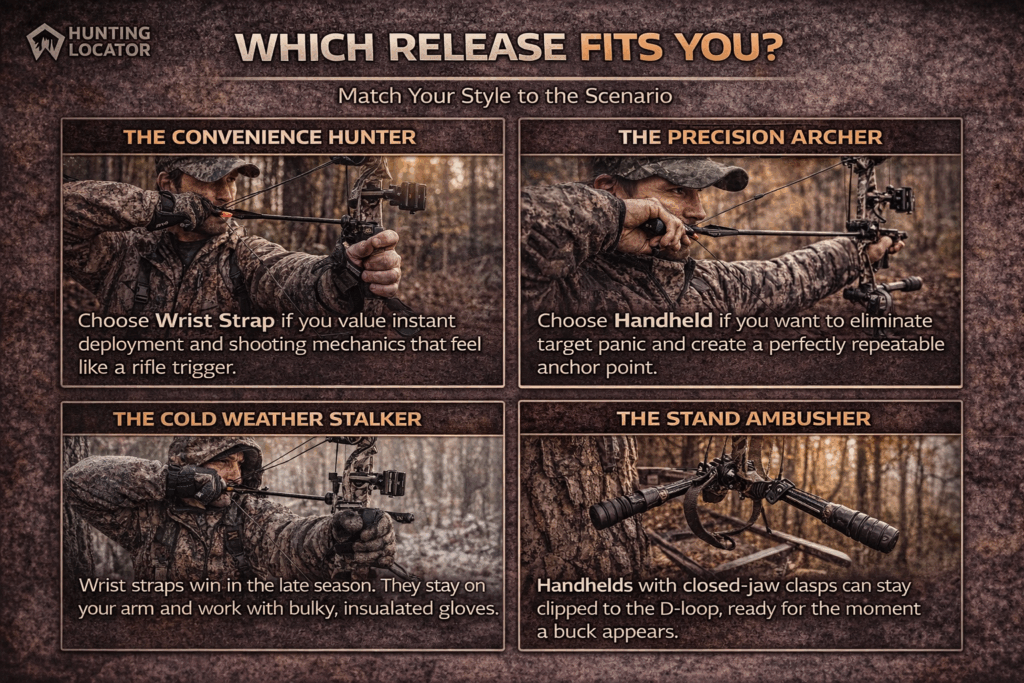
Wrist Strap Releases: Built for Real Hunting
Wrist strap releases dominate because they solve practical problems that matter when you’re actually hunting. When you draw a bow with a handheld release alone, all the weight of the bow is put on your hand. When you connect that release to a wrist strap, you add your arm to the drawing process, and it makes the draw easier. It also makes it easier to hold the bow at full draw for extended periods.
What makes wrist straps so appealing:
- Instant Access: Your release stays on your wrist—no fumbling when that buck steps out
- Rifle-Like Feel: Index finger trigger makes sense if you’ve shot guns
- Shared Load: Wrist strap helps carry draw weight, less hand strain
- Glove Compatible: Trigger guards work with thick winter gloves
When you’ve got seconds to draw on a deer, your release is already there. No digging in pockets or clipping anything on. The downside? Command shooting can create bad habits—”punching” the trigger instead of smooth execution.
Handheld Releases: The Precision Choice
Handheld releases excel at consistency and clean shot execution. A handheld release provides an easy, comfortable, and more consistent repeatable anchor point than an index finger release. If you feel like your anchor point floats and has some inconsistencies, a handheld release can help solidify your anchor point.
Why accuracy-focused hunters choose handhelds:
- Rock-Solid Anchor: Same hand position every single shot
- Surprise Break: Encourages proper form instead of trigger punching
- Thumb Control: Most hunting handhelds use thumb activation
- Practice Crossover: Skills from back tension releases transfer directly
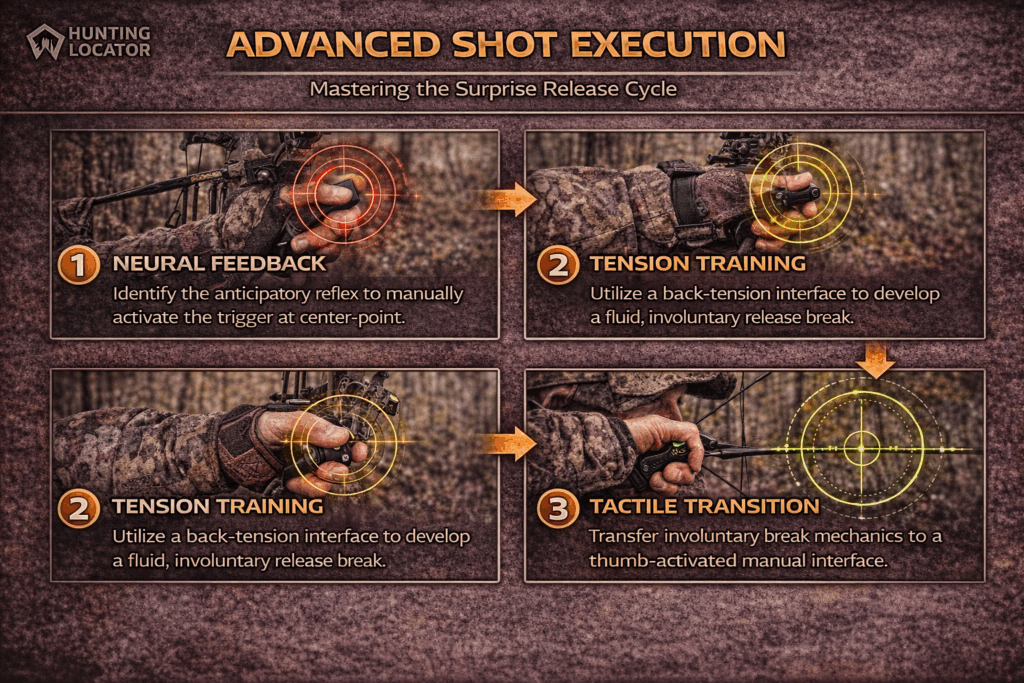
The magic happens through “surprise release” technique. A good shot is when the pin floats gently around the center of your target while you steadily and continuously activate the release until the shot breaks cleanly, taking you by surprise.
Target archers almost universally choose handhelds for maximum precision. But hunting adds complications. There’s definitely a learning curve—switching to thumb releases requires more conscious thought than index releases, and it takes many shots to transfer the firing of the release to the subconscious.
Interesting trend: many bowhunters today choose thumb-trigger releases and are adding wrist straps for drawing assistance. Best of both worlds—handheld accuracy with wrist strap convenience.
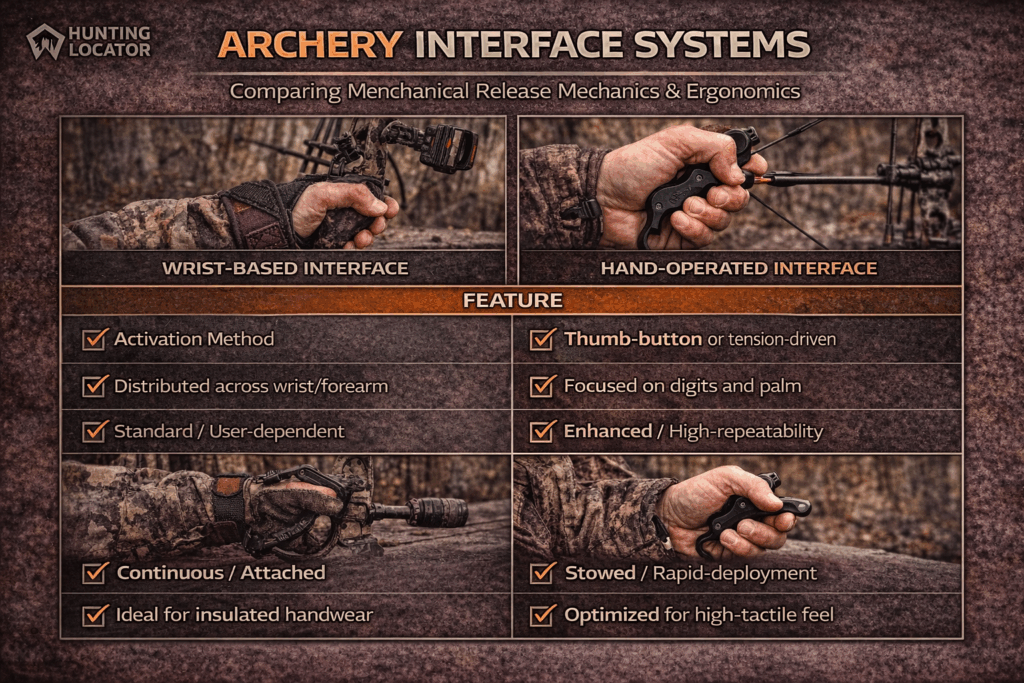
Head-to-Head Breakdown
| Feature | Wrist Strap Release | Handheld Release |
|---|---|---|
| How It Fires | Index finger trigger | Thumb trigger (most common) |
| Draw Weight Help | Shared between hand and wrist | All on your hand (unless you add a strap) |
| Anchor Consistency | Good with practice | Excellent—locks in better |
| Learning Time | Quick—feels familiar | Longer—need to retrain |
| Target Panic Risk | Higher (command shooting) | Lower (promotes surprise release) |
| Cold Weather | Great with gloves | Depends on model |
| Ready to Shoot | Always attached | Need to grab from pocket/clip |
| Best Match | New hunters, convenience priority | Accuracy seekers, target panic issues |
| Price Range | $30-$150+ | $80-$300+ |
Choosing Your Style: A Decision Framework
Understanding mechanics is one thing. Actually picking the right release means honestly evaluating your priorities, shooting habits, and hunting reality. Quality options like the Wiseguy ($130) from Spot Hogg prove you can get excellent performance in either style.
Your choice boils down to this: convenience vs. consistency, familiar vs. optimal.
Go Wrist Strap If…
- You’re new to bowhunting and want trigger mechanics that feel like rifle shooting
- Convenience matters most and you need instant deployment when game appears
- You hunt cold weather and need reliable function with thick gloves
- Command shooting works for you and you have solid trigger control
- Budget is tight and you want proven performance without breaking the bank
Many bowhunters want convenience, simplicity, and the ability to control a shot. For hunters who value practical advantages over ultimate precision, wrist straps make perfect sense.
Go Handheld If…
- Target panic is ruining your shooting or you’re fighting accuracy problems
- You want a more consistent anchor point and better shot-to-shot repeatability
- You’ll invest the practice time to retrain your shot process for long-term gains
- Accuracy trumps convenience and you don’t mind extra steps for deployment
- You want practice transfer from back tension training to your hunting setup
The Target Panic Reality
Target panic hits many bowhunters, regardless of experience. Punching the trigger is the act of quickly activating the trigger mechanism as soon as your pin hits the center of the target, instead of applying steady pressure as the pin floats.
Here’s the honest truth: Target panic is in your mind and does not care what release you are holding or how well it is set up. But handheld releases can help by forcing better habits.
Tension releases aid in overcoming target panic because you won’t have the option to pull the trigger, and a slow consistent pull takes the anticipation out of the shooter’s mind. The training method works: using a hinge-style release before migrating to a thumb-release can help, as mastering the surprise release and understanding what it feels like helps target panic dissipate.
Ready to browse options? Check out our complete selection of bow release aids—we’ve got everything from beginner-friendly wrist straps to precision handheld models organized to match your shooting style.
Hunting-Specific Considerations
Generic archery advice falls apart when you’re actually hunting. Your release needs to perform in freezing weather, awkward tree stand positions, and those heart-pounding moments when a shooter buck appears at 20 yards.
Cold Weather Reality Check
Wrist strap releases usually win with heavy gloves because trigger guards accommodate bulky fingers. Some handheld releases need bare hands or thin gloves for proper feel. The better handheld models now include larger trigger areas or adjustable sensitivity for cold-weather hunting.
Real-world test: Try any release with your actual hunting gloves before season. What feels perfect in the shop might be useless with insulated gloves at 15 degrees.
Tree Stand & Ground Blind Scenarios
The practical reality:
- Wrist strap: Always ready, no fumbling, but can catch on safety harness or clothing
- Handheld: Need to grab it, but closed-jaw models clip to D-loop and stay put
When a deer shows up at 15 yards with a narrow shooting lane, those extra seconds matter. The difference between a filled tag and watching your target walk away.
Speed vs. Precision Trade-off
This is a real decision point. Wrist straps give instant readiness. Handhelds provide better shot execution under pressure—if you’ve trained with them properly.
Hunters switching to handheld releases need practice in realistic scenarios: elevated shots, weird angles, wearing hunting clothes. Range practice alone won’t prepare you for the reality of hunting situations.
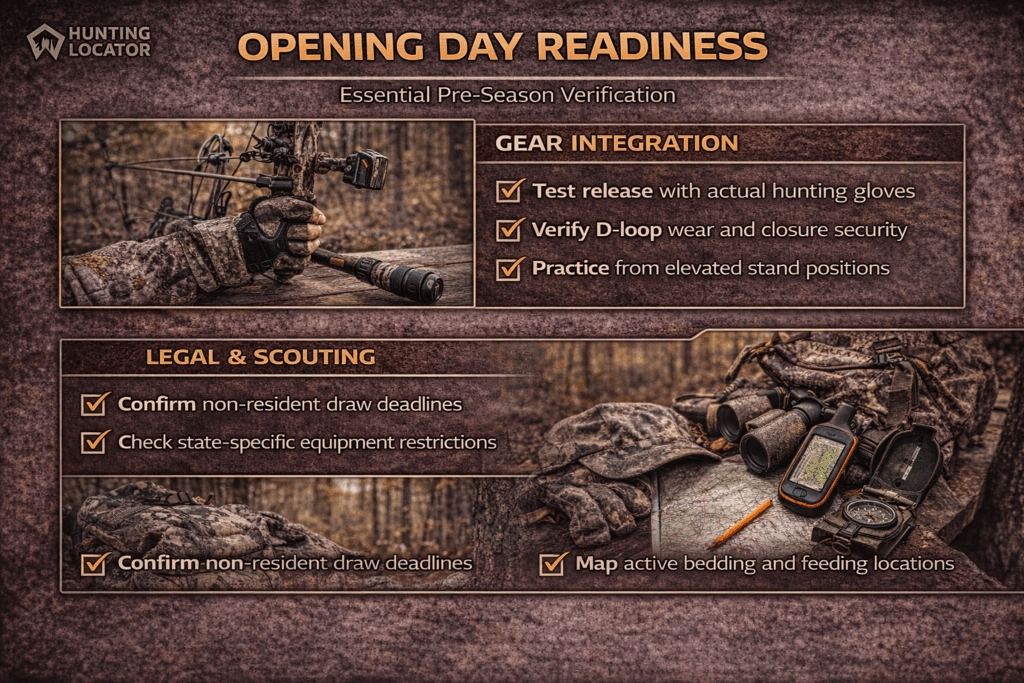
Know Before You Go: Essential Prep
The right release is just part of successful hunting. Here’s what else demands attention before opening day, especially if you’re planning to hunt out of state.
Regulations Check
Release choice is personal preference (both types are legal everywhere for archery hunting), but other regulations change dramatically by state and species. Your checklist:
- Verify archery season dates and equipment restrictions beyond release aids
- Confirm draw requirements for limited tags if you’re applying
- Check special regulations on public vs. private land that might affect your hunt
Non-resident hunters face extra complexity—every state runs different licensing systems, some using draws while others offer over-the-counter tags.
Action Item: License and Tag Acquisition
Don’t procrastinate. Application deadlines for premium hunting areas often fall months before seasons open. Research your target state’s requirements early and mark application deadlines.
Scouting & Habitat: Know Your Target
Success starts with understanding your quarry. Whether you’re chasing whitetails in Iowa or elk in Colorado, species behavior drives everything from release selection to shot opportunities.
Key signs to scout:
- Tracks and trails showing regular travel patterns
- Rubs and scrapes indicating territorial behavior (deer species)
- Feeding areas where animals feel secure
- Bedding locations for morning and evening movement
Pro tip: GPS and mapping apps excel for pre-scouting new territory. Our archery equipment section includes rangefinders and other tools that work perfectly with your scouting efforts.
Physical & Gear Readiness
Archery hunting demands more than target practice. Physical conditioning for your hunting environment—climbing into stands or hiking mountain terrain—directly impacts shooting performance when opportunities arise.
The Gear Factor
Reliable equipment separates success from disappointment. Your release works as part of a complete system, and every component must perform when game appears.
Core Gear Checklist: Our Top Recommendations
Beyond your release choice, success depends on having the right gear for your hunting environment and target species. We’ve organized recommendations by category to help you build a complete, reliable system.
Clothing & Layering
Temperature control and concealment form the foundation of hunting success. Quality base layers manage moisture while outer shells provide wind and weather protection. For archery hunting, clothing must allow full range of motion without interfering with your draw.
Store Focus: Browse our archery equipment for clothing designed specifically for bowhunters, including jackets with stretch panels and quiet fabrics that won’t spook game.
Weaponry & Arrows
Your bow, arrows, and broadheads must work as a matched system. Draw weight should handle your target species while remaining comfortable for extended practice. Arrow spine and broadhead weight affect both accuracy and penetration.
Practice is everything. Whatever setup you choose, spend serious time with it before hunting season. Your release, arrows, and broadheads must work together seamlessly.
Store Focus: Our arrows, points and broadheads section offers complete arrow systems, while our archery sights help you maximize your chosen release.
The Essentials: Navigation/Safety
Never compromise on safety gear. GPS devices, compasses, and first aid supplies can save your life in emergencies. Field dressing tools—quality knives and gloves—ensure you can properly care for harvested game.
Store Focus: Complete your setup with archery accessories including essential safety and field care equipment.
Tactics & Strategy: Hunting Success
Understanding animal behavior and adapting your approach separates successful hunters from those who just spend time in the woods.
Peak Activity Times
Most game species follow predictable patterns, with peak movement during dawn and dusk. Weather conditions, hunting pressure, and seasonal factors all influence these patterns.
Wind & Scent Control
Wind direction determines your approach route and stand placement. Human scent control involves both personal hygiene products and understanding air currents around your hunting area.
Store Focus: Effective scent control products can make the difference between success and getting busted. Explore options that fit your hunting style and budget.
The Approach
Stand placement for whitetails differs dramatically from spot-and-stalk techniques for western game. Your release choice should complement your preferred hunting method—quick deployment for ambush hunting, precision for longer shots in open country.
Shot Placement: Ethical hunters understand anatomy and shot angles. Practice from different positions and distances, always prioritizing clean, quick kills over marginal opportunities.
Post-Harvest Care: The Work After the Shot
Success doesn’t end when your arrow connects. Proper recovery, field care, and transport ensure your harvest provides quality table fare.
Tracking & Recovery
Blood trailing skills and patience lead to successful recovery. Mark your shooting position, note the animal’s reaction, and wait appropriate time before following up.
Field Dressing
Proper field dressing begins immediately after recovery. Clean, sharp knives and knowledge of anatomy ensure you preserve meat quality while preparing for transport.
Transport & Processing
Getting your harvest from field to freezer safely requires planning. Understand local transport regulations and have arrangements for processing if you’re hunting away from home.
More Resources from Hunting Locator
Expand your archery hunting knowledge and gear selection with these specialized resources:
- Archery Targets – Practice targets for hunting prep, from 3D animals to precision bullseyes
- Bow and Crossbow Cases – Protect your investment with cases built for travel and field use
- Bow Stabilizers – Reduce vibration and improve accuracy with stabilizers matched to your setup
- Arrow Rests – Complete your bow setup with rests designed for hunting accuracy and reliability
FAQ
Which release is better for beginners?
Index finger releases are recommended for beginners as they align closely with how we naturally interact with triggers and are often recommended due to their ease of use and intuitive design. The familiar trigger feel transfers well from rifle experience, making the learning curve shorter for new bowhunters.
Can handheld releases really fix target panic?
They help, but aren’t magic. Using a hinge-style release before migrating to a thumb-release can help, as mastering the surprise release and understanding what it feels like helps target panic dissipate. The key is learning proper shot execution, which handheld releases encourage through their design.
How much should I spend on my first release?
It’s probably best not to go all out and splurge on a high-end release aid when new to using release aids for archery. Quality options like the Wiseguy ($130) from Spot Hogg offer excellent performance without breaking the budget.
Do I need different releases for practice and hunting?
Many serious archers use this approach. Practicing with a back tension release for a few days can help iron out form if you notice you’re beginning to punch the trigger, then returning to shooting with your hunting release. This builds better fundamentals that transfer to your hunting setup.
Which release type works better in cold weather?
Wrist strap releases generally perform better with heavy gloves due to larger trigger guards. However, some handheld releases now feature cold-weather modifications. Test any release with your actual hunting gloves before deciding.
How do I know if my release fits properly?
Finding the right fit involves ensuring that your hand can achieve a consistent anchor point comfortably. For wrist straps, you shouldn’t have to reach for the trigger. For handhelds, the release should rest naturally in your fingers with the thumb button in a consistent position.
The Bottom Line
Choosing between handheld and wrist strap releases isn’t about finding the “best” option—it’s about finding what works for your shooting style, hunting conditions, and accuracy goals. Whether you go with the convenience and familiarity of wrist straps or the precision potential of handheld releases, success comes from consistent practice and understanding your equipment’s capabilities.
Your release works as part of a complete archery system. From arrows and broadheads to sights and stabilizers, each piece must complement the others. Most importantly, whatever you choose, invest the time to master it through regular practice in realistic hunting scenarios.
Ready to gear up for your best archery season yet? Visit our archery equipment store today! We stock top release aids, arrows, broadheads, and accessories to ensure your success in the field.


