This hunting knife guide will show you:
- What separates a reliable hunting knife from one that fails when it matters most
- How to select the right blade for your hunting style, target species, and budget
- Essential field techniques that put your knife to work—from first cut to final processing
Let’s start with the foundational prep work that sets every successful hunt in motion.
Know Before You Go: Essential Prep
Regulations Check
Checking state and local hunting regulations isn’t optional—especially if you’re hunting outside your home state. According to Iowa DNR, non-residents of any age need a hunting license to hunt any animal, bird, frog, or turtle. Requirements change dramatically from state to state.
License fees can shock you if you’re not prepared. Iowa nonresidents need both a hunting license ($131) and a nonresident habitat fee ($15). Some states have quota systems or application deadlines that close months before hunting season. Colorado sets aside up to 25% of certain hunt codes for nonresidents, but you’re still competing against thousands of other hunters.
Action: License and Tag Acquisition
Hit the state wildlife agency websites first. Note application deadlines for limited-entry hunts—missing these by even a day can kill your hunting plans. Purchase licenses through official portals only, and keep that documentation where you can grab it quickly during your hunt. Remember that “tags” are species-specific permits on top of your general hunting license. Some require applications months ahead of time.
Scouting & Habitat
Good hunting starts with knowing where animals actually live and move. You want transition zones between bedding and feeding areas, reliable water sources, and terrain features that funnel animal movement into predictable patterns.
Look for these signs that tell the real story:
- Fresh tracks and well-worn trails showing regular traffic
- Rubs and scrapes indicating territorial behavior
- Fresh scat that tells you animals were here recently
- Active feeding areas with browse lines or disturbed ground
For pre-season scouting, quality GPS units keep you from getting lost in unfamiliar country while letting you mark hot spots, access routes, and extraction paths for when you need to pack out an animal. Mark those potential recovery routes during scouting—you’ll thank yourself later if you have to track a wounded animal in the dark.
Physical & Gear Readiness
Hunting tests your body, especially backcountry hunts where you’re packing out a whole animal on your back. The physical demands hit hardest after a successful harvest, when the adrenaline wears off and you realize you’ve got 200 pounds of meat to get back to the truck.
Physical preparation gets you to the shot. But what happens after that shot depends completely on the gear you brought—and nothing matters more than the knife in your pack.
The Gear Advantage: Why Your Knife is Your Most Critical Tool
According to Benchmade’s hunting guides, “a dependable hunting knife is essential for navigating the wild with confidence. The best hunting knives combine sharpness, strength, and control.”
Here’s what goes wrong with a cheap knife: field dressing becomes a nightmare that ruins meat, dull blades force you to use dangerous amounts of pressure, and your entire trip fails because your most important tool can’t do its job. Research confirms that “a dull knife is dangerous and will make your job in the field more difficult than it has to be.”
What Makes a Quality Hunting Knife
Your hunting knife handles field dressing, skinning, and processing—the tasks that decide whether your successful hunt ends with quality meat in the freezer or spoiled protein you have to throw away. Essential features include holding a sharp edge or being easy to sharpen in the field, fitting your hand properly to prevent accidents, and being tough enough to crack through bone when needed.
What Really Matters:
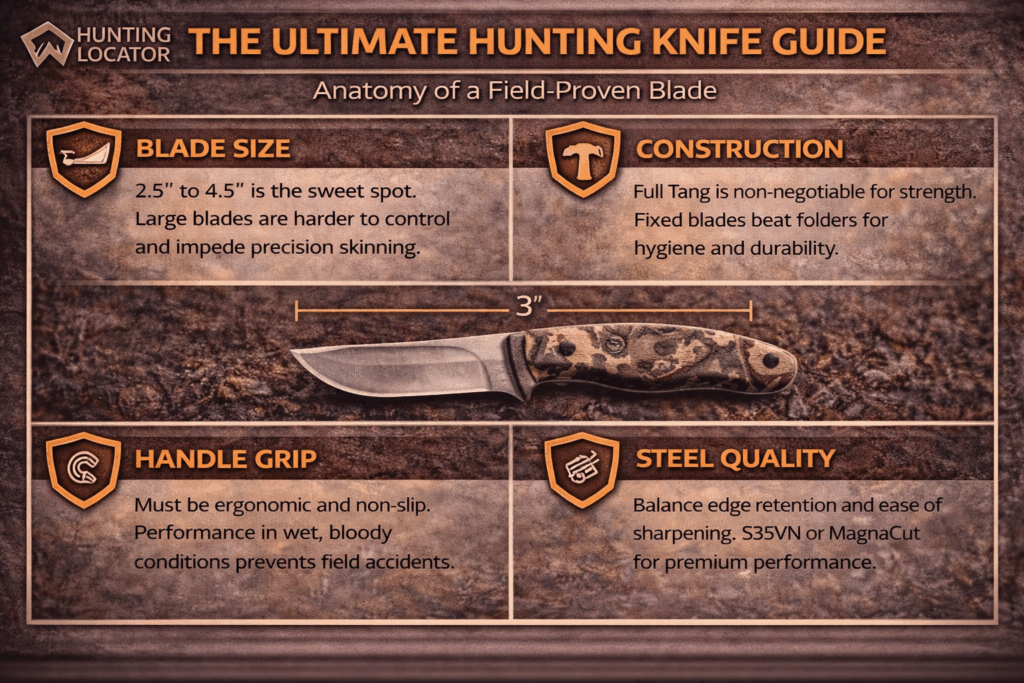
- Blade Size: Outdoor Life recommends sticking to 2.5-to-4.5-inch blades—a 2.6-inch blade handles field dressing and quartering deer just fine. Huge blades “have no practical use for hunters” and actually make skinning harder.
- Full Tang Construction: The blade steel runs through the entire handle. This gives you the strength to crack through pelvic bone without the knife failing.
- Edge Retention: Different steels determine “how long your edge lasts, how often you need to sharpen it, and how well the blade resists wear.”
- Handle That Works: An ergonomic and non-slip handle is essential because “an uncomfortable handle that keeps slipping when wet is a recipe for disaster.”
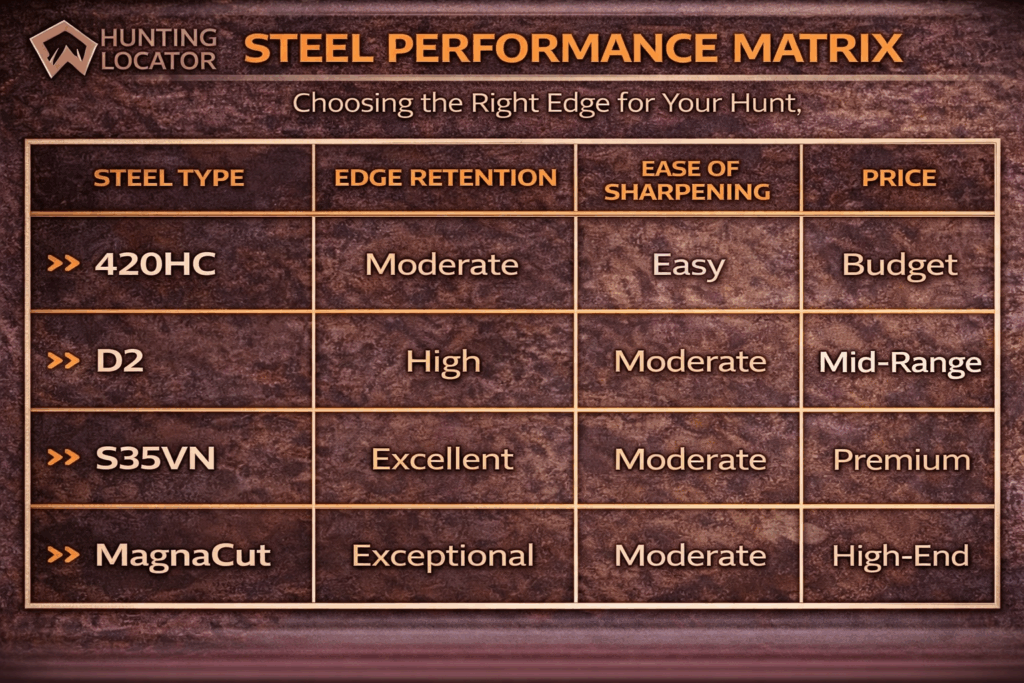
Here’s how different steel types actually perform in the field:
| Steel Type | Edge Retention | Ease of Sharpening | Corrosion Resistance | Price Point |
|---|---|---|---|---|
| 420HC | Moderate | Easy | Good | Budget-friendly |
| D2 | High | Moderate | Moderate | Mid-range |
| S30V/S35VN | Excellent | More difficult | Excellent | Premium |
| MagnaCut | Exceptional | Moderate | Superior | High-end |
S35VN offers significantly better toughness and is noticeably easier to sharpen compared to S30V. Meanwhile, MagnaCut “achieves exceptional corrosion resistance because all of its chromium remains in solution”.
Fixed Blade vs. Folding: The Field Dressing Decision
Fixed blades win for serious field dressing work. Folders make decent backup tools or convenience carry, but when you’re processing an animal, you want the strength, easy cleaning, and zero failure points that only a fixed blade provides.
First hunting knife? Get a quality fixed blade in the 3-4 inch range. It’ll handle 90% of what you need to do in the field.
Sharpening: Keeping Your Edge in the Field
When you’re working on large game like elk or moose, pack a small sharpening tool because “your knife can get dull during the skinning and quartering process.”
Hold your knife at about a 20-degree angle against the sharpening surface for hunting knives. Keep in mind that S30V models will hold their edge for longer than AUS-8 models, but are harder to sharpen—know this trade-off before you buy.
Core Gear Checklist: Our Top Recommendations
Good gear won’t guarantee you’ll fill your tag, but bad gear can definitely ruin a hunt. Here’s what experienced hunters actually prioritize.
Clothing & Layering
Get camo that matches your terrain and base layers that wick moisture away from your skin. Your boots matter as much as anything else you’ll buy—blisters and cold, wet feet will end your hunt faster than bad weather.
Weaponry & Ammunition
Whatever you’re shooting, practice matters more than specs. Ethical hunting means being confident in your shot placement. Clean, quick kills make field dressing easier and reduce animal suffering.
The Essentials: Navigation, Safety, and Field Dressing Tools
Navigation and safety gear form your foundation: compass, GPS, and first aid supplies you actually know how to use. A well-stocked first aid kit isn’t optional—knife accidents are some of the most common injuries in the field.
Your knife anchors your field dressing setup, backed up by:
- Latex or nitrile gloves (bring extras)
- Game bags to protect meat from flies and dirt
- Paracord or rope for hanging and securing
- Headlamp for processing in low light
Field dressing knife features that actually matter:
- 2.5-4.5 inch blade for control and versatility
- Full tang construction for strength during tough cuts
- Non-slip handle that grips when bloody and wet
- Quality steel that stays sharp through a whole animal
- Solid sheath for safe carry
Ready to invest in a knife that performs when it counts? Check out our selection of hunting knives chosen for field reliability. Complete your processing kit with tools that complement your primary blade.
Tactics & Strategy: Putting Your Preparation to Work
All that gear preparation pays off when your homework meets opportunity in the field.
Peak Activity Times
Big game moves most during low-light periods—early morning and late evening. Success during these windows often means field dressing in fading light, which makes that reliable knife and headlamp combo even more important.
Wind & Scent Control
Wind direction can make or break your hunt more than any other single factor. Hunt with favorable winds, use scent elimination products strategically, and always have a backup plan when the wind shifts.
The Approach: Shot Placement and Recovery
Your specific tactics depend on species and terrain—tree stands, still-hunting, ground blinds, or calling all have their place. But regardless of your approach, ethical shot placement in vital zones ensures quick, clean harvests.
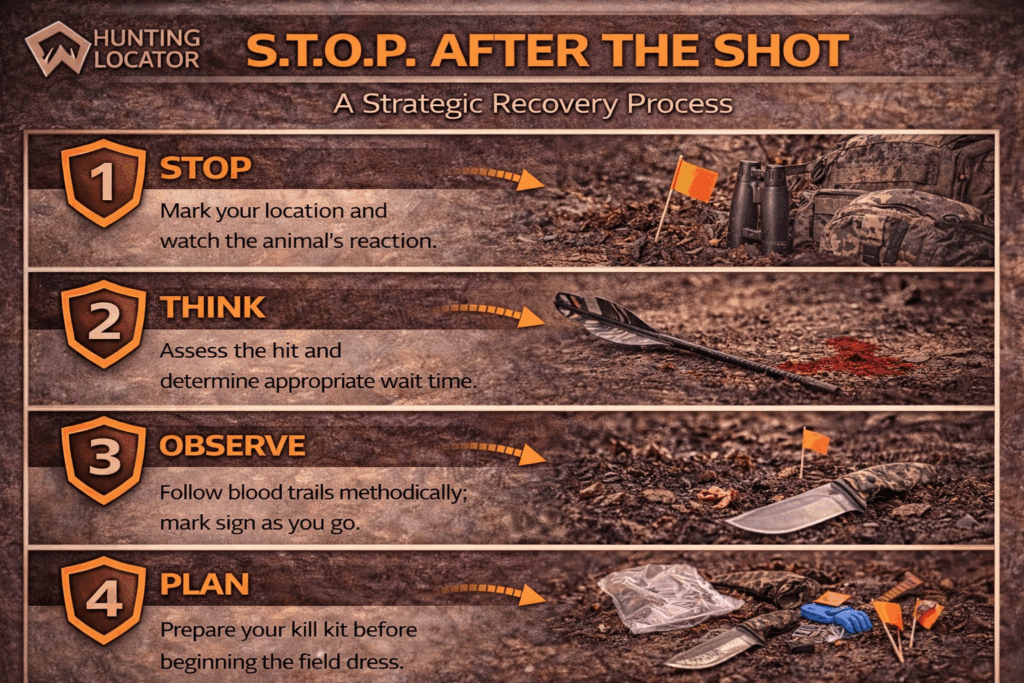
After the shot, mark where you were standing, watch how the animal reacts, and wait the appropriate time before starting your recovery. This is where all that knife preparation starts paying dividends—efficient field dressing begins the second you reach your animal.
Post-Harvest Care: The Work After the Shot
Tracking & Recovery
Follow blood trails methodically and mark your path so you can navigate back to your starting point. Put in the effort for successful recovery—this is where your field dressing preparation becomes absolutely critical.
Field Dressing
Make that initial cut carefully, work systematically to remove internal organs, and focus on cooling the carcass quickly. How sharp your knife is and how well you know your technique determines whether this goes smoothly or becomes a frustrating mess.
Transport & Processing
Get your harvest from field to freezer safely by keeping meat temperature down, protecting it from contamination, and following local transportation rules. The quality of your initial field work with a sharp, reliable knife sets up everything that comes after.
More Resources from Hunting Locator
Expand your hunting success with these specialized resources:
- Hunting Accessories – Complete gear selection for every hunting situation
- Hunting Backpacks – Carry systems for day hunts and backcountry expeditions
- Hunting Scents – Attraction scents for different game species
- Hunting Face Paint – Concealment options for close-range hunting
- Shooting Sticks – Stability systems for accurate shot placement
- Hearing Protection – Protect your hearing while staying aware
- Gun Cleaning Kits – Keep your firearms running reliably
- Hunting Flashlights – Illumination for early morning and late evening hunts
- Hand Warmers – Stay comfortable during cold weather hunts
FAQ
What size hunting knife do I need for deer hunting?
A 2.6-inch blade handles field dressing and quartering a deer just fine. Blade sizes in the 2.5-to-4.5-inch range have been proven effective through decades of actual field use. Skip the oversized blades—they’re harder to control and don’t give you any real advantage when processing game.
Should I choose a fixed blade or folding hunting knife?
Fixed blades are better for serious field dressing work because they’re stronger, easier to clean, and have no moving parts that can fail. Folders work fine as backup tools or for lighter tasks, but when you’re processing an entire animal, you want the reliability that only a fixed blade provides.
How often should I sharpen my hunting knife?
It depends on how much you use it and what steel it’s made from. For large game like elk or moose, bring a small sharpening tool in your pack since your knife can get dull while you’re skinning and quartering. S30V models will hold their edge longer than AUS-8 models, but are harder to sharpen.
What’s the difference between hunting knife steel types?
Different steels determine how long your edge lasts, how often you need to sharpen it, and how well the blade resists wear. Budget steels like 420HC are easy to sharpen but don’t hold an edge as long. Premium options like S35VN and MagnaCut stay sharp longer and resist corrosion better.
Do I need a gut hook on my hunting knife?
A gut hook is optional and a matter of preference, since most hunting knives can already open up an animal’s belly easily. Focus on the basics first—blade size, steel quality, and handle comfort matter more than specialty features.
How much should I spend on a quality hunting knife?
Quality hunting knives start around $100 for reliable performance. Think about how often you hunt and what your trips cost—a knife failure on an expensive out-of-state hunt costs way more than buying quality gear upfront.
The Final Shot
Your hunting knife isn’t just another piece of gear—it’s what determines whether your successful shot becomes a successful hunt. From the moment you reach your harvested animal until that meat hits your freezer, everything depends on having a blade that works when you need it most.
The gap between a $15 gas station knife and a quality hunting blade isn’t about spending more money—it’s about reliability when you’re miles from help, safety when you’re working with sharp tools in tough conditions, and knowing your gear won’t quit on you.
Ready to gear up with a knife that won’t let you down when it matters? Check out our hunting knife collection today. We stock quality blades, game processing tools, and field dressing accessories to back up your hunting success from first cut to final processing.


