The entire application process runs through a single 30-day window, April 1 through April 30. Miss it, and you wait another year.
This Idaho moose guide covers what you need to plan your application, budget, and hunt strategy. The Idaho Department of Fish and Game (IDFG) is issuing 510 antlered moose permits for 2026, with nonresidents eligible for up to 10% of that total. Whether you’re a longtime resident finally applying or a nonresident chasing a bucket-list bull, the numbers below lay out what you’re working with.
Here’s what’s covered:
- 2026 season dates, bag limits, and the application process — so you don’t miss a deadline
- License, permit, and cost breakdowns for residents (Price Lock vs. Standard) and nonresidents
- Where to hunt — public land, private leases through Hunting Locator, and guided options, plus field tips and gear
Start with the quick overview, then go to whichever section matters most for your hunt.

Quick Overview: Idaho Moose Season 2026 at a Glance
Two things govern Idaho moose hunting: the once-in-a-lifetime bag limit (one antlered and one antlerless moose, for life) and the controlled-hunt draw structure that determines who gets to hunt at all.
| Season / Element | Dates / Detail | Notes |
|---|---|---|
| Application Period | April 1 – April 30 (annual) | Controlled hunt draw; results in early June |
| Archery (Antlered Only) | August 30 – November 23 | Varies by unit |
| Controlled Hunts | September 15 – December 1 | Individual unit dates vary |
| Bag Limit | One antlered + one antlerless moose — in a lifetime | Once-in-a-lifetime designation |
| Antlered Permits (2026) | 510 total | Nonresidents eligible for up to 10% |
For more detail, see our Idaho moose hunting deep dive. If you’re planning hunts beyond moose this year, the full Idaho hunting season guide covers every species and season on the calendar.
Before you get into units and tags, get the paperwork requirements straight. IDFG requires:
- A valid hunting license — every applicant must hold a current Idaho hunting or combination license before applying.
- A controlled hunt application — moose is a controlled-hunt species, so you must apply during the April 1–30 window. There’s no over-the-counter tag.
- Compliance with the once-in-a-lifetime rule — harvesting a moose affects your future eligibility to apply for the same category again (more on the antlered/antlerless distinction below).
- Awareness of the species-restriction rule — applying for moose typically restricts you from also applying for other once-in-a-lifetime species, like bighorn sheep or mountain goat, in the same year.
Idaho Moose Hunting Seasons
Idaho structures moose seasons around distinct hunting methods, and exact dates are unit-specific — your opener and closer depend on where you’re drawn. Idaho publishes moose regulations on a two-year cycle, so 2026 largely mirrors the prior season’s framework. IDFG has documented a modest decline in moose populations in some regions, driven mostly by parasites and disease, which has trimmed a handful of antlered tags in recent years — one more reason this tag is worth planning around carefully.

Archery Season (Antlered Only)
Idaho’s archery moose season runs August 30 through November 23, though exact dates vary by unit, and it’s restricted to antlered bulls only. This is the earliest opportunity of the year to hunt moose, and it overlaps with the rut, which gives bowhunters willing to work in close and call bulls a real advantage.
Controlled Hunts (Rifle/General)
Controlled hunt dates begin September 15 and can run as late as December 1, with the specific window set by your drawn unit. Confirm your unit’s opener and closer before finalizing plans. Unit selection for moose works differently than for sheep or goat: Idaho has a wide range of units, and some trade easy access for lower trophy potential while others demand serious backcountry effort for a shot at a bigger bull. Choose based on what kind of hunt you actually want to do.
Second Drawing & Super Hunt
If tags remain unclaimed after the first draw, IDFG runs a second drawing, with that application window open June 15 through June 25. Separately, the state’s Super Hunt program makes four additional moose tags available each year, with the first entry deadline on May 31, according to the Idaho Fish and Game booklet. Both are legitimate second-chance paths for hunters who miss the primary draw, but leftover tags aren’t guaranteed every year — treat them as a bonus, not a plan.
Idaho Moose Licenses and Permits
Here’s what you need to hold, what it costs, and how the application process runs from start to finish, based on current 2026 figures from IDFG. The short version: hold a valid license, apply between April 1–30, then wait for results in early June.
Idaho Hunting Licenses
Before submitting a moose application, you need a valid Idaho hunting or combination license. Your total upfront cost from there depends on residency status and which license option you choose.
| Cost Element | Resident (Price Lock) | Resident (Standard) | Nonresident |
|---|---|---|---|
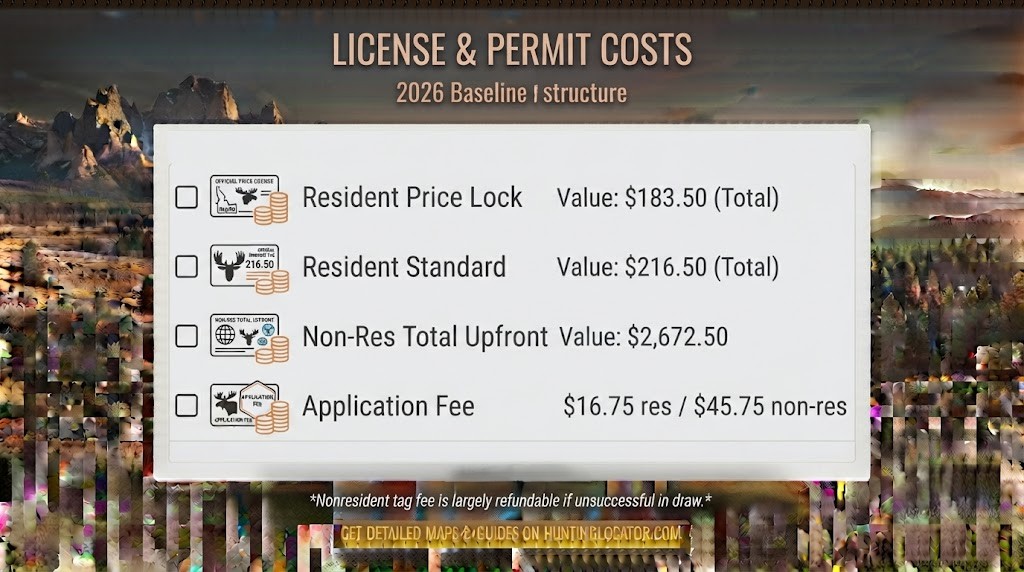
| Total Upfront Cost | $183.50 | $216.50 | $2,672.50 |
| Application Fee (Nonrefundable) | $16.75 | $16.75 | $45.75 |
| Refundability | — | — | Majority refundable if undrawn |
For nonresidents, the tag fee portion of that $2,672.50 is refunded if you don’t draw, but the license and application fees are not. So the real risk each year is limited to those nonrefundable costs, not the full amount. For residents, the choice between Price Lock ($183.50) and Standard ($216.50) comes down to whether you locked in the discounted rate ahead of time. Either way, license, tag, and application fee are covered in one upfront payment.
Idaho Moose Permits
Idaho’s moose permits work entirely through the controlled-hunt system. For 2026, IDFG is issuing 510 antlered permits, with nonresidents capped at roughly 10% of that total — around 51 nonresident permits statewide. Draw odds vary a lot by unit: outside a few standout areas, nonresident odds run long, often around 1 in 25 for many antlered hunts. Go in with realistic expectations for a tag this rare.
To apply, submit your application through IDFG during the April 1–30 window, using your valid hunting license as the entry point. Draw results post online in early June, leaving the rest of summer and early fall to plan once you know you’re drawn. Given the difficulty of the draw and the once-in-a-lifetime stakes, research units carefully rather than applying for the first one you find — your unit choice shapes the whole season.
Where to Hunt Moose in Idaho
Once you’ve got a tag, the question is where to hunt it. There are three paths: public land, private leases, and guided hunts, and the right choice depends on your unit, your budget, and how much time you have to scout. Idaho’s best moose habitat concentrates in the northeastern part of the state, the Clearwater region, and scattered pockets throughout central Idaho’s mountain valleys.
Best Public Lands
Idaho’s public land offers real opportunity for DIY hunters willing to put in the scouting time. These areas consistently produce quality moose sign and, in some cases, quality bulls.
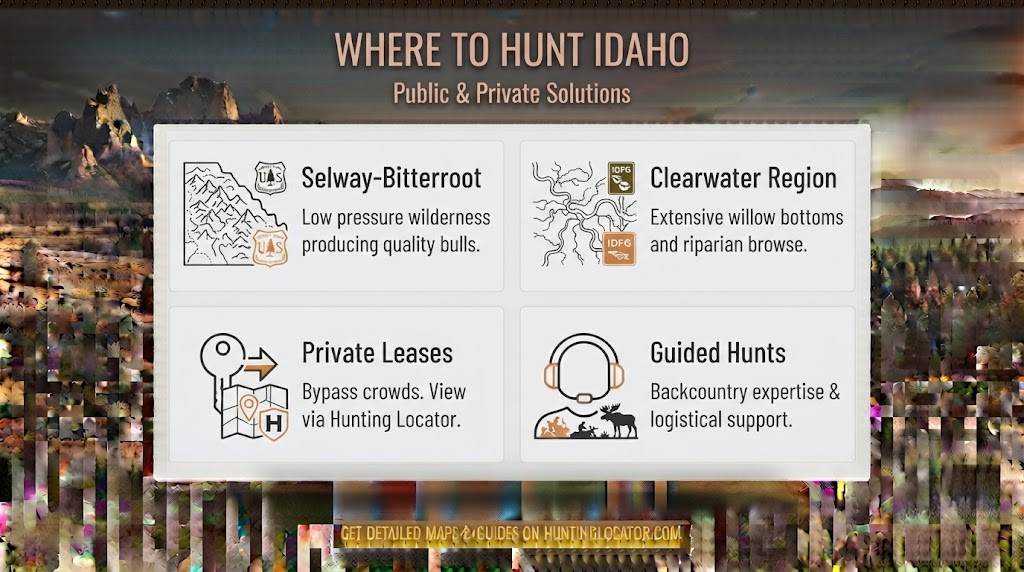
- Selway-Bitterroot Wilderness — Limited access here reduces hunting pressure significantly, and the area is known for producing quality bulls for hunters willing to go deep.
- Nez Perce-Clearwater National Forest — Extensive willow bottoms and riparian habitat give moose the year-round browse they depend on, making this forest a consistent producer.
- Central Idaho mountain valleys — Scattered habitat pockets throughout this region are worth scouting individually, especially near water sources.
- North vs. South terrain — Northern units tend to run steep and thickly timbered, demanding more physical effort, while southern units are generally more open and less punishing on your legs.
Private Land Hunting with Hunting Locator
Public land works, but it comes with competition, and for a tag you may only hold once, reducing that competition matters. Private access means more controlled ground, fewer other hunters working your unit, and often better odds of putting your tag on a quality bull. There are two real options: leasing land for the season or buying a property outright for a longer-term hunting investment. Leasing gets you access without the commitment of ownership; buying makes sense if you want a piece of Idaho moose country to return to year after year. The right call depends on your budget and how often you plan to hunt this ground.
This is where Hunting Locator does its best work. We connect you directly with Idaho landowners ready to lease or sell to hunters — no middleman, no cold calls, just a way to find ground that matches your unit and your goals. Whether you’re chasing willow-bottom habitat in the Clearwater region or a quieter corner of central Idaho away from crowded trailheads, our platform puts current opportunities in front of you.
Browse live Idaho leases to start narrowing down ground that fits your unit and your once-in-a-lifetime tag.
Guided Hunts
For hunters who want the logistics, access, and field expertise handled for them, a guided hunt can be the smartest way to make the most of a tag you may never draw again — especially if you’re heading into unfamiliar Idaho backcountry with limited time to scout.
A guide often makes sense when:
- You’re a nonresident unfamiliar with Idaho’s terrain, units, and access points.
- Your drawn unit is remote or backcountry — wilderness areas like the Selway-Bitterroot can be difficult to access without local knowledge.
- You want to maximize a once-in-a-lifetime tag and reduce the risk of coming home empty-handed.
- You lack the time to scout the season thoroughly before your hunt dates arrive.
Whichever path you choose, matching your access strategy to your unit and timeline is one of the more important decisions you’ll make all season.
Moose Hunting Tips
If you’ve spent years chasing elk or deer through Idaho elk hunting or Idaho deer hunting seasons, moose hunting will feel familiar in some ways and different in others. Here are the fundamentals that separate a successful moose hunt from a frustrating one.
- Scout early, glass smart — Glass willow bottoms and beaver pond complexes at dawn and dusk before the season opens; this is where moose spend most of their time feeding.
- Practice from a rest to 300 yards — Moose often feed in open meadows, so steady, confident long-range shooting matters more than it might for timber-bound elk.
- Think bigger than elk — Moose are far larger-bodied animals; plan your meat care and pack-out logistics before you pull the trigger, since the workload after the shot is significantly greater.
- Learn moose calling — Calling can meaningfully improve your odds during the rut window, particularly for archery hunters working in close.
- Gear up right — Reliable optics, a rugged pack, and a dependable rifle-and-optic setup matter on a hunt this important. Browse the right gear before your season starts so you’re not scrambling in August.
More Resources from Hunting Locator
Planning a moose hunt often means planning your whole Idaho hunting year. Here are more resources to round out your season.
Core Idaho Planning
- Idaho hunting season guide — the broad parent guide covering every Idaho season in one place.
- Idaho moose hunting season — our deeper species-specific companion piece to this guide.
- Idaho hunting leases — browse current private land leases available across the state.
- Hunting Locator store — gear up with the essentials before you head afield.
Other Idaho Big Game
- Idaho elk hunting season
- Idaho deer hunting season
- Idaho antelope hunting season
- Idaho bighorn sheep hunting season
- Idaho mountain goat hunting season
- Idaho black bear hunting season
- Idaho mountain lion hunting season
Idaho Small Game & Birds
- Idaho coyote hunting season
- Idaho upland game hunting season
- Idaho turkey hunting season
- Idaho migratory bird hunting season
- Idaho waterfowl hunting season
FAQ
What are Idaho’s 2026 moose season dates?
Archery season (antlered only) runs August 30 through November 23, while controlled hunts run September 15 through December 1, with exact dates varying by unit. The application window to enter the draw is April 1–30, per IDFG regulations. Confirm your unit’s specific dates once you’re drawn.
How much does an Idaho moose tag cost in 2026?
Residents pay $183.50 with Price Lock or $216.50 at the standard rate, both covering license, tag, and application fee. Nonresidents pay $2,672.50 upfront, with the majority refundable if undrawn. Nonrefundable application fees run $16.75 for residents and $45.75 for nonresidents.
How do I apply for an Idaho moose controlled hunt?
Hold a valid Idaho hunting or combination license, then submit your application during the April 1–30 window directly through IDFG. Draw results post online in early June. If you’re not selected, a second drawing runs June 15–25 for any leftover tags.
Is an Idaho moose tag really once-in-a-lifetime?
Yes — Idaho’s lifetime bag limit is one antlered and one antlerless moose, per IDFG. There’s a nuance worth knowing: if you harvest an antlered moose, you may still be eligible to apply for an antlerless permit later, and vice versa, but you can’t take two of the same type in a lifetime.
What are the nonresident draw odds for Idaho moose?
Nonresidents are capped at roughly 10% of total permits, or about 51 nonresident tags for 2026. Outside a handful of top-producing units, odds run long — often around 1 in 25 in many antlered hunts. This is a genuine bucket-list, low-odds tag, so plan your unit strategy accordingly.
Where can I find private land to hunt moose in Idaho?
Hunting Locator’s marketplace connects hunters directly with Idaho landowners ready to lease or sell their property. Browse current Idaho hunting leases to find ground that matches your drawn unit and hunting style.
The Final Shot
An Idaho moose tag is as rare as hunting opportunities get: a once-in-a-lifetime shot bound by a strict April 1–30 application window and a draw that doesn’t favor the unprepared. The hunters who succeed tend to plan early — confirm your license, apply on time, and lock in where you’ll actually hunt well before your season opens.
We’ve laid out the 2026 numbers here as accurately as possible, but confirm final regulatory details directly with IDFG before finalizing your plans. Where we can help directly is the rest of the equation: connecting you with quality land and the right gear so your once-in-a-lifetime hunt doesn’t come down to guesswork. That’s what Hunting Locator does.
If you’re ready to turn this guide into an actual hunt, the next steps are straightforward: find your unit, secure your access, and connect with Idaho landowners who can put you on quality ground when it matters.


