Hunters who confirm dates, licenses, and land access beforehand start the morning in the field instead of sorting out permit questions the night before.
This guide pulls together what you need to hunt Idaho’s uplands, whether you’re a resident who’s chased chukar in the same canyons for years or a non-resident planning a first trip west. Idaho Fish and Game (IDFG) sets these seasons through a public rulemaking process, and the Commission considered its 2026–2027 recommendations in January 2026. Hunting Locator has organized the official season dates, fees, bag limits, and land-access options into one place. All figures reflect the most current verified information available, but regulations can shift, so confirm final details with IDFG before you head afield.
Here’s what’s covered below:
- When & what: Species-by-species season dates and bag/possession limits for turkey, pheasant, chukar, quail, grouse, and dove.
- What you need: License and permit requirements, with exact costs for residents and non-residents.
- Where to go: Public land options, private-land leases through Hunting Locator, and guided-hunt considerations.
Start with the quick-reference table below, then move into the details for your specific hunt.
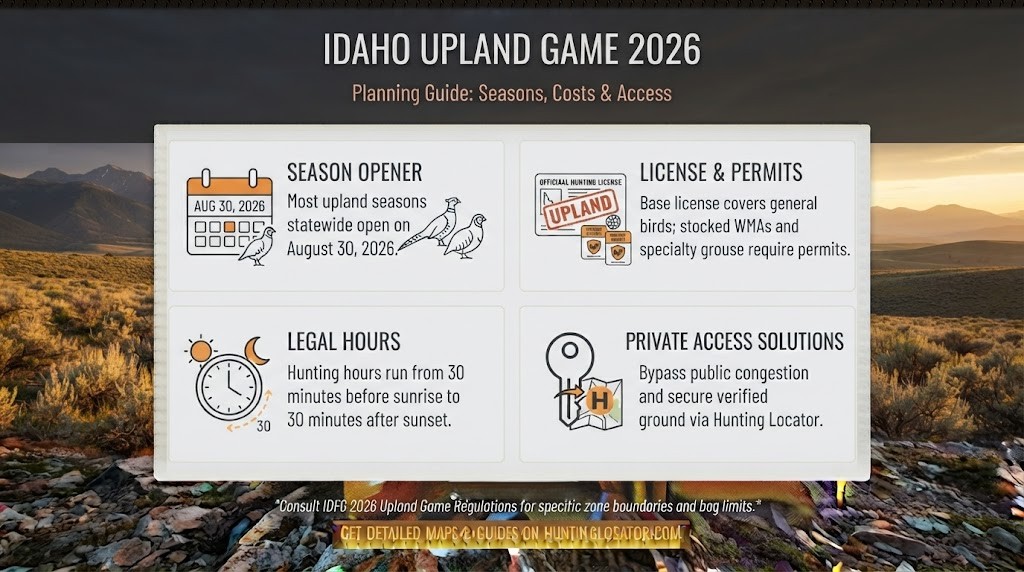
Idaho Upland Game Season 2026: Quick Overview
The dates below reflect the 2026–2027 framework as it currently stands, based on recommendations the Commission considered in January 2026. Rules can still be adjusted, so check the Idaho Fish and Game seasons page for the final word on any given season.
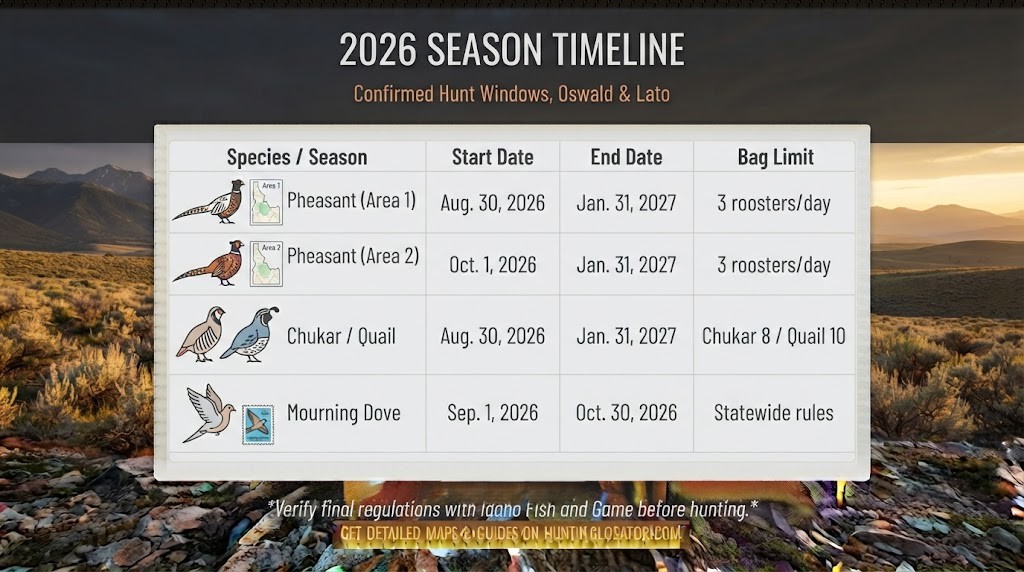
Here’s the full lineup for Idaho pheasant season 2026, Idaho chukar hunting, and the other upland species worth tracking:
| Species | Season | Area | Start Date | End Date | Daily Bag Limit |
|---|---|---|---|---|---|
| Wild Turkey | Fall 2026 | Select Units | August 30 | Jan 31, 2027 | Per tag |
| Wild Turkey | Spring 2027 | Most Areas | Apr 15, 2027 | May 25, 2027 | Per tag |
| Pheasant | Regular | Areas 1 & 2 | Aug 30 / Oct 1 | Jan 31, 2027 | 3 roosters |
| Chukar/Quail | Regular | Statewide | Aug 30, 2026 | Jan 31, 2027 | Chukar 8 / Quail 10 |
| Forest Grouse | Regular | Statewide | Aug 30, 2026 | Jan 31, 2027 | 4 |
| Mourning Dove | Regular | Statewide | Sep 1, 2026 | Oct 30, 2026 | See dove section |
For area differences, permit requirements, and possession limits, see the species sections below. If you’re new to Idaho’s hunting seasons and bag limits, the licensing section further down covers the paperwork you’ll need.
License, Permit & Education Requirements at a Glance
A license alone covers most upland birds, but stocked-bird WMAs and sage/sharp-tailed grouse require added permits. According to IDFG’s Idaho hunter’s beginner guide, a hunting license by itself is all you need for cottontail rabbits, forest grouse, quail, chukar, gray partridge, and pheasant in most locations.
Before you head out, make sure you’ve got these covered:
- Valid Idaho hunting license or Hunting Passport: Required for all upland game bird hunting.
- Upland Game Bird permit: Needed if you’re hunting stocked-bird Wildlife Management Areas (WMAs).
- Sage Grouse or Sharp-tailed Grouse permit: Required specifically for those two species, on top of your base license.
- Hunter education certification: Mandatory if you were born on or after January 1, 1975.
- Legal hunting hours: 30 minutes before sunrise to 30 minutes after sunset, statewide.
Idaho Upland Game Hunting Seasons by Species
Upland seasons vary by species, and pheasant varies by area within the state as well. Confirm final dates with IDFG before opening morning, since rules can shift slightly year to year.
Wild Turkey Season
Idaho splits turkey hunting into two windows. Fall 2026 runs August 30, 2026 through January 31, 2027 in select units; Spring 2027 opens April 15 and runs through May 25, 2027 across most areas. Turkey requires a separate tag beyond your base hunting license, a detail that catches some first-timers who assume the license covers everything.
For unit-specific strategy and season nuances, see this Idaho turkey season deep dive.
Pheasant Season
Pheasant season runs on a staggered schedule depending on location. Area 1 opens August 30, Area 2 opens October 1, and both close January 31, 2027. The daily bag limit is 3 roosters, with 9 in possession.
Pheasants stocked on Wildlife Management Areas require the Upland Game Bird permit, and that permit must be validated immediately upon harvest — entering the harvest date and location code in non-erasable ink and removing a notch, per the pheasant permit validation rules. Skipping this step puts you out of compliance even if the harvest itself was legal.
For hunting options beyond the WMAs, see the Where to Hunt section below.
Chukar & Quail Season
Chukar and quail run statewide from August 30, 2026 through January 31, 2027. Daily limits are 8 for chukar (24 in possession), 10 for quail (30 in possession), and 8 for gray (Hungarian) partridge (24 in possession).
There’s no legal hunting season for Mountain or Gambel’s Quail anywhere in the state. Idaho’s quail hunting centers on California and bobwhite quail, so confirm what species you’re looking at before you shoot.
Forest Grouse Season
Forest grouse hunting runs statewide alongside chukar and quail, August 30, 2026 through January 31, 2027, with a daily limit of 4 birds and 12 in possession. It’s one of the more accessible upland seasons in the state, with generous limits and a long window.
Sage Grouse & Sharp-tailed Grouse
Both species require special permits on top of your base hunting license — the Sage Grouse permit and the Sharp-tailed Grouse permit are separate purchases. Sage grouse carries a daily limit of 2 birds plus a season limit; sharp-tailed grouse allows 2 daily with 6 in possession. These permits exist because both species face more specific population management needs than birds like pheasant or chukar.
Mourning Dove Season
Mourning dove season runs statewide from September 1 through October 30, 2026, earlier and shorter than most other upland seasons. Dove is classified as a migratory bird rather than a resident upland species, so its rules and season structure differ from the birds above.
For how dove fits into Idaho’s broader migratory bird framework, see our Idaho migratory bird seasons guide. If you’re also considering waterfowl later in the year, our Idaho waterfowl season guide covers that overlap.
Idaho Upland Game Licenses and Permits
Getting legal to hunt in Idaho follows a straightforward order: buy your license first, then add species-specific permits where required.
Idaho Hunting Licenses
Licenses are available through IDFG offices, license vendors like sporting goods stores, online, or by phone. Non-residents can purchase online with a valid government-issued ID and proof of hunter education certification from any U.S. state or Canadian province.
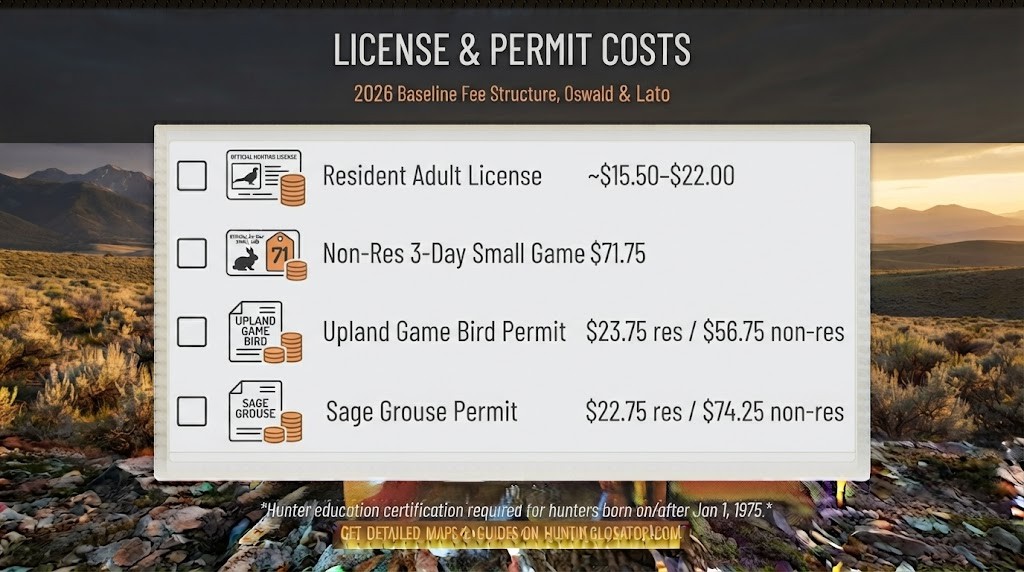
Fee breakdown:
| License/Permit Type | Cost |
|---|---|
| Resident Adult Hunting License | ~$15.50–$22.00 |
| Non-Resident 3-Day Small Game License | $71.75 |
| Upland Game Bird Permit (Stocked Birds, 18+) | $23.75–$28.75 resident / $56.75 non-resident |
| Sage Grouse Permit | $22.75 resident / $74.25 non-resident |
| Sharp-tailed Grouse Permit | $4.75–$5.75 resident / $17.75 non-resident |
Non-residents heading to stocked WMAs should budget for both the base license and the Upland Game Bird permit — that combination is where costs add up fastest.
Hunter education is required for anyone born on or after January 1, 1975. First-time hunters can use Idaho’s Hunting Passport program, which offers a discounted first license (hunters between age 8 and adulthood must hunt with a mentor 18 or older). Fees are subject to change, so confirm current pricing with IDFG before you buy.
Idaho Hunting Permits
Beyond the base license, three permits cover Idaho’s specialty upland species: the Upland Game Bird permit for stocked-bird WMAs, the Sage Grouse permit, and the Sharp-tailed Grouse permit. All three are purchased through the same vendors as the hunting license, with no separate application process.
The sequence:
- Complete hunter education if you were born on or after January 1, 1975.
- Buy your hunting license — resident or non-resident, based on your situation.
- Add species permits if you’re hunting stocked WMAs, sage grouse, or sharp-tailed grouse.
- Validate your permit on harvest — especially critical for pheasant taken on stocked WMAs, where you must notch the permit and log the date/location immediately.
A license alone gets you into the field for most upland birds, but stocked-bird WMAs and specialty grouse species always require that extra permit.
Idaho Upland Game: Where to Hunt
This section covers three paths: public land, private land access through Hunting Locator, and guided hunts.
Best Public Lands
Idaho offers substantial public hunting ground. According to IDFG, more than 60% of the state is public land, and the Access Yes! program adds roughly 375,000 acres of private land leased specifically for public hunting and fishing access. The best pheasant habitat concentrates in agricultural regions like the Magic Valley, the Treasure Valley near Boise, and the Snake River corridor.
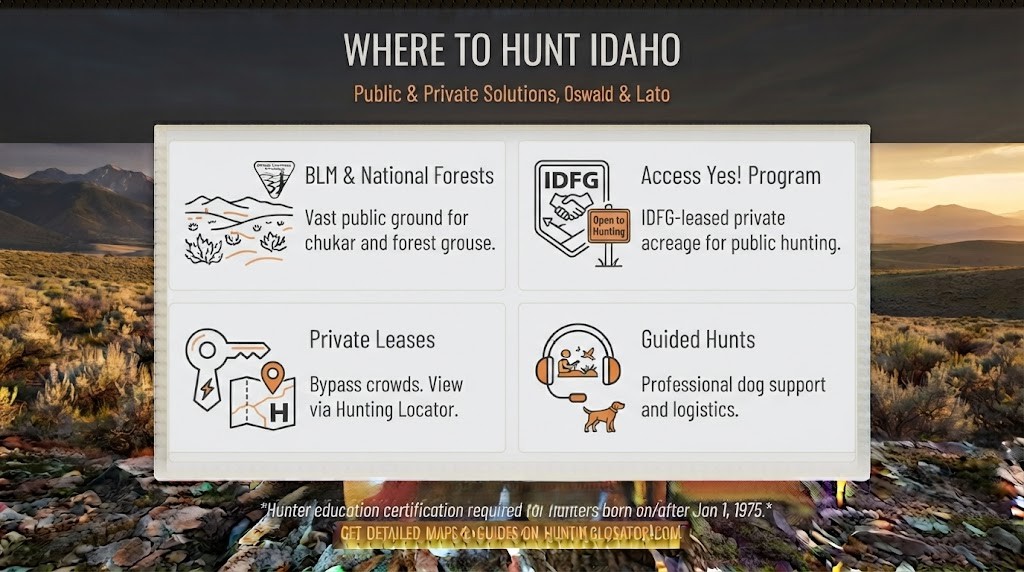
Public-land options include:
- BLM lands: Vast tracts across southern and western Idaho with solid chukar and quail habitat.
- National Forest lands: Good options for forest grouse in higher-elevation terrain.
- Wildlife Management Areas (WMAs): Free to hunt, though stocked-pheasant WMAs require the Upland Game Bird permit.
- Access Yes! properties: Private land leased by IDFG specifically to open public hunting access.
Public land is a low-cost way for newcomers to start, but popular spots get crowded fast, especially on weekends and during opening week.
Private Land Hunting with Hunting Locator
When public land gets crowded or a longtime lease falls through, private land access can save the season. Two paths exist here: leasing private land for the season, or buying land outright for long-term access.
That’s where the Hunting Locator platform comes in. Hunting Locator connects you directly with landowners across Idaho who are ready to lease or sell hunting access, without a middleman. You browse verified listings by region, acreage, and game type, connect directly with the landowner, and secure your spot for the season.
Idaho’s current lease listings cover a range of upland-friendly terrain, from agricultural ground suited to pheasant and chukar to mixed habitat properties in prime upland country. Every listing is tied to a real landowner, so you know what you’re getting before you commit.
Browse Idaho hunting leases and secure a spot before the August 30 opener. Out-of-state hunters can lock in leases well ahead of time rather than scrambling for access on arrival, and if you’ve just lost a longtime lease, this is a fast way back into the field.
Guided Hunts
If guaranteed access and local expertise matter more than saving money, a guided hunt is worth considering. Guides bring dogs, terrain knowledge, and handled logistics, which means more time hunting and less time scouting from scratch.
DIY hunting remains a completely viable option in Idaho, given that more than 60% of the state is public land. Guided hunts offer convenience and near-certain access; DIY hunting on public or leased ground rewards those willing to put in the legwork. If you’d rather skip the guide fee and secure your own private ground, you can connect with Idaho landowners directly and build a hunt on your own terms.
Idaho Upland Game Hunting Tips
A handful of fundamentals, executed well, make the biggest difference in the field:
- Hunt the right hours: Legal shooting time in Idaho runs from 30 minutes before sunrise to 30 minutes after sunset — plan your day around that window.
- Chase chukar uphill: Chukar hold on steep, rocky slopes. Work from the bottom up, pushing birds toward easier shooting lanes instead of chasing them uphill after the flush.
- Read the ag edges for pheasant: Focus efforts on agricultural cover and field edges in regions like the Magic Valley and Treasure Valley, where birds concentrate near food and cover.
- Bring a good dog and know your limits: A trained bird dog improves your odds significantly, but success only counts if you stay within daily bag and possession limits for every species you’re pursuing.
- Match your gear to the bird: A reliable upland shotgun, quality brush pants, and a well-fitted vest make long days afield more productive and more comfortable.
Before the season starts, it’s worth checking your gear. Gear up at the Hunting Locator store for a shotgun, upland-specific apparel, and field accessories.
More Resources from Hunting Locator
Planning a full Idaho season means looking beyond upland birds. Companion resources worth bookmarking:
- Idaho upland game hunting overview — the companion guide covering upland strategy across the state.
- Complete Idaho hunting season guide — the parent resource covering every Idaho season, not just upland birds.
- Idaho migratory bird seasons — details on dove and other migratory species beyond the upland lineup.
- Idaho waterfowl hunting season — pair your upland trip with duck and goose hunting.
- Shop upland hunting gear — shotguns, apparel, and field gear for long days in the uplands.
Explore Other Idaho Seasons
For a full year of hunting, these guides cover Idaho’s other major game species:
- Idaho elk hunting season — season structure and unit strategy for Idaho’s premier big-game species.
- Idaho deer hunting season — whitetail and mule deer seasons across the state.
- Idaho antelope hunting season — pronghorn hunting in Idaho’s open country.
- Idaho black bear season — spring and fall bear hunting opportunities.
- Idaho mountain lion season — houndsmen and predator hunting details.
- Idaho coyote hunting season — year-round predator control and hunting strategy.
- Idaho bighorn sheep season — limited-entry sheep hunting information.
- Idaho moose hunting season — controlled hunt details for Idaho moose.
- Idaho mountain goat season — high-country goat hunting opportunities.
Frequently Asked Questions
When does Idaho pheasant season open in 2026?
Pheasant season opens August 30, 2026 in Area 1 and October 1, 2026 in Area 2, with both areas closing January 31, 2027. The daily limit is 3 roosters. If you’re hunting a stocked-bird WMA, you’ll also need the Upland Game Bird permit. Confirm final dates with IDFG before you head out.
How much does a non-resident Idaho upland hunting license cost?
A Non-Resident 3-Day Small Game License costs $71.75. If you plan to hunt stocked-bird WMAs, the Upland Game Bird permit adds another $56.75 for non-residents. Fees can shift year to year, so verify current pricing directly with IDFG before your trip.
Do I need an upland game bird permit in Idaho?
A hunting license alone covers most upland birds, including pheasant, chukar, quail, gray partridge, and forest grouse in general areas. You need the Upland Game Bird permit specifically for stocked-bird WMAs, plus separate permits for sage grouse and sharp-tailed grouse, according to IDFG.
What are Idaho’s upland game bag limits for 2026?
Daily limits include: pheasant 3 (9 possession), chukar 8 (24 possession), quail 10 (30 possession), gray partridge 8 (24 possession), forest grouse 4 (12 possession), sharp-tailed grouse 2 (6 possession), and sage grouse 2 daily with a season limit. Possession limits are typically triple the daily limit.
What do first-time hunters need to hunt upland birds in Idaho?
You need a valid Idaho hunting license or Hunting Passport, plus hunter education certification if you were born on or after January 1, 1975. According to the Idaho hunter’s beginner guide, the Hunting Passport offers a discounted first license, though hunters under 18 need an adult mentor.
When does mourning dove season open in Idaho?
Mourning dove season runs statewide from September 1 through October 30, 2026. Dove is classified as a migratory bird rather than a resident upland species, so its season structure and rules differ from birds like pheasant and chukar.
The Final Shot
Success this season comes down to three things: know your dates, secure your license and permits, and lock down land access before the August 30 opener.
Confirm species dates and permit requirements with IDFG, get your license through an approved vendor, and secure hunting ground now rather than the week before season. This guide covers the dates, costs, and access options, but IDFG remains the final word on any rule or date affecting your hunt.
Hunting Locator focuses on making that last piece — land access — straightforward. Whether you’re chasing chukar in familiar canyons or planning a first Idaho trip from out of state, browse current Idaho leases and start building your season before the crowds do.


I see a 3 day non resident Quail permit. Is there a non resident 10 day ? If not, can you buy consecutive 3 day permits for a nine day Valley Quail hunt ?
Idaho does not offer a 10-day non-resident hunting permit.