If you’re still working out your plan, this guide covers what you need before the good ground is spoken for.
Idaho Fish and Game (IDFG) sets the seasons, limits, and rules for the state. Where you actually go to hunt is a separate question, and that’s where Hunting Locator comes in. Built on IDFG’s newly published 2026–27 migratory bird rules, this guide covers opening-day logistics through where to set up, whether you’ve hunted Idaho waterfowl for twenty years or you’re pulling on waders for the first time.
Here’s what’s covered:
- Zone-by-zone season dates and 2026 bag limits — exact opening and closing dates for every duck zone, plus the new reduced white-fronted goose limit.
- Licenses, HIP permit, and federal duck stamp requirements — what you need, what it costs, and who needs what.
- Where to hunt — public land options, private leases through Hunting Locator, and guided hunts for those who want a turnkey experience.
The fast version comes first, then the details.
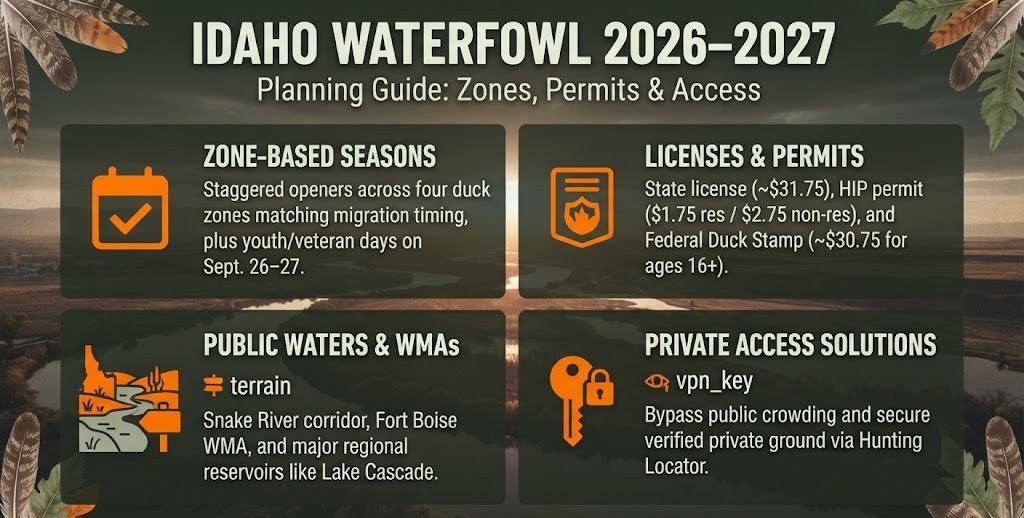
Quick Overview: 2026 Idaho Waterfowl Season at a Glance
IDFG’s published 2026–27 rules set the season structure and bag limits below, including a reduction in the white-fronted goose limit from prior years. Regulations can shift, so confirm current numbers with IDFG before you head out — treat this table as a starting reference, not the final word.
| Species / Group | Season Window (by zone) | Daily Bag Limit | Notes |
|---|---|---|---|
| Ducks & Mergansers (aggregate) | Zones 1 & 4: Oct 3, 2026 – Jan 15, 2027 · Zone 2: Oct 10, 2026 – Jan 22, 2027 · Zone 3: Oct 19, 2026 – Jan 31, 2027 | 7 aggregate | Within limit: max 2 female mallards, 2 redheads, 2 scaup, 3 pintails, 2 canvasbacks |
| Scaup | Zones 1 & 4: Oct 3 – Dec 27, 2026 · Zone 2: Oct 29, 2026 – Jan 22, 2027 · Zone 3: Nov 7, 2026 – Jan 31, 2027 | 2 (within duck aggregate) | Shorter sub-season than general duck season |
| Coots | Same as duck season by zone | $25.00 | — |
| Wilson’s Snipe | Per IDFG migratory bird seasons | $8.00 | Migratory bird — HIP permit required |
| White-Fronted Geese | Per IDFG goose seasons | 6 | Reduced from 10 in prior years (2026 change) |
| Youth, Veteran & Military Days | Sept 26–27, 2026 (statewide) | Regular limits apply | Special early opportunity |
For a broader look at everything Idaho has in season this year, see our full Idaho season overview.
Three compliance items to handle before you head afield:
- State Hunting License — required for all hunters (~$31.75 residents; higher for non-residents)
- Migratory Bird (HIP) Permit — $1.75 residents / $2.75 non-residents; required certification for anyone hunting waterfowl
- Federal Duck Stamp — ~$30.75 electronically; required for hunters age 16 and older
Each of these is covered in more detail later in this guide.
Idaho Waterfowl Hunting Seasons by Zone
Idaho’s landscapes, elevations, and climates vary enough that a single statewide season wouldn’t work well everywhere, so IDFG staggers opening and closing dates across Idaho’s four duck zones to match migration timing and hunting conditions in each region. The federal Pacific Flyway framework also caps how many hunting days Idaho can offer in total, which is part of why the season structure differs zone by zone instead of running identical dates statewide.
Zone boundaries are easiest to check on a map, so confirm which zone you’re hunting using IDFG’s official zone map before you head out rather than guessing from county lines. Below are each zone’s dates, including the nested scaup sub-seasons that run on their own schedule.

Season 1 — Zones 1 & 4
Zones 1 & 4: October 3, 2026 – January 15, 2027 (Scaup: October 3 – December 27, 2026).
This is the earliest general opener statewide, which makes Zones 1 and 4 the go-to choice if you want to be in the blind opening weekend. If you live in or near these zones, or you’re planning an early-October trip, this is your window.
Season 2 — Zone 2
Zone 2: October 10, 2026 – January 22, 2027 (Scaup: October 29, 2026 – January 22, 2027).
Zone 2 opens a week later than Zones 1 and 4. The scaup opener here runs notably later than the general duck season, so don’t head out chasing bluebills before October 29.
Season 3 — Zone 3
Zone 3: October 19, 2026 – January 31, 2027 (Scaup: November 7, 2026 – January 31, 2027).
Zone 3 opens last but runs longest into the calendar, closing January 31, the latest of any zone. If you’re chasing late-season birds pushed south by cold weather, Zone 3 is worth building your trip around.
Youth, Veteran & Military Days
Statewide: September 26–27, 2026.
These two days give eligible youth, veterans, and active military personnel an early opportunity ahead of the general opener, typically with less competition and birds that haven’t seen much pressure yet. A federal duck stamp isn’t required for hunters 15 and younger, but it is required for hunters 16 and older, even during these special days. For the full breakdown on eligibility and rules, see IDFG’s youth and veteran waterfowl days announcement.
Idaho Waterfowl Licenses and Permits
The paperwork isn’t the fun part, but it’s not optional either. IDFG is the licensing authority, so treat the figures below as a planning baseline and confirm exact current fees when you buy. This section runs in the order you’ll actually handle it: license first, then HIP permit, then federal stamp.
Idaho Hunting Licenses
| Requirement | Resident | Non-Resident | Who Needs It |
|---|---|---|---|
| State Hunting License | ~$31.75 | Higher (confirm with IDFG) | All hunters |
| Migratory Bird (HIP) Permit | $2 | $2.75 | All migratory bird hunters |
| Federal Duck Stamp | ~$30.75 (electronic) | ~$30.75 (electronic) | Hunters age 16+ |
Non-resident license pricing runs noticeably higher than the resident rate, and since exact non-resident figures shift, check IDFG’s site directly before you budget your trip. One more requirement worth knowing: if you were born on or after January 1, 1975, you’ll need to pass a hunter-education course before you can hunt, with a one-time exception through Idaho’s Hunting Passport program.
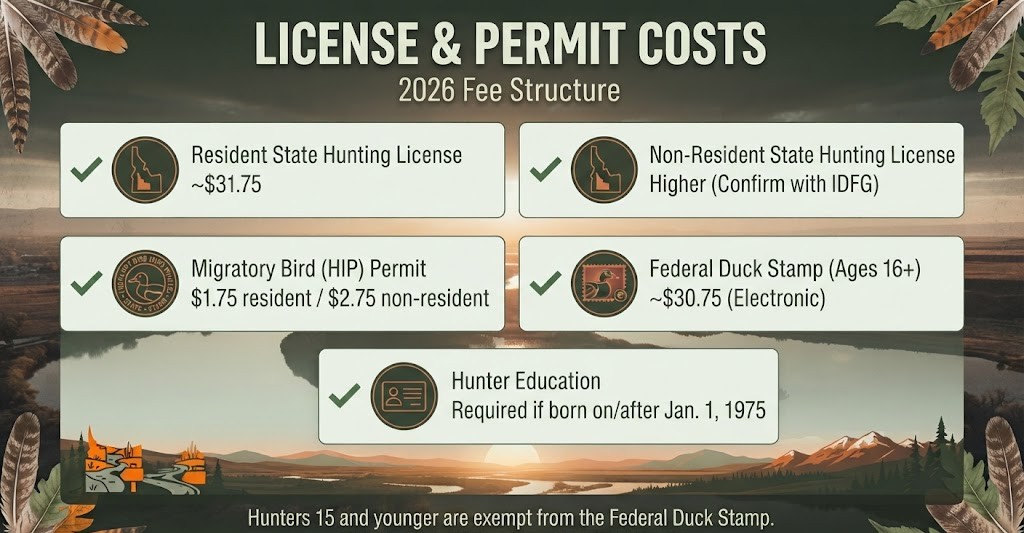
Idaho Hunting Permits
The HIP permit (Harvest Information Program) is a required migratory bird certification — your official sign-up to hunt ducks, geese, coots, and other migratory species. You’ll get it automatically when you purchase your Idaho hunting license, with no separate application to track down.
The federal duck stamp is a separate requirement from your state license. It’s required for every hunter age 16 and older and covers waterfowl specifically — you need both the state license and the stamp, not one or the other. Both the HIP permit and duck stamp are typically added at the point of license purchase, whether online or through a licensed vendor.
If you’re also chasing snipe, doves, or other migratory birds alongside your waterfowl hunt, the same HIP permit covers you there too. One more term worth knowing: your possession limit, generally three times your daily bag limit, caps how many birds you can have in hand at once, not just how many you harvest in a single day.
Where to Hunt Waterfowl in Idaho
Once your paperwork’s handled, the real question is where to go. Public land is free and accessible, but it draws a crowd fast. Leased private land trades that uncertainty for consistency and less competition. Guided hunts offer the most turnkey experience if you want local knowledge without the legwork. Here’s how each stacks up.
Best Public Lands
Idaho’s public wildlife management areas, reservoirs, and river corridors give every hunter, resident or not, a starting point that doesn’t cost anything beyond your license. Popular general areas include:
- Snake River corridor — a long, productive stretch that draws birds throughout the season
- Fort Boise WMA — a well-known managed area with reliable waterfowl habitat
- Reservoirs like Lake Cascade and Blackfoot Reservoir — deeper water that holds birds later into the season
- Panhandle region waterways — northern Idaho’s lakes and wetlands, popular with local hunters
The catch is that everyone knows about these spots too. Experienced hunters often skip the crowded honey holes and instead scout feeding, resting, and roosting sites near water and agricultural fields, watching flight patterns to find where birds are actually moving rather than where hunters are already parked. Public access can be hit or miss depending on pressure and timing, which is part of why more hunters are looking at private options.

Private Land Hunting with Hunting Locator
Leasing private land addresses the biggest frustration of public hunting: pressure. Fewer guns means birds decoy better, hold longer, and return to the same spots season after season instead of getting pushed off by opening-weekend traffic. Whether you’re looking to lease for a season or explore buying land outright for a permanent setup, private access gives you a level of control public ground doesn’t offer.
That’s what Hunting Locator was built for. Our platform connects you directly with landowners across Idaho who are ready to lease or sell hunting access, cutting out the weeks of cold calls and guesswork that used to come with finding private ground. Browse current Idaho hunting land leases by zone, acreage, and game type, and connect directly with landowners who want respectful hunters on their property.
Browse Idaho waterfowl leases and take a few minutes to see what’s open near your zone before opening day arrives and the best spots get locked up.
Guided Hunts
For hunters who want the most turnkey experience — someone else scouting, setting decoys, and calling birds while you focus on the shot — a guided hunt is worth considering. This makes the most sense in a few specific situations:
- You’re a non-resident with a limited trip window and can’t afford to burn a day scouting unfamiliar water.
- You’re new to waterfowl hunting and want hands-on mentorship before going it alone.
- You’re hunting unfamiliar terrain and don’t yet know where birds are holding.
If a full-service guided hunt feels like more than you need, leasing private land through Hunting Locator often hits the middle ground — the certainty and reduced pressure of private access without the added cost of a guide walking every step with you.
Idaho Waterfowl Hunting Tips
Once your access and paperwork are locked in, these field-tested fundamentals will help you make the most of every sit this season.
- Match Your Decoy Spread to the Species — Use a mix of decoys that reflects what you’re actually targeting, and arrange them in natural groups with clear landing zones so incoming birds commit rather than flare off.
- Read the Birds Before You Set Up — Scout feeding, resting, and roosting sites near water and agricultural fields, and watch flight patterns in the days before your hunt to find where birds are actually working.
- Stay Hidden — Your concealment and blind placement matter just as much as your decoy spread. Blend into natural cover rather than relying on your gear alone to fool wary birds.
- Dress for the Water — Late-season Idaho hunts get cold and wet fast. Quality waders keep you comfortable and in the field longer when the temperature drops.
- Learn Basic Calling — A handful of clean, well-timed calls will outperform constant noise, especially if you’re still building confidence with a call.
- Know Your Birds — Being able to identify species on the wing keeps you inside the aggregate limits — no more than 2 female mallards, 2 scaup, or 2 canvasbacks within your daily 7-bird limit.
Rounding out your kit matters as much as your technique. From waders to decoys to calls, shop waders and decoys to get squared away before opening day.
More Resources from Hunting Locator
Planning more than one hunt this year? Here’s where to go next.
- Our full Idaho hunting season guide — huntinglocator.com/blog/idaho-hunting-season-guide covers every species and season across the state in one place.
- Deeper waterfowl and migratory bird detail — Idaho waterfowl hunting season and Idaho migratory bird hunting season go further into species-specific rules and timing.
- Pair your trip with upland game — Idaho upland game hunting season is a good complement if you want to fill extra days afield.
- Find your land — Browse Idaho hunting land leases or start at the Hunting Locator homepage to explore everything the platform offers.
- Gear up — Visit the Hunting Locator store for waders, decoys, calls, and everything else on your list.
- Explore other Idaho seasons — Big game: elk, deer, antelope, moose, bighorn sheep, mountain goat, black bear, and turkey. Predators: coyote and mountain lion.
Frequently Asked Questions
Do I need a federal duck stamp to hunt waterfowl in Idaho?
Yes, if you’re 16 or older. The federal duck stamp costs roughly $30.75 when purchased electronically and is separate from your state hunting license and HIP permit. Hunters 15 and younger are exempt. Always confirm current requirements with IDFG before your hunt.
What is the HIP permit and how do I get one?
The HIP (Harvest Information Program) permit is a required migratory bird certification, costing $1.75 for residents and $2.75 for non-residents. You’ll receive it automatically when purchasing your Idaho hunting license, and it’s required before hunting waterfowl, snipe, or other migratory birds.
When are the 2026 youth, veteran, and military waterfowl days?
These special hunting days run statewide on September 26–27, 2026, giving eligible participants an early opportunity ahead of the general season opener. Hunters 16 and older still need a federal duck stamp during these days, even though younger youth hunters are exempt.
What’s the daily bag limit for ducks in Idaho for 2026?
Idaho’s 2026–27 rules set the daily limit at 7 ducks and mergansers in aggregate, with no more than 2 female mallards, 2 redheads, 2 scaup, 3 pintails, or 2 canvasbacks. Coots are limited to 25 daily, and white-fronted geese have been reduced to 6, per IDFG’s published regulations.
How much does a non-resident pay to hunt waterfowl in Idaho?
Non-residents need a state hunting license (priced higher than the resident rate of roughly $31.75 — confirm the current figure with IDFG), a HIP permit ($2.75), and a federal duck stamp (~$30.75). Budget for all three before your trip.
Where can I find private land to hunt waterfowl in Idaho?
Hunting Locator connects hunters directly with landowners across the state who are leasing or selling hunting access. Browse current Idaho hunting leases to see what’s available near your target zone and connect with landowners ready to work with respectful, serious hunters.
The Final Shot
The plan for the 2026 Idaho waterfowl season comes down to three things: know your zone’s dates (Zones 1 & 4 on October 3, Zone 2 on October 10, Zone 3 on October 19), get your license, HIP permit, and duck stamp squared away, and lock in where you’re actually going to hunt. Confirm your zone and current dates with IDFG, secure your access whether that’s public ground, a private lease, or a guided hunt, and gear up before opening day arrives.
IDFG sets the official seasons and limits. Getting from the regulations to a productive morning in the blind is where Hunting Locator comes in — connecting you with the access and gear that make the difference between a season spent scouting and a season spent hunting.
Opening day comes fast — secure an Idaho lease and gear up at the Hunting Locator store now.


