This Indiana deer guide lays out the 2026 deer season: dates for every method, license and permit costs for residents and non-residents, and where to actually hunt once you’re licensed. It also covers the year’s biggest equipment change — breech-loading muzzleloaders are now legal — so you’re not caught off guard on opening day.
What’s covered below:
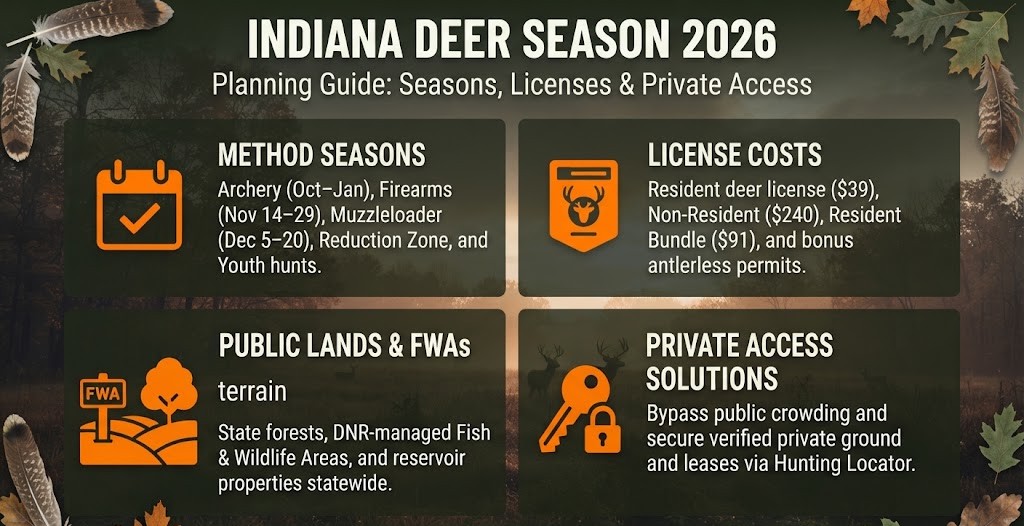
- Exact 2026–2027 season dates for every method — archery, firearms, muzzleloader, youth, and reduction zone
- A license and permit breakdown for both residents and non-residents
- Where to hunt — public ground, private leases, and guided hunts
Here are the dates first.
Quick Overview: Indiana Deer Season 2026 at a Glance
This table covers every method’s season dates, bag limits, and key notes in one place.
| Season Type | Dates | Bag Limit | Notes |
|---|---|---|---|
| Archery | Oct 1, 2026 – Jan 3, 2027 | Statewide max: 1 antlered + 6 antlerless | Longest standard season |
| Firearms | Nov 14 – 29, 2026 | Statewide max: 1 antlered + 6 antlerless | County antlerless limits apply |
| Muzzleloader | Dec 5 – 20, 2026 | Statewide max: 1 antlered + 6 antlerless | Breech-loading muzzleloaders now legal (2026 update) |
| Youth | Check local DNR guidelines (typically late September) | Statewide max: 1 antlered + 6 antlerless | Ages 17 and under |
| Reduction Zone | Sept 15, 2026 – Jan 31, 2027 | Antlerless-focused; see CABL | Longest window overall; urban/overpopulation areas |
Confirm your county’s antlerless quota (CABL) and zone status with the Indiana DNR before you hunt — regulations can change.
For the complete rundown on every rule, exception, and zone designation, see the full Indiana deer regulations breakdown. If crowded public land has you looking at other options, browse Indiana deer leases.
Before heading afield, sort out licensing and education requirements:
- A hunting license is required for both residents and non-residents
- Deer licenses are sold by method (archery, firearm, muzzleloader, reduction zone) or as a discounted bundle
- Hunter education is required for hunters born after a certain date (covered below)
- Harvested deer must be reported within 48 hours
Indiana Deer Hunting Seasons Explained
Indiana’s deer herd is exclusively whitetail — no mule deer, no elk, no separate species regulations to track. Planning comes down to picking the right windows across five season types, several of which overlap and can be combined.

Archery Season
Archery season runs October 1, 2026 through January 3, 2027 — the longest standard window of the year and the earliest legal opportunity outside reduction zones. It’s the most flexible option for hunters who want maximum time afield and a chance to pattern deer before firearms-season pressure sets in.
Firearms Season
Firearms season runs November 14–29, 2026. This is the highest-pressure period on public land statewide, with thousands of hunters in the woods at once. County antlerless limits govern how many does you can legally take, so check your County Antlerless Bag Limit before heading out.
Muzzleloader Season
Muzzleloader season runs December 5–20, 2026. The Indiana DNR made a notable equipment change for 2026: breech-loading muzzleloaders, which allow powder and primer to be loaded from the breech end, are now legal during muzzleloader season. They remain legal during youth and firearms seasons as well.
Reduction Zone & Youth Seasons
Reduction zone season runs September 15, 2026 through January 31, 2027 — the longest window of any Indiana deer season, focused on antlerless harvest in areas dealing with deer overpopulation. Per the Indiana DNR, there is no Porter County reduction zone this year, same as last year.
Youth season is reserved for hunters 17 and under. Confirm the exact youth weekend with local DNR guidelines; it typically falls in late September. Youth hunters can take the full statewide bag limit, same as adults.
Bag limit and regulation basics to keep in mind across all seasons:
- Statewide limit: A maximum of 1 antlered and 6 antlerless deer total
- Antler definition: An antlered deer is one with at least one antler 3 inches or longer
- County Antlerless Bag Limit (CABL): The number of antlerless deer you can take is set at the county level and varies by county — check your specific county before hunting
- Legal hours: From half an hour before sunrise to half an hour after sunset
Confirm your county’s CABL and zone status with the Indiana DNR before you hunt, since regulations can shift.
Indiana Deer Licenses and Permits
Locking in your license is what turns a plan into a hunt. Indiana deer licenses are sold by method — or bundled for savings — and depending on your birth year, hunter education may be required before you can buy one.
Indiana Deer Hunting Licenses
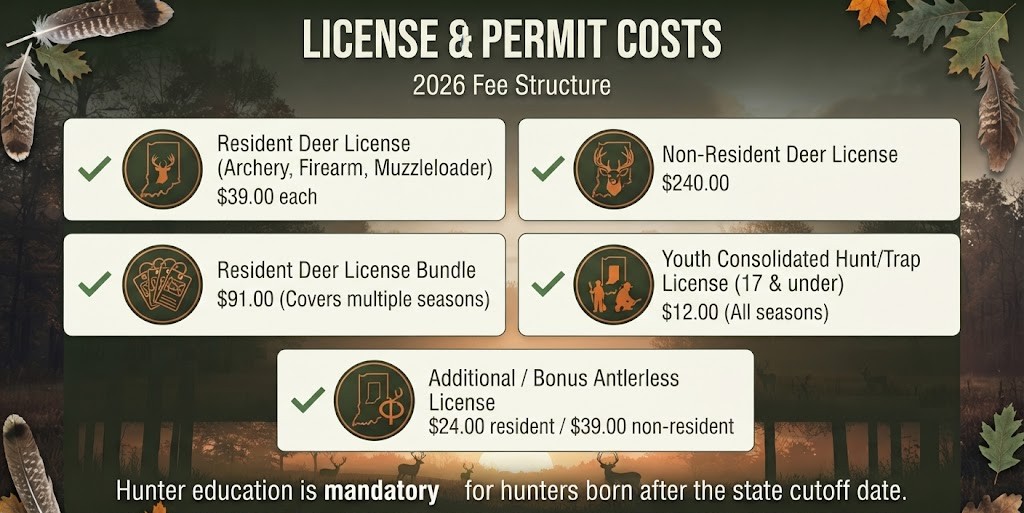
Indiana deer license costs for residents and non-residents:
| License Type | Resident | Non-Resident |
|---|---|---|
| Deer License (Archery, Firearm, Muzzleloader, or Reduction Zone) | $39 each | $240 |
| Deer License Bundle | $91.00 | — |
| Youth Consolidated Hunt/Trap License (17 & under, all seasons) | $12.00 | — |
| Additional / Bonus Antlerless License | $24 | $39 |
If you plan to hunt more than one season, the $91 resident Deer License Bundle beats buying separate $39 licenses once you’re covering two or more seasons. Outside a bundle, you’ll generally need a separate license for each season or method. Hunters 17 and under get the $12 Youth Consolidated Hunt/Trap License, which covers all seasons in one package.
Indiana Deer Hunting Permits & Requirements
Getting legally set up to hunt deer in Indiana comes down to a few steps:
- Complete hunter education if required — mandatory for hunters born after a certain cutoff date. Confirm your eligibility and ask about apprentice-license options with the Indiana DNR if you’re unsure where you stand.
- Purchase the appropriate deer license(s) or the bundle through the official Indiana DNR licensing system.
- Add bonus or additional antlerless licenses if your county’s CABL allows for more antlerless harvest than the base license covers.
- Carry your license while hunting and report every harvest within 48 hours, as required by the Indiana DNR.
Non-residents follow the same season dates and reporting rules as Indiana residents; the difference is cost. Budget for the $240 non-resident deer license, plus the $39 additional antlerless license if you want more than your base tag allows. A few reciprocal exceptions exist for farmland owners from neighboring states like Iowa and Ohio, but otherwise plan on the standard non-resident fees.
Once you’re licensed, it’s worth gearing up before opening day — you can find essential deer hunting gear to round out your kit before the season starts.
Where to Hunt Deer in Indiana
Season dates and a valid license don’t mean much without ground to hunt on. Indiana hunters generally have three tiers of access: free public land, private leases, and guided hunts — each with different tradeoffs in cost, convenience, and hunting pressure.
Best Public Hunting Land
Public land is the free, accessible starting point for most Indiana deer hunters, spread across state forests, fish and wildlife areas (FWAs), and reservoir properties statewide.
- State forests — broad, huntable acreage open to the public across much of Indiana
- DNR-managed Fish & Wildlife Areas (FWAs) — dedicated wildlife management ground with deer-specific rules
- Reservoir and lake properties — including Mississinewa, Salamonie, and Patoka Lake, where only one antlerless deer may be taken per the property’s specific restrictions
Public land works, but it comes with heavy hunting pressure, especially during firearms season, when thousands of hunters converge on the same limited acreage. Anyone who’s pulled into a public access lot on opening morning and found every spot taken knows what that pressure looks like.

Private Land Hunting with Hunting Locator
Leased private ground solves the crowding problem. Less pressure means more consistent deer patterns, ground you can scout and learn over a season, and no opening-morning scramble. Depending on your goals and budget, you can lease hunting access for a season or buy private land outright for long-term control over your hunting ground.
This is where Hunting Locator does its work. We connect hunters directly with landowners who are ready to lease or sell their land for hunting — no middleman, no cold-calling strangers. Browse listings by acreage, location, and game type, and connect directly with landowners who understand what you’re looking for.
If public-land crowding has you rethinking your options this year, browse current Indiana deer leases and see what’s available near you.
Guided Deer Hunts
For hunters who want a turnkey experience, guided deer hunts remain a solid option, particularly for non-residents making their first trip into Indiana. A guided hunt takes the guesswork out of scouting unfamiliar ground, securing access, and learning county-specific rules on the fly. You show up with gear and license, and someone with local knowledge handles the rest.
This route appeals most to out-of-state hunters who lack time to scout Indiana ground themselves or who want the confidence of hunting with someone who already knows the area’s deer patterns and regulations. If a lower-hassle first Indiana hunt sounds appealing, a guided option is worth researching alongside leasing as you plan your trip.
Indiana Deer Hunting Tips
- Scout Before You Sit: Identify food sources, trails, and bedding areas before opening day. Trail cameras let you pattern deer movement without spooking them.
- Get Up High (Safely): A quality tree stand expands your sightline and keeps you off a deer’s radar. Always use a fall-arrest system and double-check that your stand is secure before you climb.
- Stay Legal and Visible: Wear blaze orange during firearms season — it keeps you safe and keeps you compliant with Indiana regulations.
- Master Stillness: New hunters often move too much, and deer detect motion instantly. Patience is often the single biggest factor separating a filled tag from an empty one.
- Don’t Overcall: Overusing calls and scents can make deer wary of their surroundings. Use them sparingly and only when it makes sense for the situation.
- Field-Dress Ready: Keep a field-dressing kit packed and ready so you’re prepared the moment you make a clean harvest.
Once your plan is locked in, check your gear closet. You can shop deer hunting gear for tree stands, trail cameras, blaze orange apparel, and field-dressing kits.
More Resources from Hunting Locator
Deer season is just one part of Indiana’s hunting calendar. For the rest of our Indiana library:
- Indiana Deer Hunting Season deep dive — the full companion breakdown to this guide
- Indiana Hunting Season Guide — the master overview of every Indiana season
- Indiana Turkey Hunting Season — plan your spring and fall turkey hunts
- Indiana Migratory Bird Hunting Season — dove and migratory bird timing
- Indiana Small Game Hunting Season — rabbit, squirrel, and more
- Indiana Waterfowl Hunting Season — duck and goose seasons
- Indiana Furbearer Hunting & Trapping Season — includes the expanded 2026–2027 bobcat season
- Hunting Locator home — the master hub for leases, gear, and resources
Frequently Asked Questions
What are the Indiana deer season dates for 2026?
Archery season runs October 1, 2026 – January 3, 2027, firearms season runs November 14–29, 2026, and muzzleloader season runs December 5–20, 2026. Reduction zone season runs September 15, 2026 – January 31, 2027, and youth season typically falls in late September — confirm exact dates with the Indiana DNR, which sets all official season windows.
How much is a non-resident Indiana deer license in 2026?
A non-resident deer license in Indiana costs $240, with an additional antlerless license available for $39. Non-residents follow the same season dates and reporting rules as residents. If you don’t have local land access, leasing or booking a guided hunt is worth considering ahead of your trip.
What is the Indiana deer bag limit?
The statewide bag limit is a maximum of 1 antlered and 6 antlerless deer. Antlerless totals are further restricted by each county’s antlerless bag limit (CABL), so check your specific county with the Indiana DNR before hunting.
Do I need hunter education to hunt deer in Indiana?
Yes — hunter education is required for hunters born after a certain cutoff date before they can purchase a license, though apprentice license options may apply in some cases. Confirm your eligibility and the current cutoff date directly with the Indiana DNR.
What are legal hunting hours for deer in Indiana?
Legal hunting hours run from half an hour before sunrise to half an hour after sunset, per the Indiana DNR.
Where can I find deer hunting land in Indiana?
Your options range from public land — state forests, fish and wildlife areas, and reservoir properties — to private leases. Hunting Locator connects hunters directly with landowners who are leasing or selling hunting ground. Browse Indiana hunting leases to see what’s currently available.
The Final Shot
You now have the dates, licenses, and bag limits for Indiana’s 2026–2027 deer season, plus a path to the land where you’ll use them. From here it comes down to three moves: confirm your county’s antlerless bag limit with the Indiana DNR, buy the license or bundle that fits your season plans, and lock in your ground before opening day.
Regulations can shift, so double-check current rules with the Indiana DNR before you head afield. When you’re ready to stop hunting for hunting ground and start hunting deer, find your Indiana lease.


