This guide covers the 2026–2027 season dates, bag limits, license requirements, and where to find legal hunting access, drawn directly from the Indiana DNR and official state regulations.
Here’s what’s covered:
- Exact 2026–2027 season dates, bag limits, and the 12-inch carapace rule for turtles
- Resident vs. non-resident license requirements and current fees
- Where to legally hunt — public land options, guided hunts, and private-lease access
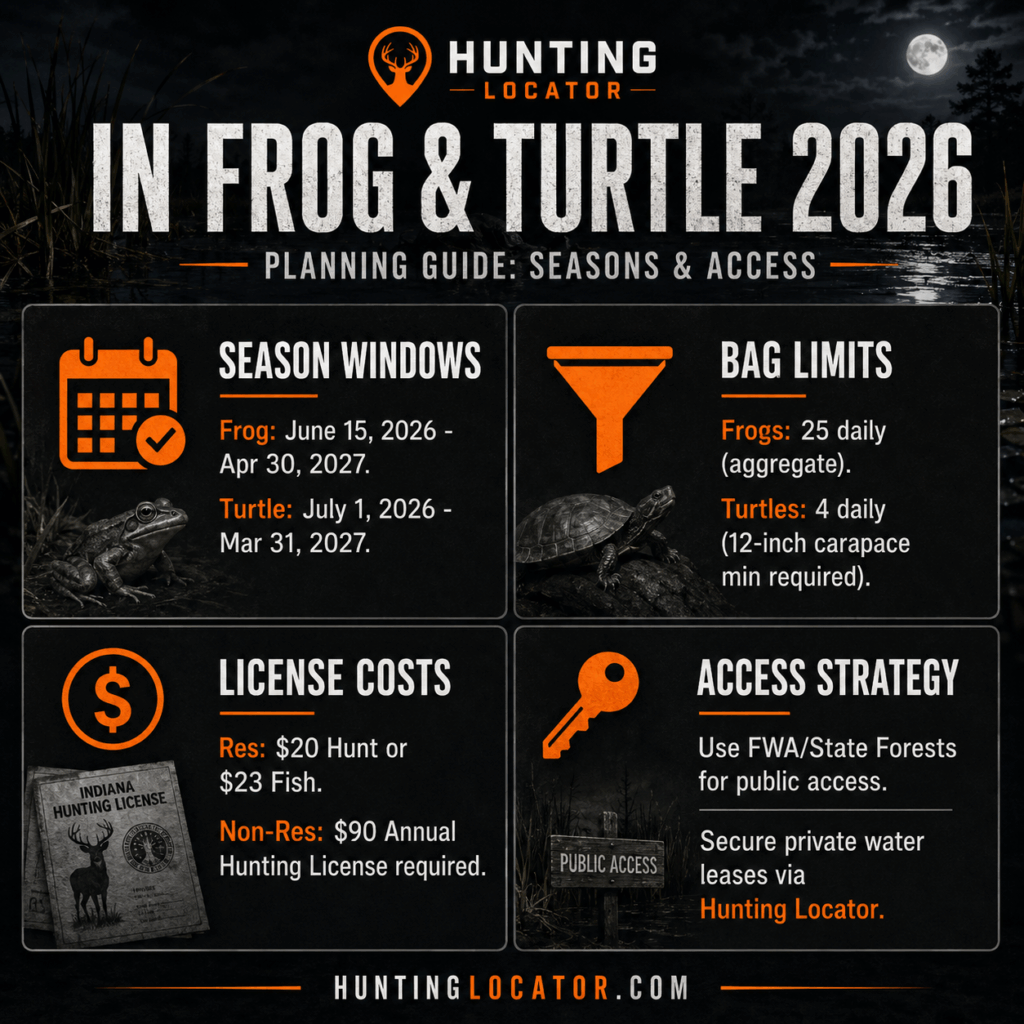
Quick Overview: Indiana Frog & Turtle Season at a Glance
| Species | Season Dates | Daily Bag Limit | Possession Limit | Key Notes |
|---|---|---|---|---|
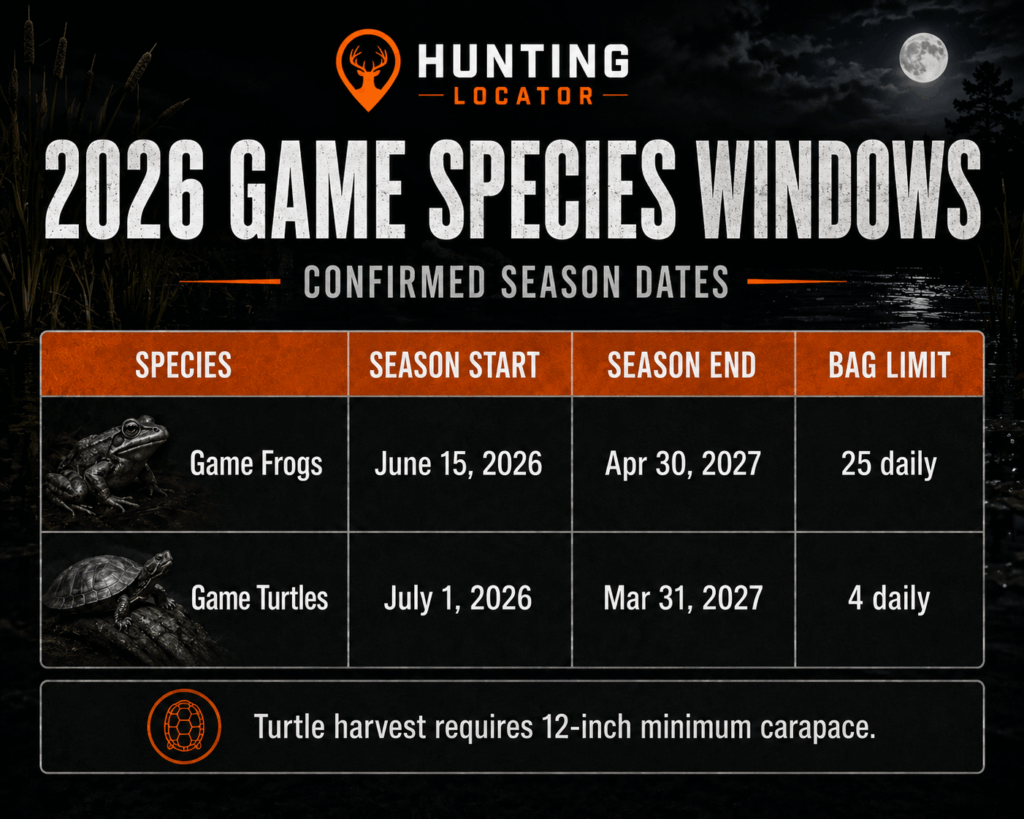
| Game Frogs (bullfrog, green frog) | June 15, 2026 – April 30, 2027 | 25 (in aggregate) | 50 (in aggregate) | Gigs, bow & arrow, or clubs permitted |
| Game Turtles (Eastern snapping, smooth softshell, spiny softshell) | July 1, 2026 – March 31, 2027 | 4 (singly or in aggregate) | 8 (total) | Minimum 12-inch carapace length required |
Beyond dates and limits, a few regulatory requirements apply to everyone hunting frogs or turtles in Indiana:
- License required: Per the Indiana DNR, anyone 18 or older needs a valid hunting or fishing license to take frogs or turtles from the wild.
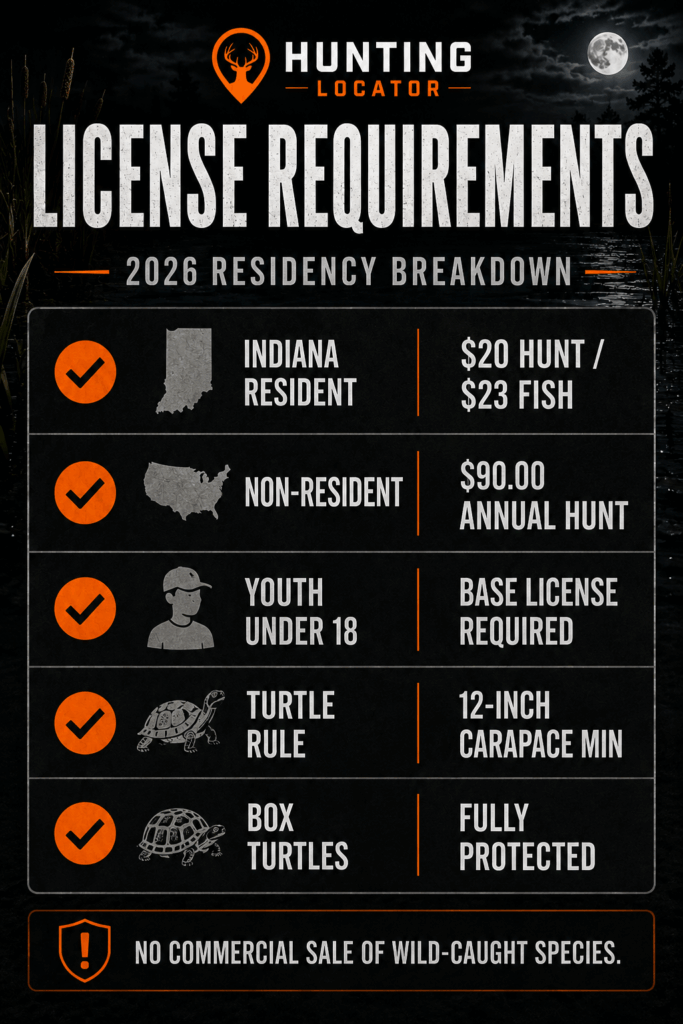
- Non-residents: Per eRegulations, all non-resident adults and youth must hold a non-resident annual hunting license — the resident fishing-license option does not apply.
- Protected species: Eastern box turtles and any state- or federally-listed endangered species may not be taken at any time.
- No commercial sale: Reptiles and amphibians collected from the wild in Indiana may not be sold under any circumstances.
Indiana Frog and Turtle Hunting Seasons Explained
Indiana classifies frogs and turtles as game species, each with its own season window, legal species list, and harvest limits set by the DNR.
Frog Season: Bullfrog & Green Frog
Indiana’s frog season opens June 15, 2026 and runs through April 30, 2027 — a nearly eleven-month window that makes Indiana one of the more accessible frog hunting states in the Midwest.
Only two species are classified as legal game frogs: the bullfrog and the green frog. All others are off-limits. The daily bag limit is 25 frogs in aggregate, with a possession limit of 50 — meaning your combined bullfrog and green frog total counts toward one shared limit, not separate limits per species.
Legal harvest methods include gigs, longbows and arrows, and clubs. Gigging is the most traditional and widely used method in Indiana. Frogs can be taken during the day, but most hunters target them at night, when a flashlight picks up their eyes along vegetated shorelines.
Turtle Season: Snapping & Softshell
Indiana’s turtle season opens July 1, 2026 and runs through March 31, 2027. Three species are classified as legal game turtles:
- Eastern snapping turtle
- Smooth softshell turtle
- Spiny softshell turtle
The daily bag limit is 4 turtles, singly or in aggregate, with a possession limit of 8. Your combined total across all three legal species cannot exceed 4 per day or 8 in possession — not 4 of each species. Both limits apply statewide to residents and non-residents alike.
The 12-Inch Carapace Rule (and How to Measure It)
Every legal turtle must have a carapace length of 12 inches or greater to be legally harvested. Undersized turtles must be released immediately.
Carapace length is the straight-line measurement along the top of the shell — from the central front edge behind the neck to the central back edge above the tail. This is not a curved measurement following the shell’s contour, so a flexible tape measure alone won’t give you an accurate reading. Carry a rigid ruler or calipers, or mark your gig handle at 12 inches as a field reference. If a turtle is borderline, release it.
Protected Species & Ethical Harvest
Eastern box turtles are fully protected and cannot be collected from the wild at any time in Indiana. Any frog, toad, turtle, or other reptile or amphibian on the state or federal endangered species list carries the same year-round protection. Know your target species before you take a shot or make a grab — if identification isn’t certain, let it go.
Indiana Frog & Turtle Licenses and Permits
Indiana Hunting & Fishing Licenses
For Indiana residents, the DNR requires anyone 18 or older to hold either a valid hunting or fishing license to take frogs or turtles. Either satisfies the requirement — no additional species-specific stamp or permit is needed beyond the base license.
For non-residents, the rules are stricter. All non-resident adults and youth must hold a non-resident annual hunting license when collecting reptiles and amphibians. The resident “fishing license is fine” flexibility does not extend to out-of-state hunters. If you’re crossing state lines to frog gig or turtle hunt, the non-resident annual hunting license is your only valid credential.
Current license fees, valid April 1, 2026 through March 31, 2027:
| License Type | Resident Fee | Non-Resident Fee |
|---|---|---|
| Annual Hunting License | $20 | $90 |
| Annual Fishing License | $23 | $60 |
| One-Day Fishing License (includes Trout/Salmon) | $10 | $15 |
A few important notes on this fee schedule:
- Non-residents hunting frogs or turtles must purchase the Annual Hunting License ($90) — annual or one-day fishing licenses do not satisfy the non-resident requirement.
- Indiana residents may use either the $20 hunting license or the $23 fishing license for frog and turtle harvest.
- The one-day fishing license applies only to residents for a single-day outing; it does not satisfy the non-resident requirement for reptile and amphibian harvest.
- Licenses can be purchased online at in.gov.
Indiana Frog & Turtle Permits
Indiana does not require any species-specific permit, stamp, or special authorization beyond the base hunting or fishing license described above. There are no lottery draws, quota permits, or application processes for frogs or turtles. Purchase the appropriate license for your residency status, confirm the season is open, and you’re legal to hunt on any authorized water body. The Indiana DNR maintains a searchable database of public hunting and fishing properties — visit on.IN.gov/dfwproperties for a complete list.
Indiana Frog & Turtle Hunting: Where to Hunt
Best Public Lands for Frog & Turtle Hunting in Indiana
Hunters with a valid fishing or hunting license may take game frogs and turtles from any DNR property where fishing and hunting is authorized — with the exception of state parks. That opens up a substantial inventory of publicly accessible water across the state.
Frogs occupy a wide range of aquatic environments including lakes, ponds, wetlands, and river banks, so productive habitat is broadly distributed across Indiana’s public land network. Strong options for public access include:
- Fish & Wildlife Areas (FWAs) — Managed specifically for hunting and fishing access, FWAs are the most productive public land category for frog and turtle hunters. Prioritize properties with significant wetland or river frontage.
- State Forests — Indiana’s state forests permit hunting where authorized and frequently include river corridors and pond systems with quality frog and turtle habitat.
- Hoosier National Forest — Southern Indiana’s Hoosier National Forest contains quality flatwater habitat. Tucker Lake is noted among local hunters as productive bullfrog water.
- Reservoir margins and river access points — Many of Indiana’s major reservoirs and navigable rivers have public access points managed by state or federal agencies where gigging is permitted.
- Wetland management areas — Indiana’s managed wetland areas, maintained for waterfowl and other wildlife, frequently hold strong frog populations throughout the summer months.
Use the Indiana DNR’s property finder at on.IN.gov/dfwproperties to locate authorized public hunting properties near your target area.
Guided Frog & Turtle Hunts in Indiana
Guided frog and turtle hunts are a niche offering in Indiana, but they do exist — particularly for out-of-state visitors who want a productive first trip without spending time scouting unfamiliar water. A guide provides immediate local knowledge: where the biggest bullfrogs are holding, which boat launch to use, and how to work a shoreline efficiently after dark.
Look for outfitters operating in Indiana’s river bottoms and southern reservoir country, where bullfrog populations are historically strongest. When evaluating any guide service, confirm they operate on legally authorized water, that they’re current on DNR regulations for both frogs and turtles, and that licensing expectations for the trip are clearly defined upfront. Hunting Locator’s outfitter directory is a useful starting point for finding professional Indiana hunting guides.
Private Land Hunting in Indiana
Private land consistently produces better frog and turtle hunting than public land — less pressure, exclusive access, and the ability to work the same water season after season. The two main pathways to private land access in Indiana are leasing and purchasing.
Leasing private land is the most accessible route for most hunters. A hunting lease grants exclusive or shared access rights to a landowner’s property for a defined season or annual period. For frog and turtle hunters, the ideal lease includes ponds, wetlands, river frontage, or oxbow lakes — low-pressure, vegetation-rich water where game frogs and legal turtles concentrate. Lease agreements typically specify access dates, harvest expectations, and property rules, so read carefully and communicate with the landowner before signing.
Buying hunting land is the longer-term option for hunters who want permanent access. Rural Indiana has a range of price points for small tracts with wetland or water features, and ownership means you control the rules year after year.
Finding the right private land doesn’t have to be a seasonal scramble. Hunting Locator connects hunters with landowners ready to lease or sell. Browse Indiana hunting land listings by property type, acreage, and game species — including water-access properties suited to frog and turtle hunting. Search, connect directly with landowners, and get on the water. Find your Indiana hunting lease today.
Frog & Turtle Hunting Tips for Indiana
- Hunt frogs after dark — Bullfrogs are most commonly targeted at night, when their eyes reflect a flashlight beam and they’re far less likely to spook. Start at dusk and work vegetated shorelines systematically.
- Fix the light, move slow — Keep the flashlight beam fixed on the frog as you approach and avoid sudden movements or splashing. Patience closes more frogs than speed.
- Know your target species — Only bullfrogs and green frogs are legal game. Learn to distinguish them from wood frogs, leopard frogs, and other protected species before your first outing. Visual ID guides from the Indiana DNR are freely available online.
- Always measure turtles before you keep them — The 12-inch carapace minimum is non-negotiable. Mark your gig handle or carry a rigid ruler. A borderline turtle gets released.
- Scout habitat strategically — Frogs concentrate in lakes, ponds, wetlands, and along river banks with heavy vegetation. Target the densest cattail and lily pad edges in warm, still water first.
- Use the right gear — A high-powered light, gig, collection basket, and a small boat or canoe are the core tools for Indiana frog gigging. A flat-bottomed johnboat or kayak lets you work shoreline edges quietly and efficiently. Gear up at the Hunting Locator store before the season opens.
- Track your possession limits on multi-day trips — The possession limit of 50 frogs and 8 turtles applies at all times. The possession limit is twice the daily bag limit and applies to what you have on hand — not just what you took that day.
- Know the release rules — Only legally collected amphibians or reptiles held fewer than 30 days may be released at their original capture site, and only if they’ve never been housed with another animal. If you’re not keeping it, release it immediately on-site.
- Secure private water for more consistent results — Public land near popular water bodies can see significant pressure. A private pond or wetland lease gives you undisturbed water and more consistent harvest over the course of a season.
More Resources from Hunting Locator
- Indiana Hunting Season Guide — A full overview of all Indiana hunting seasons in one place.
- Indiana Deer Hunting Season — Archery, firearms, and muzzleloader seasons with dates, zones, and licensing details.
- Indiana Turkey Hunting Season — Spring turkey dates, bag limits, and the best habitat regions.
- Indiana Small Game Hunting Season — Squirrel, rabbit, pheasant, and other non-migratory small game in Indiana.
- Indiana Waterfowl Hunting Season — Duck and goose seasons, zone breakdowns, and public water access options.
- Indiana Migratory Bird Hunting Season — Doves, woodcock, snipe, and other migratory species with federal and state regulation details.
- Indiana Furbearer Hunting and Trapping Season — Coyote, fox, raccoon, beaver, and other furbearers with trapping regulations and season structure.
- Indiana Hunting Land Leases — Browse available private land leases in Indiana, filtered by game type, acreage, and region.
Frequently Asked Questions
Do I need a hunting license or a fishing license to hunt frogs in Indiana?
Indiana residents have flexibility — either a valid hunting or fishing license satisfies the requirement for residents 18 and older. Non-residents must hold a non-resident annual hunting license specifically — the fishing license option does not apply to out-of-state hunters for reptile and amphibian harvest.
When does Indiana frog season open in 2026?
Indiana’s 2026 frog season opens June 15, 2026 and runs through April 30, 2027. Both bullfrog and green frog — the only two legal game species — may be taken anytime within that window. Always confirm current dates at in.gov before your trip.
What is the minimum size for harvesting turtles in Indiana?
All three legal turtle species must have a carapace length of at least 12 inches to be legally harvested. Carapace length is the straight-line measurement along the top of the shell from the front edge behind the neck to the back edge above the tail. Turtles below this minimum must be released immediately.
Can I sell frogs or turtles I harvest in Indiana?
No. Reptiles and amphibians collected from the wild in Indiana may not be sold. This applies to both frogs and turtles harvested under the legal season structure. All harvest is for personal use only.
Are Eastern box turtles legal to harvest in Indiana?
No. Eastern box turtles are fully protected and cannot be collected from the wild at any time in Indiana. They are not included in the game turtle season regardless of size. Learn to identify box turtles before you hunt — their high-domed shell and hinged plastron make them visually distinct from legal softshell and snapping species.
Can I access state parks for frog and turtle hunting in Indiana?
No. While hunters with a valid license may take game frogs and turtles from DNR properties where hunting is authorized, state parks are explicitly excluded. Stick to Fish & Wildlife Areas, state forests, and other DNR properties that specifically permit hunting activity.
Final Notes
Indiana offers one of the longest frog seasons in the Midwest — nearly eleven months — along with a substantial bag limit and three legal turtle species. The regulations are straightforward once you understand the key distinctions: residents have licensing flexibility, non-residents need the annual hunting license, and any turtle under 12 inches goes back in the water.
Access tends to determine how good a season actually is. Public land is a reasonable starting point, but private water — a leased pond, a river-bottom wetland, a farm lake with no pressure — typically produces more consistent results. Hunting Locator lists Indiana private land available for lease or purchase; browse by property type and connect directly with landowners before the June 15 opener.


