With season frameworks submitted to the U.S. Fish and Wildlife Service and dates now official, it’s time to start planning your dove, waterfowl, and upland migratory bird hunts across the Hoosier State.
This guide pulls together everything you need to know about Indiana migratory bird seasons. No hunting through multiple websites or deciphering confusing regulations. We’ve done the legwork to give you official DNR regulations, prime hunting spots, and licensing requirements all in one place. Whether you’re double-checking dates, considering Indiana for your next hunting trip, or just getting started with migratory birds, you’ll find what you need here.
Here’s what we cover:
- Complete 2026-27 season dates and bag limits for all migratory species (dove, waterfowl, woodcock, snipe, sora)
- Step-by-step licensing requirements with resident and non-resident cost breakdowns
- Where to hunt—from premier public FWAs to private land lease options
Let’s jump into the quick overview so you can bookmark the key dates and requirements.
Quick Overview of Indiana’s 2026-27 Migratory Bird Seasons
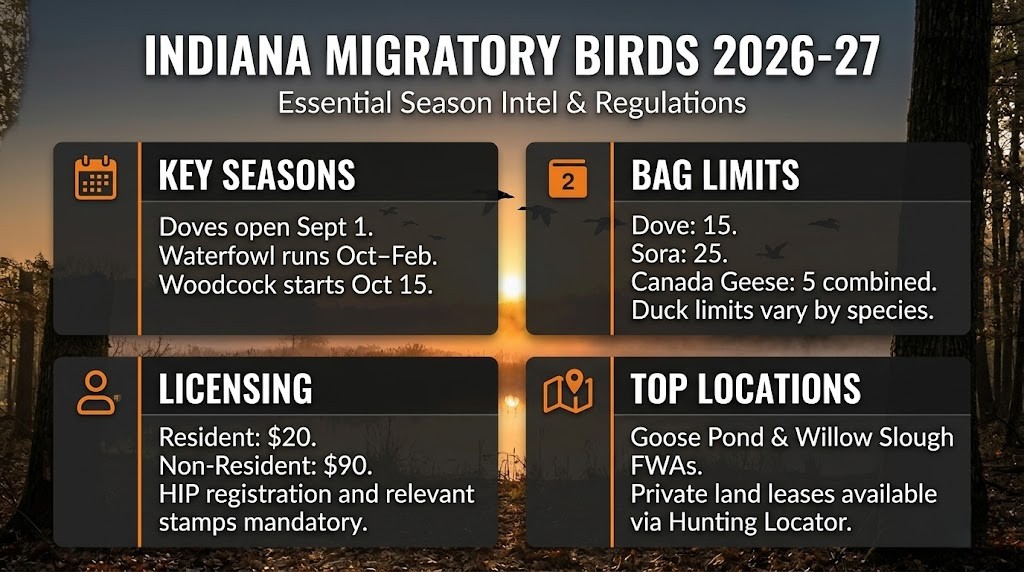
Indiana’s migratory bird seasons run from September 2026 through February 2027, covering mourning dove, waterfowl, woodcock, snipe, and sora rails. The U.S. Fish and Wildlife Service coordinates these dates with Indiana DNR, and Indiana’s spot on the Mississippi Flyway means excellent migratory bird action throughout the seasons.
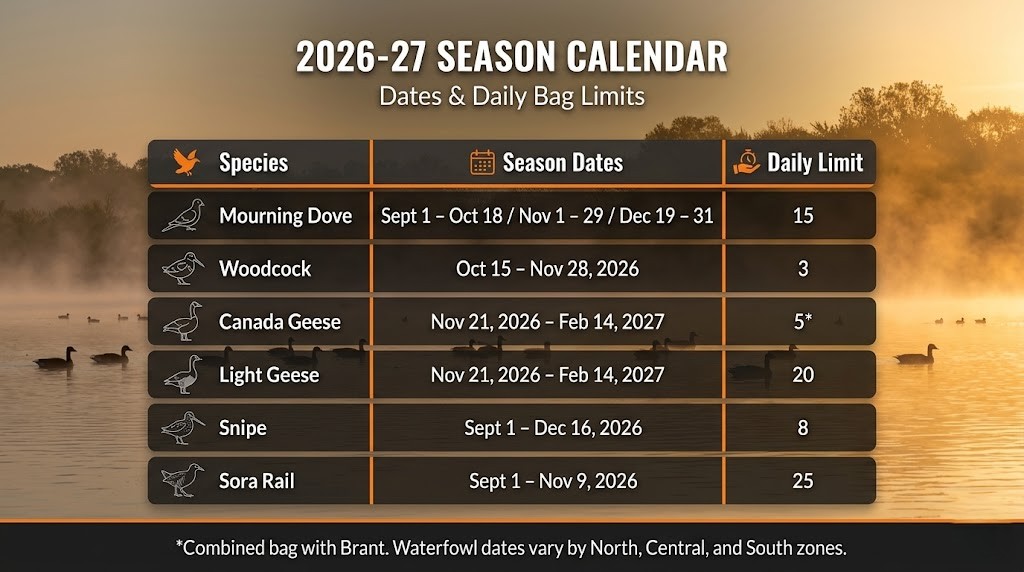
| Species | Season Dates | Daily Bag Limit | Key Notes |
|---|---|---|---|
| Mourning Dove | Sept. 1 – Oct. 18, 2026; Nov. 1 – Nov. 29, 2026; Dec. 19 – Dec. 31, 2026 | $15 | Three split seasons; Game Bird Habitat Stamp required |
| Woodcock | Oct. 15 – Nov. 28, 2026 | $3 | Single continuous season |
| Sora Rail | Sept. 1 – Nov. 9, 2026 | 25 | Highest bag limit of all migratory species |
| Snipe | Sept. 1 – Dec. 16, 2026 | 8 | Extended season through mid-December |
| White-Fronted Geese | Nov. 21, 2026 – Feb. 14, 2027 | 2 | Statewide season |
| Canada Geese & Brant | Nov. 21, 2026 – Feb. 14, 2027 | 5 (combined) | Statewide; combined bag limit |
| Light Geese (Snow/Ross’s) | Nov. 21, 2026 – Feb. 14, 2027 | 20 | No possession limit |
| Ducks/Mergansers/Coots | Varies by zone (Oct–Jan typical) | 3 | Three-zone system; dates vary |
Before you head out, make sure you’ve got these licensing requirements covered:
- Valid Indiana hunting license (resident or non-resident)
- HIP (Harvest Information Program) registration—free and federally required
- Federal Migratory Bird Hunting & Conservation Stamp (Duck Stamp) for waterfowl hunters 16+
- Indiana Waterfowl Stamp Privilege for duck and goose hunting
- Game Bird Habitat Stamp for mourning dove and other migratory game birds
- Nontoxic shot required for all waterfowl hunting
Migratory Bird Hunting Seasons in Indiana
Indiana delivers solid migratory bird hunting from early September through mid-February. Waterfowl seasons work on a three-zone system while other migratory species have statewide seasons. Being positioned right on the Mississippi Flyway means you’ll see consistent waterfowl migration throughout these extended seasons.
Mourning Dove Season
Indiana’s mourning dove season splits into three parts, giving you plenty of chances to get after them:
- First Split: September 1 – October 18, 2026
- Second Split: November 1 – November 29, 2026
- Third Split: December 19 – December 31, 2026
Daily bag limit sits at 15 birds with a possession limit of 45. Every dove hunter needs the Game Bird Habitat Stamp ($11) on top of their base hunting license. That September opener hits right when doves are most active around ag fields, and those later splits catch birds moving through during migration.
Waterfowl Seasons (Ducks, Geese, Coots, Mergansers)
Indiana runs three waterfowl hunting zones: North, Central, and South. These zones got renamed recently and boundaries were adjusted based on geography, climate patterns, and long-term waterfowl migration data.
Goose Seasons (statewide):
- White-Fronted Geese: November 21, 2026 – February 14, 2027 | Daily bag: 2
- Canada Geese & Brant: November 21, 2026 – February 14, 2027 | Combined daily bag: 5
- Light Geese (Snow/Ross’s): November 21, 2026 – February 14, 2027 | Daily bag: 20, no possession limit
Key Regulations:
- Nontoxic shot (steel or approved alternatives) required for all waterfowl and coot hunting
- Federal Duck Stamp required for hunters 16 and older
- Indiana Waterfowl Stamp Privilege ($11) required
- Shotguns must be plugged to three-shell capacity
Those extended goose seasons running through mid-February give non-residents plenty of flexibility when planning trips.
Woodcock, Snipe, and Sora Rail Seasons
These species offer fantastic hunting with way less pressure than waterfowl:
- Woodcock: October 15 – November 28, 2026 | Daily bag: 3
- Snipe: September 1 – December 16, 2026 | Daily bag: 8
- Sora Rail: September 1 – November 9, 2026 | Daily bag: 25
Possession limit for all migratory birds is three times the daily bag limit, except for light geese which have no possession limit.
Indiana Migratory Bird Licenses and Permits
Indiana requires specific licenses, stamps, and registrations depending on what species you’re hunting. Getting properly licensed before the season starts is crucial, and it’s pretty straightforward once you know what you need.
Indiana Hunting Licenses
Everyone needs a base hunting license as the foundation, then you add stamps and privileges based on what species you’re after. You can buy licenses online through Indiana DNR or at more than 500 retail locations throughout the state.
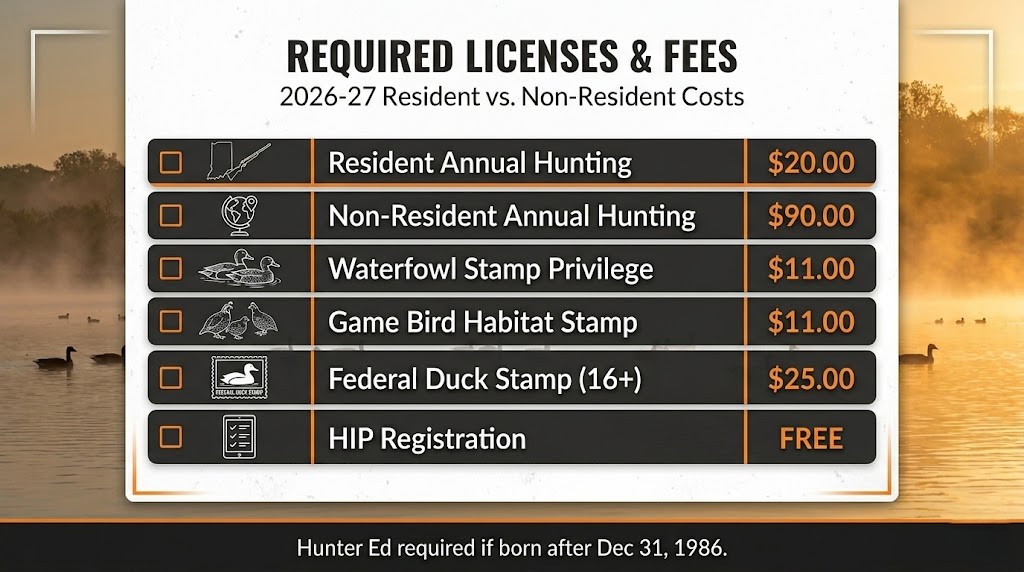
| License Type | Resident Cost | Non-Resident Cost |
|---|---|---|
| Annual Hunting License | $20 | $90 |
| Waterfowl Stamp Privilege | $11 | $11 |
| Game Bird Habitat Stamp | $11 | $11 |
| Federal Duck Stamp | $25 | $25 |
| HIP Registration | Free | Free |
| Durable License Card (optional) | $10 | $10 |
Total Cost Examples:
- Resident waterfowl hunter: $56 minimum ($20 license + $11 waterfowl stamp + $25 federal duck stamp)
- Non-resident waterfowl hunter: $126 minimum ($90 license + $11 waterfowl stamp + $25 federal duck stamp)
- Dove hunter (resident): $31 minimum ($20 license + $11 game bird habitat stamp)
Hunter education certification is required if you were born after December 31, 1986. You can grab the Federal Duck Stamp at post offices, some sporting goods stores, or online.
Indiana Hunting Permits and Registrations
The Harvest Information Program is free and federally required. You just answer some basic questions about your previous year’s migratory bird hunting. HIP validation happens when you buy your hunting license.
Indiana offers reserved (draw) hunts on Fish & Wildlife Areas and Indiana Private Lands Access (IPLA) properties. You can apply through the Indiana DNR Reserved Hunt page online.
Where to Hunt Migratory Birds in Indiana
Finding good hunting access is probably the biggest challenge migratory bird hunters face. Indiana gives you options from public Fish & Wildlife Areas to private land leases.
Best Public Lands for Migratory Bird Hunting
Indiana’s Fish & Wildlife Areas (FWAs) offer excellent migratory bird hunting, though popular spots can get crowded, especially on opening weekends.
Top FWAs for Migratory Birds:
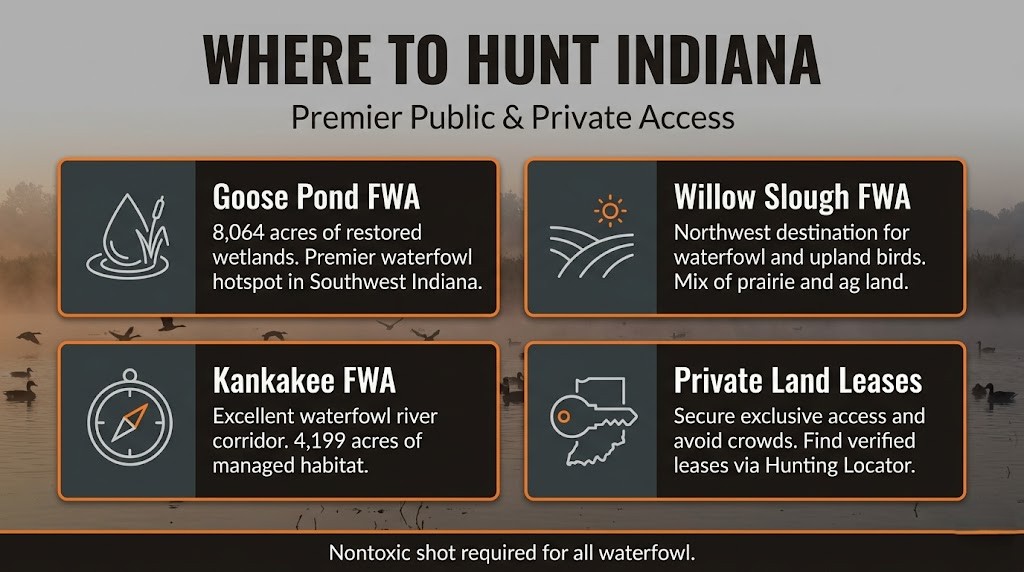
- Goose Pond FWA (Greene/Sullivan Counties) — 8,064 acres of restored wetlands and ag fields; premier waterfowl spot in southwest Indiana; offers reserved hunts for controlled access
- Willow Slough FWA (Newton County) — Northwest Indiana; known for waterfowl and upland birds; mix of wetlands, prairie, and agricultural land
- Kankakee FWA (Starke County) — 4,199 acres in northwest Indiana; excellent waterfowl habitat along the Kankakee River corridor
- Hovey Lake FWA (Posey County) — Southwest Indiana along the Ohio River; 4,400+ acres with solid waterfowl opportunities
- Jasper-Pulaski FWA (Jasper/Pulaski Counties) — 8,000+ acres; famous for sandhill crane migration viewing; offers diverse migratory bird hunting
Guided Hunts
Guided hunts work great for non-residents who don’t know Indiana, beginners wanting to learn, or hunters who want a premium experience without spending time scouting. Guided hunts usually include access to private or leased land, blind setups, decoy spreads, calling expertise, and often bird cleaning services.
Plenty of Indiana outfitters specialize in waterfowl hunting during peak migration, offering both half-day and full-day packages. Do your homework on outfitters and read reviews from previous clients.
Private Land Hunting with Hunting Locator
Private land hunting means less pressure, better success rates, and more flexible scheduling compared to public areas. Indiana hunters have two main options: leasing directly from landowners or buying hunting land.
Private hunting leases in Indiana typically run $5-15 per acre annually, depending on location, game populations, and amenities. For serious hunters, buying hunting property gives you long-term access and control.
Hunting Locator makes finding quality private land simple. Our platform connects you directly with Indiana landowners offering hunting leases and land for sale. Browse verified hunting leases in Indiana with detailed property descriptions, photos, and direct landowner contact. Skip the time-consuming process of cold-calling farmers and find your perfect hunting spot in days, not months.
Migratory Bird Hunting Tips
Success in migratory bird hunting comes down to preparation, proper gear, and understanding how birds behave. Here are the must-know tips for Indiana’s 2026-27 seasons:
- Scout Before Opening Day — Hit potential hunting areas the week before seasons open to figure out flight patterns, roosting areas, and feeding spots
- Master Your Calling — Practice duck and goose calls all summer long; bad calling will send birds packing faster than no calling at all
- Invest in Quality Decoys — Use species-specific decoys in realistic numbers; too many decoys look fake to smart birds
- Understand Weather Patterns — Cold fronts and changing weather push new birds into Indiana; plan your hunts around weather systems
- Perfect Your Concealment — Proper camo and blind construction are everything; migratory birds have incredible eyesight and will flare from poor concealment
- Time Your Hunts — Early morning and late afternoon are prime time; midday hunting can work during overcast conditions
- Use Proper Shot Size — #2 or #3 steel shot for ducks and geese; #6 or #7 for dove and upland migratory birds
- Practice Shooting Moving Targets — Clay pigeon shooting throughout the year will dramatically improve your success on fast-flying birds
More Resources from Hunting Locator
Expand your Indiana hunting knowledge with these guides and tools:
- Indiana Hunting Season Guide — Complete overview of all Indiana hunting seasons, dates, and regulations
- Indiana Turkey Hunting Season — Detailed guide to Indiana’s spring and fall turkey seasons with zone maps
- Indiana Small Game Hunting Season — Complete coverage of rabbit, squirrel, and other small game opportunities
- Indiana Waterfowl Hunting Season — In-depth waterfowl guide with zone maps, species ID, and prime locations
- Indiana Deer Hunting Season — Complete deer hunting resource covering archery, firearm, and muzzleloader seasons
- Hunting Locator Main Platform — Search thousands of hunting leases, outfitters, and guides across all 50 states
FAQ
When do I need to buy my 2026 Indiana hunting license?
You can buy your 2026 Indiana hunting license starting in March 2026. Licenses are good from April 1, 2026, through March 31, 2027. Since migratory bird seasons start September 1, get your license and required stamps by late August so you’re ready for opening day.
Can non-residents hunt all the same migratory bird species as residents?
Absolutely. Non-residents get access to the same migratory bird hunting opportunities as residents. The only difference is license cost—non-residents pay $90 for the annual hunting license compared to $20 for residents. All other stamps, permits, and regulations are identical regardless of where you live.
Do I need different licenses for dove versus waterfowl hunting?
You need the same base hunting license for all migratory birds, but different stamps are required. Dove hunters need the Game Bird Habitat Stamp ($11), while waterfowl hunters need both the Indiana Waterfowl Stamp Privilege ($11) and Federal Duck Stamp ($25). All migratory bird hunters must complete free HIP registration.
What happens if I’m caught hunting migratory birds without proper licenses?
Hunting migratory birds without proper federal and state licenses is serious business. You’re looking at substantial fines, license revocation, and potential criminal charges. Federal violations can mean fines up to $15,000 and six months in jail. Always make sure you have all required licenses, stamps, and registrations before hunting.
Are there special seasons or bag limits for youth hunters?
Indiana offers special youth waterfowl hunting days with extended bag limits for hunters 17 and younger. These usually happen before the regular season opens and provide mentored hunting opportunities. Youth hunters still need proper licenses and must be accompanied by a licensed adult hunter.
Can I hunt migratory birds on private land without permission?
No way. You must have explicit written permission from the landowner to hunt on private property in Indiana. Trespassing to hunt is illegal and can result in criminal charges. Always get proper permission and understand property boundaries before hunting private land.
The Final Shot
Indiana’s 2026-27 migratory bird seasons offer incredible opportunities across multiple species and extended timeframes. From the September 1 dove opener through the February 14 goose season closure, Hoosier hunters have nearly six months of quality migratory bird hunting ahead.
Success starts with proper preparation. Get the right licenses and stamps, understand season dates and bag limits, and most importantly, find quality places to hunt. Whether you go with public FWAs, guided hunts, or private land access, the key is getting started early and being ready when seasons open.
Ready to lock down your hunting access for 2026? Browse available hunting leases and connect directly with landowners offering prime migratory bird hunting opportunities. Your best season yet is just a click away.


