Production was above average in 2025, so we expect another good spring season in 2026. Whether you’ve been chasing gobblers for decades or you’re planning your first Indiana hunt, this guide has what you need for 2026-2027.
We’ve pulled together current regulations, season dates, and hunting opportunities straight from official sources. As hunters ourselves, we know you don’t just want the basic dates—you want the practical stuff that actually helps you fill your tag.
Here’s what we’re covering to help you plan your Indiana turkey hunting:
- Season dates and bag limits for spring and fall 2026-2027
- License requirements and costs for residents, non-residents, and youth hunters
- Where to hunt, from public lands to private lease opportunities
Let’s jump into the dates and details you need to start planning.
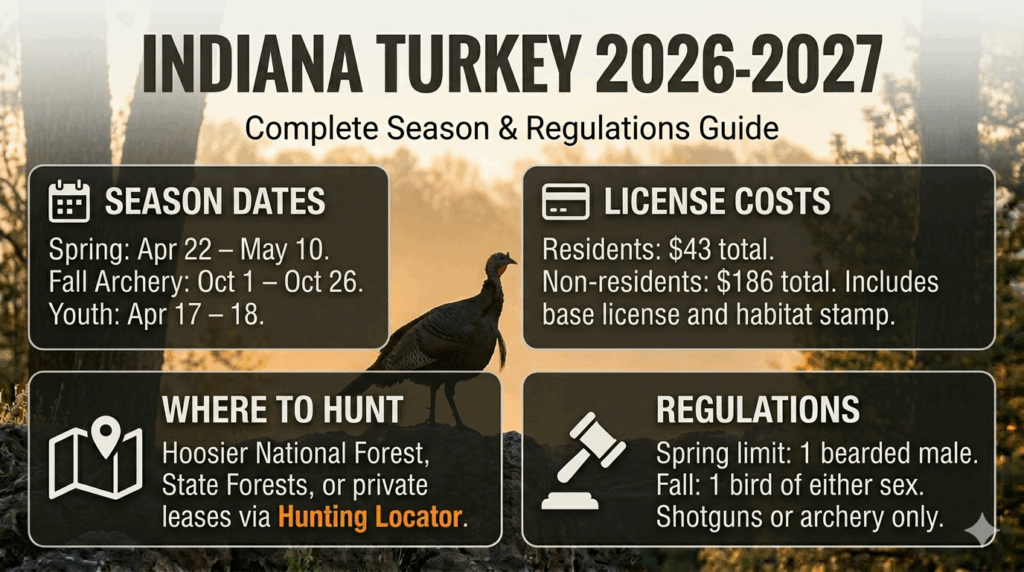
Quick Overview of Indiana Turkey Season 2026
When you’re mapping out your turkey season, you need the key info fast. Here’s your complete reference for Indiana’s 2026-2027 turkey seasons that you can save or screenshot.
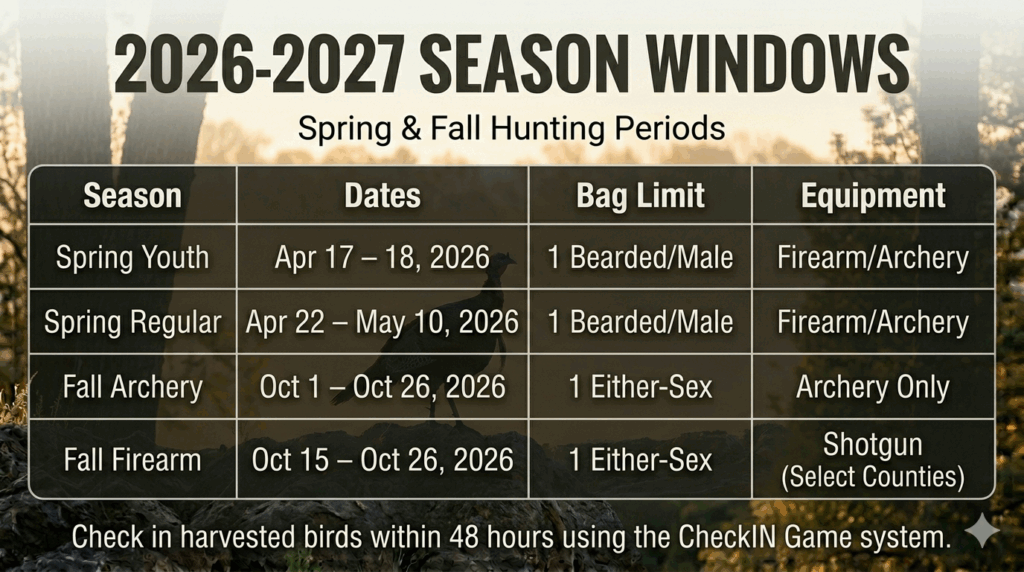
| Season | Dates | Bag Limit | Key Regulations |
|---|---|---|---|
| Spring Youth | Apr 17 – Apr 18, 2026 | 1 Bearded/Male | Hunters 17 and under with adult supervisor |
| Spring Regular | Apr 22 – May 10, 2026 | 1 Bearded/Male | 18 consecutive days |
| Fall Archery | Oct 1 – Oct 26, 2026 | 1 bird (Either-sex) | Statewide; archery equipment only |
| Fall Firearm | Oct 15 – Oct 26, 2026 | 1 bird (Either-sex) | Select counties only |
Before you hit the woods, double-check your credentials. All turkey hunters need proper licensing, and what you need depends on where you live and how old you are.
You’ll need these licenses:
- Valid Indiana hunting license (resident or non-resident)
- Spring or Fall Turkey License ($32 resident / $175 non-resident)
- Game Bird Habitat Stamp ($11 for most hunters)
- Hunter education certification if born after December 31, 1986
Indiana Turkey Hunting Seasons
Indiana gives you multiple shots at turkeys across fall and spring seasons. Each has specific rules designed to manage the state’s solid Eastern wild turkey population. Know the rules for each season so you hunt legally and boost your odds.
Spring Youth Season
Indiana’s youth turkey season is April 17-18, always the weekend before regular spring season opens. This gives young hunters a chance to learn turkey hunting without competing with everyone else.
Youth hunters must be 17 or younger on the hunt date. Supervision rules are clear: “Youth hunters must be accompanied by an adult who is at least 18 years of age and licensed to hunt wild turkey.” The adult can’t carry a firearm, bow, crossbow, or harvest a turkey during youth season—they can only carry a legally possessed handgun.
Bag limit is one bearded or male turkey, and youth hunters get one turkey total for the entire spring season (youth and regular combined).
Spring Regular Season
Indiana’s spring regular season runs April 22 through May 10, following the traditional setup where seasons “open the first Wednesday after April 20 and run for 18 days.” This is prime time turkey hunting when toms are actively looking for hens and responding hard to calls.
Bag limit is one bearded or male turkey. Hunting hours are different between general properties and DNR-managed lands. On DNR Fish & Wildlife properties, “spring turkey season hunting hours [are] one-half hour before sunrise until noon for properties on Central Time and until 1 p.m. for properties on Eastern Time.”
Early season usually gives you the most active gobbling as toms establish territories and look for mates. That’s why this is the most popular and productive hunting period.
Fall Archery Season
Fall archery runs October 1 through October 26, 2026—your longest turkey hunting window of the year. This statewide season is open to all properly licensed hunters and gives bowhunters some real advantages.
You can take one bird of either sex. That means tom, jake, or hen. This is way different from spring season rules and reflects how they manage fall populations. Indiana DNR regulations state that “wild turkeys may be hunted only from one-half hour before sunrise to sunset.”
Any bow that meets Indiana’s archery requirements works, and crossbows are good to go. This season is perfect for bowhunters who want to combine turkey hunting with early deer season scouting.
Fall Firearm Season
Fall firearm season runs October 15 through October 26, 2026, overlapping with the tail end of fall archery. But here’s the catch you absolutely need to know before you plan anything.
This season only runs in select counties. You must verify your hunting spot is in an approved county before you hunt with firearms. The approved county list changes every year based on forest cover, harvest data, and population numbers.
Same bag limit—one bird of either sex. Legal firearms have restrictions: “A .410 caliber and 10-, 12-, 16-, 20-, or 28-gauge shotgun loaded with pellets of size No. 4, 5, 6, 7, or 7½, or with Tungsten Super Shot 8, 9 and 10.”
Indiana Turkey Licenses and Permits
Getting Indiana’s licensing right prevents expensive mistakes and keeps you legal. The system has multiple parts with different costs for residents, non-residents, and youth hunters.
Indiana Hunting Licenses
All turkey hunters need a base hunting license plus turkey-specific stuff. What you need and what it costs varies a lot between residents, non-residents, and youth, so figure out your category first.
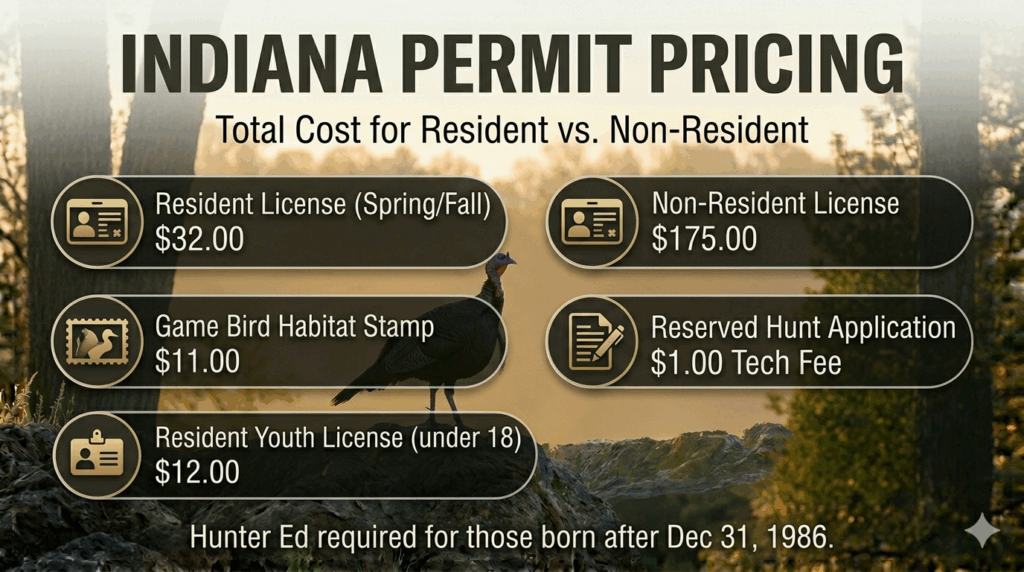
| License/Permit | Resident Cost | Non-Resident Cost | Notes |
|---|---|---|---|
| Spring/Fall Turkey License | $32 | $175 | Required for all adult turkey hunters |
| Game Bird Habitat Stamp | $11 | $11 | Required for most hunters |
| Youth Hunt/Trap License (under 18) | $12 | Varies | Includes turkey privileges; no stamp required |
| Total (Adult) | $43 | $186 | Plus base hunting license if needed |
Hunter education applies to most hunters: “Anyone born after Dec. 31, 1986, must successfully complete a DNR-offered hunter education class to purchase a hunting license.” Out-of-state hunter education certifications usually work.
The resident youth hunt/trap license is a steal at $12 for “any Indiana resident age 17 or younger and includes all hunting and trapping licenses and stamp privileges, including small game, deer, wild turkey, and waterfowl.”
Indiana Turkey Permits
Most turkey hunting in Indiana just needs standard licensing, but some premium spots run reserved hunts that require special permits through drawings.
Reserved hunts work through a specific system: “Applications and draws are managed through the DNR reserved hunt system” with “a $1 tech fee charged for each hunt application.” These hunts typically happen on national wildlife refuges and select DNR properties.
Big Oaks National Wildlife Refuge and Muscatatuck National Wildlife Refuge offer reserved turkey hunts, including youth-specific opportunities. These spots provide managed hunting pressure and often include educational stuff like safety briefings and hunting workshops.
Applications open during set periods, and you can apply through the Indiana DNR Reserved Hunt page. Regular turkey hunting on most public lands and all private property doesn’t need special permits beyond proper licensing.
Where to Hunt Turkey in Indiana
Finding good hunting land is usually the biggest challenge for turkey hunters. Indiana has everything from huge public forests to exclusive private land opportunities, so there’s something for every hunter’s needs and budget.
Best Public Lands for Turkey Hunting
Public land gives most hunters an accessible starting point, and Indiana’s public properties hold solid turkey populations. But popular areas get hunting pressure, especially opening week of spring season.
Top public hunting spots:
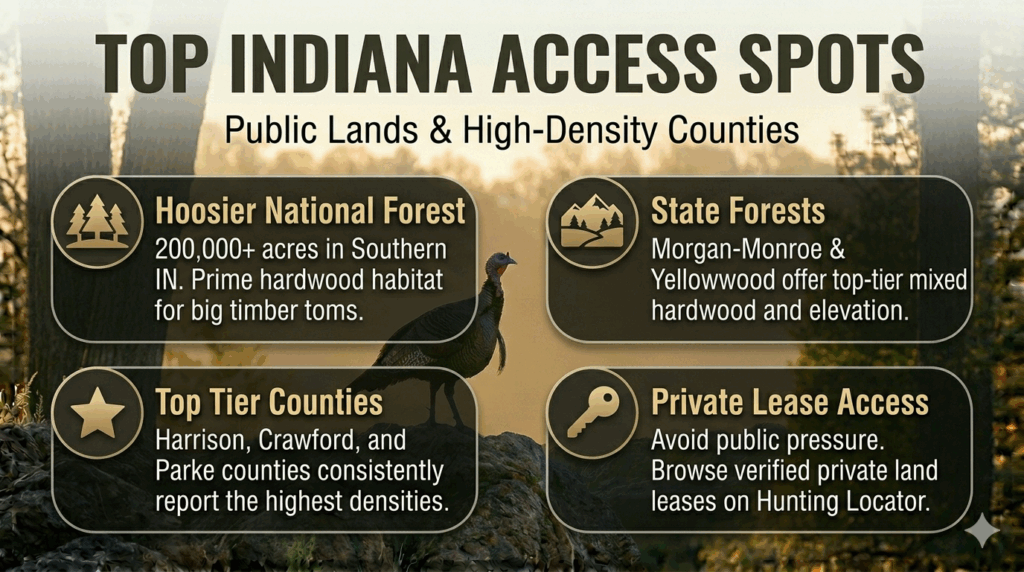
- Hoosier National Forest – Over 200,000 acres across southern Indiana, this is the state’s biggest public hunting opportunity with diverse hardwood habitat that’s perfect for turkey roosting and feeding.
- Morgan-Monroe State Forest – Popular spot in south-central Indiana with mixed hardwood forests ideal for turkey habitat. Expect moderate to heavy pressure during peak season.
- Yellowwood State Forest – Right next to Morgan-Monroe, giving you more acreage and similar habitat quality. Good choice if you’re willing to hike deeper into the property.
- Big Oaks National Wildlife Refuge – Has reserved turkey hunts including youth-specific opportunities. You need to apply through the draw system in advance, but you get managed hunting pressure.
- Muscatatuck National Wildlife Refuge – Another reserved hunt option with controlled access and educational components.
Certain counties offer exceptional opportunities: “Harrison County is known for its robust turkey population. Crawford County offers excellent turkey hunting prospects. Parke County is another top choice among hunters due to its lush landscapes and high turkey density.”
Guided Turkey Hunts
Guided hunts give you a middle ground between public land challenges and getting your own private lease. They’re especially valuable for non-resident hunters who don’t know Indiana terrain and local turkey patterns.
Professional guides typically offer access to private land with established turkey populations, local knowledge of bird patterns and productive setup spots, equipment and calling expertise for newer hunters, and simplified logistics for out-of-state hunters.
Indiana law requires proper licensing for guides offering services for money. When you’re researching outfitters, make sure they have valid annual Hunting Guide Licenses, check references from previous clients, and confirm they have legitimate land access agreements.
Private Land Hunting
Lots of experienced hunters know that private land often holds less-pressured birds and gives you better hunting opportunities. Private land offers less hunting pressure, ability to scout and pattern specific birds before season opens, exclusive access with no competition, and often better habitat management.
Traditional access methods—knowing landowners, asking permission, family connections—still work but get harder as land changes hands and hunting pressure increases. Hunting leases give you formal arrangements for accessing private property, from day-use to seasonal to annual agreements.
Hunting Locator completely changes the traditional game. Our platform connects hunters directly with Indiana landowners who are ready to lease their property for hunting access. Instead of spending your off-season searching for opportunities, you can browse verified listings, compare properties, and lock in your hunting spot—all from one place.
Browse Indiana hunting leases to explore private land opportunities that match your specific needs and budget.
Turkey Hunting Tips for Indiana Success
Success in Indiana’s diverse turkey habitat means understanding both the birds and the terrain. These proven strategies work whether you’re hunting pressured public land or exclusive private property.
Scout During the Off-Season – Indiana’s landscapes offer diverse turkey habitat “from dense hardwood forests in the south to agricultural fields and pastures in the north.” Use this diversity by identifying roosting areas, feeding patterns, and travel corridors before season opens.
Focus on Edge Habitat – Target transition zones: “Blended locations are turkey hotspots, meaning a mixture of mast-producing hardwood trees, open fields, green pastures, and access to waterways, as these environments provide necessary roosting, feeding, and water access.”
Master Your Calling – Don’t overcall, which can tip off birds to your presence. Research shows to “avoid overusing turkey calls, as this can alert birds to your presence and impact movement patterns.” Start conservative and only increase calling intensity if birds respond positively.
Invest in Quality Camouflage – Proper concealment is critical because “camouflage clothing is essential as turkeys have exceptional vision.” Complete camouflage including face masks and gloves makes a real difference.
Use Proper Equipment – Choose appropriate gear for Indiana conditions: “Turkey-specific broadheads are recommended” for bowhunters, while “a comfortable and portable hunting chair or seat cushion is crucial” for long sits during spring season.
Bring Quality Optics – Binoculars are invaluable “in spotting distant turkeys” across Indiana’s varied terrain. Quality optics help you identify birds, determine sex, and plan your approach before birds spot you.
More Resources from Hunting Locator
Expand your Indiana hunting knowledge and opportunities with these additional resources designed to help you succeed throughout the season:
- Indiana Hunting Season Guide – Complete overview of all Indiana hunting seasons and regulations
- Indiana Deer Hunting Season – Detailed guide to Indiana’s deer seasons and prime hunting locations
- Indiana Waterfowl Hunting Season – Everything you need for duck and goose hunting in Indiana
- Indiana Small Game Hunting Season – Squirrel, rabbit, and other small game opportunities
- Indiana Migratory Bird Hunting Season – Dove, woodcock, and other migratory species information
- Indiana Furbearer Hunting and Trapping Season – Coyote, fox, and trapping opportunities
FAQ
When does Indiana spring turkey season start in 2026?
Indiana spring turkey season runs April 22 through May 10, 2027. The season follows Indiana’s traditional rule of opening “the first Wednesday after April 20 and run[ning] for 18 days.” Youth season happens earlier on April 17-18, 2027.
How much does a non-resident turkey license cost in Indiana?
Non-resident turkey hunters pay $186 total for required licenses: a spring turkey license costing $175 and the $11 Game Bird Habitat stamp. This compares to $43 total for resident hunters.
Can you hunt turkeys with a rifle in Indiana?
No, rifles aren’t legal for turkey hunting in Indiana. Legal firearms are limited to specific shotguns: “A .410 caliber and 10-, 12-, 16-, 20-, or 28-gauge shotgun loaded with pellets of size No. 4, 5, 6, 7, or 7½, or with Tungsten Super Shot 8, 9 and 10.” Archery equipment is also legal.
Do you need hunter education to hunt turkeys in Indiana?
Hunter education is required for most hunters: “Anyone born after Dec. 31, 1986, must successfully complete a DNR-offered hunter education class to purchase a hunting license.” Out-of-state certifications are typically accepted.
How do you check in a turkey in Indiana?
Turkey harvest reporting is mandatory: “Hunters are required to check in their harvested turkey within 48 hours of the kill” using the CheckIN Game system. You must also complete temporary transportation tags immediately upon harvest.
What counties have the best turkey hunting in Indiana?
Research identifies several top counties: “Harrison County is known for its robust turkey population. Crawford County offers excellent turkey hunting prospects. Parke County is another top choice among hunters due to its lush landscapes and high turkey density.”
The Final Shot
Indiana’s 2026-2027 turkey seasons offer exceptional opportunities for hunters willing to plan ahead and understand the regulations. With three years of record spring harvests behind us and above-average production in 2025, the upcoming season looks excellent for both residents and visitors.
Success starts with proper preparation—knowing the exact season dates, getting the right licenses, and most importantly, finding quality hunting locations. While public land gives you accessible opportunities, hunting pressure drives many successful hunters toward private land alternatives. Ready to lock in your hunting access for the upcoming season? Explore verified private land opportunities on Hunting Locator and connect directly with Indiana landowners ready to lease their property.


