This Iowa migratory bird guide covers the confirmed 2026 season dates, exact license and fee amounts, and legal access options — public and private — that you’ll need sorted before opening day.
It’s part of a broader hunting planning resource covering season dates, licensing, and access across states, so you’re not piecing information together from a dozen different sites.
Here’s what’s covered below:
- Confirmed 2026 season dates for doves, ducks, geese, snipe, rail, and woodcock, plus bag and possession limits for each
- Licenses, fees, and stamps — what you owe, what you need, and how to get it done before the opener
- Where to hunt — public land, private leases, and guided hunts
The quick-reference table below covers the essentials. Details follow in the sections after it.
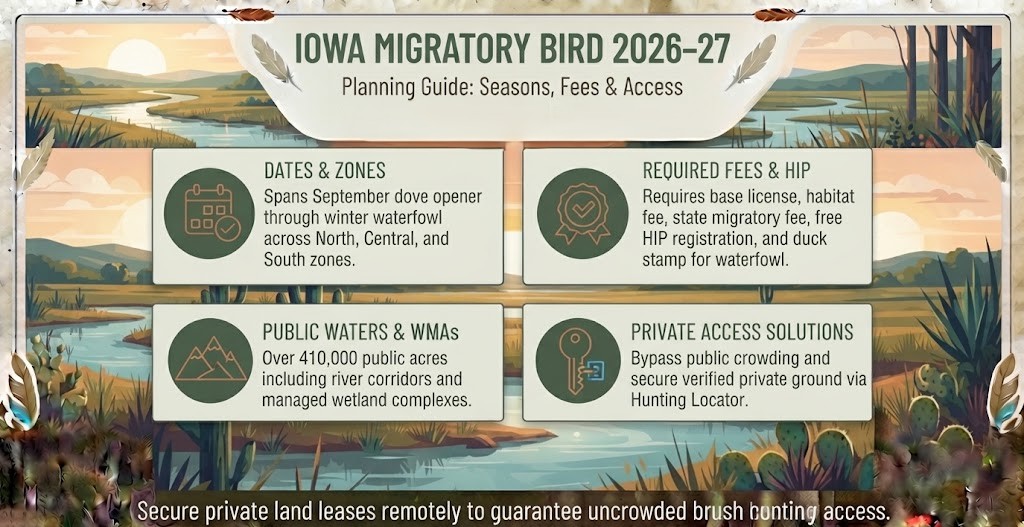
Quick Overview: Iowa Migratory Bird Seasons at a Glance
| Species | Season Dates (2026/2027) | Daily Bag Limit | Possession Limit | Notes |
|---|---|---|---|---|
| Doves | Sep. 1 – Nov. 29 | $15 | 45 | Season opener; no duck stamp needed |
| Snipe | Sep. 5 – Nov. 30 | 8 | 24 | |
| Rail | Sep. 5 – Nov. 13 | $12 | 36 | |
| Woodcock | Oct. 3 – Nov. 16 | 3 | 9 | Migratory bird fee required |
| Ducks | Varies by zone (North/Central/South), early Oct. – early Jan. | 6 | 18 | Species restrictions apply (max 4 mallards, 3 wood ducks); duck stamp required |
| Dark Geese (Canada, White-fronted, Brant) | Varies by zone | 5 | 15 | |
| Light Geese (Snow, Blue-phase, Ross’) | Varies by zone | 20 | 60 | |
| Coots | Aligns with duck zones | 15 | 45 |
Possession limits generally run three times the daily bag limit for migratory birds statewide.
Before heading out, make sure the following is in order:
- A valid Iowa hunting license (resident or nonresident)
- The state migratory bird fee
- The Wildlife Habitat Fee, unless exempt by age
- A Federal Duck Stamp if hunting waterfowl and 16 or older
- Free annual HIP registration
This article focuses specifically on migratory birds. For deer, turkey, and the full statewide calendar, see the Iowa hunting season guide. Each item in the checklist above is covered in detail in the licensing section below.
Iowa Migratory Bird Hunting Seasons by Species
Iowa’s migratory bird calendar covers more ground than most hunters expect — upland species like doves, snipe, rail, and woodcock, plus the full range of waterfowl. Each runs on its own schedule with its own limits. For a more detailed species breakdown, see the migratory bird season guide. Below, they’re covered in order of complexity, starting with the simplest.
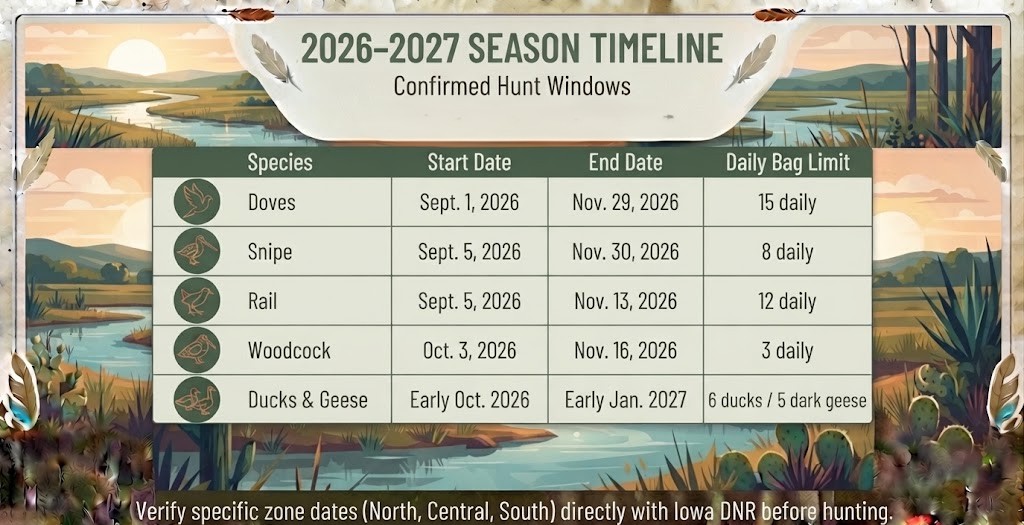
Dove Season
Iowa’s dove season runs September 1 through November 29, with a daily limit of 15 and a possession limit of 45. It’s Iowa’s official season opener: doves are abundant, gear requirements are minimal, and the weather is usually still mild. Dove hunters don’t need a Federal Duck Stamp — that’s a waterfowl-only requirement — but HIP registration is still required before hunting.
Snipe, Rail & Woodcock Seasons
These three round out Iowa’s upland migratory bird lineup. They don’t draw the numbers doves and ducks do, but they’re worth knowing if you’re after a complete season.
| Species | Season Dates | Daily Bag Limit |
|---|---|---|
| Snipe | Sep. 5 – Nov. 30 | $8 |
| Rail | Sep. 5 – Nov. 13 | 12 |
| Woodcock | Oct. 3 – Nov. 16 | $3 |
Woodcock hunters need the Iowa migratory bird fee and HIP registration in place before hunting, same as any other migratory species. These three don’t get much attention, but they’re a solid way to extend your day if you’re already out for doves or early-season ducks.
Ducks, Geese & Coots: The Zone System
This is the part that trips up more hunters than anything else. Iowa splits its duck and goose seasons across three geographic zones — North, Central, and South — to match how migration timing differs across the state. Knowing your zone matters as much as knowing the calendar.
Regular duck and goose segments generally run from early October through early January, with exact dates shifting by zone. The daily bag limit for ducks is 6, with species-specific restrictions: no more than 4 mallards (only 2 of which can be hens) and no more than 3 wood ducks. Dark geese — Canada geese, white-fronted geese, and brant — carry a daily limit of 5. Light geese (snow, blue-phase, and Ross’) carry a daily limit of 20. Coots run a daily limit of 15.
One caveat worth flagging: Iowa DNR is actively developing new zone boundaries and season structures for 2026–2030, based on updated migration and harvest data. That means exact zone dates for 2026/2027 aren’t locked into a simple published table the way dove or woodcock dates are. Check the current zone dates directly with Iowa DNR before planning your trip.
For the full breakdown on zone structure, segments, and waterfowl-specific detail, see the Iowa waterfowl season page.
Iowa Migratory Bird Licenses and Permits
Getting legal to hunt migratory birds in Iowa is straightforward — there’s no draw, no lottery, and no complicated application process for general waterfowl hunting. Everything can be completed online or at an authorized retailer. Iowa DNR coordinates its season-setting through Mississippi Flyway Council management, which is why some rules and dates are tied to broader federal flyway decisions rather than set by Iowa alone.
Iowa Hunting Licenses & Fees
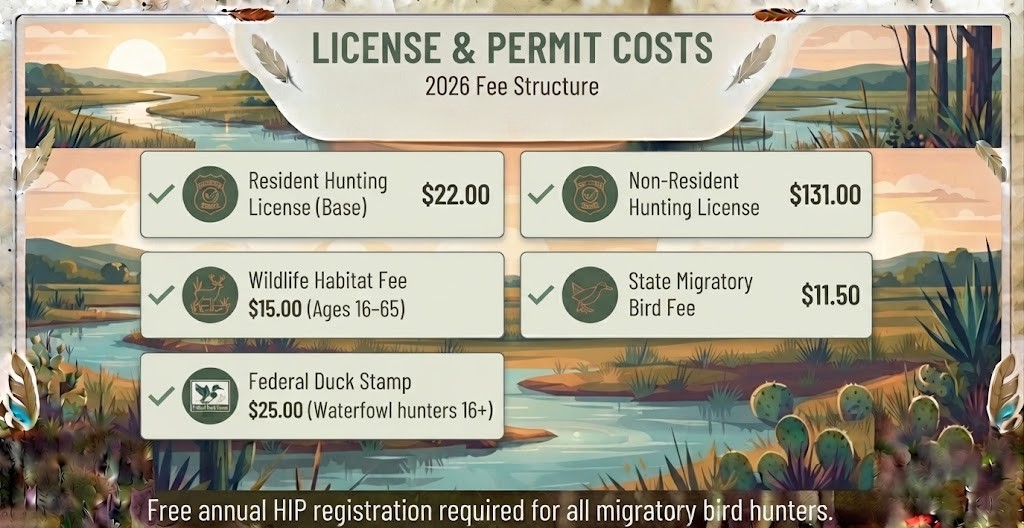
Here’s what residents and nonresidents can expect to pay for the 2026 season:
| Fee | Resident | Nonresident |
|---|---|---|
| Hunting License (base) | $22.00 | $131.00 |
| Wildlife Habitat Fee | $15.00 (unless exempt by age) | $15.00 |
| State Migratory Bird Fee | $11.50 | $11.50 |
| Federal Duck Stamp | $25.00 (waterfowl hunters 16+) | $25.00 (waterfowl hunters 16+) |
The Wildlife Habitat Fee applies to hunters aged 16 to 65 unless exempt. If you’re hunting only doves, snipe, rail, or woodcock, you need the base license, the migratory bird fee, and HIP registration — no duck stamp required. Waterfowl hunters need all of that plus the Federal Duck Stamp. Iowa also requires hunter education certification as a prerequisite for license eligibility for hunters in the applicable age bracket, so confirm that’s on file before buying anything else.
Permits, Stamps & HIP Registration: Step by Step
- Buy your Iowa hunting license — resident or nonresident, online or through an authorized vendor.
- Add the Wildlife Habitat Fee, if you’re between 16 and 65 and not otherwise exempt.
- Pay the $11.50 state migratory bird fee, required for all migratory bird hunters regardless of species.
- Purchase your Federal Duck Stamp if hunting waterfowl and 16 or older. Iowa now offers this as a digital E-Stamp, available through all Iowa license vendors and the Go Outdoors Iowa portal, valid for the entire season with no wait for a physical stamp.
- Complete your free annual HIP registration through Iowa DNR or the Go Outdoors Iowa app. It’s mandatory, free, takes a few minutes, and has to be renewed every year.
Double-check everything with Iowa DNR before opening day. Regulations and season dates can shift, and given the zone restructuring underway for 2026–2030, that verification step matters more this year than most.
Where to Hunt Migratory Birds in Iowa
Iowa offers two main paths into the field — public access or private ground — each with tradeoffs worth understanding before committing your season to one.
Best Public Lands
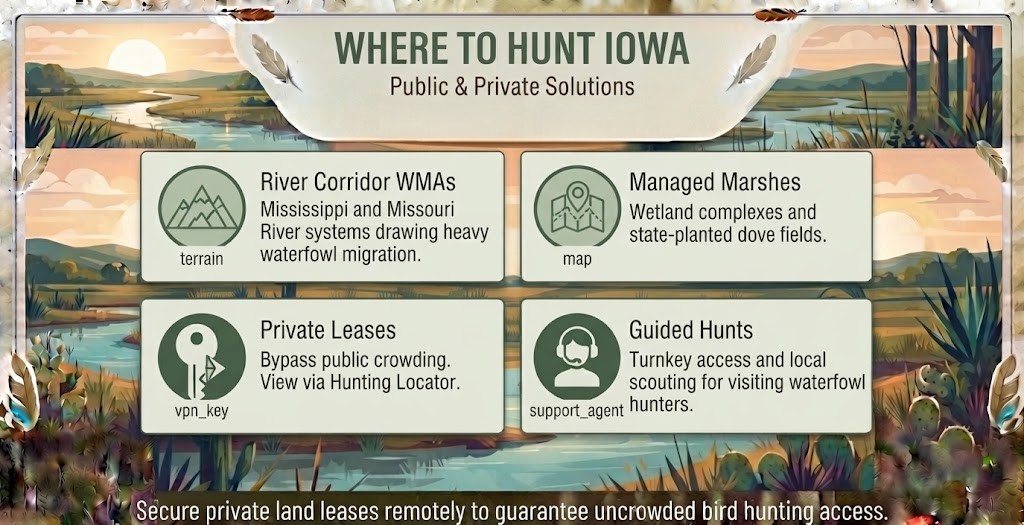
Iowa DNR manages more than 410,000 acres of public land open every day of the year, a solid foundation if you’re hunting on a budget or don’t have private access lined up yet. The DNR’s online hunting atlas is the tool for locating public dove fields and wildlife management areas, with pins marking the nearest parking to each field.
Productive public options generally fall into a few categories:
- River corridor WMAs along the Mississippi and Missouri River systems, which draw heavy waterfowl traffic during migration
- Managed marshes and wetland complexes, built for duck and goose hunting access
- State-managed dove fields, planted and maintained for the September opener
- Multi-use wildlife management areas that hold birds through the fall depending on cover and water conditions
These are strong starting points, but treat them as a category guide rather than a spot list — conditions and bird activity shift year to year, so scouting before your hunt pays off.
Private Land Hunting with Hunting Locator
Finding quality private access is one of the bigger hurdles standing between most hunters and a great season. Public land works, but it gets crowded fast, and scouting time before the opener is already tight without adding a land search on top of it.
Private ground offers less pressure, better bird activity, and the ability to hunt the same productive ground season after season. There are two paths here: leasing private land for the season, or buying land outright for a longer-term investment.
That’s the gap Hunting Locator was built to close. It connects hunters directly with landowners ready to lease or sell hunting access, organized in one searchable platform instead of cold-calling strangers or hoping a Facebook post pans out.
Browse live Iowa hunting leases to see what’s currently available across the state. The earlier access is locked in, the more of the season is left to actually hunt instead of search.
Guided Hunts
For hunters traveling into Iowa from out of state, a guided hunt can be the simplest way to hunt productively without spending the whole trip scouting blind. This applies especially to nonresident hunters looking for a turnkey experience — local knowledge, established access, and gear already in place.
A guided hunt typically means:
- Local scouting knowledge from someone who already knows where birds are working that week
- Gear and blinds provided, so decoys and layout blinds don’t have to cross state lines with you
- Legal access already sorted, removing any question about where you’re allowed to hunt
- A smoother first trip for hunters new to Iowa migratory bird hunting
Guided hunts aren’t the right fit for every hunter or budget, but for a traveling hunter with limited time and no established Iowa contacts, they’re a legitimate way to secure a productive trip.
Iowa Migratory Bird Hunting Tips
Preparation and gear are what separate a decent day in the field from a great one. A few fundamentals:
- Scout Before You Shoot — Pattern where birds are feeding and flying in the days leading up to the opener rather than guessing the morning of.
- Read the Weather and Migration — Cold fronts push fresh birds south, so timing late-season duck hunts around a front can make a real difference in what flies past your blind.
- Match Your Load — A twelve or twenty gauge with light-to-medium shot, typically size 7 or 8, works well for doves; waterfowl hunting requires non-toxic shot by law.
- Know Your Birds — Take the extra second to properly identify your target before the shot. Mourning doves and the legal Eurasian collared-dove look similar at a glance but aren’t identical, and knowing the difference matters.
- Hunt Safe — Establish each hunter’s zone of fire before the first bird flies, and stay aware of where everyone in your group is positioned.
- Bring a Retriever — A well-trained retriever is a real asset on marsh and river hunts, where downed birds can be difficult to recover without one.
Once your plan is set, gear for the hunt — decoys, blinds, ammunition, and waterfowl-specific equipment — is worth having dialed in before opening day.
More Resources from Hunting Locator
- Hunting Locator home — the central hub for hunting access opportunities nationwide.
- Iowa Leases — live private-land lease and sale listings across the state.
- Iowa Hunting Season Guide — the complete statewide season calendar covering every major game species.
- Iowa Migratory Bird Hunting — a deeper companion piece focused specifically on migratory birds.
- Iowa Waterfowl Season — focused detail on duck and goose zones, segments, and limits.
- Iowa Deer Season — for hunters planning a full fall lineup beyond migratory birds.
- Iowa Turkey Season — spring and fall turkey season planning.
- Hunting Locator Store — gear for every species and season.
Frequently Asked Questions
What license do I need to hunt migratory birds in Iowa?
A valid Iowa hunting license, the $11.50 state migratory bird fee, the Wildlife Habitat Fee (if you’re between 16 and 65), and free HIP registration. Waterfowl hunters 16 and older also need a $25 Federal Duck Stamp. Doves don’t require the duck stamp. Verify specifics with Iowa DNR before your hunt.
When does Iowa dove season open in 2026?
Iowa’s dove season opens September 1, 2026 and runs through November 29, with a daily limit of 15 and a possession limit of 45. It’s the traditional season opener and a good starting point for hunters new to migratory birds, given abundant birds and simple gear requirements.
What is HIP registration and do I need it?
HIP, the Harvest Information Program, is a mandatory, free, annual registration required for every migratory bird hunter in Iowa. It’s completed through Iowa DNR or the Go Outdoors Iowa portal, takes a few minutes, and has to be renewed every year — it doesn’t carry over from season to season.
How much does a nonresident Iowa hunting license cost?
A nonresident hunting license runs $131.00, plus a $15.00 nonresident Wildlife Habitat Fee. Add the $11.50 migratory bird fee, and for waterfowl, a $25 Federal Duck Stamp. No draw or lottery is required for general waterfowl hunting in Iowa, according to Iowa DNR.
What are the daily bag limits for ducks and geese in Iowa?
Ducks carry a daily limit of 6 (no more than 4 mallards, only 2 of which can be hens, and 3 wood ducks). Dark geese are limited to 5 daily, light geese to 20 daily, and coots to 15 daily. Possession limits generally run three times the daily bag — confirm current limits with Iowa DNR before you hunt.
Do I need a Federal Duck Stamp to hunt doves?
No. The Federal Duck Stamp is required only for waterfowl hunters age 16 and older. Dove hunters need a valid hunting license, the state migratory bird fee, and HIP registration, but the duck stamp doesn’t apply to dove season.
The Final Shot
Iowa’s migratory bird season comes down to three things: knowing your dates, getting your paperwork right, and having somewhere legal and productive to hunt. Dove season opens the calendar on September 1, the licensing requirements are straightforward once you go fee by fee, and Iowa offers real options on both public and private ground.
Lock in target dates, handle licensing and HIP registration now, and secure access before the season fills up. Verify current regulations with Iowa DNR before opening day, particularly with zone boundaries and season structures under review for 2026–2030 — dates can shift, and the five-minute check is worth it.
This guide is meant to be a reference to come back to throughout the season, alongside the rest of Hunting Locator’s planning tools — from finding acreage to gearing up for opening morning. When you’re ready, browse Iowa leases and start turning the plan into a season in the field.


