Most Kansas hunters chase whitetails and pheasants and never look west, so a strip of shortgrass prairie holds one of the least-pressured big-game opportunities in the Midwest. The scarcity is what makes a tag worth pursuing.
This Kansas antelope guide covers the seasons, licenses, permits, and access options. All three 2026 seasons closed in early October, so read it two ways: as a reference for how the 2026 rules worked, and as a plan for the next spring draw, which opens in mid-May. The Kansas Department of Wildlife & Parks (KDWP) sets the rules, and Hunting Locator can help with access.
The guide includes:
- 2026 season dates, bag limits, licenses, and permit fees in quick-reference tables
- How the resident draw, preference points, and over-the-counter archery option work, including what nonresidents can do
- Where to hunt, from limited public ground to private land, including Kansas hunting leases
Kansas Antelope Season 2026 at a Glance
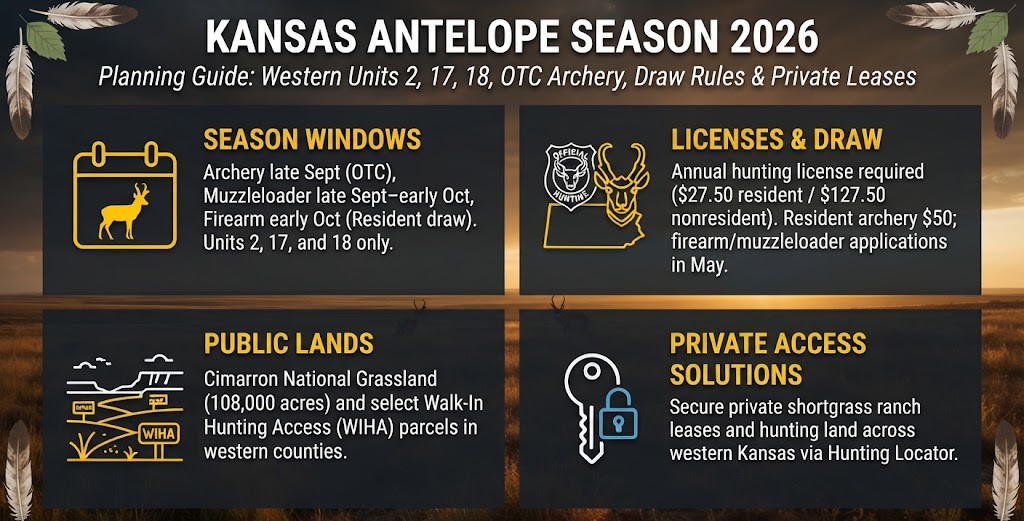
Pronghorn hunting is open only in Units 2, 17, and 18, all in western Kansas. Nonresidents can buy an over-the-counter archery permit. Firearm and muzzleloader permits are resident-only through the draw. For the full calendar covering other species, you can see every Kansas season in one place.
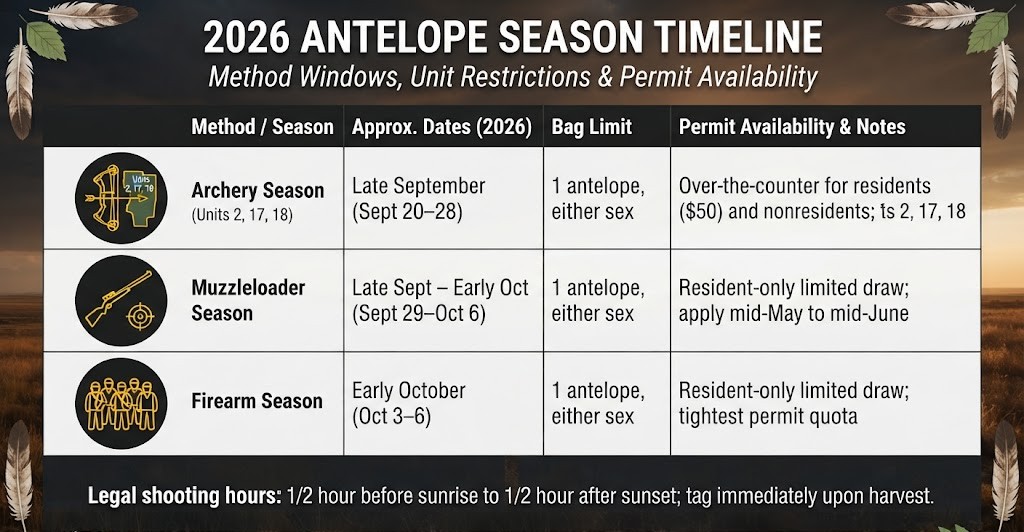
| Season | Approx. Dates (2026) | Permit Type / Availability | Bag Limit | Notes |
|---|---|---|---|---|
| Archery | Typically late September (approx. Sept 20–28) | Over-the-counter; residents and nonresidents | 1 antelope, either sex | Units 2, 17, 18; most accessible entry point |
| Muzzleloader | Late September–early October (approx. Sept 29–Oct 6) | Resident-only limited draw | 1 antelope, either sex | Apply mid-May–mid-June |
| Firearm | Early October (approx. Oct 3–6) | Resident-only limited draw | 1 antelope, either sex | Most sought-after permit |
Dates shown are approximate. Regulations change annually, so confirm exact dates and rules with the Kansas Department of Wildlife & Parks (KDWP) before buying or hunting. Check KDWP’s official antelope regulations for current dates and fees.
Legal shooting hours run from one-half hour before sunrise to one-half hour after sunset.
When is Kansas antelope season? It runs in three parts. Archery opens first in late September, muzzleloader follows from late September into early October, and the firearm season runs a few days in early October. All three are limited to Units 2, 17, and 18, and each permit allows one antelope of either sex.
Before you hunt, make sure you have:
- A valid Kansas hunting license, unless you are exempt
- An antelope permit for your season or method
- Hunter education, if you were born on or after July 1, 1957
- A permit that matches the unit you’re hunting (2, 17, or 18)
- A tag applied immediately on harvest, before you move the carcass, and kept attached until processing
Kansas Antelope Hunting Seasons
Kansas antelope season has three methods, with one bag limit per permit. Only archery is open without a draw.
Archery Season
Archery typically runs in late September (approx. Sept 20–28). It is the realistic way into Kansas pronghorn hunting, especially if you have no preference points.
Archery permits are sold over the counter to both residents and nonresidents. A resident permit costs $50, the resident landowner/tenant archery permit is $25, and the resident youth archery permit is $10.
KDWP makes you choose a route each year: buy an over-the-counter archery permit, or apply for the firearm and muzzleloader draw or buy a preference point.
September heat shapes the hunt. Waterhole blinds are the usual approach when conditions are dry, and spot-and-stalk works where the terrain gives you cover. The bag limit is one antelope of either sex.
Muzzleloader Season
The muzzleloader season runs from late September into early October (approx. Sept 29–Oct 6). Permits come through the resident-only draw for Unit 2, 17, or 18, and the limit is one antelope of either sex. A muzzleloader gives you more effective range than a bow, which matters on open prairie where animals see you coming from a long way off.
Firearm Season
The firearm season runs in early October (approx. Oct 3–6). It is the tightest draw of the three, and permits are very limited. Resident hunters apply for a permit tied to one specific unit.
Expect long glassing sessions and long shots. A good rangefinder matters more here than in most places, and the tips section below explains why.
Kansas Antelope Licenses and Permits
You need a hunting license and an antelope permit to hunt Kansas pronghorn. The tables below show what each costs and how you get it.
Kansas Hunting Licenses
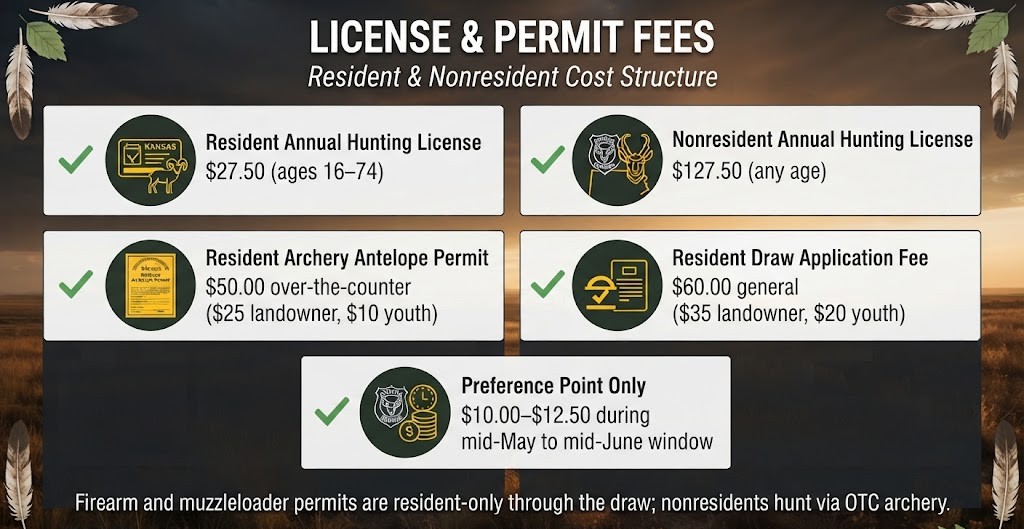
| License | Who | Cost |
|---|---|---|
| Annual Hunting License | Resident, ages 16–74 | $28 |
| Annual Hunting License | Nonresident, any age | $127.50 |
Residents and nonresidents hunting on Kansas land they own or operate are exempt from the hunting license requirement. Verify that exemption with KDWP before relying on it.
Hunter education is required for anyone born on or after July 1, 1957. If you plan to combine your trip with other species, the same annual license also covers deer hunting; see our Kansas deer season guide.
Kansas Hunting Permits
| Permit / Application | Cost | How Obtained |
|---|---|---|
| Resident archery permit | $50 | Over-the-counter |
| Resident landowner/tenant archery | $25 | Over-the-counter |
| Resident youth archery (15 and under) | $10 | Over-the-counter |
| Nonresident archery | Confirm with KDWP | Over-the-counter |
| General resident firearm/muzzleloader application | $60 | Draw (mid-May–mid-June) |
| Resident landowner/tenant application | $35 | Draw |
| Resident youth application (15 and under) | $20 | Draw |
| Preference point only | $10–$12.50 | Application window only |
How the draw works:
- Applicants with the highest number of preference points draw first.
- You can buy one point per year, and only during the application window.
- You cannot buy a permit and a preference point in the same year.
- Applicants who don’t draw a permit automatically receive a point at the close of the draw.
Point creep applies here. When demand for limited-draw permits rises faster than the number of permits, the points needed to draw climb over time. Buying a point every year keeps you in line, but odds are low, and Kansas pronghorn permits are very limited.
How to apply for the 2027 draw:
- Confirm residency and hunter education. Make sure your documentation is in order before the window opens.
- Buy or renew your hunting license. You need it on file to apply.
- Decide on your route. Apply for a permit, buy a preference point only, or skip the draw and go with over-the-counter archery.
- Apply online during the window. The window typically runs May 12–June 12.
- Choose Unit 2, 17, or 18. Pick the unit where you have access lined up.
- Check your results. If you draw, line up your land access right away.
Planning for next year: Mark mid-May on your calendar now. Missing the window costs you a full year.
Landowner, tenant, and youth options:
- Landowner and tenant eligibility requires 80 or more acres of Kansas farm or ranch land.
- Immediate family members domiciled with the landowner or tenant may also apply.
- Landowner and tenant fees are lower: $35 for the application and $25 for archery.
- Youth means ages 15 and under: $20 for the application and $10 for archery.
- Youth hunters must hunt under the supervision of an adult 18 or older.
Land access ties directly to permit opportunity here. If you’re also considering Kansas’s other limited big-game draw, see the Kansas elk hunting season.
Where to Hunt Antelope in Kansas
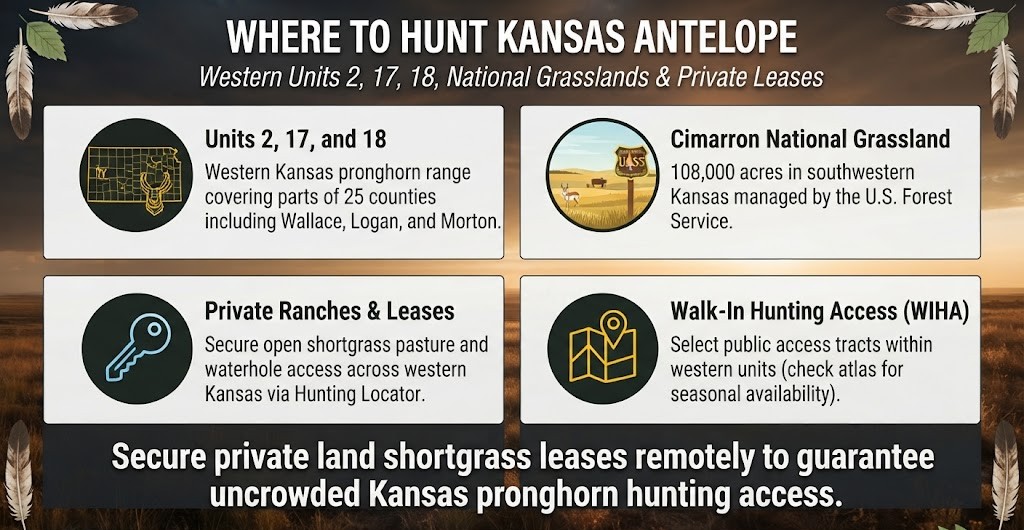
Pronghorn range covers parts of 25 western counties, including Wallace, Logan, Greeley, Gove, Wichita, Hamilton, and Morton. Most of that ground is private, so access is the main obstacle.
Where can I hunt antelope in Kansas? Kansas antelope hunting is limited to Units 2, 17, and 18 in the western part of the state. Public options include Cimarron National Grassland and some Walk-In Hunting Access tracts, but most pronghorn habitat is private ranch and farm ground, so leases and landowner relationships matter.
Best Public Lands
Public ground is limited, but there are a few starting points:
- Cimarron National Grassland: About 108,000 acres in southwestern Kansas, managed by the U.S. Forest Service. It is one of the few public pronghorn options in the state.
- Walk-In Hunting Access (WIHA): Tracts within the units are open to public hunting. Access periods vary by tract and may not cover September archery, so check the current atlas.
- Unit check: Confirm that any parcel falls inside Units 2, 17, or 18 and matches your permit before you commit to a hunt.
Private Land Hunting with Hunting Locator
Western Kansas shortgrass is mostly working ranch and farm ground, which is why private land dominates the pronghorn picture. A good lease gives you something public land rarely can: time to learn the ground.
When you evaluate a lease, look for:
- Open shortgrass with long sight lines
- Reliable water, such as stock tanks and windmills
- Minimal cover that lets animals see you coming, so you can plan your stalk or blind accordingly
- A location inside Units 2, 17, or 18
Buying land is the long-term path. Owning 80 or more acres opens resident landowner permit options. Nonresident landowner rules differ, so verify them with KDWP before you buy.
Antelope-specific listings can be scarce, so check back as the next draw approaches.
Hunting Locator connects hunters directly with landowners who lease or sell hunting ground. You can search by state, game, and acreage, then contact landowners who share your commitment to ethical, respectful hunting. Browse Kansas hunting leases by county, acreage, and game to see what’s available.
Own ground in western Kansas? List it on Hunting Locator and connect with responsible hunters who will treat your property with care.
Guided Hunts
A guide makes sense if you’re short on access or experience. Options are limited by the units and permits, so go in with clear expectations.
| Option | Access | Permit Path | Effort | Best Fit |
|---|---|---|---|---|
| Guided | Outfitter’s ground | OTC archery or your drawn permit | Low | First-timers, nonresidents |
| Self-guided | Public/WIHA | OTC archery or draw | High | Experienced, budget-minded |
| Leased ground | Exclusive private | OTC archery or draw | Medium | Hunters planning multiple seasons |
Ask any outfitter these questions before you book:
- Does your land lie within Units 2, 17, or 18?
- Which permits work with your hunt?
- Do you have archery blinds or waterhole setups?
- What’s included?
You can search hunting opportunities on Hunting Locator to start comparing outfitters and guides.
Pronghorn Hunting Tips
Pronghorn have some of the sharpest eyes in North America, and Kansas prairie offers little cover. These tips work around both facts:
- Glass first, stalk with terrain: Spend more time behind good optics than on your feet. Pick out animals from a distance, then use draws and ridgelines to close the gap.
- Sit waterholes in September heat: Dry weather concentrates animals at water. A ground blind near a tank or windmill is a proven archery setup.
- Range everything, because prairie distances deceive: Open country makes targets look closer than they are. A reliable rangefinder keeps shots ethical.
- Use a decoy for archery: A decoy can pull a curious animal into range and hold its attention while you draw.
- Cool meat fast: Early-fall warmth works against you. Pack game bags and a cooler so you can get the animal cooled quickly.
- Keep tags attached until processing: Tag the animal immediately, before moving it, and leave the tag on until the meat is processed.
- Confirm unit boundaries before you shoot: Your permit is valid in one unit only, so know exactly where you stand.
You can find pronghorn gear in the Hunting Locator store, including optics, blinds, and field-care essentials.
More Resources from Hunting Locator
Hunting Locator is more than a lease marketplace. These pages help you plan access, learn the seasons, and gear up.
Find land
- Hunting Locator home: Search leases, outfitters, and guides across the country.
- Kansas hunting leases: Browse private land available in Kansas.
Kansas season guides
- All Kansas hunting seasons: The full calendar in one place.
- Kansas antelope season hub: Our evergreen antelope season hub.
- Kansas deer hunting season: Dates and rules for whitetail and mule deer.
- Kansas elk hunting season: The state’s other limited big-game draw.
- Kansas upland game hunting season: Pheasant and quail in the same western counties.
- Kansas migratory bird hunting season: Dove season overlaps with September archery.
- Kansas waterfowl hunting season: Ducks and geese across the state.
- Kansas small game hunting season: Squirrel, rabbit, and other small game.
Gear
- Hunting Locator store: Gear to help you hunt this species with confidence.
FAQ
Can nonresidents hunt antelope in Kansas?
Yes, through the over-the-counter archery permit. Firearm and muzzleloader permits are resident-only, unless the hunter qualifies as a landowner or tenant, so verify eligibility with KDWP. Nonresidents planning a combo trip can pair pronghorn with the Kansas deer season or upland game seasons in the same counties.
How do Kansas antelope preference points work?
You can buy one preference point per year, only during the application window, for $10–$12.50. Applicants with the most points draw first, and you can’t buy a permit and a point in the same year. Point creep means the points needed to draw rise over time.
Is the archery antelope permit really over the counter?
Yes. Archery permits are available without entering the draw. A resident permit costs $50, a landowner or tenant permit costs $25, and a youth permit costs $10. They are valid in Units 2, 17, and 18.
Who qualifies for a landowner/tenant antelope permit?
Residents who own or farm 80 or more acres of Kansas farm or ranch land qualify. Immediate family members domiciled with the landowner or tenant may also apply. The application fee is $35.
Can youth hunters get an antelope permit?
Yes. Hunters ages 15 and under can apply for a youth permit at $20, or buy the youth archery permit at $10. Adult supervision is required, and the supervising adult must be 18 or older.
Can I shoot a doe or fawn?
Yes. Each permit allows one antelope of either sex, meaning a buck, doe, or fawn. Tag the animal immediately, before moving it.
Do I need hunter education?
Yes, if you were born on or after July 1, 1957. Complete your certification before you buy a license or apply for a permit.
When are the 2027 Kansas antelope seasons?
KDWP lists archery for Sept 18–26, 2027 and muzzleloader for Sept 27–Oct 4, 2027. Firearm dates are still to be announced. The application window typically runs mid-May to mid-June, so confirm details with KDWP as spring approaches.
The Final Shot
The 2026 Kansas antelope season is over, and planning for the next one starts now. You can buy an over-the-counter archery permit and hunt next September, or build preference points and apply for the draw. Either way, access is what turns a permit into a hunt.
Use the off-season to plan:
- Winter: Scout, study the units, and line up your access.
- May 12–June 12: Apply or buy your preference point.
- September: Archery season opens.
Confirm every rule and date with KDWP before you buy or hunt. Then line up private access early: browse Kansas hunting leases on Hunting Locator and find your ground before the next Kansas antelope season arrives.


