This isn’t your typical western elk hunt. Kansas elk live on open plains, not mountain forests. They bed in creek bottoms and timber edges, not alpine basins. And honestly? That makes them harder to hunt in some ways. There’s nowhere to hide out there.
If you’re serious about elk hunting in Kansas, you need to understand the system. The draw process, bonus points, hunt-own-land permits, Fort Riley access – it’s all connected. Miss one piece and you could be waiting years longer than necessary.
Here’s everything you need to know:
- Season dates and regulations for every hunting method
- How the permit system actually works (and how to beat it)
- Where elk actually live and how to hunt them
Let’s get into the details that matter.
Quick Overview of Kansas Elk Hunting
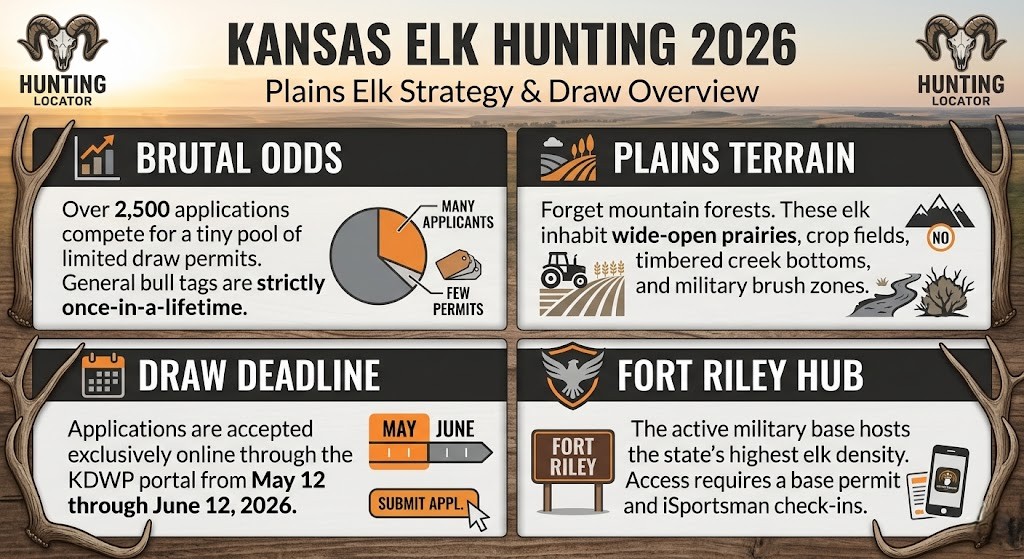
Kansas elk hunting is nothing like Colorado or Montana. These are plains elk living in wide-open country, and 2024 saw 229 general permits issued – the most in state history. More elk are moving off Fort Riley onto private ground, which creates opportunities if you know where to look.
| Season Type | Start Date | End Date | Bag Limit |
|---|---|---|---|
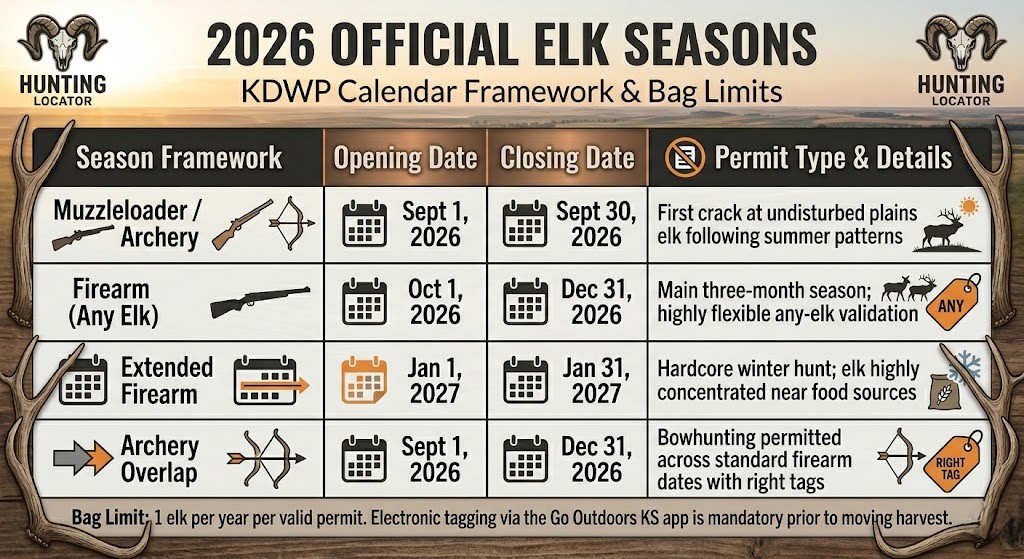
| Muzzleloader/Archery | 09/01/2026 | 09/30/2026 | 1 per permit |
| Firearm (Any Elk) | 10/01/2026 | 12/31/2026 | 1 per permit |
| Extended Firearm | 01/01/2027 | 01/31/2027 | 1 per permit |
You can’t just show up and hunt. Here’s what you need first:
- Kansas hunting license (resident or nonresident)
- Elk permit from the limited draw OR hunt-own-land permit
- Hunter education if you were born after July 1, 1957
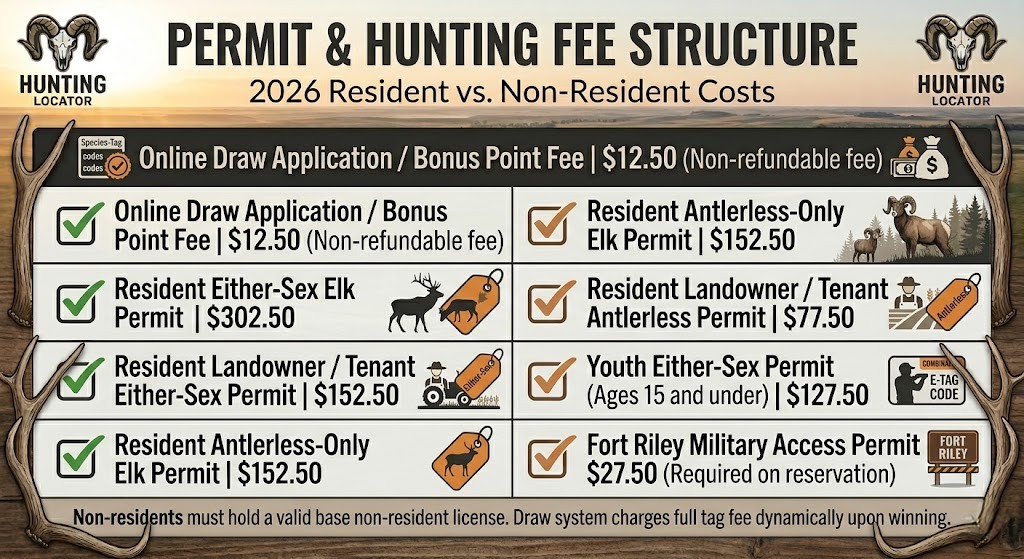
- Fort Riley Access Permit ($27.50) for military base hunting
Kansas Elk Hunting Seasons
Kansas breaks elk seasons into three distinct periods, and your permit only works for the specific season you draw. Choose wrong and you’re stuck with weather or conditions you didn’t plan for.
Muzzleloader/Archery Season
September 1-30 gives you first crack at elk before rifle hunters show up. Elk are still following summer patterns – more visible, less spooked. The weather’s usually decent too. Archery season actually runs all the way through December 31, overlapping with rifle seasons if you’ve got the right permits.
This early season can be gold if you’ve done your homework. Elk haven’t been pressured yet, and they’re often feeding in open areas during cooler parts of the day.
Firearm Season (Any Elk)
October through December is the main event. Three full months to hunt, and “Any Elk” means you can take a bull or cow. This is what everyone wants in the draw – maximum flexibility, longest season.
Late fall weather starts pushing elk into predictable patterns. Cold fronts move them around, and by December they’re thinking about winter survival. That means more concentrated feeding and bedding areas.
Extended Firearm Season
January hunting is for the hardcore crowd. Most hunters are done, pressure drops way off, and elk can be easier to pattern. But Kansas winters are brutal. Ice storms, bitter cold, snow that makes travel miserable.
If you draw a January tag, pack serious cold weather gear. Elk will be concentrated around food and shelter, but you better be ready for whatever Mother Nature throws at you.
Kansas Elk Licenses and Permits
The numbers tell the whole story: 2024 saw over 2,500 applications and bonus point purchases – a 31% jump from the year before. Competition is getting worse every year.
Kansas Hunting Licenses
Get your hunting license sorted before you even think about elk permits:
| License Type | Requirement | Notes |
|---|---|---|
| Resident Hunting License | Kansas residents | Must prove residency per state rules |
| Nonresident Hunting License | Out-of-state hunters | Required regardless of age |
| Hunter Education | Born after July 1, 1957 | Must complete before hunting |
Your license has to be valid before the elk application window opens. Don’t wait until the last minute – the system gets slammed during application periods.
Kansas Elk Permits
Here’s where it gets expensive and competitive. Current fees:
Application/Bonus Point Fee: $12.50 Resident Either-Sex: $302.50 (Landowner/Tenant: $152.50) Resident Antlerless-Only: $152.50 (Landowner/Tenant: $77.50) Youth (15 and under): $127.50 (Either-Sex) / $52.50 (Antlerless)
Mark your calendar: May 12 – June 12, 2026 – Applications only accepted online through Kansas Department of Wildlife & Parks. Miss this window and you’re waiting another year.
The bonus point system gives you extra chances in the draw, but each bonus point just means one more entry in the hat. It’s not a guarantee of anything. Worse yet, skip applying or buying points for five straight years and you lose everything.
Here’s the kicker: draw an any-elk or bull-only permit once, and you can never apply for another one. This is literally once-in-a-lifetime hunting.
Hunt-own-land permits are the secret weapon for people who can access private property in elk zones. No draw, no waiting, no competition.
Kansas Elk: Where to Hunt
Kansas elk hunting started at Fort Riley back in 1990, and that’s still where most of the action happens. But elk are spreading out, creating new opportunities for hunters who think outside the box.
Best Public Lands
Public land options are pretty limited compared to western states:
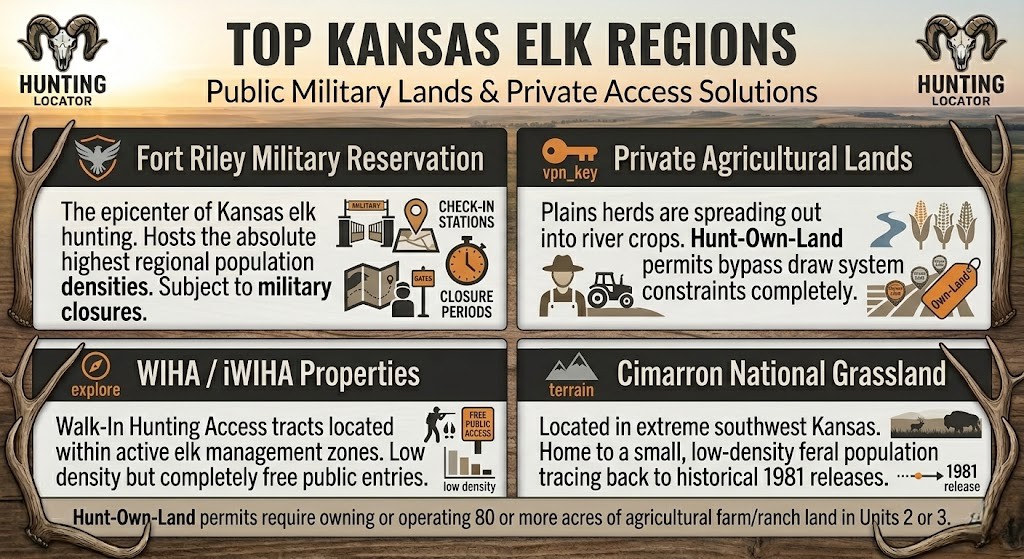
Fort Riley Military Reservation: This is the main show. Most elk hunting happens on the military base, but you need a Fort Riley Access Permit and iSportsman registration.
Walk-in Hunting Access (WIHA/iWIHA): Some properties in elk management units offer free public access. Success rates are low, but they’re great for scouting and learning elk behavior.
Cimarron National Grassland: Elk from Maxwell were released here in 1981, and there’s still a small population. Very low density though.
Let’s be honest – elk numbers outside Fort Riley are extremely low. Public land hunting means lots of walking, lots of glassing, and realistic expectations about success rates.
Fort Riley Military Hunting
Fort Riley has the highest elk concentration in Kansas, but access comes with military rules. Only active-duty personnel stationed at Fort Riley get military permits – everyone else goes through the regular draw.
You must use the Fort Riley iSportsman Program to check in and out daily. Fort Riley Access permits cost $27.50 through their website. Complete the Outdoor Recreation Briefing video and any required safety briefings before hunting.
Register your firearms through DES Physical Security, and remember that military training takes priority over hunting – areas can close without notice.
Best elk areas include Outdoor Recreation Areas C, F, H, K, L, M, P, and Q, but availability depends on training schedules.
Questions? Call Fort Riley Environmental Office at 785-239-6211 (7:30 a.m. – 4 p.m., Monday-Friday).
Private Land Hunting with Hunting Locator
Private land is your best bet for consistent elk hunting access. Hunt-own-land permits are the only way to hunt elk on private land without the limited draw. You need to own or operate 80+ acres of farm/ranch land in elk management units (Units 2 and 3).
These permits aren’t limited like draw tags. No competition, no waiting, valid during any open season with appropriate weapons. But you need legitimate agricultural operations – hunting leases typically don’t qualify.
Two paths forward: buy qualifying property in elk country, or find landowners willing to work with you. Property ownership gives you guaranteed annual access while building equity.
Instead of cold-calling random landowners or driving backroads hoping to find the right property, check out verified listings where landowners are actually ready to lease or sell hunting access. Browse Kansas hunting land on Hunting Locator to find properties in elk management zones that could put you in the game without years of waiting.
Elk Hunting Tips
Kansas plains elk hunting requires completely different tactics than mountain hunting. You’re dealing with open prairies, grasslands, and river bottoms – mostly flat with minimal cover.
Scout Before Season Opens: Limited access and tight hunting windows mean you need to know the land and elk patterns ahead of time. Use satellite imagery and pre-season visits to identify bedding areas and travel routes.
Learn Plains Elk Behavior: Kansas elk bed in timber during temperature extremes and use side hills for visibility. Without mountain cover, they adapt by using terrain features and staying alert.
Target Water and Transition Zones: In open country, elk concentrate near water and where timber meets grassland. These edges are your best ambush spots.
Prepare for Weather Swings: Kansas weather changes fast, especially late season. Layer up and have backup plans for wind, which affects both elk movement and your shooting across open ground.
Master Electronic Tagging: Kansas requires electronic tagging through the Go Outdoors KS mobile app before moving your elk. Download it and practice before your hunt.
Gear for Distance: Plains hunting often means longer shots across open ground. Make sure your optics and weapon are dialed in for the distances you’ll encounter. Check out quality hunting gear at the Hunting Locator Store to get properly equipped for Kansas conditions.
More Resources from Hunting Locator
Kansas offers more than just elk hunting. Here are additional resources to maximize your hunting trips:
- Kansas Hunting Seasons Overview – Complete breakdown of all Kansas seasons and regulations for planning multi-species hunts.
- Kansas Deer Hunting Season – Many elk hunters also chase whitetails. Get the complete guide to Kansas deer opportunities.
- Kansas Antelope Hunting Season – Another big game option for hunters making western Kansas trips.
- Kansas Hunting Land Listings – Browse available hunting leases and land for sale, including properties in elk management zones.
FAQ
When is the application deadline for 2026 Kansas elk permits?
Applications are only accepted online from May 12 through June 12, 2026. Miss this window and you wait another full year. The $12.50 application fee is non-refundable whether you draw or not.
Can nonresidents hunt elk in Kansas?
Yes, but you’re in the same brutal draw as everyone else. With roughly 900 applications for 20 permits annually, residency doesn’t help your odds much. Everyone’s competing for the same tiny number of tags.
What happens if I draw a permit but can’t hunt?
You’re out of luck. Kansas elk permits are non-refundable and non-transferable. Draw a tag and can’t use it? You lose the permit and all the money. Make sure you can commit before applying.
How do hunt-own-land permits work?
These are for landowners or tenants with 80+ acres of farm/ranch land in elk management units. It’s the only way to hunt elk on private land without the limited draw. No limits on these permits, and they work during any open season.
What are my realistic chances of drawing?
Pretty terrible. About 900 applications for 20 permits each year, and 2024 saw over 2,500 applications and bonus point purchases – a 31% increase. Competition is getting worse every year.
Can civilians hunt Fort Riley?
Yes, but you need permits through the same limited draw as other public hunters. Only active-duty personnel stationed at Fort Riley get special military permits. All Fort Riley hunters need the $27.50 access permit and iSportsman registration.
The Final Shot
Kansas elk hunting is tough – really tough. Between the brutal draw odds, limited public access, and challenging plains hunting conditions, success requires serious commitment and realistic expectations. But that’s exactly what makes it special.
The elk population is expanding beyond Fort Riley, creating new opportunities for hunters willing to think creatively about land access. Whether you’re playing the long game with bonus points, exploring hunt-own-land options, or planning your Fort Riley strategy, patience and preparation are everything.
Ready to get serious about Kansas elk hunting? Start exploring hunting opportunities and land access on Hunting Locator to turn those long-shot dreams into a real hunting plan.


