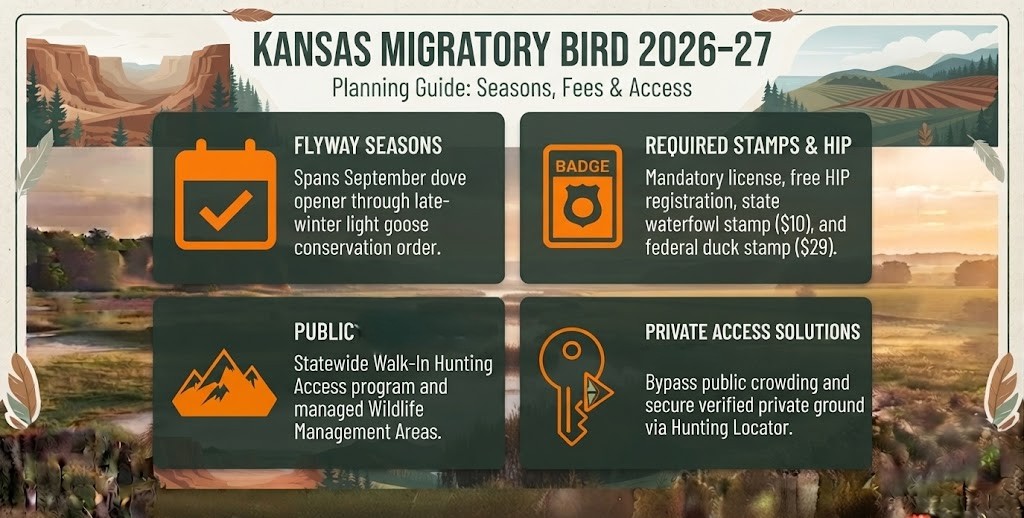
This Kansas migratory bird guide pulls together the confirmed 2026–2027 season dates, bag limits, and stamp requirements in one place, for residents and the nonresidents who fly in for the state’s Central Flyway action. Treat it as a companion to the Hunting Locator homepage — something to bookmark before opening day. For the official word on dates and fees, check KDWP and Go Outdoors Kansas directly; this guide gets you most of the way there.
Here’s what’s covered:
- Confirmed 2026–2027 season dates and bag limits for every migratory species Kansas offers, from doves to light geese
- Which licenses, stamps, and permits you need, and where to buy them
- Where to hunt in Kansas — public WIHA land, private leases, and guided options
Below is the season at a glance before we get into specifics.
Quick Overview: Kansas Migratory Bird Seasons at a Glance
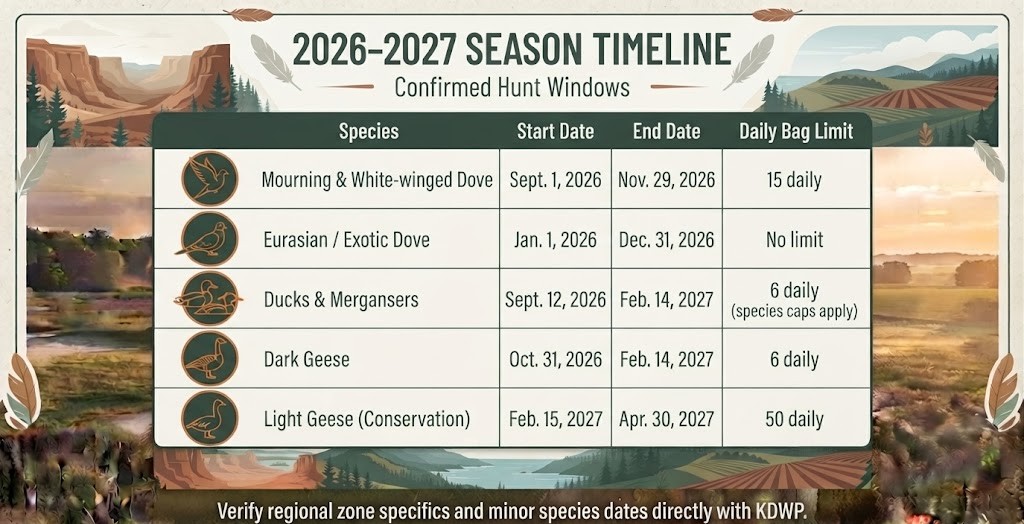
This table gives the broad season window for each species. Waterfowl dates vary by regional zone, so confirm your specific zone before heading to the blind.
| Species | Season Dates (2026–2027) | Daily Bag Limit | Possession Limit / Notes |
|---|---|---|---|
| Mourning & White-winged Dove | Sept 1 – Nov 29, 2026 | $15 | 45 |
| Eurasian / Exotic Dove | Jan 1 – Dec 31 (year-round) | No limit | No limit |
| Ducks & Mergansers | Sept 12, 2026 – Feb 14, 2027 (varies by zone) | $6 | Species caps apply (mallard, wood duck, pintail, redhead, canvasback, scaup) |
| Dark Geese | Oct 31 – Nov 1, 2026; Nov 4, 2026 – Feb 14, 2027 | 6 | — |
| Light Geese (Conservation Order) | Feb 15 – Apr 30, 2027 | 50 | No possession limit |
| Coots | Sept 12, 2026 – Feb 14, 2027 (with waterfowl) | 15 | — |
| Rails | Per season | 25 | — |
| Common Snipe | Per season | 8 | — |
| Woodcock | Per season | 3 | — |
| Sandhill Crane | Permit required | 3 | — |
The waterfowl dates above are the broad statewide window. Your actual opener and closer depend on your duck zone, covered in detail below.
Before heading out, have these squared away:
- Kansas Hunting License — required for residents 16–74 and all nonresidents
- HIP Registration — mandatory for anyone hunting migratory birds
- State Waterfowl Stamp ($10) and Federal Duck Stamp ($29) — required for waterfowl hunters
- Kansas HIP Stamp ($2.50)
- Hunter Education — required for anyone born on or after July 1, 1957
This guide focuses on migratory birds specifically. For a fuller season across species, see the full Kansas hunting seasons hub.
Kansas Migratory Bird Hunting Seasons
Kansas migratory bird hunting runs from the early-fall dove opener through the late-winter light goose conservation order, with dates and limits shifting by species. Much of what makes Kansas hunting good is its position in the Central Flyway — the major north-south migration corridor that funnels ducks, geese, and other birds through the state each fall and winter. All figures below reflect the confirmed 2026–2027 seasons; double-check final dates with KDWP before you load up the truck.
Dove Season
Dove season is the September 1 opener that most Kansas hunters build their fall around. Mourning and white-winged dove season runs September 1 through November 29, 2026, with a 15-bird daily bag limit and 45-bird possession limit. Legal hunting hours run from one-half hour before sunrise to sunset.
Eurasian collared and other exotic doves are different: huntable year-round, January 1 through December 31, with no daily or possession limit. They’re classified as invasive/exotic species rather than native migratory birds, so Kansas doesn’t cap harvest the way it does for mourning doves.
Two practical notes: electronic calls are legal for dove hunting, and you can hunt over normally farmed crops, but you can’t manipulate a crop specifically to attract birds. If you’re also chasing pheasant, quail, or other upland game this fall, see Kansas upland game hunting as a complementary trip.
General Waterfowl Season (Ducks & Coots)
The general waterfowl season for ducks and coots runs September 12, 2026 through February 14, 2027, though that window varies by regional flyway zone. Ducks carry a 6-bird daily bag limit with species-specific caps, while coots carry a 15-bird daily limit.
Within the overall 6-duck limit, Kansas imposes sub-limits on certain species:
- Mallards — 5 daily, no more than 2 of which may be female
- Wood ducks — 3 daily
- Pintails — 3 daily
- Redheads — 2 daily
- Canvasbacks — 2 daily
- Scaup — 2 daily
Kansas splits its waterfowl seasons into regional zones, and the boundaries don’t always follow intuitive geographic lines. A tract of land on one side of a highway can fall into a different duck zone — with a different opener and closer — than a tract a few miles away. Treat the dates above as the broad statewide window, and confirm your specific zone’s exact dates with KDWP before you commit. For zone-specific detail, see the Kansas waterfowl hunting guide.
Goose Seasons (Dark & Light Geese)
Dark geese hunting runs in two segments: October 31 – November 1, 2026, and November 4, 2026 – February 14, 2027, with a 6-bird daily bag limit throughout. Light geese operate under a different structure — the Light Goose Conservation Order runs February 15 – April 30, 2027, with a 50-bird daily bag limit and no possession limit.
The Conservation Order exists because light goose (snow goose) populations have grown large enough across their range to damage fragile Arctic breeding habitat. Wildlife agencies created this late-winter season with liberal limits to help reduce those overabundant populations, which is why the bag limit jumps from 6 to 50 and the possession cap disappears entirely.
Sandhill Crane & Minor Species (Rails, Snipe, Woodcock)
Rounding out the Kansas migratory bird lineup are a handful of smaller-profile species, each with its own daily bag limit: sandhill crane at 3 daily (a separate permit is required in addition to your standard license and HIP registration), rails at 25 daily, common snipe at 8 daily, and woodcock at 3 daily. Coots, covered above, carry a 15-bird daily limit alongside general waterfowl.
The bag limits above are confirmed, but exact season dates for sandhill crane, rails, snipe, and woodcock should be verified directly with KDWP before you plan a hunt, since date confirmations for these species come later in the year.
Kansas Migratory Bird Licenses and Permits
Before dates and bag limits matter, you need to be legally eligible to hunt. Kansas layers a few requirements: a base license, HIP registration, the right stamps, and, for most hunters, a hunter education card.
Kansas Hunting Licenses
A Kansas state hunting license is required for residents ages 16–74 and for all nonresidents, regardless of age. Residents can purchase online through Go Outdoors Kansas. Per the resident license and exemptions rules, the standard resident license runs $27.50 for ages 16–74, with exemptions for landowners hunting their own property, residents under 16, and residents over 75.
For nonresidents: every nonresident, regardless of age, needs a Kansas hunting license to hunt migratory birds in the state. Published nonresident fee figures vary across sources and aren’t confirmed in our research, so check Go Outdoors Kansas for the exact current nonresident fee before planning your trip.
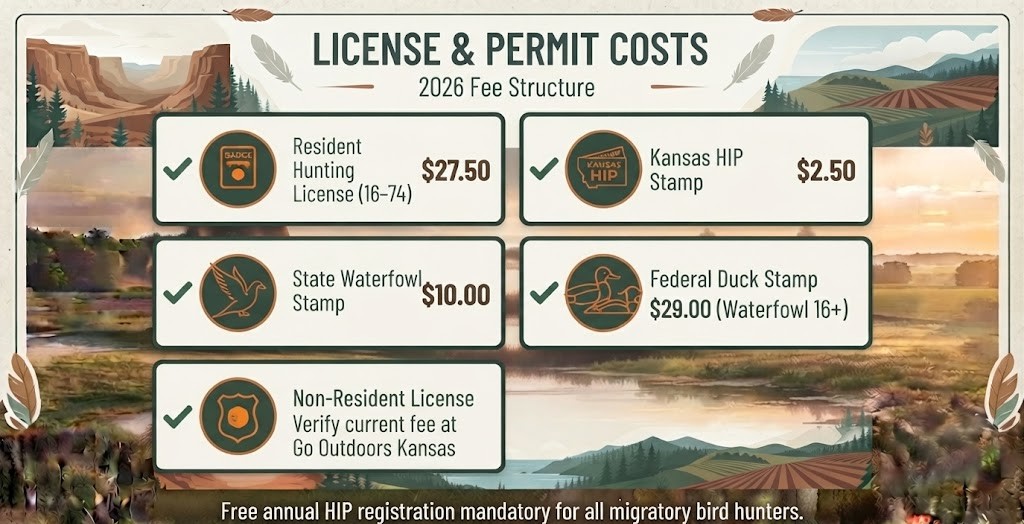
Here’s a quick-reference fee table for the core costs:
| Item | Fee |
|---|---|
| Resident Hunting License (16–74) | $28 |
| Kansas HIP Stamp | $2.50 |
| State Waterfowl Stamp | $10.00 |
| Federal Duck Stamp | $29.00 |
| Nonresident Hunting License | Verify current fee at Go Outdoors Kansas |
Hunter education is required for anyone born on or after July 1, 1957, unless you’re hunting under an apprentice license. Nonresidents can satisfy this with hunter education certification from any U.S. state or Canadian province — no need to retake the course.
Kansas Migratory Bird Permits & Stamps
Beyond the base license, migratory bird hunters need a few additional items.
HIP registration (Harvest Information Program) is the main one: a free, mandatory registration for anyone hunting migratory game birds, including doves, ducks, geese, cranes, rails, snipe, woodcock, and coots. You add it when you buy your license, and it involves a few quick questions about last season’s harvest. Per the Kansas HIP registration rules, proof of HIP must be carried in the field and presented to a wildlife officer if asked. The Kansas HIP Stamp costs $2.50.
Waterfowl hunters need two more items: the State Waterfowl Stamp ($10) and the Federal Duck Stamp ($29). Dove-only hunters need a license plus HIP; waterfowl hunters need those two things plus both stamps.
You can purchase your license, stamps, and HIP registration online through Go Outdoors Kansas, in person at any licensed vendor, or at a KDWP department office. Handling it all online means you’re set before you leave the driveway.
Where to Hunt Migratory Birds in Kansas
Once your paperwork is squared away, the next question is where to go. Kansas offers three main routes — free public land, private leases, and guided hunts — and finding your spot before opening day matters, since popular public areas get crowded fast once the season opens.
Best Public Lands (WIHA & WMAs)
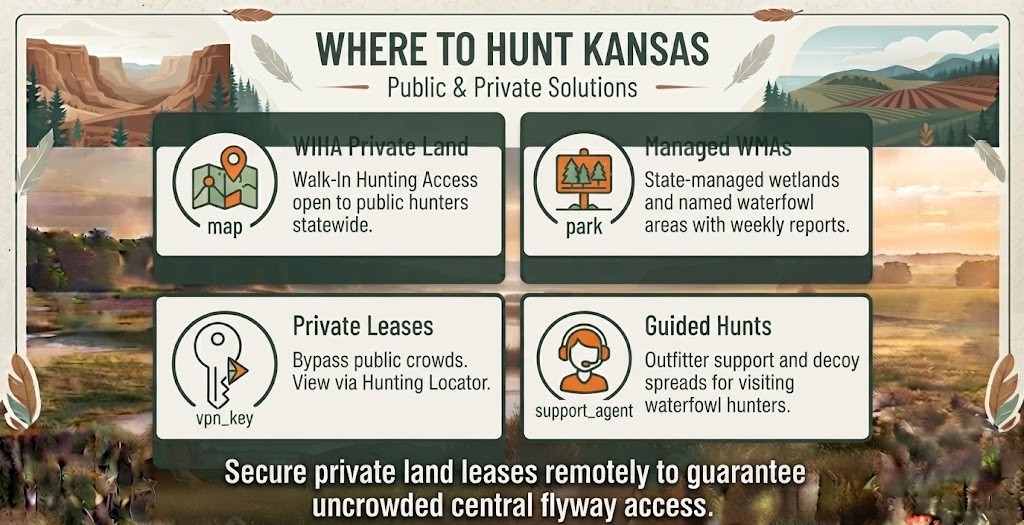
Kansas’s Walk-In Hunting Access (WIHA) program is private land the state pays landowners to open to public hunters, and it works alongside the state’s Wildlife Management Areas (WMAs) to provide free options to scout.
- Named waterfowl areas — Kansas posts weekly waterfowl condition reports covering bird numbers and conditions at spots like Glen Elder, Jamestown, Milford, Perry, Wilson, and Webster, so you can scout before committing to a drive.
- Kansas Hunting Atlas — KDWP’s Kansas online hunting atlas shows where to find migratory birds and WIHA parcels across the state.
- Beginner tip — If you’re new to Kansas migratory bird hunting, WIHA is the lowest-friction way to find legal ground without navigating private land negotiations.
Private Land Hunting with Hunting Locator
Public land works, but it comes with tradeoffs: more hunters, more pressure, less control over your morning. That’s why many Kansas hunters, resident and nonresident alike, eventually look toward private land — whether they’re tired of losing a usual spot to crowds or planning a first Kansas trip and want quality ground locked in ahead of time.
There are two real paths: leasing private land for the season, or buying land outright if you’re in it for the long haul. Leasing is the faster, lower-commitment route for most hunters — it gets you exclusive access to quality ground without the overhead of ownership.
This is where Hunting Locator comes in. It’s a marketplace connecting hunters directly with landowners across Kansas who are ready to lease or sell their ground — vetted listings you can browse on your own time, no cold-calling involved. Whether you’re after dove fields, flooded timber for ducks, or open ground for goose decoy spreads, you can browse Kansas hunting leases and connect with landowners directly.
For nonresidents especially, this solves a common headache of planning an out-of-state trip: securing quality private ground in advance without knowing anyone in the area or cold-calling landowners blind. The earlier you lock in a lease, the less you’re leaving to chance.
Guided Hunts
Whether a guided hunt makes sense depends on a few factors. If you’re unfamiliar with Kansas geography, short on time to scout, or want higher odds on a first trip into the state, a guide can help — guided versus self-guided hunting research suggests a reliable outfitter improves a nonresident’s odds of success, though plenty of DIY hunters put together good seasons on their own.
If you decide to book guided, plan ahead. Demand for Kansas waterfowl and dove hunts runs high during peak weeks, and both leases and guided trips fill up before the season opens.
Kansas Migratory Bird Hunting Tips
- Run non-toxic shot for waterfowl — Lead shot is prohibited for all waterfowl hunting in Kansas; you’re required to use steel or another approved non-toxic load. Shotguns must also be 10-gauge or smaller and plugged to hold no more than three shells.
- Scout with the weekly reports — Check KDWP’s weekly waterfowl condition reports before committing to a long drive; bird numbers shift fast, and a spot that was hot two weeks ago might be empty now.
- Match your dove loads — Lighter loads tend to perform well for early-season doves. Electronic calls are legal if you want an extra edge in the field.
- Build a realistic decoy spread — A natural-looking spread makes a real difference for both duck and goose success. Don’t overcrowd it, and pay attention to wind direction.
- Know your zone and dates cold — Kansas waterfowl zones can split by highway, not just county. Confirm your exact zone dates before you plan your morning.
Once you know what you need, the Hunting Locator store carries non-toxic shot, decoys, and calls for the species you’re chasing this season.
More Resources from Hunting Locator
Planning a full Kansas hunting season goes beyond migratory birds. Here’s the rest of what Hunting Locator offers:
- Hunting Locator homepage — the brand hub for leases, gear, and guides across every state covered.
- Kansas hunting leases — browse and secure private land access across Kansas for migratory birds and beyond.
- Hunting Locator store — gear for every species and season, from shot shells to decoys.
- Full migratory bird breakdown — a companion pillar guide covering Kansas migratory birds in more depth.
- Kansas waterfowl guide — a deep dive specifically on ducks and geese.
- All Kansas hunting seasons — the statewide seasons hub covering every species Kansas offers.
- Kansas upland game — for hunters also chasing pheasant, quail, and prairie chicken.
- Kansas small game — related-species seasons and limits worth knowing.
- Kansas deer season — plan your big-game year alongside your bird season.
- Kansas elk season — dates and tag information for Kansas elk.
- Kansas antelope season — pronghorn opportunities across the state.
Frequently Asked Questions
When does dove season open in Kansas in 2026?
Dove season opens September 1, 2026, and runs through November 29 for mourning and white-winged dove, with a 15-bird daily bag limit and 45-bird possession limit. Eurasian collared doves are huntable year-round with no daily or possession limit.
When does duck season open in Kansas?
The general waterfowl season runs September 12, 2026 through February 14, 2027, but your actual opener depends on which duck zone you’re hunting. Ducks carry a 6-bird daily limit with species-specific caps on mallards, wood ducks, pintails, redheads, canvasbacks, and scaup — verify your specific zone dates with KDWP.
What stamps and permits do I need to hunt migratory birds in Kansas?
You’ll need a Kansas hunting license plus free HIP registration for any migratory bird species. If you’re hunting waterfowl, you’ll also need the State Waterfowl Stamp ($10) and Federal Duck Stamp ($29). Purchase everything through Go Outdoors Kansas.
Do non-residents need a special license to hunt waterfowl in Kansas?
Yes. Every nonresident needs a Kansas hunting license plus HIP registration, and waterfowl hunters need both required stamps as well. Check Go Outdoors Kansas for the current nonresident fee. Nonresident hunter education requirements allow certification from any U.S. state or Canadian province.
What is HIP registration and who needs it?
HIP (Harvest Information Program) registration is a free, mandatory registration for anyone hunting migratory birds — doves, ducks, geese, cranes, rails, snipe, woodcock, and coots all fall under it. It’s added when you buy your license, and you must carry proof in the field.
Is lead shot legal for waterfowl in Kansas?
No. Lead shot is prohibited for waterfowl hunting in Kansas. You must use steel or another approved non-toxic shot, and your shotgun must be 10-gauge or smaller, plugged to hold no more than three shells.
When is the Light Goose Conservation Order in Kansas?
The Light Goose Conservation Order runs February 15 through April 30, 2027, with a 50-bird daily bag limit and no possession limit. It’s a special season designed to help reduce overabundant snow goose populations.
The Final Shot
A successful Kansas migratory bird season depends on knowing your dates and zone, squaring away your license, HIP, and stamps, and locking in a place to hunt before the crowds show up.
The sequence: verify your final dates at KDWP or Go Outdoors Kansas, buy your license plus stamps and HIP registration, and secure your ground.
This guide gets you most of the way there, but KDWP and Go Outdoors Kansas remain the final word on official dates and fees — confirm before you head out. Hunting Locator has done the groundwork on leases and gear, so the remaining work is mostly logistics: pick your spot and get there on time.


