This guide covers Kentucky elk season, from dates and bag limits to costs, the quota drawing, and where to hunt once you’re drawn. It applies to residents and nonresidents, whether you’re holding a tag now or planning for the next draw. As of October 2026, the early archery hunt and both bull firearm hunts have closed, and three hunts remain.
Inside:
- Remaining 2026–27 season dates, bag limit, and reporting rules.
- Resident and nonresident costs, plus how the quota drawing works.
- Where to hunt: public land, private leases, land for sale, and guided options.
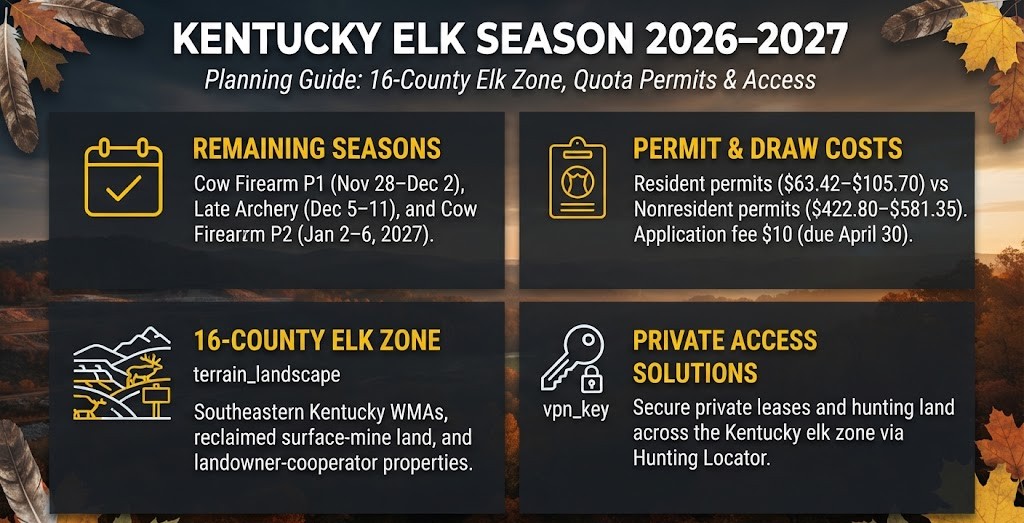
Kentucky Elk Season 2026: Quick Overview
Kentucky elk hunts are permit-only, assigned through a random quota drawing. All hunting takes place in the 16-county elk zone in southeastern Kentucky, which the Kentucky elk regulations page defines as Bell, Breathitt, Clay, Floyd, Harlan, Johnson, Knott, Knox, Leslie, Letcher, Magoffin, Martin, McCreary, Perry, Pike, and Whitley counties. For more on the species in the state, see our Kentucky elk hunting season overview.
| Season | Dates | Sex | Bag Limit | Notes |
|---|---|---|---|---|
| Archery/Crossbow – Early | Sept 12–25, 2026 | Either-sex | 1 elk/license year | 170 archery/crossbow permits (shared) |
| Bull Firearm – Period 1 | Sept 26–30, 2026 | Bull | 1 elk/license year | Prime bugling time |
| Bull Firearm – Period 2 | Oct 3–7, 2026 | Bull | 1 elk/license year | 140 bull permits total |
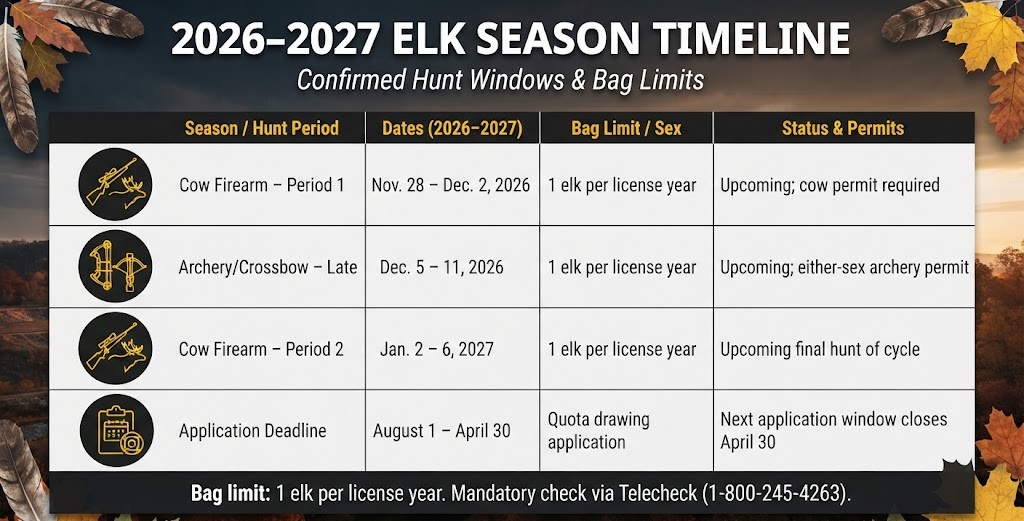
| Cow Firearm – Period 1 | Nov 28–Dec 2, 2026 | Cow | 1 elk/license year | Better draw odds |
| Archery/Crossbow – Late | Dec 5–11, 2026 | Either-sex | 1 elk/license year | Late-season cold |
| Cow Firearm – Period 2 | Jan 2–6, 2027 | Cow | 1 elk/license year | Final hunt of cycle |
Shooting hours run from 30 minutes before sunrise to 30 minutes after sunset. Baiting is prohibited in the elk zone, and every harvested elk must be checked through Telecheck.
Every elk hunter needs a license and a permit. For statewide context, see our Kentucky hunting season and license guide. You’ll need:
- An annual hunting license (resident or nonresident).
- An elk quota permit (either-sex, cow, or youth).
- A $10 application fee per hunt choice.
- Hunter education: Kentucky hunter education requirements apply; confirm your status with KDFWR before purchasing.
The drawing window is open now, and applications are due by April 30, so there’s time to apply for every hunt choice you’d want. Confirm current regulations with KDFWR before you hunt.
Kentucky Elk Season Dates 2026 by Hunting Method
Kentucky’s elk season is split into three methods and six hunt periods, all within the 16-county zone. Each method has its own permit pool, which matters when you decide which hunt choices to put on your application.
Archery/Crossbow Elk Season (Early and Late)
Archery and crossbow hunters get two windows. The early season ran September 12–25, 2026 and is now closed. The late season runs December 5–11, 2026 and is still ahead. Both are either-sex, and 170 archery/crossbow permits are available.
If you hold a late-season tag, expect cold weather and daylight-only shooting hours. The early season overlaps rut activity, so it’s a useful reference when planning future applications.
Bull Firearm Elk Season (Periods 1 and 2)
The bull firearm hunts ran in two periods: Period 1 on September 26–30, 2026 and Period 2 on October 3–7, 2026. Both are now closed. Only 140 permits are issued, and Period 1 is known as prime bugling time.
This is the most sought-after tag in the state. If you’re planning for next year, apply for other hunt choices as well, since each additional application adds a chance of drawing.
Cow Elk Firearm Season (Periods 1 and 2)
Both cow firearm hunts are still ahead. Period 1 runs November 28–December 2, 2026, and Period 2 runs January 2–6, 2027. There are 164 permits, and these hunts offer better draw odds than the bull tags.
If you hold a cow tag, a few things are worth sorting out early:
- Plan your meat care before you head out.
- Keep the Telecheck number handy: 1-800-245-4263.
- Mark your calendar for the post-season survey, due by the end of February.
One Elk Per License Year. You may take one elk per hunter per license year. After a harvest, you must stop hunting elk and the permit becomes invalid. You also cannot take an elk in both a quota hunt and an out-of-zone hunt in the same season.
Kentucky Elk Permit Cost and Licenses (Resident and Nonresident)
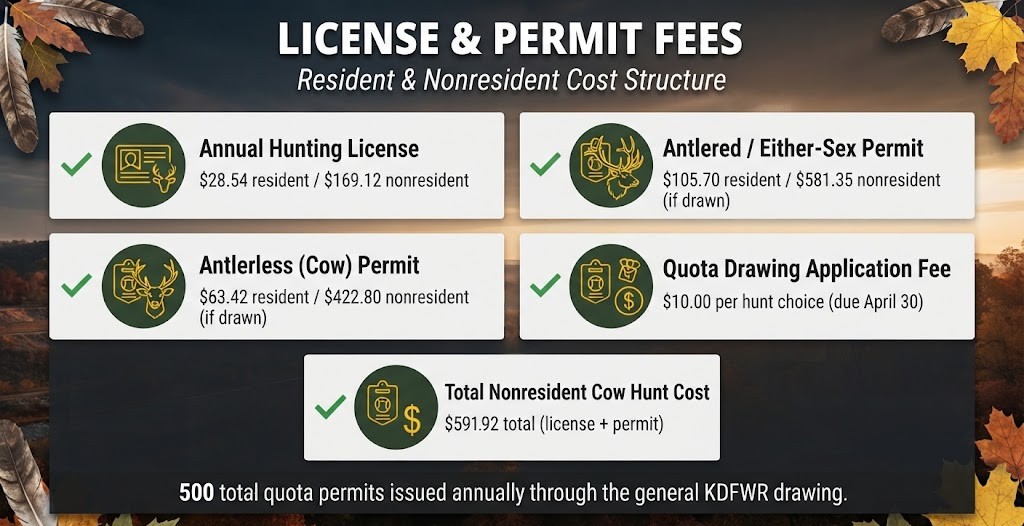
You pay $10 to apply. License and permit fees apply only if you’re drawn, and the figures below cover everything you’ll owe.
Kentucky Hunting Licenses
| Item | Resident | Nonresident |
|---|---|---|
| Annual hunting license | $29 | $169 |
| Antlered / Either-Sex permit | $106 | $581 |
| Antlerless (Cow) permit | $63 | $422.80 |
| Youth Either-Sex permit | $31.71 | $211.40 |
| Application fee (per hunt choice) | $10 | $10 |
A successful hunt costs the following once you add license and permit together:
- Nonresident either-sex/bull: $169.12 + $581.35 = $750.47
- Nonresident cow: $169.12 + $422.80 = $591.92
- Resident either-sex: $134.24
- Resident cow: $91.96
Add $10 per application in every case. The low resident cost puts this hunt within reach of most hunters. Nonresident permits are limited, so apply early and apply every year.
Kentucky Elk Quota Hunt Drawing and Permits
Kentucky issues 500 permits through the general drawing:
| Permit Type | Number of Permits |
|---|---|
| Bull firearm | 140 |
| Cow firearm | 164 |
| Archery/crossbow | 170 |
| Youth | 26 |
| Total | 500 |
Those 500 permits go up against heavy statewide and nonresident demand, so apply every year and for multiple hunt choices. The process runs in this order:
- Apply online with KDFWR between August 1 and April 30, paying $10 per hunt choice.
- Pick multiple hunt types to improve your chances.
- Watch for results after the May drawing.
- If drawn, buy your license and permit by June 15 or you forfeit the permit.
- Submit up to five unit choices by June 30. A second random draw assigns your unit.
- Scout your unit and secure access before your season.
Units cap hunter numbers on public access land, so your unit determines where you can go. Once you hold a tag, the unit and your access matter as much as the draw did.
A few rules to keep in mind as you plan:
- Shooting hours are daylight only.
- Baiting is banned in the elk zone.
- Elk calling is restricted on public land from September 1 until archery season opens.
Kentucky Elk Zone: Where to Hunt
The elk zone spans roughly 4 million acres of reclaimed mine land and hardwoods across southeastern Kentucky. The state was the first in the East to restore elk, and RMEF’s Kentucky access coverage explains how that restoration effort continues to expand hunting opportunities.
Best Public Lands for Elk Hunting in Eastern Kentucky
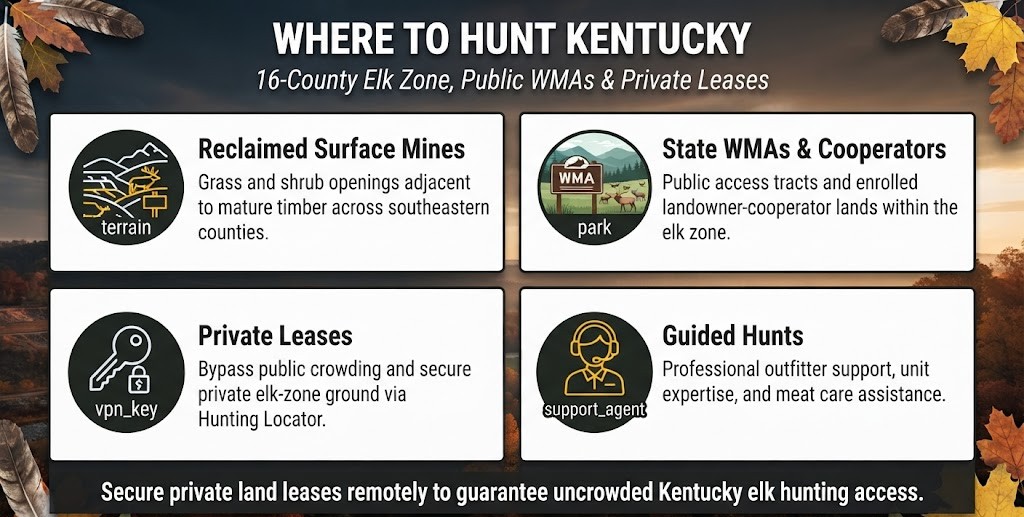
Public access exists but is limited by unit. Places to focus:
- Wildlife management areas within the zone. Confirm current boundaries and access rules with KDFWR before you go.
- Reclaimed surface-mine land. Grass and shrub openings next to mature timber create good elk habitat.
- Landowner-cooperator lands. These properties are enrolled in public hunting agreements, and landowners earn one either-sex permit for every 5,000 acres enrolled.
- Your assigned unit’s public access areas. Study them closely once you’re drawn.
Elk country also overlaps bear range, so if you want to add another species to your trip, see the Kentucky black bear hunting season guide.
Private Land Hunting with Hunting Locator
Public ground gets pressure, and scouting time is short. Private land lets you spend your days hunting instead of searching.
There are two main routes to private ground:
- Leasing: Lower upfront cost, seasonal flexibility, and terms set by the landowner. Check the access rules, permitted species, and liability terms before you sign.
- Buying hunting land: Long-term control and year-round use, with more commitment. Buying hunting land for sale in Kentucky suits hunters ready to invest in a permanent base.
Elk-zone ground is useful beyond elk season. It holds whitetail, covered in the Kentucky deer hunting season guide, and spring gobblers add more value, which our Kentucky turkey hunting season guide covers.
Hunting Locator connects hunters directly with landowners who will lease or sell their land. Our Kentucky hunting leases page lets you search by state, game type, and acreage to find a property that fits your hunt. Listings change, so check the live page for what’s available right now.
Browse Kentucky hunting leases and contact landowners before your season so your scouting days go to hunting.
Guided Elk Hunts in Kentucky
You don’t need a guide to hunt Kentucky elk, but one can help a nonresident or first-timer get oriented. If you’re considering an outfitter, check for:
- Kentucky licensing.
- Experience in your assigned unit.
- Access to private or cooperator land.
- What’s included (lodging, meat care).
- References you can call.
- Alignment with your season dates.
Hunting Locator can help you connect with outfitters and landowners when you’re ready to start the search.
Kentucky Elk Hunting Tips
These tips reflect widely accepted elk hunting practice. When you’re ready to gear up, the Hunting Locator store is a good place to start.
- Scout reclaimed mine edges. Elk feed in the grass and shrub openings and bed in nearby timber, so the transition zones are where you want to be.
- Glass at first and last light. Quality optics let you locate elk from a distance without bumping them, and you’ll find options in the store.
- Respect the calling restriction. Mimicking elk sounds on public land is restricted from September 1 until archery season opens, so check the rules before you bring a call afield. Calls are available in the store.
- Never bait in the zone. Baiting is prohibited in the 16-county elk zone, so plan your setup around natural travel routes instead.
- Place shots ethically. Use a rifle or bow with enough power for large game, and take only shots you’re confident you can make cleanly.
- Pack for meat care. A 700-pound animal means real work after the shot, so bring game bags and a pack that can handle the haul. Packs are in the store.
- Have your Telecheck plan ready. Report your harvest at 1-800-245-4263, and finish the post-season survey by the end of February.
- Train for steep terrain. Eastern Kentucky hills are demanding, and good conditioning makes every day in the field easier.
The store carries optics, calls, packs, and field gear for the late season.
More Resources from Hunting Locator
These Hunting Locator pages cover access, the rest of your Kentucky seasons, and gear.
Find Access
- Hunting Locator home: Search leases, outfitters, and land for sale nationwide.
- Kentucky hunting leases: Browse Kentucky listings by game type and acreage.
Plan Your Kentucky Seasons
- Kentucky elk hunting season: Our companion overview of elk hunting in the state.
- Kentucky hunting season: Statewide dates, licenses, and rules.
- Kentucky deer hunting season: Plan your whitetail hunts.
- Kentucky black bear hunting season: Bear dates and regulations.
- Kentucky turkey hunting season: Spring and fall turkey info.
- Kentucky waterfowl hunting season: Plan the rest of your Kentucky season.
Gear Up
- Hunting Locator store: Get the right gear for elk and every other species.
FAQ
When are the 2026 Kentucky elk seasons?
Kentucky has six elk hunts. Early archery/crossbow (Sept 12–25) and bull firearm periods (Sept 26–30 and Oct 3–7) have closed. Three remain: cow firearm Period 1 (Nov 28–Dec 2, 2026), late archery/crossbow (Dec 5–11, 2026), and cow firearm Period 2 (Jan 2–6, 2027).
How much does a nonresident elk tag cost?
A nonresident either-sex or bull hunt costs $750.47 ($169.12 license plus $581.35 permit). A cow hunt costs $591.92 ($169.12 license plus $422.80 permit). Both are on top of the $10 application fee per hunt choice, which you pay up front.
When is the Kentucky elk application deadline?
The application window runs August 1 through April 30. Winners are drawn in May, and drawn hunters must buy their license and permit by June 15 or forfeit the permit. Unit selections are finalized by June 30.
How many elk permits does Kentucky issue?
Kentucky issues 500 permits through the general drawing: 140 bull firearm, 164 cow firearm, 170 archery/crossbow, and 26 youth permits. Demand is heavy, so apply every year and for multiple hunt choices.
Can I bait elk in Kentucky?
No. Baiting is prohibited throughout the 16-county elk zone. Elk calling is also restricted on public land from September 1 until archery season opens, so check the rules before you bring a call afield.
How do I check a harvested elk?
Report your harvest through Telecheck at 1-800-245-4263. You must also complete the post-season survey by the end of February. Meeting both deadlines keeps you in good standing for future draws.
Can I hunt elk on private land?
Yes, with landowner permission. Landowner-cooperator properties are enrolled in public hunting agreements, and you can search for additional access on the Kentucky hunting leases page.
Do I need a guide?
No, a guide isn’t required. A licensed outfitter can help nonresidents and first-timers, though. Use the outfitter checklist in the Guided Elk Hunts section to evaluate your options before you book.
Can I take an elk in both a quota hunt and an out-of-zone hunt?
No. Kentucky limits you to one elk per hunter per license year. After a harvest, you must stop hunting elk and your permit becomes invalid, regardless of which hunt you were on.
The Final Shot
Three hunts remain this season, with cow firearm Period 1 opening November 28. After any harvest, you’ll need to report through Telecheck and complete the post-season survey, and the next application deadline is April 30.
If you plan to apply, start looking at access now. Browse Kentucky hunting leases and contact landowners so your ground is lined up when your tag comes through.


