This Maryland waterfowl guide will have everything you need to know for a successful hunt: dates, bag limits, and fees. Here’s what you’ll find below:
- Confirmed 2026-2027 season dates and bag limits for teal, ducks, and Canada geese, broken down by season type and zone
- Licenses, stamps, and HIP requirements for both residents and non-residents
- Where to hunt — public Wildlife Management Areas, private leases, and guided outfitters
Confirm final details against official Maryland DNR regulations before heading afield. Here are the fast facts first.
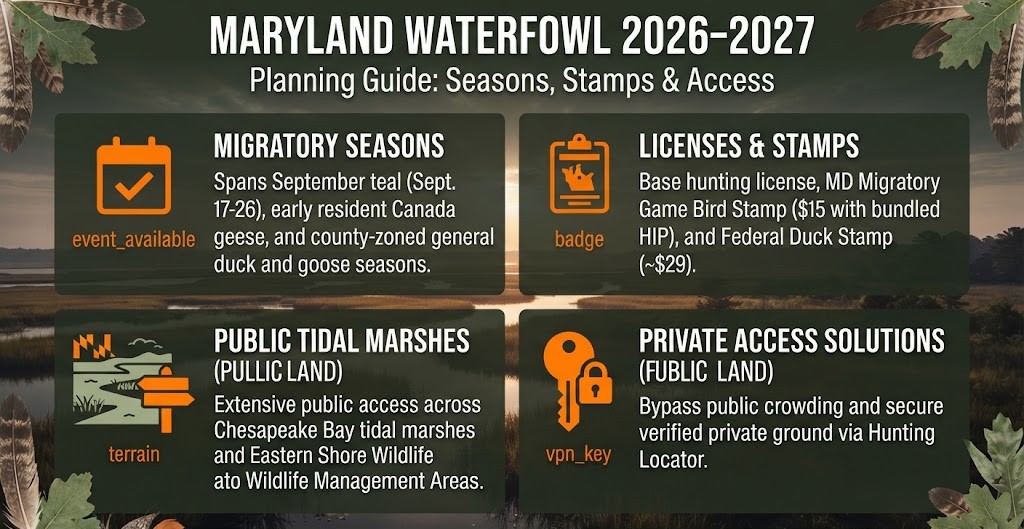
Quick Overview: 2026-2027 Maryland Waterfowl Seasons at a Glance
These are the confirmed 2026-2027 dates per Maryland DNR and the 2026-2027 Maryland Guide to Hunting and Trapping. County-specific zone splits apply on top of these statewide dates — full framework details live in the official Guide. For a species-by-species breakdown, see the full Maryland season guide, and for more on waterfowl regs specifically, check our full waterfowl regs deep-dive.
| Species | Season Type | Dates | Bag Limit | Notes |
|---|---|---|---|---|
| Teal | Special September Teal Season | Sept 17–26, 2026 | 6/day (possession 18) | Shooting hours: ½-hr before sunrise to sunset |
| Canada Goose | Early Resident | Starts Sept 1, 2026 | Per 2026-2027 DNR Guide | Extended shooting hours: ½-hr before sunrise to ½-hr after sunset |
| Canada Goose | Late Southern MD Resident Zone | Nov 21–23; Nov 24–27; Dec 15, 2026–Jan 30, 2027; Feb 1–Mar 10, 2027 | 5/day; 2/day; 2/day; 5/day (by segment) | Southern Maryland Canada goose zone segments |
| Ducks, Coots & Other Geese | General Season | Full framework in 2026-2027 MD Guide | See official Guide | County-specific zone splits apply |
Check these dates and your specific zone against official DNR regulations before you load the truck.
Getting legal to hunt comes down to a short checklist:
- Base hunting license — required for most hunters, resident or non-resident.
- Maryland Migratory Game Bird Stamp ($15) — required for all migratory bird hunters, including license-exempt landowners; includes your HIP registration.
- Federal Duck Stamp (~$29) — required for all waterfowl hunters ages 16 and older.
- Hunter education — mandatory for hunters born on or after January 1, 1975, with a non-resident waterfowl exception covered below.
Maryland Waterfowl Hunting Seasons
Maryland’s waterfowl calendar runs as a series of overlapping opportunities, starting with September teal and continuing through Canada goose segments into March. Every date and bag limit below comes directly from Maryland DNR and the 2026-2027 Maryland Guide to Hunting and Trapping.

Special September Teal Season
The Special September Teal Season runs September 17–26, 2026, giving hunters an early crack at the flyway before broader duck season opens. Daily bag limit is 6 teal, possession limit 18, shooting hours from a half-hour before sunrise to sunset.
Teal move early and fast, so hunters who scout flooded fields and shallow impoundments in mid-September often find birds before most other waterfowlers are thinking about the season yet.
Early Resident Canada Goose Season
The Early Resident Canada Goose season starts September 1, 2026, with extended shooting hours from a half-hour before sunrise to a half-hour after sunset. That extra time at both ends of the day helps hunters targeting local resident geese before the broader migration pushes new birds into the state.
Full bag-limit specifics for this segment are published in the 2026-2027 Maryland Guide to Hunting and Trapping — confirm your exact numbers there before opening morning.
Late Southern Maryland Resident Canada Goose Zone & General Duck Season
The Southern Maryland Canada goose zone breaks the late season into four segments, each with its own daily bag limit:
| Segment Dates | Daily Bag Limit |
|---|---|
| Nov 21–23, 2026 | 5/day |
| Nov 24–27, 2026 | 2/day |
| Dec 15, 2026–Jan 30, 2027 | 2/day |
| Feb 1–Mar 10, 2027 | 5/day |
The daily limit shifts across the winter by design, timed to migration patterns and local goose populations in Southern Maryland. Confirm your county falls within this zone before counting on these numbers.
For general ducks, coots, and other geese, the full regulatory framework — including county-specific zone splits and per-species duck limits — is published in the 2026-2027 Maryland Guide to Hunting and Trapping. Maryland’s regular waterfowl framework stretches from early winter into March 2027; rather than reproduce an incomplete table here, we’ll point you to the official Guide for the exact numbers in your zone. As a general rule, possession limits run three times your daily bag limit across most migratory species.
Before setting a decoy spread anywhere in the state, verify your county’s zone assignment against the DNR’s interactive zone map. Zone lines cut through counties in ways that surprise even longtime hunters.
Maryland Waterfowl Licenses & Permits
Getting legal to hunt waterfowl in Maryland boils down to a base license, a couple of required stamps, and — depending on your birth year — a hunter education card. Everything below can be purchased through official DNR channels: online, by phone, at a DNR service center, or through one of the state’s sport license agents.
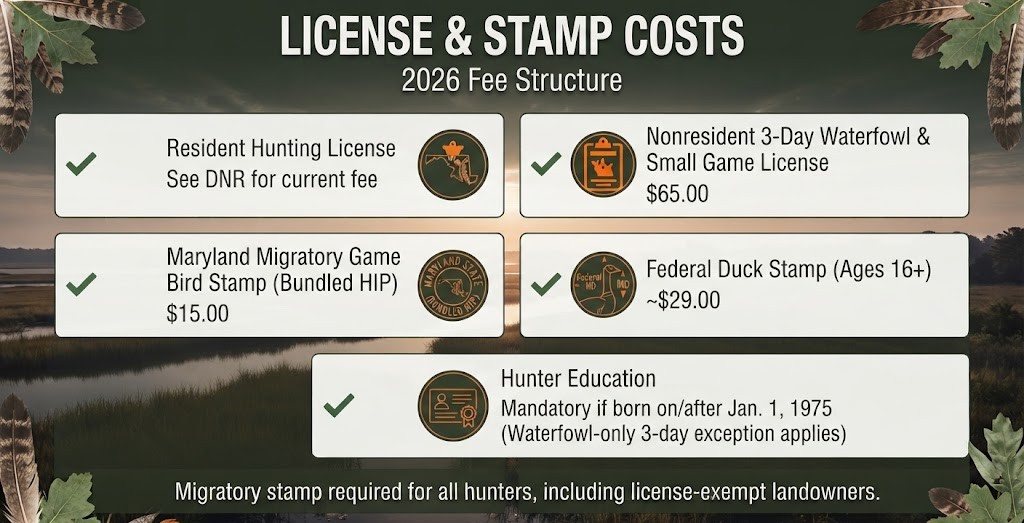
Maryland Hunting Licenses
Your license needs depend on where you live and how long you’re hunting:
| License Type | Who It’s For | Cost | Notes |
|---|---|---|---|
| Resident Hunting License | Maryland residents | See DNR for current fee | Base license required for migratory bird hunting |
| Nonresident 3-Day Waterfowl & Small Game License | Out-of-state hunters on short trips | $65.00 | Covers all legal game except deer, bear, and turkey for 3 consecutive legal hunting days; also covers upland/small game |
| Junior/Senior Hunting Licenses | Youth and senior hunters | See DNR | Qualify holders to hunt migratory game birds |
If you’re traveling in from out of state for a short trip, the Nonresident 3-Day Waterfowl & Small Game License ($65) is likely your best fit. It covers waterfowl over three consecutive hunting days and also covers upland and small game, worth knowing if you want to fit in a pheasant or rabbit hunt while you’re there.
Planning a longer trip? Check the DNR site for full-term nonresident license options, and confirm current fees with Maryland DNR before purchasing since pricing can shift year to year.
Maryland Hunting Permits & Stamps
Beyond your base license, Maryland requires a short stack of stamps and permits before you can legally chase waterfowl:
- Maryland Migratory Game Bird Stamp ($15) — required for all migratory bird hunters, including license-exempt landowners. This stamp includes your HIP registration, so no separate registration is needed.
- Federal Duck Stamp (~$29) — required for all waterfowl hunters ages 16 and older; carry a printed receipt in the field.
- HIP (Harvest Information Program) permit — required registration for migratory bird hunters that feeds harvest data into population management decisions. In Maryland, it’s bundled directly into the Migratory Game Bird Stamp, so one purchase covers both.
- Where to buy — online, by phone at 855-855-3906, at a DNR service center, or through any of the state’s roughly 250 sport license agents.
The license-exempt-landowner detail trips up a lot of hunters: even if you own the land you’re hunting and don’t need a base hunting license, you still need the Migratory Game Bird Stamp to legally target migratory birds.
Hunter education is mandatory for hunters born on or after January 1, 1975, with one exception: it does not apply to hunters targeting only waterfowl under the Nonresident 3-Day Waterfowl & Small Game License. That’s a real shortcut for traveling hunters who haven’t completed a hunter education course elsewhere.
Confirm all current requirements with Maryland DNR before your hunt — regulations get updated, and a five-minute check beats a costly mistake in the field.
Maryland Waterfowl: Where to Hunt
Finding birds is only half the equation; finding somewhere to legally and consistently hunt them is the other half. Maryland offers three paths: free public land, private leases, and guided hunts.
Best Public Lands & WMAs
Public land is the lowest-commitment way to get into the marsh, and Maryland has genuine opportunity if you know where to look. The state’s public waterfowl access generally falls into a few categories:
- Chesapeake Bay tidal marshes — extensive public marsh access along the Bay’s tributaries, holding ducks and geese throughout the season
- Eastern Shore Wildlife Management Areas — public WMAs across the Eastern Shore that see heavy migration traffic during peak months
- River and impoundment access — public water and flooded-field access inland, offering an alternative when coastal spots get crowded
For the current, complete directory of public WMAs and the interactive waterfowl zone map, check the official Maryland DNR site directly — that’s the best source for exact boundaries and any seasonal access changes.
The best public spots get hammered fast once migration peaks. Pressured birds get wary, blinds fill up before sunrise, and a spot that produced last week can go quiet the next. That’s usually when hunters start looking for something more reliable.
Public spots getting crowded? Browse Maryland hunting leases and hunt on your own terms instead of racing for a parking spot before dawn.

Private Land Hunting with Hunting Locator
Private land solves the crowding problem in a way public access never fully can. Less competition means birds decoy better, patterns hold longer, and you get to manage your own spread instead of adjusting to whoever set up nearby overnight. That applies whether you’re leasing a marsh for the season or looking at waterfowl hunting land for sale outright.
Losing access — or never finding it in the first place — is one of the most frustrating parts of hunting. That’s why Hunting Locator exists: to connect hunters directly with landowners ready to lease or sell quality hunting ground, without cold calls and word-of-mouth leads that dry up.
Right now, Maryland waterfowl leases on the platform include tracts across Eastern Shore counties suited to duck and goose hunting, with acreage and access details listed for each property. Browse by county, game type, or acreage to find ground that matches how and where you want to hunt this season.
Whether you’re chasing a season-long lease or looking to put down roots with a property of your own, the same search connects you to both.
Guided Waterfowl Hunts
Not every hunter wants to manage a lease or spend a season scouting new water, and that’s where a guided hunt earns its keep. Guided hunts make sense for non-residents unfamiliar with Maryland’s zones, beginners who want a mentored first experience, or any hunter short on time to scout ahead of the season.
The core difference comes down to what’s included:
- Guided hunts are full-service — your guide handles access, decoys, calling, and often dogs, so you show up and hunt
- Leased land gives you independent access to hunt on your own schedule, without a guide directing the day
If independence and repeat access matter more to you than a full-service experience, secure your own lease instead and build a spot you can return to season after season.
Maryland Waterfowl Hunting Tips & Gear
A little field-tested know-how goes a long way toward turning a slow morning into a limit. These fundamentals apply whether you’re hunting your first season or your fifteenth.
- Scout before you set up. Read the wind and water before you commit to a spot — waterfowl land into the wind, so position your blind and decoys with that in mind rather than fighting the conditions.
- Match your decoy spread to the season. Species-specific decoys matter; a tight teal spread works early, while a larger, more spread-out goose rig makes more sense as the season progresses into winter.
- Stay hidden. A well-brushed layout blind or a floating blind is often the difference between birds flaring off at 60 yards and finishing right in your lap.
- Master a few calls. A beginner-friendly duck or goose call, used sparingly and with restraint, will out-produce over-calling almost every time.
- Shoot legal, shoot clean. Non-toxic shot — steel or bismuth — is federally required for waterfowl, so pattern your 12-gauge with a modified or full choke before opening day rather than guessing in the field.
- Dress for the marsh. Quality waders and waterproof outerwear keep you comfortable in cold, wet Chesapeake conditions, and a life jacket is essential safety gear anytime you’re hunting open water.
Ready to fill out your kit? Shop waterfowl hunting gear at the Hunting Locator store, where you’ll find decoys, calls, blinds, and cold-weather essentials built for exactly this kind of hunting.
More Resources from Hunting Locator
Consider Hunting Locator your season-planning hub — beyond this guide, we’ve built out resources covering every major species and hunting need in Maryland:
- Maryland Waterfowl Hunting Season — a companion deep-dive covering waterfowl regulations in more detail.
- Maryland Hunting Season Guide — the statewide master guide covering every species and season in one place.
- Maryland Deer Hunting Season — whitetail season dates and tactics.
- Maryland Elk Hunting Season — everything you need to know about Maryland’s elk opportunities.
- Maryland Small Game and Upland Bird Hunting Season — a natural add-on, especially since your Nonresident 3-Day license already covers upland game.
- Maryland Turkey Hunting Season — dates and strategy for Maryland’s spring and fall turkey seasons.
- Maryland Hunting Leases — find private waterfowl access near you, season after season.
- Hunting Locator Store — gear up with everything from decoys to waders before opening day.
Frequently Asked Questions
Do I need a duck stamp to hunt waterfowl in Maryland?
Yes. All waterfowl hunters ages 16 and older need the Federal Duck Stamp (~$29), and all migratory bird hunters need the Maryland Migratory Game Bird Stamp ($15), which includes your HIP registration. Both are confirmed requirements per Maryland DNR for the 2026-2027 season.
What are the Maryland teal season 2026 dates?
The Special September Teal Season runs September 17–26, 2026, with a daily bag limit of 6 teal and a possession limit of 18. Shooting hours run from a half-hour before sunrise to sunset. These dates are confirmed by Maryland DNR.
How much is a non-resident Maryland waterfowl license?
The Nonresident 3-Day Waterfowl & Small Game License costs $65.00 and covers all legal game except deer, bear, and turkey for three consecutive legal hunting days, plus the required stamps. Confirm current fees directly with Maryland DNR before purchasing, since pricing can change year to year.
What is the HIP permit and do I need it in Maryland?
HIP, or the Harvest Information Program, is a required registration for migratory bird hunters that helps wildlife agencies track harvest data for population management. In Maryland, it’s bundled directly into the Maryland Migratory Game Bird Stamp, so buying that stamp automatically covers your HIP requirement.
When does the Early Resident Canada Goose season start in Maryland?
The Early Resident Canada Goose season starts September 1, 2026, and features extended shooting hours running from a half-hour before sunrise to a half-hour after sunset. This date and detail are confirmed by Maryland DNR for the 2026-2027 season.
Do non-residents need hunter education to waterfowl hunt in Maryland?
Generally, hunter education is mandatory for hunters born on or after January 1, 1975. However, this requirement does not apply to hunters targeting only waterfowl under the Nonresident 3-Day Waterfowl & Small Game License. Confirm your specific situation with Maryland DNR before your trip.
The Final Shot
Between confirmed 2026-2027 season dates, a clear path through licenses and stamps, and access options ranging from public marsh to private leases, you have what you need to plan a legal, productive Maryland waterfowl season. What’s left is straightforward: confirm your dates and zone, get your license and stamps squared away, and lock in your access before the migration peaks.
Before you head out, take one more pass through the official Maryland DNR regulations and the 2026-2027 Maryland Guide to Hunting and Trapping — regulations can shift, and a final check keeps you legal and confident in the field. That’s the standard Hunting Locator holds to: pairing accurate, up-to-date regulatory information with real access to the land you need to hunt it well.
When you’re ready to stop competing for crowded public spots and hunt on your own terms, browse Maryland hunting leases and get your season locked in before opening day arrives.


