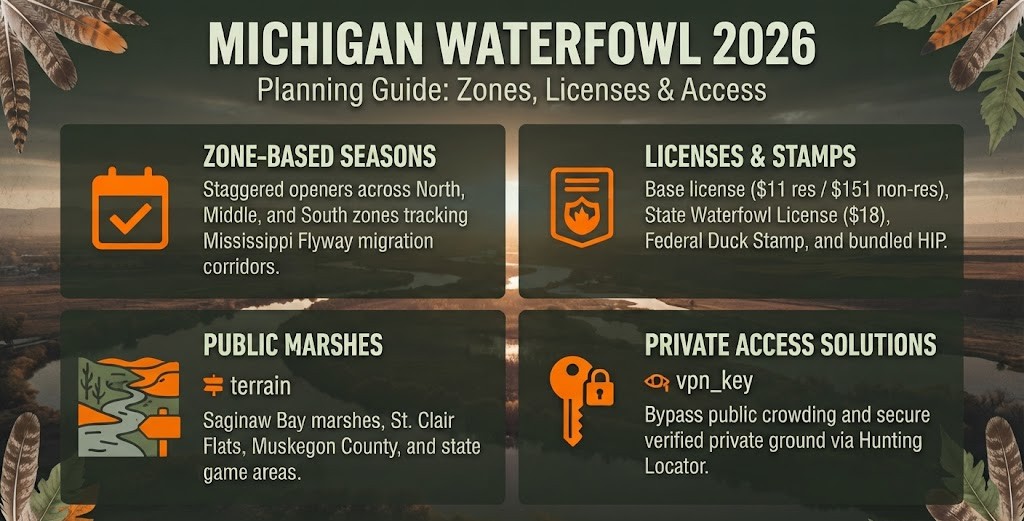
This Michigan waterfowl guide puts the zone-by-zone dates, bag limits, license costs, and access options in one place. Whether you’ve hunted the same Michigan marsh for twenty years or you’re flying in as a non-resident for a week of duck hunting, you’ll find what you need here, including where to actually hunt — from free public land to leased private ground through the Hunting Locator platform. Michigan sits in the Mississippi Flyway, and the state’s zone structure follows that migration corridor south, which is why the dates below shift depending on where you’re standing.
What’s covered:
- 2026 season dates and bag limits by zone — North, Middle, and South, plus the early teal and goose openers
- Licenses, permits, and the Federal Duck Stamp — what you need, what it costs, and how the pieces fit together
- Where to hunt — public land, leased private ground, and guided options for every budget
Michigan Waterfowl Season at a Glance
Michigan splits its waterfowl season into three zones — North, Middle, and South — each opening at a different time to track the fall migration as birds push south through the state. Your zone determines your legal dates, so start there.
| Species/Season | Dates | Daily Bag Limit | Notes |
|---|---|---|---|
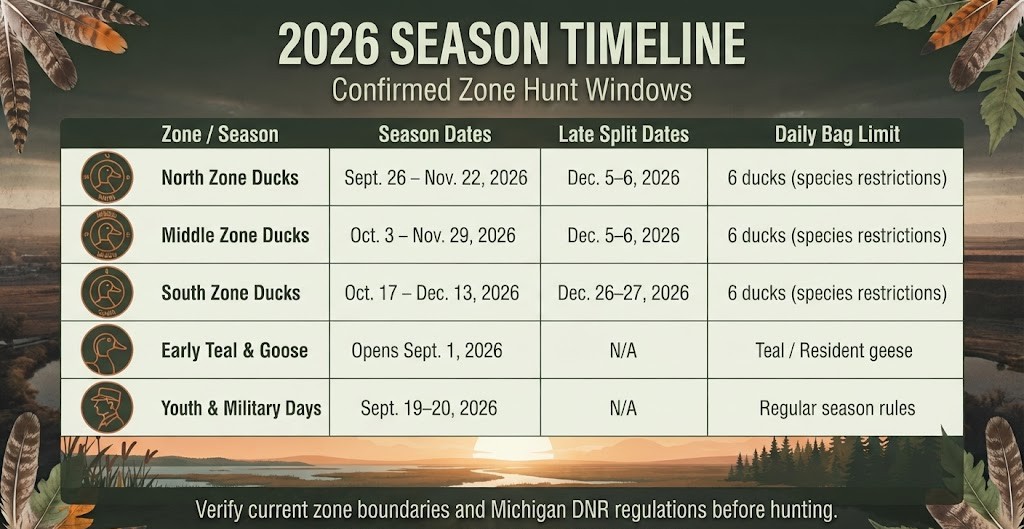
| North Zone Ducks | Sept 26 – Nov 22, 2026; late split Dec 5–6, 2026 | 6 ducks (species restrictions apply) | Opens earliest in the state |
| Middle Zone Ducks | Oct 3 – Nov 29, 2026; late split Dec 5–6, 2026 | 6 ducks | Central band of the state |
| South Zone Ducks | Oct 17 – Dec 13, 2026; late split Dec 26–27, 2026 | 6 ducks | Split-season structure |
| Early Teal | Opens Sept 1, 2026 | Teal only | Statewide |
| Early Goose | Opens Sept 1, 2026 | Targets resident Canada geese | Statewide |
| Mergansers | Season aligns with duck zones | 5 daily (max 2 hooded) | |
| Coots | Season aligns with duck zones | 15 daily | |
| Dark Geese (Canada, Brant, White-fronted) | Regular season | 5 daily | |
| Light Geese (Snow, Blue, Ross’s) | Regular season | 20 daily | |
| Possession Limit | — | 3x daily bag | Applies to most migratory birds |
| Shooting Hours | — | — | ½ hour before sunrise to sunset |
These dates and limits come from the Michigan DNR waterfowl regulations framework for 2026, but regulations can be finalized or adjusted closer to the season. Verify current dates and limits with the Michigan DNR before you hunt.
Basics to square away before you head out:
- Base hunting license — required for every hunter in Michigan
- State waterfowl license — required in addition to your base license
- Federal Duck Stamp — mandatory for hunters 16 and older
- HIP endorsement — included with your waterfowl license
- Hunter education — required if you were born on or after January 1, 1960
Michigan Duck Hunting Seasons by Zone
Michigan’s three zones function as checkpoints along the Mississippi Flyway. As ducks push south through the fall, the season opens later the farther south you go, giving hunters in each region a fair shot at birds as they arrive. For a broader look at how this season fits into the rest of Michigan’s hunting calendar, see our Michigan waterfowl season page.
Your legal dates depend on where your spot falls on the map, regardless of whether you’re a longtime resident or a non-resident hunting the state for the first time.
North Zone Season
The North Zone opens earliest, running September 26 – November 22, 2026, with a late split reopener on December 5–6, 2026. This zone gets first crack at the season because migrating birds reach Michigan’s northern reaches before pushing farther south.
Middle Zone Season
The Middle Zone covers the state’s central band and runs October 3 – November 29, 2026, with the same late split on December 5–6, 2026. It bridges the gap between the early-opening north and the later South Zone, giving hunters in Michigan’s midsection a season that lines up with when birds are actually moving through.
South Zone Season
The South Zone opens latest, running October 17 – December 13, 2026, with a late split reopener on December 26–27, 2026. That structure — a first segment, a short break, then a reopener around the holidays — gives southern Michigan hunters a second chance once colder weather up north pushes more birds down.
Early Teal, Early Goose & Special Days
Early teal season opens September 1, 2026 and runs through September 9, per the statewide youth and veterans days framework; only teal may be harvested during this window. Early goose season also opens September 1, targeting Michigan’s resident Canada goose population before migratory birds arrive later in the fall.
Michigan also sets aside two special statewide days that both fall on September 19–20, 2026: Youth Waterfowl Hunting Weekend and Veterans & Active-Duty Military Days. Both run concurrently on public and private land open to waterfowl hunting. If a reserved waterfowl area is part of your plan, note the application window of August 1–28, 2026 and apply early.
Michigan Waterfowl Licenses and Permits
Getting legal to hunt waterfowl in Michigan comes down to a three-part license stack: your base hunting license, the state waterfowl license, and the Federal Duck Stamp.
Michigan Hunting Licenses
| License Type | Resident Cost | Non-Resident Cost | Who Needs It |
|---|---|---|---|
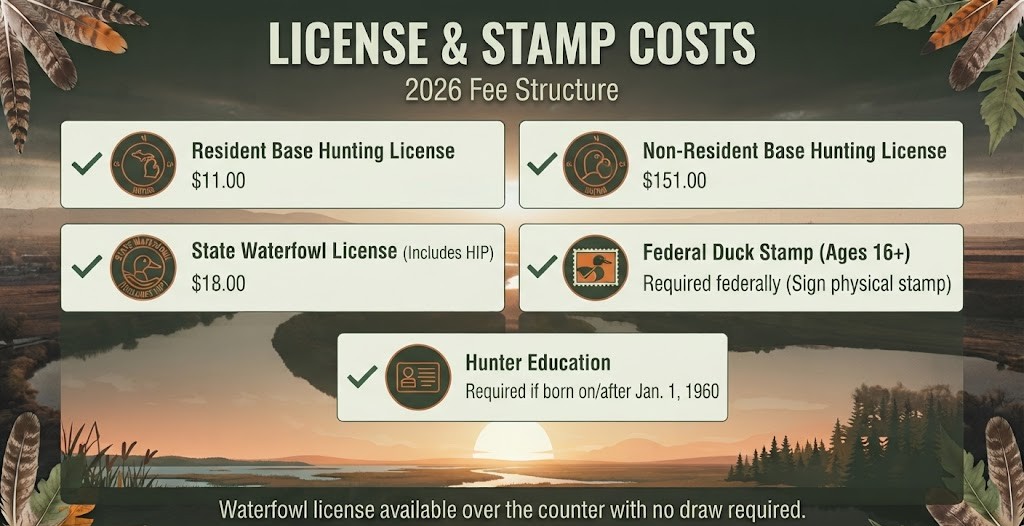
| Base Hunting License | $11 | $151 | Every hunter in Michigan |
| State Waterfowl License | $18 | $18.00 | All waterfowl hunters (in addition to base license) |
| Federal Duck Stamp | Required 16+ (price set by USFWS) | Required 16+ | Waterfowl hunters age 16 and older |
For non-residents, the math is $151 for the base license plus $18 for the state waterfowl license plus the Federal Duck Stamp — that’s your legal foundation to hunt Michigan waterfowl. There’s no residency surcharge on the waterfowl license itself; it’s the same $18 whether you live in Detroit or Dallas.
The HIP endorsement comes automatically with your waterfowl license purchase, so there’s no separate step. The waterfowl license is also available over the counter with no draw or lottery required, so you can pick it up whenever you’re ready. Non-residents can purchase all the licenses and stamps they need without any special restriction.
Michigan Hunting Permits & Requirements
The Federal Duck Stamp is required for every hunter 16 and older, and the revenue goes toward wetland conservation. You can buy it in physical or electronic format through the U.S. Fish & Wildlife Service; if you get the physical stamp, it has to be signed across the face to be valid in the field.
Hunter education is the other piece to sort out early. If you were born on or after January 1, 1960, you’ll need proof of completing an approved hunter safety course before you can buy a license. If you haven’t taken the course yet, you can hunt under an apprentice license instead, but that option is limited to two license years before you’re required to complete the course.
Licenses, stamps, and permits are all available through the Michigan DNR website or any approved license vendor across the state. Rules around apprentice licenses and endorsements can shift year to year, so double-check current requirements with the Michigan DNR before your season starts.
Where to Hunt Waterfowl in Michigan
Once your dates and licenses are locked in, the next question is where to set up. Michigan hunters generally choose from three paths: free public land, leased private ground, or a fully guided hunt.
Best Public Lands for Waterfowl
Michigan’s public land offers some of the most productive waterfowl hunting in the Midwest, and it’s a good starting point whether you’re new to the sport or just new to the state. According to industry sources tracking recognized waterfowl staging areas, these spots consistently draw birds and hunters alike:
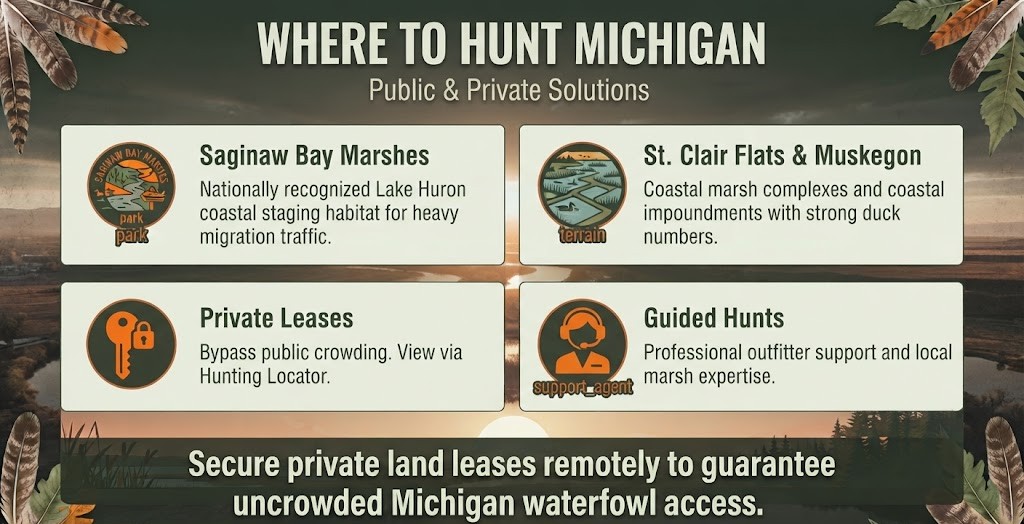
- Saginaw Bay marshes — nationally recognized staging habitat along Lake Huron’s coast, drawing heavy duck and goose traffic during migration
- St. Clair Flats — a productive coastal marsh complex known for strong puddle duck and diver numbers
- Muskegon County Wastewater System — impoundments along the Lake Michigan coast that attract large numbers of waterfowl, with public hunting available on portions of the property
- Houghton Lake and surrounding state game areas — central Michigan water offering accessible hunting for puddle ducks and Canada geese
These areas are a solid starting point if you’re scouting new water this season or arriving from out of state without a local connection yet.
Private Land Hunting with Hunting Locator
Public land gets crowded fast. More hunters are turning to private land every season because it means less pressure, better game management, and access that doesn’t disappear once word gets out.
There are two real paths to private land access: leasing and buying. Leasing gives you exclusive or semi-exclusive rights to hunt a property for a set period, with arrangements ranging from a simple annual fee to a full management agreement where the landowner handles habitat work. Buying is the long-term play — you own the ground outright and manage and hunt it for as many seasons as you want. Both routes get you off crowded public land and onto water where you control the pressure.
That’s what Hunting Locator is built for. We connect you directly with landowners across Michigan who are ready to lease or sell, with no middleman involved.
Right now, you can browse live Michigan waterfowl leases and see exactly what’s available, where, and for what terms. Leases move fast once the season gets close, so it’s worth checking what’s open near your zone soon.
Guided Waterfowl Hunts
If you’re new to Michigan waterfowl hunting, or you’re a non-resident without the local knowledge to scout water on your own, a guided hunt can shortcut a lot of the learning curve. Guides know the water, the birds’ patterns, and the legal lines that keep you compliant while you focus on the hunt itself.
According to industry sources, guided Michigan waterfowl hunts typically run from September into November, with day-hunt pricing generally falling in the $250–$300 range. Bookings are often handled first come, first served, with a deposit required to lock in your dates, so if a guided hunt is part of your plan, reach out well before the season starts.
Before booking with anyone, verify a guide’s licensing, insurance, and references.
Michigan Waterfowl Hunting Tips
Success on Michigan water comes down to preparation, concealment, and having the right gear on hand when the birds commit.
- Match your waders to the season: Breathable waders work well for warm early-season hunts, while breathable versus neoprene waders — specifically 3.5–5mm neoprene — hold up better once the water turns cold in late season.
- Build a versatile decoy spread: A spread of 1 to 3 dozen mallard decoys, plus a motion decoy or two, is usually enough to pull birds in. Scale it up or down depending on the water you’re hunting.
- Carry the right calls: A quality mallard call and a goose flute will cover most situations you’ll run into across Michigan’s marshes and flooded timber.
- Invest in solid concealment: A layout blind or ground blind that matches your surroundings keeps you hidden as birds work the decoys and circle for a closer look.
- Consider a retriever: It’s not required, but a well-trained dog is one of the most valuable pieces of gear you can bring, especially in Michigan’s cold water and heavy cover.
- Practice waterfowl ID: Learn to identify species in flight before opening day so you stay within species-specific limits like the one-pintail, two-hen-mallard restrictions.
When it’s time to gear up, the Hunting Locator store carries what you need to fill out your waterfowl kit, from decoys to concealment gear, so you’re not scrambling the week before the season opens.
More Resources from Hunting Locator
- Hunting Locator platform hub — the main hub for finding leases, outfitters, and hunting land across the country
- Live Michigan hunting leases — browse current private land opportunities across the state
- Hunting Locator store — gear up for waterfowl season and beyond
- Michigan hunting season guide — the master guide covering every season Michigan offers
- Michigan waterfowl hunting season — a deeper dive specifically on Michigan waterfowl
- Michigan game bird hunting season — for hunters who also chase upland birds
- Michigan deer hunting season — dates and details for Michigan’s deer seasons
- Michigan turkey hunting season — spring and fall turkey season info
- Michigan small game hunting season — rabbits, squirrels, and other small game dates
- Michigan elk hunting season — everything on Michigan’s limited-draw elk hunt
- Michigan black bear hunting season — bear season dates and application details
Frequently Asked Questions
What license do I need to hunt ducks in Michigan?
You’ll need a base hunting license, a state waterfowl license, and a Federal Duck Stamp if you’re 16 or older, plus the HIP endorsement (included with your waterfowl license). If you were born on or after January 1, 1960, you’ll also need proof of hunter education.
How much does it cost a non-resident to hunt waterfowl in Michigan in 2026?
Non-residents pay $151 for the base hunting license plus $18 for the state waterfowl license, plus the cost of the Federal Duck Stamp required for hunters 16 and older. Together, these three pieces make up your legal foundation to hunt waterfowl in Michigan for the season.
What are the 2026 Michigan duck season dates by zone?
The North Zone runs September 26 – November 22, with a late split December 5–6. The Middle Zone runs October 3 – November 29, with the same late split December 5–6. The South Zone runs October 17 – December 13, with a late split December 26–27. These dates come from the Michigan DNR framework — always verify before you hunt.
What is the daily bag limit for ducks in Michigan?
The daily bag limit is 6 ducks, including no more than 4 mallards (with a max of 2 hens), 3 wood ducks, 2 redheads, 2 canvasbacks, 2 black ducks, and 1 pintail. Possession limit is 3 times the daily bag limit for most migratory birds.
When does early teal season open in Michigan in 2026?
Early teal season opens September 1, 2026, and runs through September 9, with only teal legal to harvest during that window. Early goose season also opens September 1, targeting Michigan’s resident Canada goose population.
How can I find affordable hunting land in Michigan if I don’t own property?
Michigan’s state game areas offer free public access and are a good starting point, while private-land leases give you lower-pressure hunting without the crowds of popular public spots. Browsing current Michigan hunting leases is one of the fastest ways to find quality private access without buying land outright.
The Final Shot
Michigan’s 2026 waterfowl season rewards hunters who plan ahead: know your zone’s dates, stack your three licenses — base, waterfowl, and Duck Stamp — and lock in where you’re actually going to hunt before the good spots fill up.
Before you head afield, take a minute to confirm final dates, limits, and any late regulatory updates directly with the Michigan DNR. Regulations can shift, and it’s worth the five-minute check.
Turning all this regulation into an actual hunt is where we come in. We connect you directly to quality land instead of leaving you to guess. If access is the piece still missing from your plan, browse Michigan waterfowl leases and see what’s available near you.


