According to a local news report citing the DNR directly, the DNR has 5,330 licenses available across 15 bear permit areas for the 2026 season, which opens September 1 and closes October 18.
This guide covers the confirmed dates, licensing paths, and hunting access options for residents and non-residents planning a 2026 Minnesota bear hunt.
- Confirmed 2026 season dates, fees, and bag limits
- The lottery, surplus, and no-quota license paths explained
- Where to hunt: public land, guided hunts, and private leases through Hunting Locator
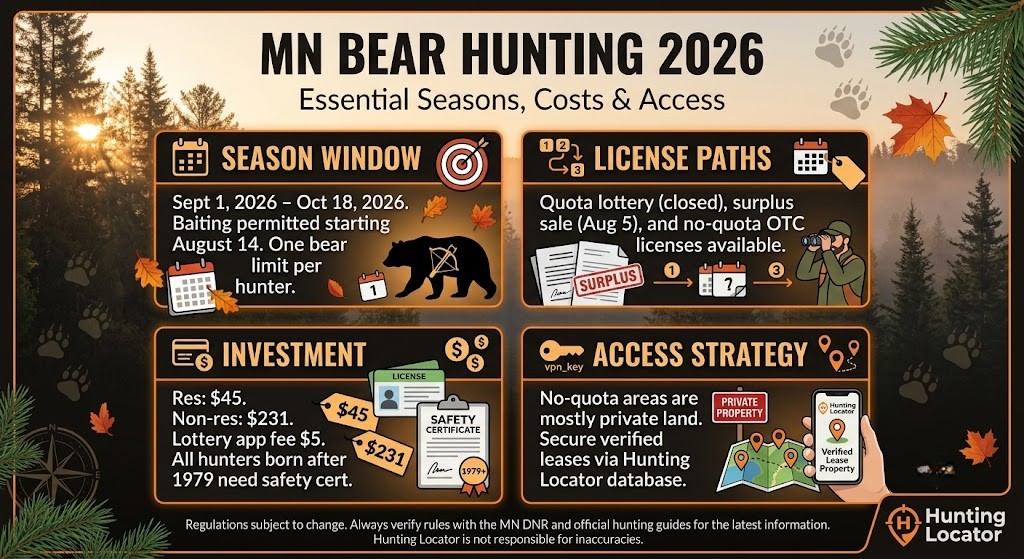
Minnesota Bear Season 2026: Quick Overview
The table below summarizes the 2026 Minnesota black bear season, drawn from the Minnesota DNR and verified reporting. Confirm current rules at the Minnesota DNR bear hunting page before purchasing a license or heading afield.
| Detail | 2026 Information |
|---|---|
| Baiting Begins | August 14 |
| Hunting Season | September 1 – October 18 |
| Bag Limit | One adult bear per licensed hunter per calendar year (either sex, except cubs) |
| Party Hunting | Prohibited — you may only tag a bear you personally harvest |
| Lottery Application Deadline | May 1 (closed for 2026) |
| License Purchase Deadline (Lottery Winners) | August 1 |
| Surplus/Unsold Licenses Available | August 5 at noon |
| Permit Structure | 15 bear permit areas (quota) + no-quota area (unlimited OTC) |
| Total Quota Licenses | 5,330 across the 15 permit areas |
Important: Tagging and registration requirements for 2026 will be announced by the DNR in June. Confirm all current rules at dnr.state.mn.us/hunting/bear before your hunt.
Before purchasing, understand which licenses and credentials apply to your situation:
- A valid Minnesota bear license is required to hunt — and to place bait
- Quota permit areas require a lottery-drawn license tied to a specific permit area; the no-quota area uses over-the-counter licenses available to anyone
- Hunters born after December 31, 1979, need a hunter safety certification or firearms safety certificate before hunting
- Applicants must be at least 10 years of age to apply for a lottery license
- All bait stations must be registered with the DNR before use
Minnesota Bear Hunting Seasons
Minnesota’s 2026 black bear season runs September 1 through October 18. How you access that season depends on your licensing path. Three routes exist, each with its own timeline, eligibility, and geographic scope.
The Lottery (Quota Permit Areas)
Minnesota’s quota system allocates bear licenses across 15 designated bear permit areas (BPAs), each tied to regional population trends. For 2026, the DNR made 5,330 licenses available across these 15 permit areas, with moderate quota increases where population trends support them. Quota zones sit in prime northern Minnesota bear country, and competition reflects that.
The 2026 application window closed May 1. For 2027 planning — and for understanding what lottery winners are navigating now — here’s how the process works:
- Apply during the application window — online, at any license agent, or by phone at 888-665-4236
- Pay the $5 application fee — applies to both residents and non-residents
- Choose a permit area — or apply for preference only (Area 99) to bank a preference point without entering the draw
- Wait for results — the DNR mails notifications to lottery winners by June 1, 2026
- Purchase your license by August 1 — winners who miss the August 1 deadline forfeit their license to the surplus pool
Preference points: Applying for Area 99 keeps you out of the draw that year but earns one preference point. Each preference point improves your odds in future lottery draws — a reasonable approach for hunters who haven’t yet built enough preference to compete for a top zone.
One geographic note: the DNR recently revised several Bear Permit Areas. BPA 451 has been removed and folded into the no-quota area, and portions of BPAs 12 and 46 along reservation boundaries have also been reassigned. Confirm your target permit area against the current DNR BPA map before applying.
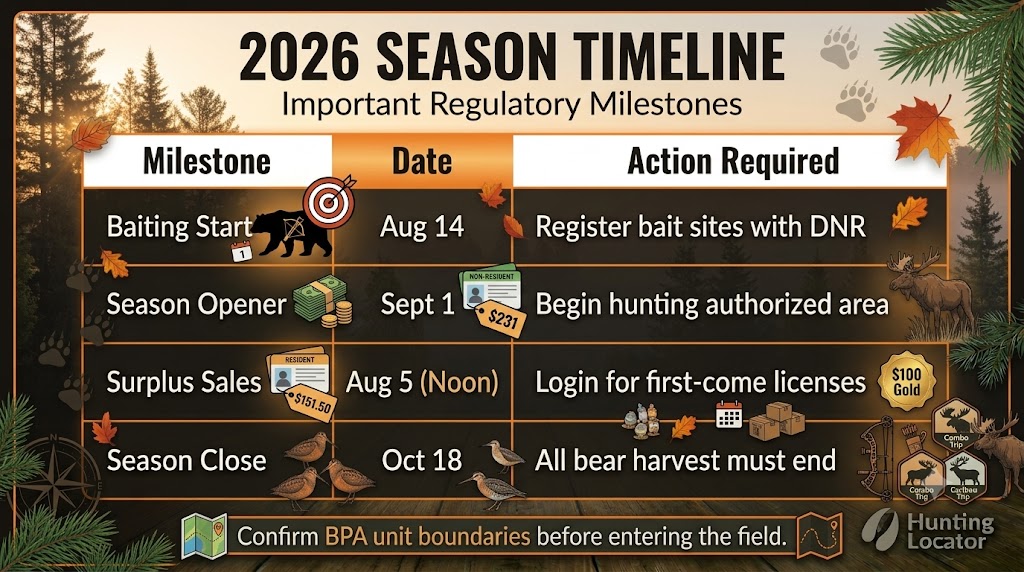
Surplus & Unsold Licenses
When lottery winners fail to purchase by the August 1 deadline, those unclaimed licenses are released to the public. Any remaining licenses become available starting at noon on August 5 on a first-come, first-served basis.
Two things to know before August 5: available permit listings are not updated in real time as sales occur, and these licenses sell out quickly. Be logged into the DNR licensing portal and ready at noon.
The No-Quota Area (Over-the-Counter)
An unlimited number of bear licenses are sold over the counter for the no-quota area, which covers east-central and far northwest Minnesota. No application, no lottery, no deadline. These licenses are valid only within no-quota area boundaries.
One detail every no-quota hunter needs to know before purchasing: the no-quota area is almost entirely private land, and hunters should find a place to hunt and obtain landowner permission before buying a no-quota license. Buying the license before securing access risks ending up with a tag and nowhere legal to hunt. We cover land access options in the section below.
Minnesota Bear Licenses and Permits
Minnesota Bear Hunting Licenses
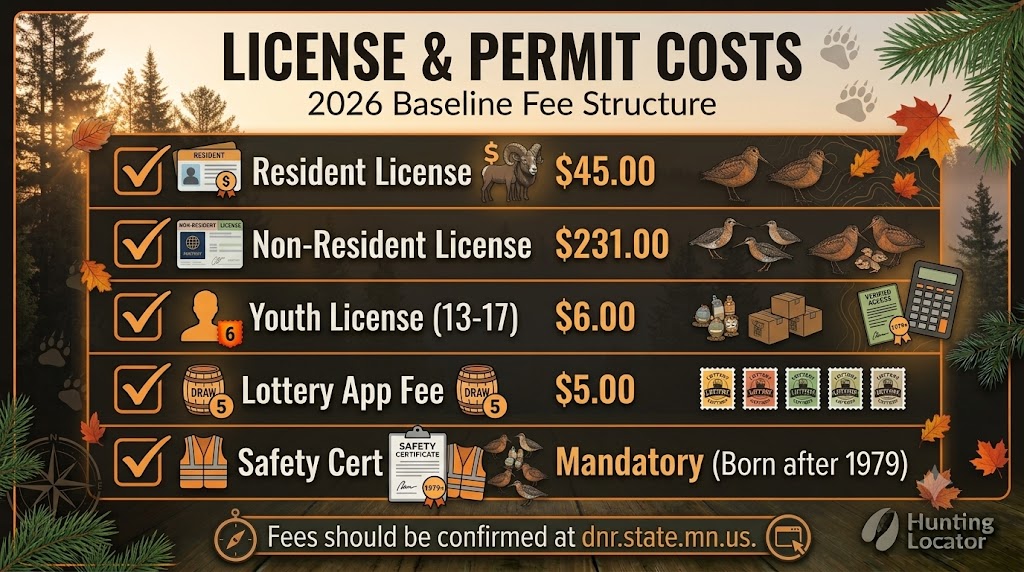
The table below lists every license category with 2026 fees. Verify current fees at the Minnesota DNR before purchasing.
| License Category | Fee |
|---|---|
| Resident (Age 18+) | $45 |
| Non-Resident (Age 18+) | $231 |
| Youth (Ages 13–17) | $6.00 |
| Lottery Application | $5 |
| Resident Military on Leave | Free |
The $5 lottery application fee is separate from the license purchase price — winners pay both. Non-residents should budget at least $236 ($231 license + $5 lottery application) before adding guide services, lodging, and travel. The $6 youth license makes Minnesota one of the more accessible states for introducing young hunters to bear hunting. Verify all fees at the DNR bear hunting page before purchasing.
Minnesota Bear Permits & The Application Process
A Minnesota bear license authorizes you to hunt. A quota permit area is the specific geographic zone that a lottery-drawn license is valid within. A license drawn for BPA 12 is only valid within BPA 12. A no-quota license is only valid within the no-quota area.
- Quota permit areas require a lottery-drawn license tied to one of 15 designated bear permit areas. Apply during the window, pay the $5 fee, select a permit area or choose Area 99 for preference points, and wait for DNR results mailed by June 1. Winners must purchase by August 1 or the license goes to the surplus pool.
- The no-quota area accepts any hunter who purchases an over-the-counter license — no draw, no deadline — but the no-quota area is comprised mostly of private land, so access needs to be secured before purchase.
Non-residents follow the same application process as residents. Both must be at least 10 years of age to apply, and all hunters born after December 31, 1979, must have a valid firearms safety certificate before hunting. Draw results are posted at mndnr.gov/hunting/bear.
Minnesota Bear Hunting: Where to Hunt
Finding legal, productive ground is often the harder half of planning a Minnesota bear season — particularly for non-residents without local knowledge and for no-quota hunters who need private land access before they can purchase a license.
Best Public Lands for Minnesota Bear Hunting
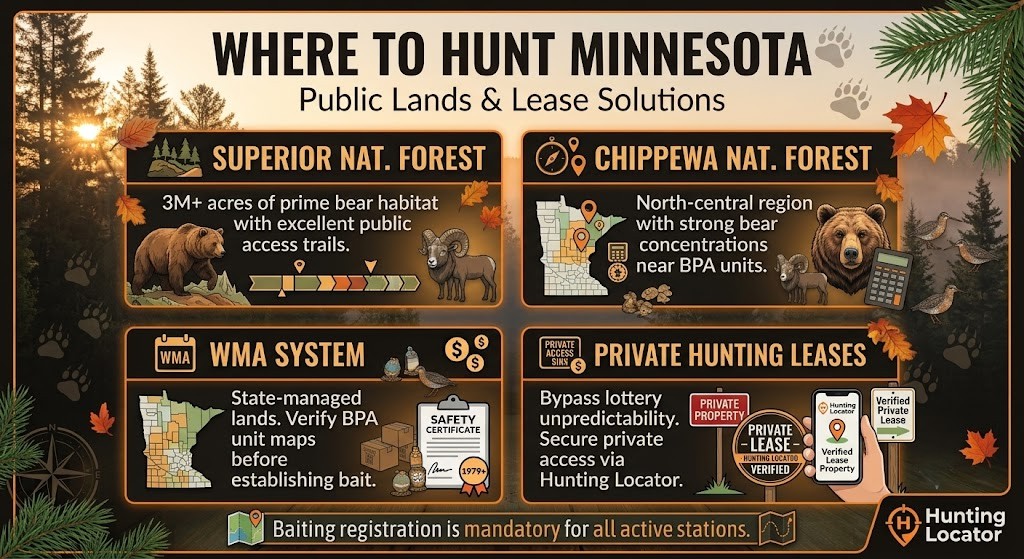
Hunters can pursue bear on state Wildlife Management Areas, county, state, and national forests, with the strongest populations concentrated in northern Minnesota. Public land is free and widely available, but bait sites there face more competition and you have less control over the hunting environment.
Minnesota’s best bear hunting typically happens on private land, where game faces less pressure and benefits from active management. Public land can produce results for hunters willing to put in the work, but the trade-offs are real.
Notable public land options include:
- Superior National Forest — Over three million acres of bear habitat in northeastern Minnesota. Licensed guides use the Sawbill Trail, Gunflint Trail, and Arrowhead Trail as primary access corridors, which gives a reasonable indication of where habitat concentrations are strongest.
- Chippewa National Forest — Located in north-central Minnesota, offering substantial bear habitat within or adjacent to several quota permit areas.
- State Wildlife Management Areas (WMAs) — Scattered across northern Minnesota, generally with less pressure than main trailheads.
- County and State Forests — Minnesota’s county and state forest system adds millions of additional huntable acres, often adjacent to private parcels that concentrate bear movement.
Before selecting public land for a bait site, confirm the parcel falls within your licensed permit area using the DNR’s online mapping tools.
Guided Bear Hunts in Minnesota
For non-residents making a trip from out of state and first-time hunters who want to reduce logistical variables, a guided hunt is worth considering. Licensed Minnesota outfitters bring established bait sites, local knowledge, and operational experience that takes years to develop independently.
What guided Minnesota bear hunts typically involve:
- Short shot distances — baited bear hunts average 15–20 yards, making this style accessible to hunters at most experience levels
- Bait management handled by the guide — state law allows 3 bait stations per hunter, with 3 additional stations available under a guide license, giving guided clients more covered ground than most DIY setups
- Variable inclusions — many outfitters provide meals and cooler storage for meat and hide, but plan to bring your own coolers for the return transport of hide and meat
Book early. Prime dates fill well before the season opens. Verify that any guide holds a current Minnesota guide license and operates within the areas covered by your license type.
Private Land Hunting with Hunting Locator
For no-quota hunters, private land access is a prerequisite — the DNR is explicit that the no-quota area is mostly private land. Quota hunters benefit from it as well: less pressure, more control over bait sites, and better odds of consistent bear activity.
Hunting Locator’s Minnesota lease listings connect hunters directly with landowners across the state who are open to leasing or selling hunting access. Whether you need a baiting parcel in east-central bear country or a lease adjacent to public land in a quota zone, the platform puts you in contact with landowners actively looking for hunters.
Leasing private land gives you exclusive access and the ability to establish and manage bait sites without competing for the same ground as every other public-land hunter in the area. For hunters new to baiting, a private lease also means fewer variables to manage at once.
Buying hunting land is the longer-term option — permanent access and the ability to manage the property for bear season after season, with no access uncertainty.
Hunting Locator connects hunters with landowners ready to lease or sell. Search by state, game type, and acreage; contact landowners directly; and secure access before the season opens. Browse available Minnesota hunting leases now.
Black Bear Hunting Tips for Minnesota
- Hunt the first two weeks hard — The best hunting occurs before small game and archery seasons open and push additional pressure into bear country. In years of normal wild food abundance, roughly 70% of the bear harvest occurs in the first week and about 80% by the end of the second. A productive bait site in week one tends to outperform anything that comes after.
- Start baiting on August 14 — Minnesota’s baiting season opens August 14, giving you more than two weeks to pattern bears before September 1. You must hold a current-year bear license before placing bait, and all bait stations must be registered with the DNR. Use the pre-season window to identify which bears are hitting your site and when.
- Load bait with high-value attractants — Bears respond to sweet, aromatic offerings — grain, candy, cereal, pastries, chocolate, and maple syrup are all proven attractants. Rotate and replenish frequently to maintain scent presence.
- Manage wind carefully — Bears have limited eyesight but extraordinary scent detection. Set your stand downwind of the bait station and approach in a way that keeps human scent out of the area. One careless approach can shut down a site for days.
- Position your stand for concealment — Place your elevated stand so your silhouette can’t be seen against the skyline. Bears that catch movement in a stand tend to abandon the site.
- Confirm your firearm is legal — Minnesota requires centerfire rifles for big game to be at least .220 caliber; smooth-bore muzzleloaders must be at least .45 caliber, and rifled muzzleloaders at least .40 caliber.
- Choose appropriate bullets — Select projectiles designed for big game — bonded or all-copper designs from major manufacturers are well-suited for bear. At typical baited-hunt distances, shot selection still matters.
- Tag, register, and pull a tooth within 48 hours — Successful hunters must tag and register their bear within 48 hours of harvest. Tooth submission is mandatory — failure to submit a tooth sample is a violation of Minnesota Game and Fish Law. The DNR uses tooth data to track age and manage population health.
- Consider a DNR bear hunting clinic if you’re new — The DNR offers a three-hour bear hunting clinic covering bear biology, behavior, and hunting techniques. For first-time bear hunters, it’s an efficient orientation before the season opens.
- Gear up before you go — From tree stands and safety harnesses to coolers for field care, the right equipment matters. Visit the Hunting Locator store to find gear suited for a Minnesota bear hunt.
More Resources from Hunting Locator
- Minnesota Bear Hunting Season — Additional coverage on Minnesota bear hunting, regulations, and access strategies
- Minnesota Hunting Season Guide — An overview of all Minnesota hunting seasons for full-year planning
- Minnesota Deer Hunting Season — Dates, regulations, and tactics for whitetail in Minnesota
- Minnesota Turkey Hunting Season — Season dates, license requirements, and tactics for spring and fall turkey hunting
- Minnesota Elk Hunting Season — Permit structure and hunting opportunities for Minnesota elk
- Minnesota Waterfowl Hunting Season — Duck and goose season planning for one of the flyway’s more productive states
- Minnesota Game Bird Hunting Season — Grouse, pheasant, woodcock, and other upland bird seasons
- Minnesota Small Game Hunting Season — Rabbits, squirrels, and other small game seasons with dates and license requirements
- Minnesota Furbearer Hunting Season — Trapping and hunting seasons for Minnesota’s furbearing species
- Minnesota Hunting Leases — Available private land leases across Minnesota for the 2026 season
Frequently Asked Questions
Can I still get a Minnesota bear license for 2026 if I missed the May 1 lottery deadline?
Yes. Two paths remain. Surplus and unsold quota licenses become available August 5 at noon on a first-come, first-served basis — be logged into the DNR licensing portal and ready at noon. An unlimited number of over-the-counter licenses are also available for the no-quota area covering east-central and far northwest Minnesota, with no application or deadline required. If you go the no-quota route, secure landowner access before buying your license.
What is the bag limit for black bear in Minnesota?
One adult bear per licensed hunter per calendar year. Either sex is legal, except cubs. Party hunting is prohibited — you may only tag a bear that you personally harvest.
What do I need to do after harvesting a bear in Minnesota?
Tag and register your bear within 48 hours of harvest. Tooth submission is also mandatory — every person who kills a bear must submit a tooth sample to the DNR for age analysis, and failure to do so is a violation of Minnesota Game and Fish Law. Tagging and registration specifics for 2026 will be announced by the DNR in June — confirm the current process at the DNR bear hunting page before your hunt.
How much does it cost to hunt bear in Minnesota as a non-resident?
The base cost is $231 for the hunting license plus a $5 lottery application fee if you applied through the quota draw. Guide services, travel, lodging, and private land access add to that floor. Minnesota’s estimated population of 13,000–18,000 black bears and the range of guided and DIY options make it a competitive destination for out-of-state hunters.
Do I need hunter education certification to hunt bear in Minnesota?
All hunters born after December 31, 1979, must have a valid firearms safety certificate before hunting — residents and non-residents alike. If you completed hunter education in another state, Minnesota may recognize that certification; confirm reciprocity details with the Minnesota DNR. First-time bear hunters should also consider attending a DNR bear hunting clinic — a three-hour session covering bear biology, behavior, and hunting technique.
What weapons are legal for bear hunting in Minnesota?
Centerfire rifles must be at least .220 caliber for big game. Smooth-bore muzzleloaders must be at least .45 caliber, and rifled muzzleloaders at least .40 caliber. Dogs and drones are prohibited for hunting big game in Minnesota, and wireless devices cannot be used in the field. Archery equipment is also legal during the season — confirm current archery regulations with the DNR before your hunt.
Closing Notes
Minnesota’s 2026 black bear season has three entry points: the quota lottery (closed for 2026 but relevant for planning), the surplus license window on August 5 at noon, and over-the-counter licenses for the no-quota area. With an estimated 13,000 to 18,000 black bears across the state and roughly 80% of the harvest occurring in the first two weeks, the opportunity is real — but access needs to be settled before opening day.
No-quota hunters must have private land lined up before purchasing a license. Quota hunters benefit from it too — less pressure and more control over bait site conditions. Browse Minnesota hunting leases on Hunting Locator to connect with landowners offering access for the 2026 season, or visit Hunting Locator to search by state, game type, and acreage.


