This Minnesota Game Bird Season Guide for 2026 lays out what is still open and what you need to hunt legally.
Minnesota’s 2026–27 bird regulations are spread across zones, segments, stamps, and validations, and it’s easy to miss a detail. This guide pulls them onto one planning page and then turns to the next question: where to hunt. Hunting Locator connects hunters with landowners who lease or sell land, and with outfitters. It’s meant for nonresidents planning a short trip, residents hunting every season, and first-timers alike.
Here’s what you’ll find:
- Every 2026–27 season date and daily/possession limit in one table, with our evergreen companion reference on the Minnesota game bird hunting season.
- Which licenses, stamps, and validations to buy, with a bundle comparison and a nonresident checklist.
- Where to hunt: public lands, private leases, and guided options, plus tips and gear.
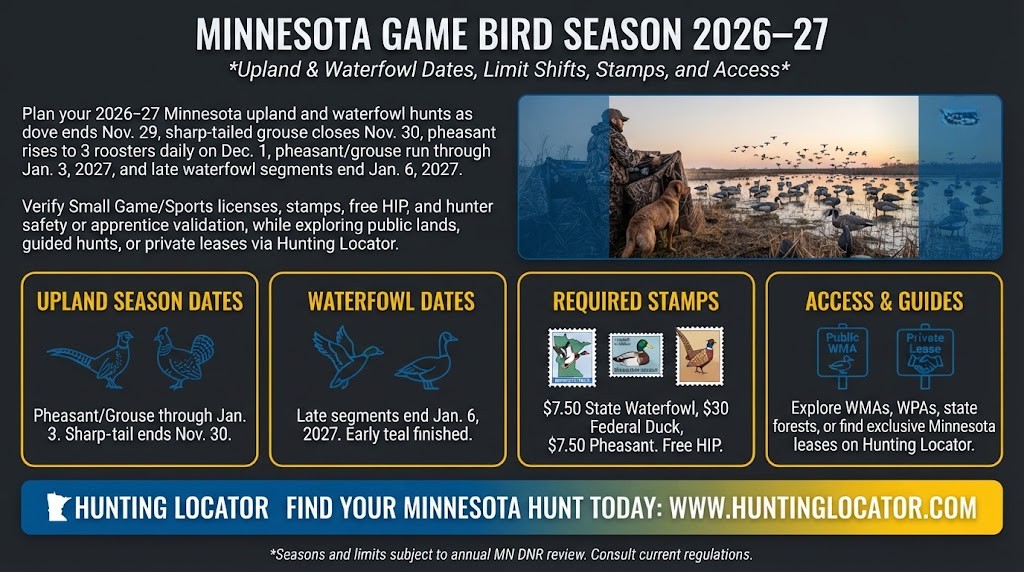
Quick Overview: 2026–27 Minnesota Game Bird Seasons at a Glance
Three concepts make the table below easier to read:
- Daily vs. possession limits. The daily limit is what you can take in one day. Possession for migratory birds is generally three times the daily limit unless noted.
- Zones and segments. Waterfowl dates vary by zone, with 42 segments statewide.
- License vs. stamp vs. validation. A license is your base privilege. A stamp is a species add-on. A validation is a certification, such as HIP or the apprentice validation.
Verify your zone and segment details in the Minnesota DNR’s 2026–2027 Hunting and Trapping Regulations before you head out.
| Species | Season Dates | Daily/Possession | Key Regulations | Notes |
|---|---|---|---|---|
| Ducks | Sept 1, 2026 – Jan 6, 2027 (by zone/segment); early teal Sept 5–9 | 6 total / 3x daily | Species/sex caps (see Waterfowl section); HIP, state + federal stamps | Verify your zone’s segments |
| Mergansers | Within duck segments | 5 / 3x daily | Same stamps/HIP | — |
| Geese | Varies by zone | 5 dark (Canada, white-fronted, brant) / 20 light (snow, blue, Ross’s) | Same stamps/HIP | Check the DNR for zone dates |
| Coots & gallinules | Migratory season | 15 / 3x daily | HIP | — |
| Rails & snipe | Migratory season | Rails 25/75; snipe 8/24 | HIP | — |
| Pheasant | Oct 10, 2026 – Jan 3, 2027 | 2/6, then 3/9 from Dec 1 | Roosters only; 9 a.m.–sunset; pheasant stamp | Limit rises Dec 1 |
| Ruffed & spruce grouse | Sept 19, 2026 – Jan 3, 2027 | 5 combined (max 2 spruce) / 10 | Small Game License | — |
| Sharp-tailed grouse | Sept 19 – Nov 30, 2026 (Northwest Zone) | 3 / 6 | East-Central Zone closed | Closes Nov 30 |
| Woodcock | Sept 19 – Nov 2, 2026 | 3 / 9 | HIP | Closed |
| Mourning dove | Sept 1 – Nov 29, 2026 | 15 / 45 | HIP | Closes Nov 29 |
| Wild turkey | Spring 2027: mid-April – May 31; Fall 2027: Oct 2–31 | 1 bird | Youth, Archery, Seasons A–F | Fall 2026 (Oct 3–Nov 1) closed |
Also worth knowing: prairie chicken runs September 26–October 4 (2 per season, by lottery), Hungarian partridge runs September 19–January 3 (5 daily, 10 possession), and sandhill crane ran September 12–October 18 (2 daily, 6 possession).
Most bird hunters need a Small Game License, stamps that match their species, HIP certification for migratory birds, and proof of hunter education. For year-round planning, see our complete Minnesota hunting season guide.
There are two ways to meet the education requirement:
- A firearms safety certificate is the standard route.
- The $3.50 apprentice validation lets eligible hunters without the certificate hunt legally, up to twice in a lifetime.
Nonresidents will need the following:
- $102 Small Game License
- $7.50 pheasant stamp (nonresidents under 18 are exempt)
- $7.50 state waterfowl stamp
- $30 federal duck stamp
- Free HIP certification
Base costs exclude issuing fees, so expect the checkout total to run slightly higher.
Minnesota Game Bird Hunting Seasons
Minnesota’s bird seasons fall into three groups: waterfowl, upland birds, and turkey. Each section below opens with the short version and then fills in the details.
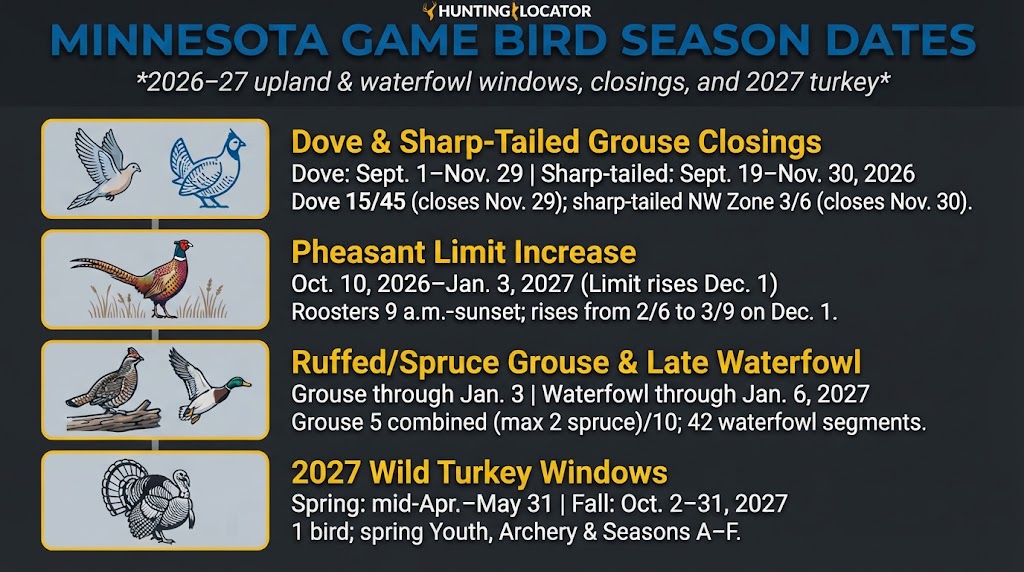
Waterfowl Season: Ducks, Geese, and Other Migratory Birds
Minnesota’s 2026–27 waterfowl season runs September 1, 2026 through January 6, 2027 across zones and 42 segments. The daily limit is 6 ducks with species caps, plus 5 mergansers. Goose limits are 5 dark and 20 light, with dates that vary by zone.
Early teal ran September 5–9 and is over. Within the 6-duck daily limit, the species caps are:
- 1 hen mallard
- 1 black duck
- 1 canvasback
- 2 wood ducks
- 2 redheads
- 2 scaup
- Up to 3 pintails
Geese fall into two groups: 5 dark geese per day (Canada, white-fronted, and brant combined) and 20 light geese (snow, blue snow, and Ross’s). Coots and gallinules run 15 daily, rails run 25 daily (75 possession), and snipe run 8 daily (24 possession). Possession limits for most of these birds are three times the daily limit.
Segment dates differ by zone, so confirm yours and your goose dates in the DNR regulations. As of late November, segments in some zones remain open into January, so there is still time to get on the water. For more detail, see our Minnesota waterfowl hunting season guide.
Upland Season: Pheasant, Grouse, Woodcock, and Dove
Minnesota’s 2026–27 pheasant season runs October 10, 2026 to January 3, 2027, roosters only, with shooting hours of 9 a.m. to sunset. The limit is 2 daily (6 possession), rising to 3 daily (9 possession) on December 1. The other upland seasons break down like this:
- Ruffed and spruce grouse: September 19 through January 3. The limit is 5 combined with a maximum of 2 spruce, and possession is 10.
- Sharp-tailed grouse: Northwest Zone only, September 19 through November 30, 3 daily and 6 possession. The East-Central Zone is closed.
- Woodcock: September 19 through November 2, 3 daily and 9 possession. This season is now closed.
- Mourning dove: September 1 through November 29, 15 daily and 45 possession.
What’s still open after Thanksgiving:
- November 29: Last day for mourning dove
- November 30: Last day for sharp-tailed grouse
- December 1: Pheasant limit rises to 3 roosters
- January 3: Last day for pheasant and ruffed/spruce grouse
Vermillion Highlands has special pheasant dates, so check parcel rules before you hunt there.
Wild Turkey: Spring 2027 and Fall 2027
The fall 2026 turkey season ran October 3–November 1 and is closed. Spring 2027 runs mid-April through May 31 with Youth, Archery, and Seasons A–F. Fall 2027 runs October 2–31. The limit is one bird.
Spring is split into time periods (Seasons A–F) so you can choose a window that fits your schedule. The DNR releases specific period dates, permit details, and deadlines, so watch for that announcement as spring approaches. For more, see our Minnesota turkey hunting season guide.
Minnesota Game Bird Licenses and Permits
You need one base license plus add-ons depending on the bird you’re hunting. Choosing the right bundle can save money.
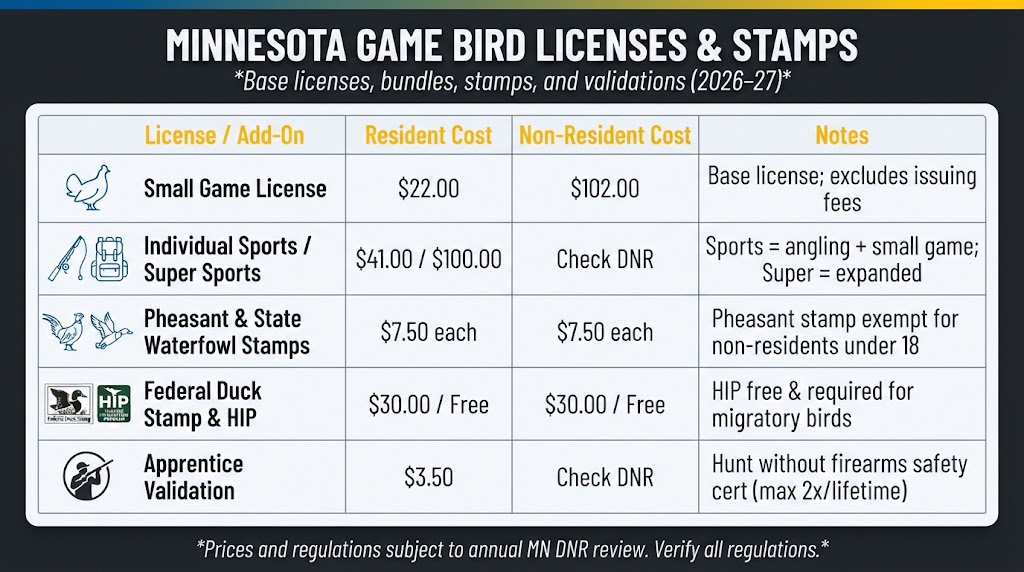
Minnesota Hunting Licenses
| License | Resident | Nonresident | Covers |
|---|---|---|---|
| Small Game | $22 | $102 | Grouse, pheasant (with stamp), woodcock, dove, waterfowl (with stamps/HIP) |
| Individual Sports | $41 | — | Angling + small game |
| Individual Super Sports | $100 | — | Expanded bundle (see DNR for full inclusions) |
| Married combinations | Available | — | Couple packages (pricing per DNR) |
| Apprentice validation | $4 | Available to eligible hunters | Hunt without a firearms safety certificate; twice in a lifetime |
Base costs exclude issuing fees. If you also fish, the Individual Sports license is the better value, since it bundles angling with small game. The Small Game License covers grouse, pheasant, and woodcock; our small game hunting season guide explains how those seasons fit together. For Super Sports inclusions and married-combination pricing, check the Minnesota DNR.
Minnesota Hunting Permits
Beyond your license, these stamps, validations, and permits may apply:
- Pheasant stamp: $7.50. Nonresidents under 18 are exempt.
- State waterfowl stamp: $7.50.
- Federal duck stamp: $30.
- HIP certification: Free, and required for migratory birds.
- Prairie chicken lottery permit: $23 for residents.
Licenses, stamps, and permits are sold through the Minnesota DNR’s licensing system. Prairie chicken and turkey permits are application- or lottery-based, so check DNR announcements for deadlines and odds rather than relying on secondhand numbers.
Minnesota Game Bird Hunting: Where to Hunt
Hunters have three options: public land, private leases, and guided hunts. Each suits a different budget and timeline.
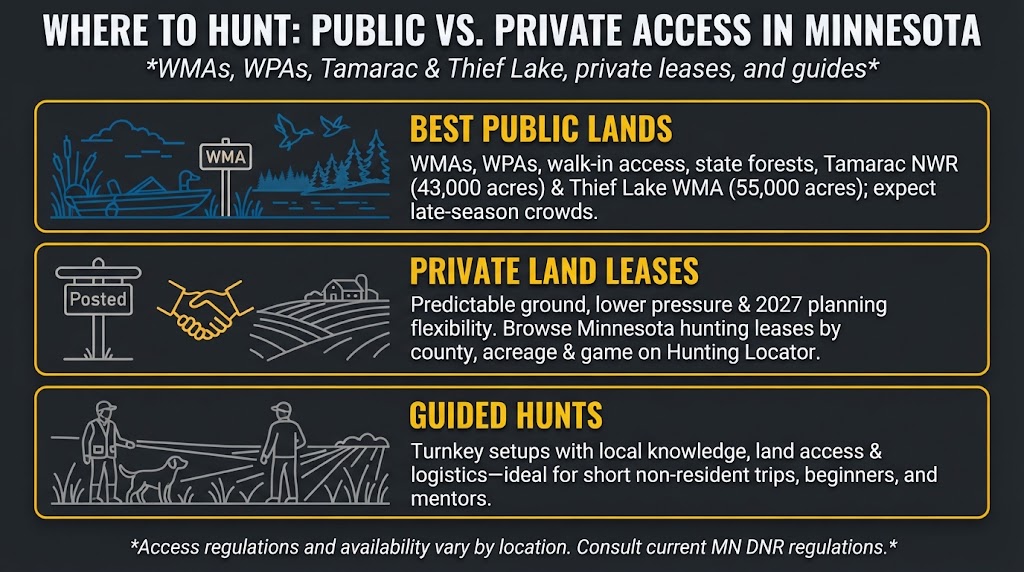
Best Public Lands
Minnesota has plenty of public ground, but it can get crowded late in the season. Good options include:
- Wildlife Management Areas (WMAs): Reliable for upland birds and waterfowl.
- Federal Waterfowl Production Areas (WPAs): Prairie wetlands that hold ducks and pheasants.
- Walk-in access areas: Found throughout the pheasant range.
- State forests: A natural fit for ruffed grouse.
- Tamarac National Wildlife Refuge: 43,000 acres open for duck, goose, coot, woodcock, and snipe hunting.
- Thief Lake WMA: 55,000 acres, including 85 blinds and shooting stations and 2.1 miles of hunter walking trails.
- Vermillion Highlands: Special pheasant dates apply, so check parcel rules.
Respect other hunters and the land wherever you go. If crowded WMAs are a problem, you can browse private ground on Hunting Locator’s Minnesota hunting leases.
Private Land Hunting with Hunting Locator
Public land pressure and the risk of losing access are real concerns. A lease gives you predictable ground, less competition, and the chance to plan the 2027 season on your own schedule. There are two ways to get there.
Leasing offers flexibility with a lower commitment. Before you sign, ask the landowner about the game species on the property, acreage, access dates, and house rules for vehicles, dogs, and guests.
Buying gives you long-term control. For many hunters, owning ground becomes a legacy: a place where traditions get handed down and seasons stack up over the years.
Hunting Locator is a platform that connects you directly with landowners who lease or sell land. You can search by state, game type, or acreage and contact the people who control the ground, working from real listings.
Listings change, so confirm current details on each one:
- Check the live Minnesota lease page for properties showing waterfowl, upland, or turkey opportunities in your target county.
- Each listing shows its own acreage, county, and game types, so you can filter by what you hunt.
- If a listing doesn’t mention the bird you’re after, ask the landowner directly before you commit.
To start looking, browse Minnesota hunting leases and connect with landowners. However you hunt a property, treat it as your own: get clear permission, follow the landowner’s rules, and leave the gate the way you found it.
Guided Hunts
A guided hunt can make sense when time is short or the terrain is unfamiliar. It suits you if you:
- Are a nonresident on a short trip and want to skip the scouting.
- Are new to bird hunting and want to learn from someone who knows the ground.
- Are a mentor looking for a safe, structured first hunt for a new hunter.
- Want access to land and birds without managing logistics yourself.
Before you book, ask the outfitter:
- What’s included: meals, lodging, birds cleaned, transportation?
- What type of land will you hunt, and what species are realistic?
- Are dogs provided, or should you bring your own?
- Which licenses and stamps do you need to buy yourself?
- How many hunters are in each group?
Connect with outfitters through Hunting Locator, and use the species guides linked above to plan your timing.
Minnesota Hunting Tips
Cold weather and wary birds are part of hunting in Minnesota, and the right gear matters. The Hunting Locator store carries what you need for Minnesota birds. Here are the main tips:
- Hunt the late-season edges: In December, pheasants hold in cattails and thick cover near food. Slow down and work the edges.
- Match your choke to the bird: Open chokes suit grouse and woodcock cover, while tighter chokes help with late-season roosters and decoying ducks. Browse choke options at the Hunting Locator store.
- Dress for Minnesota cold: Layer up, and wear an upland vest with pockets for shells and birds. Find vests and layering gear at the Hunting Locator store.
- Set a realistic decoy spread: For waterfowl, scout first and let the birds tell you what they want. A smaller, well-placed spread often beats a big one in the wrong spot.
- Know your zone before you load up: Verify your segments, stamps, and HIP certification so a missed detail doesn’t end your day.
- Hunt with or without a bird dog: A dog helps with flushes and retrieves, but you can hunt solo by working cover slowly and thoroughly.
- Start new hunters on forgiving birds: Dove and ruffed grouse make a good start. Walk quietly, stop often, and scan.
- Respect the land and landowners: Get permission, close gates, and pack out your trash.
More Resources from Hunting Locator
Keep planning with these guides.
Bird seasons:
- Minnesota game bird hunting season: Full species-by-species bird season reference.
- Minnesota waterfowl hunting season: Ducks, geese, zones, and segments.
- Minnesota turkey hunting season: Spring and fall turkey planning.
- Minnesota small game hunting season: Grouse, pheasant, and other small game.
Statewide planning:
- Minnesota hunting season guide: Your year-round overview of every season.
Planning beyond birds:
- Minnesota deer hunting season: Dates, licenses, and strategy for whitetails.
- Minnesota bear hunting season: Bear season planning.
- Minnesota elk hunting season: Elk hunting information.
- Minnesota furbearer hunting season: An off-season pursuit for the winter months.
Land and gear:
- Minnesota hunting leases: Browse private land in the state.
- Hunting Locator: Search leases, outfitters, and landowners nationwide.
- Hunting Locator store: Gear for your next hunt.
FAQ
When does pheasant season end in Minnesota 2026?
Pheasant season ends January 3, 2027. It’s roosters only, and the limit rises from 2 daily (6 possession) to 3 daily (9 possession) on December 1. Shooting hours run from 9 a.m. to sunset.
How much is a nonresident small game license in Minnesota?
A nonresident Small Game License costs $102. You’ll also need the right stamps for the birds you hunt and HIP certification for migratory birds, and you should expect issuing fees on top of the base price.
Do I need a pheasant stamp?
Yes, the Minnesota pheasant stamp costs $7.50. Nonresidents under 18 are exempt. You buy it in addition to your Small Game License.
What is the duck limit in Minnesota?
The daily limit is 6 ducks with species caps, such as 1 hen mallard, 1 black duck, and 1 canvasback, plus 5 mergansers. Possession is generally three times the daily limit. Check the Minnesota DNR regulations for the caps that apply in your zone.
When is spring turkey season 2027?
Spring turkey season runs mid-April through May 31, 2027, with Youth, Archery, and Seasons A–F. The limit is one bird. The DNR releases specific period dates and deadlines, so check our Minnesota turkey hunting season guide for planning help.
Can I hunt without firearms safety?
Yes, with the $3.50 apprentice validation. Eligible hunters without a firearms safety certificate can use it twice in a lifetime. Confirm eligibility details with the Minnesota DNR.
What is the easiest game bird for a beginner?
Dove and ruffed grouse are both good places to start. Still hunting, which means walking quietly, stopping often, and scanning, works well for grouse. Dove offer plenty of action with a generous 15-bird daily limit.
Do I need a bird dog?
No. A dog helps with flushing and retrieving, but you can hunt solo by working grassy or brushy cover slowly and thoroughly. Many hunters take birds without one.
Where can I lease hunting land in Minnesota?
Browse private land for lease on Hunting Locator’s Minnesota hunting leases page. You can connect directly with landowners and compare acreage, location, and game types.
What other Minnesota seasons can I plan with a Super Sports license?
Start with our Minnesota deer hunting season guide, and use the complete Minnesota hunting season guide to map out your full year. Check the Minnesota DNR for exactly what the Super Sports bundle includes.
The Final Shot
The dates to remember are November 29 for dove, November 30 for sharp-tailed grouse, December 1 when the pheasant limit rises, January 3 for pheasant and grouse, and January 6 for the last waterfowl segments. Buy the right license bundle and stamps, then verify your zone details with the Minnesota DNR before you head out.
When the season ends, start planning 2027. Searching leases and contacting landowners and outfitters through Hunting Locator early gives you more options before the next fall rush. If you want to stay in the field through winter, our Minnesota furbearer hunting season guide covers the options.


