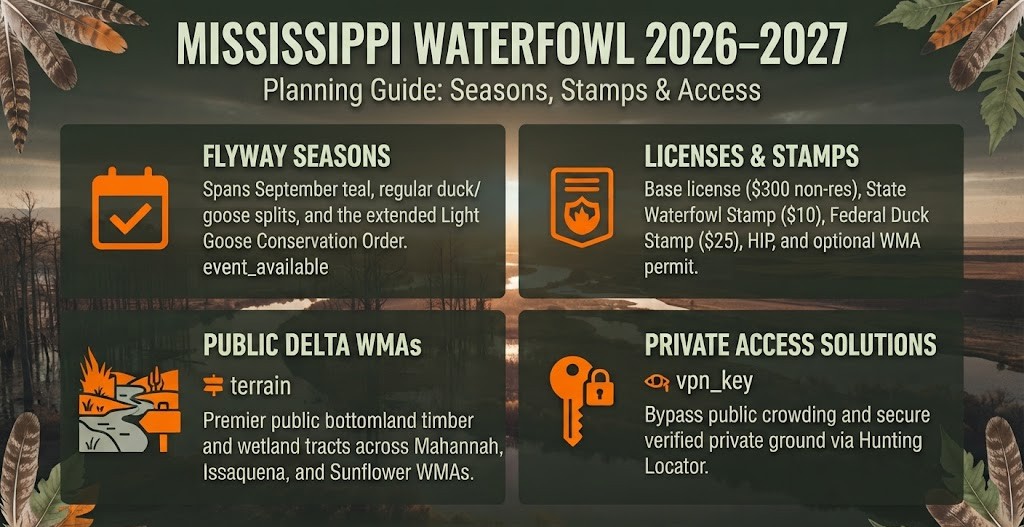
This Mississippi waterfowl guide walks through the 2026–2027 season structure — dates, licenses, bag limits, where to hunt, and gear — so you can plan around it instead of getting caught off guard. Hunting Locator built it as an organized reference, but confirm final dates and limits with the Mississippi Department of Wildlife, Fisheries, and Parks (MDWFP) before you head out, since state numbers are the final word.
What’s covered below:
- Exact 2026–2027 season dates and bag limits — every split, from September Teal through the Light Goose Conservation Order.
- License, permit, and stamp requirements with costs — what residents and non-residents both need to hunt legally.
- Where to hunt — public WMAs, private-land leases through Hunting Locator, and guided-hunt options.
Start with the numbers that shape your calendar: season dates and bag limits.
Quick Overview: 2026–2027 Mississippi Waterfowl Season at a Glance
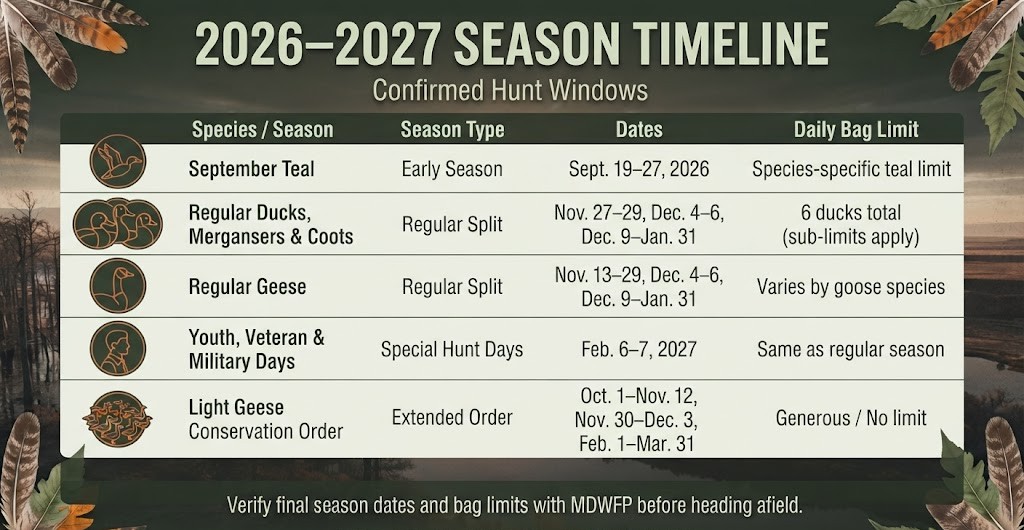
Mississippi sits inside the Mississippi Flyway, one of North America’s major migratory bird corridors, which is a big part of why the state draws serious waterfowl attention every fall and winter. Below is the master rundown of dates and limits for the 2026–2027 season. For more detail, see our full Mississippi waterfowl guide.
| Species/Category | Season Type | Dates (2026–2027) | Daily Bag Limit (Summary) |
|---|---|---|---|
| Teal | September Teal | Sept. 19–27, 2026 | Species-specific teal limit |
| Ducks, Mergansers & Coots | Regular Season (Split) | Nov. 27–29, Dec. 4–6, Dec. 9–Jan. 31 | 6 ducks total (sub-limits apply) |
| Geese | Regular Season (Split) | Nov. 13–29, Dec. 4–6, Dec. 9–Jan. 31 | Varies by goose species |
| Waterfowl | Youth, Veteran & Active Military Days | Feb. 6–7, 2027 | Same as regular season |
| Light Geese | Conservation Order | Oct. 1–Nov. 12, Nov. 30–Dec. 3, Feb. 1–5, Feb. 8–Mar. 31, 2027 | Generous/no limit (order-specific) |
Before you buy anything, here’s what’s required:
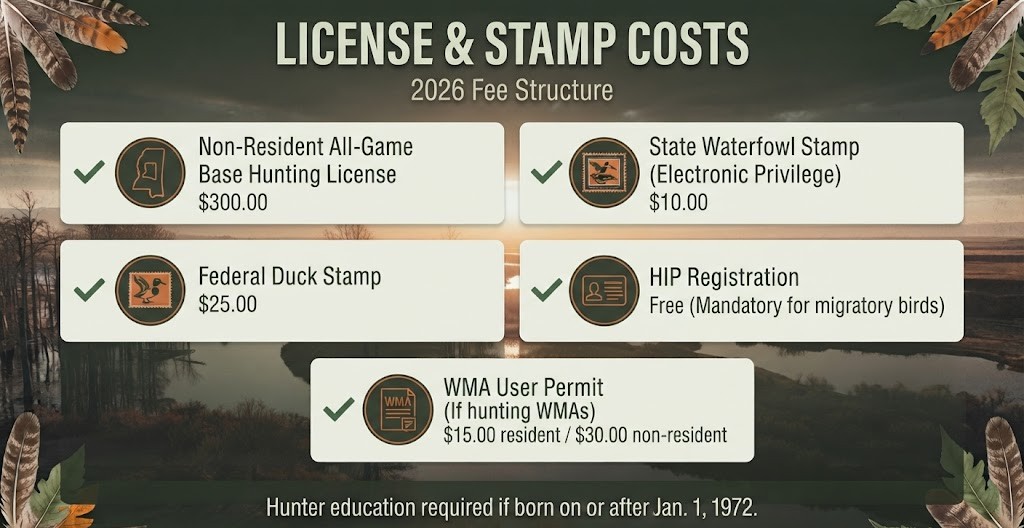
- Base Hunting License — required for all hunters 16 and older; non-resident All-Game runs $300.00.
- State Waterfowl Stamp — $10.00 for residents and non-residents (electronic privilege).
- Federal Duck Stamp — $25.00, purchasable through the MDWFP Licensing Portal.
- HIP Registration — free, and mandatory for all migratory bird hunters.
- WMA User Permit — $15.00 if you plan to hunt any of Mississippi’s Wildlife Management Areas.
- Hunter Education — required if you were born on or after January 1, 1972.
Confirm exact dates and limits with the MDWFP Licensing Portal before you buy. Season frameworks can shift slightly year to year.
Mississippi Waterfowl Hunting Seasons Explained
Mississippi’s waterfowl seasons run in segments, or “splits,” separated by closed periods. These splits are built around migration timing and hunting pressure — understanding them helps you plan trips instead of getting caught by a closure. Here’s the full bag-limit breakdown to keep handy all season:
| Species | Daily Bag Limit |
|---|---|
| Ducks (daily total) | $6 |
| Mallards | 4 max (no more than 2 females) |
| Wood Ducks | $3.00 |
| Redheads | $2.00 |
| Canvasbacks | 2 |
| Pintails | 1 |
| Mottled Ducks | 1 |
| Black Ducks | 2 |
| Scaup | 1/day (Nov. 27–29, Dec. 4–6, Dec. 9–17); 2/day (Dec. 18–Jan. 31) |
September Teal Season
Mississippi’s waterfowl calendar opens with September Teal, running Sept. 19–27, 2026 — the first shot opportunity of the year and a favorite early warmup for residents who don’t want to wait until late November. Non-toxic shot requirements and HIP registration apply here just like the rest of the year, so handle your paperwork before opening morning.
Regular Duck, Merganser & Coot Season
The main event runs in three segments: Nov. 27–29, Dec. 4–6, and Dec. 9–Jan. 31. These splits affect travel planning and lease timing, so mark all three windows on your calendar rather than assuming it’s one continuous season.
One detail hunters commonly miss: the scaup limit changes mid-season. You’re allowed just 1 scaup per day during Nov. 27–29, Dec. 4–6, and Dec. 9–17, but that bumps up to 2 per day from Dec. 18 through Jan. 31. Non-toxic shot is required throughout for all ducks, mergansers, and coots.
Goose Seasons & the Light Goose Conservation Order
Regular goose season runs Nov. 13–29, Dec. 4–6, and Dec. 9–Jan. 31 — closely mirroring the duck splits, which makes combo hunts easy to plan. The Light Goose Conservation Order extends opportunity well beyond that, covering Oct. 1–Nov. 12, Nov. 30–Dec. 3, Feb. 1–5, and Feb. 8–Mar. 31, 2027.
The Conservation Order exists because light goose populations, snow geese in particular, have grown large enough that wildlife agencies allow extended, more liberal harvest to help manage the population. It requires a free permit but, unlike regular waterfowl hunting, does not require the Federal Duck Stamp — worth knowing if you’re planning a late-winter or early-spring goose hunt.
Youth, Veteran & Active Military Waterfowl Days
Set for Feb. 6–7, 2027, these special days mirror regular-season bag limits and offer a dedicated opportunity for youth hunters, veterans, and active-duty military. If you’re introducing a young hunter to the sport or want an outing without peak-season crowds, this weekend is a good entry point into Mississippi waterfowl hunting.
Mississippi Waterfowl Licenses & Permits
Getting your paperwork straight before opening day saves you from scrambling later. Mississippi’s licensing structure is straightforward once you know the pieces: residency status determines your price point, and your hunting habits (WMA vs. private land) determine which add-ons you need. You’re considered a resident if you’ve lived in Mississippi for 30+ consecutive days, and your driver’s license typically determines which category you fall into.
Mississippi Hunting Licenses
Here’s how the core license and stamp costs break down:
| License / Stamp | Resident | Non-Resident | Notes |
|---|---|---|---|
| Base Hunting License (All-Game) | Varies by license type | $300 | Required for all hunters 16+ |
| State Waterfowl Stamp | $10 | $10.00 | Electronic privilege, both categories |
| Federal Duck Stamp | $25.00 | $25.00 | Required nationally for waterfowl 16+ |
| WMA User Permit | $15.00 | $30.00 | Required only if hunting WMAs |
If you’re traveling in from out of state, pay close attention to the $300 non-resident All-Game license and the $30 non-resident WMA User Permit. These two costs most often catch traveling hunters off guard when budgeting a trip. Non-resident hunters, except minors under sixteen, are required to obtain a Mississippi hunting license before hunting anywhere in the state.
Worth clearing up: the Federal Duck Stamp and the State Waterfowl Stamp are separate requirements. The Federal Duck Stamp is a national program administered by the U.S. Fish & Wildlife Service, while the State Waterfowl Stamp is Mississippi’s own privilege requirement. Both are required for every waterfowl hunter age 16 and older, so budget for both through the MDWFP Licensing Portal and the USFWS Federal Duck Stamp channels.
Mississippi Waterfowl Permits & HIP Registration
Getting fully licensed is easier when you break it into steps:
- Complete hunter education — required if you were born on or after January 1, 1972.
- Buy your base hunting license — resident or non-resident All-Game, depending on your status.
- Add the State Waterfowl Stamp — $10.00, required for all waterfowl hunters.
- Buy the Federal Duck Stamp — $25.00, required separately from the state stamp.
- Complete HIP registration — free, and mandatory for every migratory bird hunter.
- Add a WMA User Permit — $15 resident / $30 non-resident, if you plan to hunt public Wildlife Management Areas.
The Harvest Information Program (HIP) endorsement sounds like bureaucratic overhead, but it does real work: it helps state and federal wildlife agencies track harvest data and manage migratory bird populations. You complete it alongside your license purchase, with no extra hassle.
If your plans include any of Mississippi’s 50+ Wildlife Management Areas, add the WMA User Permit. At $15 for residents and $30 for non-residents, it supports habitat management on those public lands. And regardless of where you’re hunting, non-toxic shot is required for all waterfowl and coots.
Where to Hunt Waterfowl in Mississippi
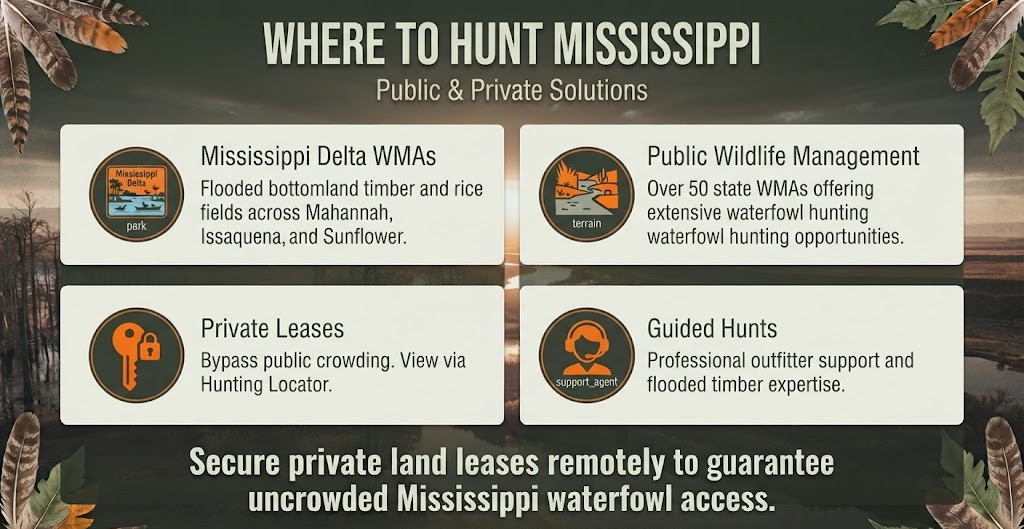
Mississippi gives you two broad paths to a hunt: public Wildlife Management Areas or private land. Which one makes sense depends on your budget, how much company you’re willing to share a blind with, and how much control you want over your hunting schedule.
Best Public Lands for Duck Hunting
Mississippi manages more than 50 WMAs, and ducks and geese rank among the most commonly pursued species across them. The Mississippi Delta — the fertile stretch between the Mississippi and Yazoo rivers — is widely regarded as the premier waterfowl region in the state, known for flooded timber and rice-field habitat that draws heavy migratory traffic all season.
Some of the better-known Delta-region WMAs for waterfowl hunters include:
- Mahannah WMA — flooded bottomland habitat popular with duck hunters in the northern Delta.
- Issaquena WMA — another Delta-region option known for waterfowl activity.
- Leroy Percy WMA — a long-standing public option with varied wetland habitat.
- Sunflower WMA — one of the larger public tracts, offering extensive bottomland hardwood forest.
Public land comes with a real trade-off. During peak weeks of duck season, these WMAs fill up fast, and some operate on draw systems with noon closings and no overnight blinds or decoys allowed. That access pressure is part of why some hunters look at private-land leasing as an alternative.
Private Land Hunting with Hunting Locator
Leasing or buying private land solves the crowding problem directly. With your own access, there’s no draw system, no shared blind, and no racing another truck to the levee before daylight — just your setup, your schedule, and birds that haven’t already been pushed off the water by other hunting parties.
This is where Hunting Locator does its best work. We connect hunters directly with landowners across Mississippi who are ready to lease or sell hunting land, cutting out the guesswork and cold-call networking that used to be the only way to find good private ground.
Browse Mississippi hunting leases to start narrowing down your options before the best spots fill up. Quality waterfowl ground tends to move fast once hunters lock in their plans for the split seasons ahead.
If you’re thinking longer-term, Hunting Locator’s marketplace also includes listings for hunters looking to buy Mississippi hunting land outright — a solid option if you want a permanent stake in Delta-region waterfowl ground rather than a season-by-season lease.
Guided Hunts
For hunters who don’t have the gear, dogs, or local knowledge to hunt flooded timber effectively on their own, a guided hunt handles the heavy lifting. Outfitters typically manage the blinds, decoy spreads, calling, and scouting, letting you focus on the hunt instead of the logistics.
Guided hunts tend to make the most sense if:
- You’re a non-resident without an established local lease or property connection.
- You’re new to duck hunting and want expert guidance before investing in your own setup.
- You’re short on time and need a turnkey experience rather than weeks of scouting.
Guided trips and premium leases both tend to fill up early, especially around the prime late-November and December windows. Booking ahead is often the difference between hunting the Delta this year or waiting until next.
Mississippi Waterfowl Hunting Tips
Success in the blind comes down to a handful of fundamentals that hold true whether you’re hunting flooded timber or open rice fields. Here’s what tends to separate a good hunt from a slow one:
- Scout Before You Shoot — Understanding where birds actually want to be in flooded timber beats any piece of gear you could buy. Time spent watching flight patterns pays off more than time spent tweaking your decoy spread.
- Set a Realistic Decoy Spread — Proper spacing and a natural mix of species draw in more birds than simply maximizing decoy count. Quality and placement matter more than quantity.
- Master a Few Basic Calls — Restrained, strategic calling consistently outperforms constant noise. Learn a handful of calls well before trying to master an entire repertoire.
- Layer for Cold, Wet Conditions — Quality waders and layered waterproof clothing keep you comfortable and in the blind longer, which translates to more opportunities. Browse waders, outerwear, and cold-weather gear through the Hunting Locator store before opening morning.
- Know Your Ducks Before You Pull the Trigger — Species identification protects you against exceeding limits on mallards, hens, pintails, and canvasbacks, all species with strict sub-limits this season.
- Prioritize Concealment — Lay-out blinds and natural cover can make or break a hunt, especially on pressured public water where birds have already learned to spot movement.
More Resources from Hunting Locator
Waterfowl is just one piece of Mississippi’s hunting calendar. Here’s where to keep planning your full season:
- Hunting Locator home — the platform hub for leases, gear, and guides across every state.
- Mississippi hunting season guide — a broad overview covering every species and season in the state.
- Mississippi waterfowl hunting season — the companion deep-dive dedicated entirely to waterfowl.
- Mississippi small game hunting season — dates and details for squirrel, rabbit, and other small game.
- Mississippi deer hunting season — whitetail dates and regulations for the state.
- Mississippi bobwhite quail hunting season — upland quail guidance and season structure.
- Mississippi turkey hunting season — everything you need for spring turkey planning.
- Browse Mississippi leases — the full marketplace of current lease and land listings.
- Hunting Locator store — gear and equipment to outfit your entire season.
Frequently Asked Questions
What are the Mississippi duck season dates for 2026–2027?
September Teal runs Sept. 19–27, 2026, and the regular duck, merganser, and coot season follows in three splits: Nov. 27–29, Dec. 4–6, and Dec. 9–Jan. 31. Confirm final dates with the MDWFP Licensing Portal before your trip.
How many ducks can I harvest per day in Mississippi?
The daily total is 6 ducks, with sub-limits including 4 mallards (no more than 2 hens), 1 pintail, 2 canvasbacks, and 3 wood ducks. Scaup limits vary by date, so double-check species identification before you shoot.
What licenses and stamps do non-residents need to hunt waterfowl in Mississippi?
Non-residents need the $300 non-resident All-Game license, the $10 State Waterfowl Stamp, the $25 Federal Duck Stamp, and free HIP registration. If you plan to hunt WMAs, add the $30 non-resident WMA User Permit.
What is HIP registration and is it required?
Yes. The Harvest Information Program (HIP) endorsement is free and mandatory for every migratory bird hunter, including non-residents. It helps wildlife agencies track and manage bird populations, and you complete it when you buy your license.
Do I need a permit to hunt Mississippi WMAs?
Yes. A WMA User Permit ($15 resident / $30 non-resident) is required in addition to your base hunting license for any of Mississippi’s 50+ Wildlife Management Areas.
How do I find a private duck hunting lease in Mississippi?
The fastest way is to browse current listings through Hunting Locator’s Mississippi hunting leases marketplace, where you can connect directly with landowners who are leasing or selling hunting land across the state.
The Final Shot
Getting ready for Mississippi’s waterfowl season comes down to three things: know your dates, get legal with the right licenses and stamps, and lock in where you’re actually going to hunt. Handle those three in order, and everything else — decoys, calls, cold-weather gear — falls into place from there.
This Mississippi Waterfowl Season Guide for 2026 was built to take you from planning to boots-in-the-water, and Hunting Locator is here for every step, connecting you with landowners, guides, and gear so you’re not starting from scratch each season. Explore Hunting Locator to see the full range of tools available to Mississippi hunters.
When you’re ready, browse current Mississippi leases and gear up for what’s shaping up to be a strong season in the Delta. And as always, confirm your final season dates, limits, and license details with MDWFP before opening day.


