This isn’t just good news for Missouri residents. Non-resident hunters are discovering what locals have known for years—Missouri offers some of the most liberal coyote hunting regulations in the country. And 2026 brings the biggest expansion of night hunting opportunities we’ve seen, with thermal and night vision now legal for 252 days of the year.
We’ve compiled everything from Missouri Department of Conservation sources and the latest regulation updates. No need to dig through scattered information or wonder if you’re missing something important.
Here’s what you’ll find in this complete planning resource:
- Current season dates and the game-changing 2026 night hunting expansion that opens up prime nocturnal opportunities
- License requirements and costs for residents and non-residents, plus where to actually buy your permits
- Where to hunt—public land strategies, guided options, and the reality of finding private ground access
Let’s jump into what you need to know.
Quick Overview: Missouri Coyote Hunting at a Glance
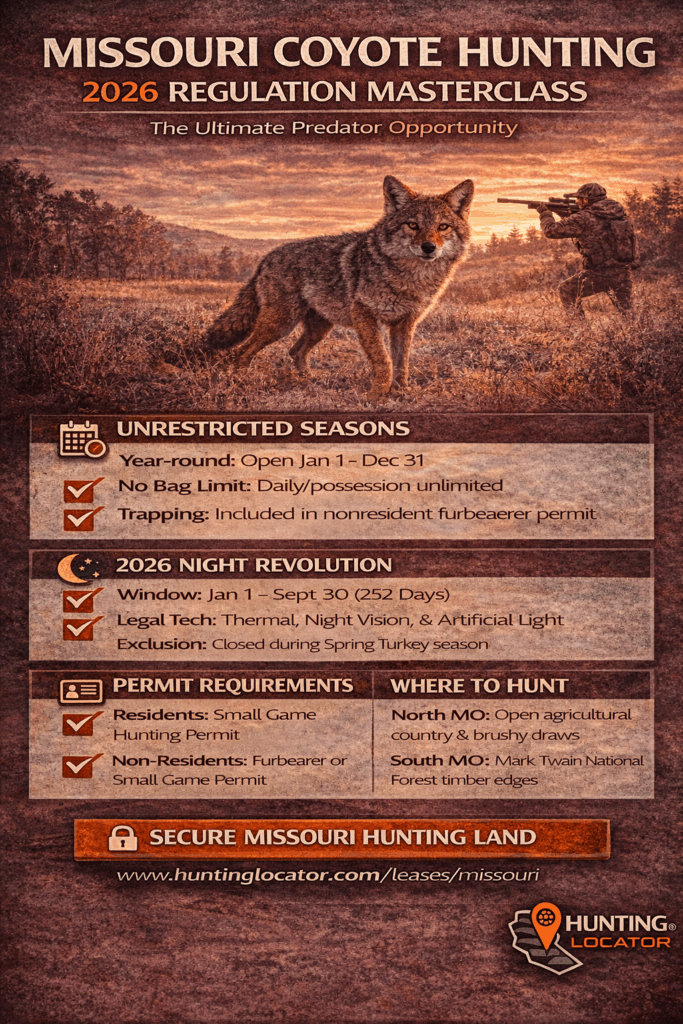
Here are the essentials before we get into the details. All information comes straight from Missouri Department of Conservation.
| Element | Details |
|---|---|
| Season Dates | Year-round (January 1 – December 31, 2026) |
| Bag Limit | No limit (daily or possession) |
| Night Hunting w/ Thermal/Night Vision | January 1 – September 30 (252 days), excluding spring turkey season |
| Daylight Restriction Period | April 1 through day before spring turkey season opens |
| Electronic Calls | Legal year-round |
| Firearms Deer Season Restriction | During daylight hours, only deer hunting methods may be used |
| License Required | Yes—hunting permit required for all hunters |
License requirements depend on where you live:
- Missouri residents: Small game hunting permit
- Non-residents: Nonresident Furbearer Hunting and Trapping Permit
- No special coyote permit needed beyond your basic hunting license
- Buy permits through MDC online or authorized vendors
Always double-check current regulations with the Missouri Department of Conservation. Rules can change, and you don’t want surprises.
Missouri Coyote Hunting Seasons
Missouri hands predator hunters one of the best deals in the country. The Missouri Department of Conservation puts it simply: “coyotes may be hunted year round with no bag limit”. Try finding that combination in most other states.
Year-Round Hunting: No Closed Season
The basic rule couldn’t be simpler: hunt coyotes any day of the year. Missouri Department of Conservation confirms that “pelts and carcasses of coyotes may be possessed and transported without limit throughout the year”. Some method restrictions apply during certain periods, but the season never closes.
This creates real value for hunters who want more time afield. Deer season ends? Coyote season continues. Turkey season wraps up? Still open for coyotes. It’s a game-changer for anyone serious about predator hunting.
Night Hunting Revolution: 2026’s Big Change
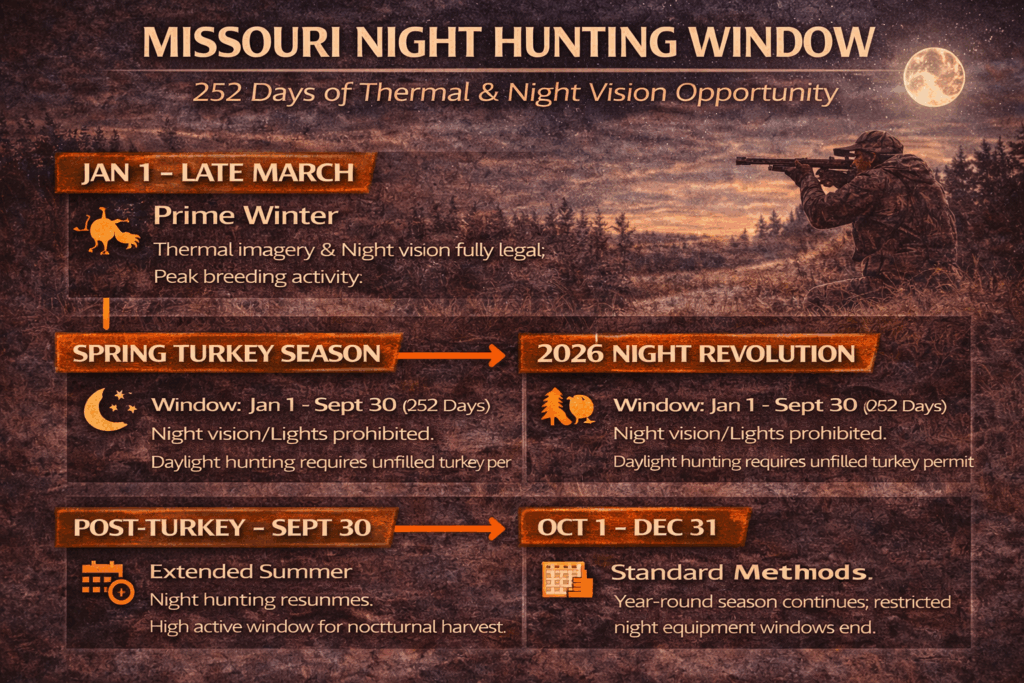
Here’s the headline news for 2026. The Conservation Commission gave final approval to regulation changes that dramatically increase the number of days allowing artificial light, night vision, and thermal imagery equipment when harvesting coyotes, effective Jan. 1, 2026.
The numbers tell the story: 252 days from Jan. 1 through Sept. 30, excluding spring turkey hunting season. That’s a massive jump from the old two-month window.
MDC spokesperson Francis Skalicky explained the thinking: “The main thing is to give hunters more opportunity” and “The interest is there and the resources can support it”. For hunters with thermal scopes and night vision, this opens up prime hunting when coyotes are naturally most active.
When Methods Get Restricted
Year-round season doesn’t mean anything goes all the time. Coyotes may not be taken during daylight hours from April 1 through the day prior to the beginning of the Spring Turkey Hunting season. During spring turkey season itself, coyote hunters must also possess an unfilled spring turkey hunting permit.
Deer season creates another wrinkle. During firearms deer season, “if hunting furbearers during daylight hours during firearms deer season, only deer hunting methods may be used”. Translation: follow deer hunting weapon rules and safety requirements if you’re after coyotes during daylight hours in deer season.
Missouri Coyote Hunting Licenses and Permits
License requirements split along residency lines, and the differences matter for your wallet. Missouri Department of Conservation requires a hunting permit to hunt coyotes in Missouri, but which permit depends on where you call home.
What License Do You Need?
Your residency determines your permit requirements:
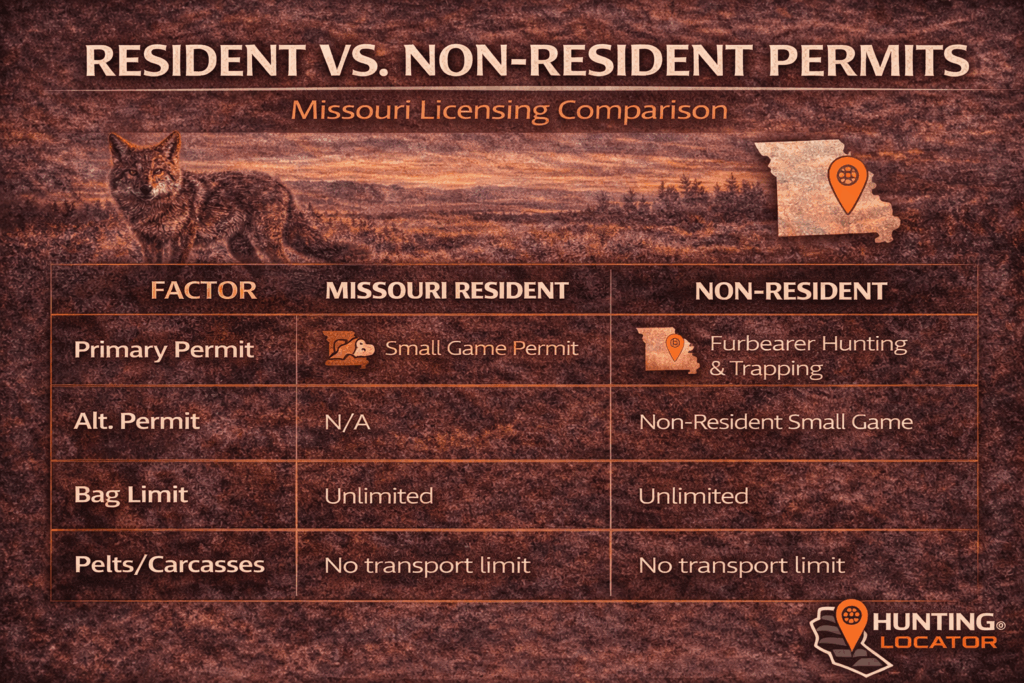
| License Type | Who Needs It | Validity Period | Price |
|---|---|---|---|
| Resident Small Game Permit | Missouri residents | Annual | $11.50 |
| Nonresident Furbearer Hunting and Trapping Permit | Out-of-state hunters | Valid until June 30 | $108 |
| Nonresident Small Game Permit | Alternative for non-residents | Annual | $108 |
Missouri residents need a valid small game hunting permit, while nonresidents need a valid nonresident furbearer hunting and trapping permit. Non-residents get options though—you can hunt coyotes in Missouri with either a Nonresident Furbearer Hunting and Trapping Permit or Small Game Permit.
Already have a small game permit for rabbits or squirrels? You’re covered for coyotes too.
Additional Permit Considerations
A few extra requirements might apply depending on your plans. Planning to sell pelts? You might need additional fur harvester documentation. During overlapping hunting seasons, hunters must also obtain specific permits, including the Nonresident Furbearer Hunting and Trapping Permit.
Don’t forget the spring turkey season quirk: hunting coyotes during spring turkey season requires possessing an unfilled spring turkey permit. That’s an extra permit requirement during that specific window.
Check the Missouri Department of Conservation website for current pricing and to buy permits online.
Where to Hunt Coyotes in Missouri
You’ve got three main paths: public land (free access, more pressure), guided hunts (convenient, expensive), and private land (best hunting, hardest to find). Each comes with real trade-offs.
Public Land Reality Check
Missouri delivers on public hunting opportunities—Mark Twain National Forest, hundreds of conservation areas, and Corps of Engineers lands around major lakes. The catch? Everyone else knows about them too.
Your best public land options:
- Mark Twain National Forest: Massive area spanning multiple counties, from oak-hickory forests to grasslands and ag edges
- Missouri Conservation Areas: State-managed lands scattered across Missouri, everything from small wetlands to large timber tracts
- Corps of Engineers Properties: Federal lands around Truman Lake, Lake of the Ozarks, and other reservoirs with excellent edge habitat
For habitat selection, Missouri Department of Conservation points out that “coyotes prefer brushy areas, edges of timber, and open agricultural country found in northern Missouri”. CRP fields, brushy draws or farmland, wetlands, and young timbered areas are all good locations.
Here’s the reality about pressure: Due to public lands being public, hunters must be flexible, and some have hunted areas for several years only to find suddenly there were too many hunters. Educated coyotes become much harder to call as hunting pressure builds.
Guided Hunt Option
Guided hunts solve the access problem instantly, especially valuable for out-of-state hunters who don’t know Missouri terrain. Outfitters usually provide a location to hunt as well as hunting stands, lodging, other amenities such as skinning sheds.
You get private land access, local knowledge of coyote patterns, and often equipment like calls and decoys. The downside? Higher costs, less flexibility in hunting style, and limited availability during peak times.
Private Land: The Holy Grail
Private land offers what every serious coyote hunter wants—less pressure, less educated coyotes, and the chance to build relationships with productive ground. The challenge is real though: “Gaining permission to hunt on private property is a challenge hunters face, with questions about who to ask, how to approach landowners, and where to seek permission often deterring hunters”.
Traditional door-knocking still works if you’re persistent. Missouri Department of Conservation suggests “hunters can knock on doors, talk to friends or relatives, ask around at local community meetings or civic clubs, visit local hardware stores and restaurants, and visit places that may receive deer damage such as orchards”.
Coyote hunters have a unique advantage here: farmers are advocates of hunting as a means of population control and appreciate hunters reducing crop damage. Position yourself as providing predator control services, not just recreation.
Hunting Locator cuts through the door-knocking hassle by connecting you directly with Missouri landowners ready to offer hunting access through seasonal leases or land sales. Browse verified properties, filter by location and size, and connect with landowners who actually want hunters on their ground. Check out Missouri hunting land →
Coyote Hunting Tips for Missouri Success
These tactics work specifically in Missouri conditions. Success comes from understanding local coyote behavior and adapting to hunting pressure.
- Wind Direction Rules Everything: One critical thing to keep in mind when coyote hunting during the day or night is wind direction. Coyotes rely heavily on their superb sense of smell and utilize it to their full advantage. Setting up with the proper wind direction and the ability to see in multiple directions will increase the odds of success.
- Match Calls to Season: Distress calls year-round and coyote vocalizations during breeding season are highly effective. January and February breeding season? Try howls and challenge calls. Prey distress calls work consistently all year.
- Hunt the Transition Zones: Coyotes prefer brushy areas, edges of timber, and open agricultural country found in northern Missouri. Focus where cover meets open areas—that’s where coyotes travel and hunt.
- Time It Right: Coyotes are most active during the hours of dawn and dusk. Late fall through winter months are prime time, with November through February being when cold weather increases daylight activity and fur quality peaks.
- Adjust for Hunting Pressure: It’s tougher to call in coyotes later in season versus calling them in early. By that time most coyotes have been called in and been shot at or watched one of their buddies get shot. They start to associate distress sounds with danger the later in season it is.
- Use Cover Strategically: You can increase their confidence if you call where they’d like to be—near cover. Calling them to a highly used road may cause them to hang up, but should you call them toward dense cover or a brushy fence line, your probability of a bold showing increases.
- Maximize Night Hunting: With Missouri’s expanded night hunting season, take full advantage of thermal and night vision from January through September. Coyotes are primarily nocturnal, but they can be active during daylight hours, especially in areas with low human activity.
- Right Equipment Matters: Shotguns or centerfire rifles in .22 caliber are preferred for hunting coyotes, foxes, and bobcats in Missouri. For calling, a reliable electronic game caller with animal vocalizations seems most popular, but predators can be called in with mouth calls that imitate rabbits or rodents in distress.
More Resources from Hunting Locator
Hunting Locator provides additional resources to help you plan successful Missouri hunts and find the land access that separates good hunts from great ones.
- Missouri Hunting Land Leases – Browse private land leases across Missouri, from whitetail properties with excellent coyote hunting to dedicated predator access
- Missouri Hunting Guide – Complete overview of Missouri hunting opportunities, seasons, and regulations across all species
- Missouri Deer Hunting – Complete whitetail hunting guide, including how deer and coyote seasons overlap
- Missouri Turkey Hunting Season – Turkey season restrictions that affect coyote hunting methods during spring
- Missouri Duck Hunting – Waterfowl opportunities that often overlap with prime coyote habitat
- Missouri Small Game Hunting – Small game seasons and how your small game license covers coyote hunting
- Hunting Gear Store – Equipment for Missouri coyote hunting, from electronic calls to thermal optics and Missouri-appropriate camouflage
FAQ
When is coyote season in Missouri?
Coyote season in Missouri runs year-round from January 1 through December 31. No closed season, though method restrictions apply during certain periods like daylight restrictions from April 1 through the day before spring turkey season.
Do I need a special license to hunt coyotes in Missouri?
A hunting permit is required to hunt coyotes in Missouri. Missouri residents need a small game hunting permit. Non-residents need either a Nonresident Furbearer Hunting and Trapping Permit or Small Game Permit. No additional coyote-specific permit required.
Can I use thermal scopes and night vision for coyote hunting in Missouri?
Yes. The regulation change extends the use of artificial light, night vision, and thermal imagery equipment to 252 days from Jan. 1 through Sept. 30, excluding spring turkey hunting season. This is a huge expansion from previous rules.
Are there bag limits for coyotes in Missouri?
No. Coyotes may be hunted year round with no bag limit. Pelts and carcasses of coyotes may be possessed and transported without limit throughout the year.
Can I hunt coyotes during deer season in Missouri?
Yes, with restrictions. If hunting furbearers during daylight hours during firearms deer season, only deer hunting methods may be used. Follow deer season weapon restrictions and safety requirements.
What’s the best time of year to hunt coyotes in Missouri?
Late fall through winter months are prime time, with November through February being when cold weather increases daylight activity and fur quality peaks. January and February are especially productive due to breeding season behavior.
The Final Shot
Missouri’s year-round coyote season with no bag limits creates exceptional opportunities for predator hunters. Whether you’re filling the off-season gap or planning a dedicated coyote trip, Missouri delivers. The 2026 expansion of night hunting to 252 days makes it even better for pursuing these nocturnal predators when they’re most active.
Success boils down to three things: understanding the liberal regulations and how they interact with other seasons, finding quality hunting ground with manageable pressure, and adapting your tactics to local conditions.
The biggest challenge isn’t learning to call or buying the right gear—it’s securing access to productive hunting land. Public areas offer free access, but the pressure makes calling educated coyotes much tougher.
Ready to find your next great coyote hunting spot? Browse Missouri hunting land on Hunting Locator and connect with landowners who welcome hunters. Skip the door-knocking and start planning your most productive Missouri coyote hunt.


