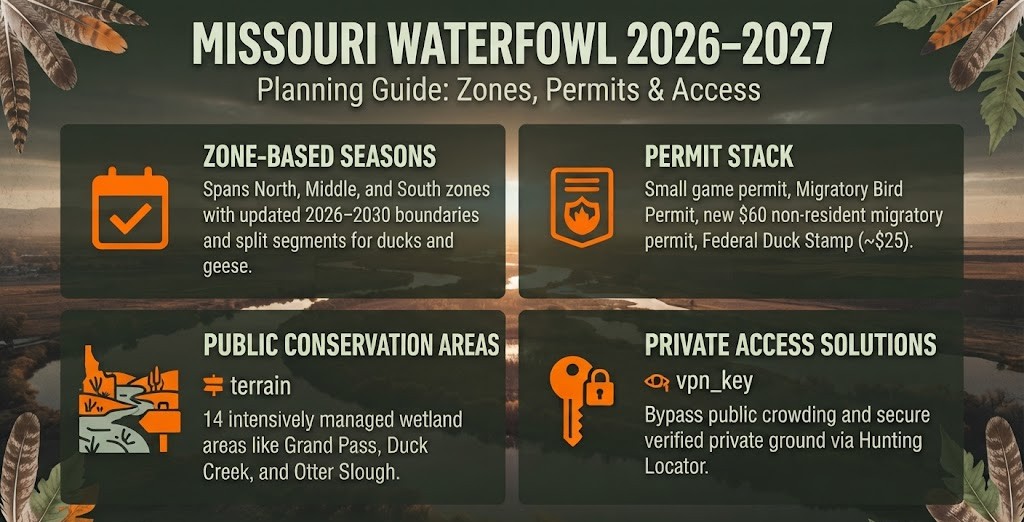
If you haven’t nailed down your zone dates, your permit stack, or where you’re hunting this year, this Missouri Waterfowl Season Guide for 2026 gathers that information in one place instead of six different tabs.
Hunting Locator built this guide as an all-in-one planning resource for the 2026–2027 season, covering what residents and non-residents need, based on official Missouri Department of Conservation (MDC) regulations. The Missouri Conservation Commission approved the 2026–2027 waterfowl seasons, and zone boundaries and date formulas changed for the 2026–2030 seasons — worth checking even if you’ve hunted the same spot for years. Once your dates and permits are locked in, the state’s live lease marketplace is at huntinglocator.com/leases/state/missouri, ready when you are to secure your own ground.
This guide covers:
- Zone-by-zone season dates and bag limits — North, Middle, and South Zone dates, youth seasons, and the species restrictions that keep you legal.
- The full permit stack — including the new non-resident migratory bird permit that changes the math for out-of-state hunters in 2026.
- Where to hunt — public conservation areas, private leases, and guided-hunt options so you’re not scrambling for access in October.
With the big picture in view, here are the numbers that matter most: your Missouri waterfowl season dates and limits.
Quick Overview: Missouri Waterfowl Season at a Glance
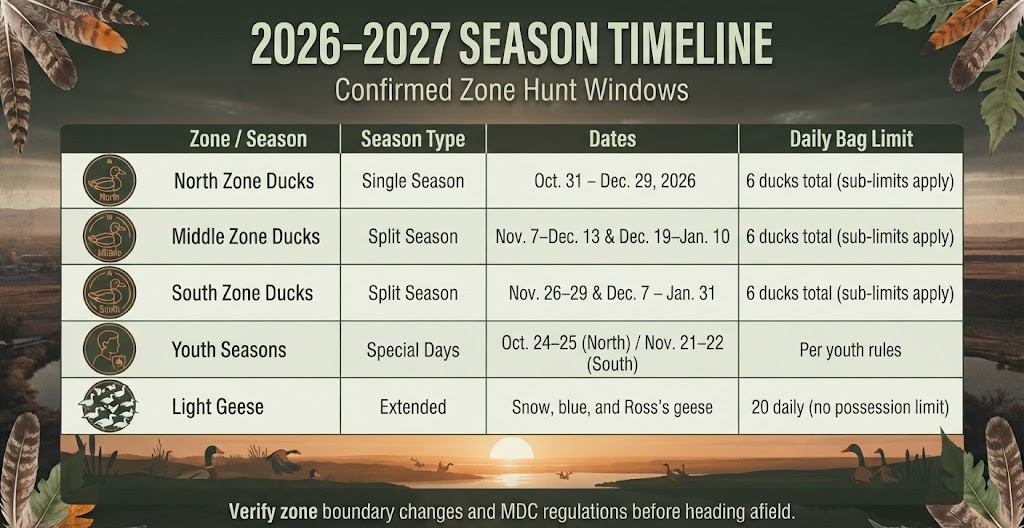
Before the zone-by-zone details, here’s the fast version. The table below summarizes the 2026–2027 Missouri waterfowl season as approved by the Missouri Department of Conservation. Confirm current-year specifics directly with MDC before heading out, since regulations can be adjusted between now and opening day.
| Species / Season Type | Dates | Daily Bag Limit | Notes |
|---|---|---|---|
| Ducks — North Zone | Oct 31 – Dec 29, 2026 | 6 ducks | No split; 60-day season |
| Ducks — Middle Zone | Nov 7 – Dec 13, 2026 & Dec 19, 2026 – Jan 10, 2027 | 6 ducks | Split season |
| Ducks — South Zone | Nov 26–29, 2026 & Dec 7, 2026 – Jan 31, 2027 | 6 ducks | Split season; extended late dates |
| Duck sub-limits (all zones) | — | Max 4 mallards (max 2 hens), 3 wood ducks, 3 pintails, 2 scaup, 2 hooded mergansers, 2 redheads, 2 canvasbacks, 2 black ducks, 1 mottled duck | Counts within the overall 6-bird limit |
| Coots | Same dates as ducks by zone | 15 per day | Often overlooked but fully in play |
| Canada Geese / Brant (combined) | Designated segments | 3 per day | Confirm exact segment dates with MDC |
| Light Geese (snow, blue, Ross’s) | — | 20 per day | No possession limit |
| Youth Seasons | North Oct 24–25 / Middle Oct 31–Nov 1 / South Nov 21–22, 2026 | — | See Youth Seasons section below |
If you’re weighing which zone to build your season around, our Missouri duck hunting guide breaks down the flyway timing in more detail. The short version: peak action tends to fall between Thanksgiving and Christmas, when every zone is holding birds.
Before any of those dates matter, you need to be squared away legally:
- Small Game Hunting Permit — the base permit required for waterfowl hunting in Missouri.
- Migratory Bird Hunting Permit — required for residents and non-residents age 16 and over.
- Federal Duck Stamp — a federal requirement for all hunters age 16 and older.
- Youth exception — hunters 15 and younger may hunt without permits during designated Youth Waterfowl Days if accompanied by a qualified adult 18 or older; confirm current supervision rules with MDC.
The licenses section below covers where to buy each of these and what they cost.
Missouri Duck Hunting Seasons by Zone
Missouri splits waterfowl hunting into three zones — North, Middle, and South — and which zone you’re hunting determines your legal dates more than the calendar date alone. MDC sets these boundaries based on migration timing and the condition of the mallard breeding population and prairie ponds up north, which is why boundaries and date formulas were updated for 2026–2030. If you’ve hunted the same spot for years, confirm your zone hasn’t shifted before planning opening weekend.
North Zone
The North Zone runs October 31, 2026 – December 29, 2026, a full 60-day season with no split. The Youth Season falls on October 24–25, 2026. North Zone hunters sit closest to the incoming migration, often getting first crack at fresh birds pushing down out of Canada and the northern prairies.
Middle Zone
The Middle Zone opens November 7 – December 13, 2026, closes, then reopens December 19, 2026 – January 10, 2027 — a split-season structure. The Youth Season runs October 31 – November 1, 2026. The split gives hunters two distinct windows to plan around rather than one long stretch.
South Zone
The South Zone opens briefly for November 26–29, 2026, closes, then reopens December 7, 2026 – January 31, 2027, the longest late-season window of the three zones. The Youth Season falls on November 21–22, 2026. In Missouri’s Bootheel, this zone shines once winter really sets in up north and pushes birds south; the rice country and managed wetland habitat here hold late migrants other zones miss.
Missouri Waterfowl Licenses and Permits
Legal waterfowl hunting in Missouri comes down to a three-part “permit stack.” It sounds like a lot at first, but once you know what you need and where to get it, checking these boxes takes a few minutes. MDC is the place to buy and confirm current pricing before finalizing your plans.

Missouri Hunting Licenses
Here’s how the permit stack breaks down, including the new requirement that changes things for out-of-state hunters:
| Requirement | Who Needs It | Approx. Cost | Where to Buy |
|---|---|---|---|
| Small Game Hunting Permit | Resident waterfowl hunters (base permit) | Confirm current price with MDC | MDC / any permit vendor |
| Missouri Migratory Bird Hunting Permit | Residents & non-residents 16+ | Approx. $7.50 (confirm with MDC) | Any permit vendor / mdc.mo.gov/buypermits |
| Non-Resident Migratory Bird Permit (NEW) | Non-residents, effective Jan 1, 2026 | $60.00 | MDC |
| Federal Duck Stamp | All hunters 16+ | Approx. $25 (confirm current) | U.S. Post Offices, MDC offices, e-Stamp online |
The non-resident migratory bird permit is new for 2026, so if you’ve hunted Missouri waterfowl before as an out-of-state hunter, this is a line item that wasn’t part of your permit stack last season. Full details on permit and stamp requirements, including exact fees, are published directly through MDC.
Pricing above reflects the most recent confirmed figures, but permit fees can change, so verify current costs with MDC before buying. The Federal Duck Stamp is a federal requirement layered on top of your state permits, not a substitute for any of them.
Missouri Hunting Permits & How to Buy Them
Buying your permits is straightforward once you know the order of operations:
- Confirm your zone — verify which zone covers the land you plan to hunt, since 2026–2030 boundaries shifted slightly.
- Buy your Small Game and Migratory Bird Hunting permits — available from any permit vendor or online.
- Add the non-resident migratory bird permit if you’re hunting from out of state.
- Purchase your Federal Duck Stamp — either in person or as an e-Stamp for immediate use.
- Confirm hunter education and HIP requirements directly with MDC before opening day.
State permits can be purchased online at mdc.mo.gov/buypermits, the fastest path for most hunters. If you’re hunting with a younger hunter, the general rule requires those 15 and younger to carry a Hunter Education Certificate or hunt in the immediate presence of a qualified adult 18 or older. Confirm the exact current requirement with MDC before your youth hunter’s first trip afield.
Where to Hunt Waterfowl in Missouri
Once your permits are squared away, the next question is where you’re actually hunting. Missouri hunters generally have three paths — public conservation areas, private leased land, and guided hunts — and each solves a different problem depending on your budget, timeline, and how much control you want over your hunt.
Best Public Lands
Missouri’s public waterfowl hunting is anchored by its managed wetland system. According to MDC, some of the best public waterfowl hunting opportunities are found on the state’s 14 intensively managed wetland areas. A few well-known conservation areas worth knowing:
- Grand Pass Conservation Area — flooded fields and wetlands that draw mallards, teal, and pintails, with a lottery-style draw system for hunting spots.
- Duck Creek Conservation Area — a southeast Missouri staple offering managed wetlands with both walk-in and boat-in access.
- Eagle Bluffs Conservation Area — a well-managed wetland complex popular with hunters working the Missouri River corridor.
- Otter Slough Conservation Area — part of the Bootheel’s managed wetland network, holding birds well into the South Zone’s late season.
Confirm a few things with MDC before you go: many conservation areas require nontoxic shot for all shotgun hunting, the 14 intensively managed wetland areas typically require advance reservation, and party-size limits often apply on designated areas. Public land can be excellent, but it comes with more rules and more competition for space than private ground.

Private Land Hunting with Hunting Locator
Anyone holding the proper permits can hunt private land with the landowner’s permission — that’s the easy part. The harder part is finding land in the first place and making sure the arrangement is clear for both sides. A solid lease agreement, whether it’s a day-rate deal or a full-season lease, keeps everyone legal, keeps expectations aligned, and keeps you from losing access right when you need it most.
That’s the problem Hunting Locator was built to solve. It’s a platform connecting hunters directly with landowners across Missouri who are ready to lease or sell their property, without cold calls or guesswork about whether a listing is legitimate. Whether you’re looking for a season-long lease on flooded timber or exploring the idea of buying your own piece of waterfowl ground, the marketplace puts current opportunities in front of you instead of leaving you to network your way into access.
You can browse current Missouri waterfowl leases now and see what’s available for the 2026–2027 season, with no pressure to commit on the spot.
Guided Hunts
If leasing or buying land isn’t the right fit for your season, a guided hunt is worth considering, especially for non-resident hunters who want local knowledge without the long-term commitment. Before you book, here’s what to know:
- What’s typically included: blinds, decoys, and a guide are standard; many outfitters also offer lodging, meals, and bird processing as part of the package.
- General price range: guided packages commonly run from roughly $1,200 to $2,500, depending on how much is bundled in and how many days you’re booking.
- Questions to ask before booking: Confirm which zone the outfitter operates in, what species they’re typically seeing, what happens if weather or water levels shut down a hunt, and whether the price includes your permits and stamp or just access and guiding.
- Why it matters for access: A good guided hunt gets you onto prime private ground — flooded timber, managed impoundments — without navigating public land reservations or scouting land you’ve never seen.
Guided hunts pair well with the zone strategy covered earlier in this guide. Knowing whether you want an early-season North Zone hunt or a late-season South Zone push should shape which outfitter and dates you book.
Missouri Waterfowl Hunting Tips
Dialing in your season starts well before opening day. Here are the fundamentals that separate a productive hunt from a frustrating one:
- Scout Before Opening Day: Locate the ponds, wetlands, timber holes, and crop fields ducks are actively using in the days leading up to your hunt. Birds move, and last week’s hotspot might be empty by Saturday.
- Match the Migration: Peak action typically falls between Thanksgiving and Christmas as the flyway loads up with birds pushed south by cold fronts. Time your hunts, and your zone choice, around that window when possible.
- Pattern Your Shotgun: Test your loads, choke, and shot size well before the season opens, since nontoxic shot is required across Missouri’s waterfowl hunting.
- Build a Realistic Decoy Spread: Mallard decoys are the standard starting point for most Missouri setups, and adding motion decoys can make a real difference once late-season birds get wary.
- Stay Legal on Sub-Limits: Know your 6-duck daily limit cold, including the species restrictions — no more than 4 mallards with a max of 2 hens, plus the caps on wood ducks, pintails, and other species.
- Gear for the Wet and Cold: Reliable waders, waterproof outer layers, and solid blind concealment keep you comfortable, and hunting, through a long sit in December water.
Once you know what you need, gear up before opening day at the Hunting Locator store, where you’ll find the waders, decoys, and blind gear that hold up through a Missouri waterfowl season.
More Resources from Hunting Locator
Planning a full season takes more than duck dates — here are more Hunting Locator resources to round out your Missouri hunting plans.
- Missouri Hunting Hub: Missouri hunting overview — your statewide starting point for planning any hunt in the state.
- Duck-Adjacent Reading: our Missouri duck hunting guide for a deeper dive on zone strategy, and the Missouri game bird hunting season guide for upland and other migratory bird opportunities.
- Other Missouri Seasons: Round out your hunting calendar with guides to Missouri turkey hunting season, Missouri deer hunting, Missouri elk hunting season, Missouri bear hunting season, Missouri coyote hunting season, and Missouri small game hunting season.
- Tools & Access: Browse Missouri hunting leases to find land for this season, shop the Hunting Locator store for gear, or head to the Hunting Locator homepage to start your search across any state.
Frequently Asked Questions
What are the 2026–2027 Missouri duck season dates by zone?
North Zone runs October 31 – December 29, 2026. Middle Zone runs November 7 – December 13, 2026, then reopens December 19, 2026 – January 10, 2027. South Zone runs November 26–29, 2026, then reopens December 7, 2026 – January 31, 2027. These dates come from MDC and should be confirmed there before you finalize plans.
What permits do non-residents need to hunt waterfowl in Missouri?
Non-residents need the Migratory Bird Hunting Permit, a Federal Duck Stamp (required for all hunters 16 and older), and the new non-resident migratory bird permit, which costs $60 and became effective January 1, 2026. All of these can be purchased through MDC, including online at mdc.mo.gov/buypermits.
What is the Missouri daily duck bag limit for 2026?
The daily limit is 6 ducks total, with species-specific sub-limits including a maximum of 4 mallards (no more than 2 hens), 3 wood ducks, 3 pintails, 2 scaup, and additional caps on other species. MDC is the source of record for these limits, so confirm details before you hunt.
When are the Missouri youth waterfowl season dates?
Youth Seasons run October 24–25 in the North Zone, October 31 – November 1 in the Middle Zone, and November 21–22 in the South Zone, all in 2026. Youth hunters 15 and younger may hunt without permits under the supervision of a qualified adult during these designated days — confirm current supervision requirements with MDC.
Do I need a Federal Duck Stamp to hunt ducks in Missouri?
Yes, a Federal Duck Stamp is required for all waterfowl hunters age 16 and older. It’s available for roughly $25 at U.S. Post Offices, MDC regional offices, or online as an e-Stamp for immediate use — a federal requirement layered on top of your Missouri state permits.
Where can I find private land to hunt waterfowl in Missouri?
Hunting Locator’s Missouri lease marketplace connects you directly with landowners across the state who are leasing or selling waterfowl ground for the 2026–2027 season, a straightforward way to browse real opportunities without relying on word-of-mouth or outdated listings.
The Final Shot
Getting your Missouri waterfowl season right comes down to three things: know your zone and its exact dates, lock in your full permit stack — including the new non-resident permit if it applies to you — and secure your access before opening day.
MDC remains the final word on dates, limits, and current pricing, so verify the specifics there as opening day approaches; regulations and fees can shift, and it’s worth the five minutes to confirm. Hunting Locator built this guide to pull that planning together in one place, so you’re not chasing down zone maps and permit pages on your own.
When you’re ready to lock in your land for the season, browse Missouri waterfowl leases or head to the Hunting Locator homepage to start your search.


