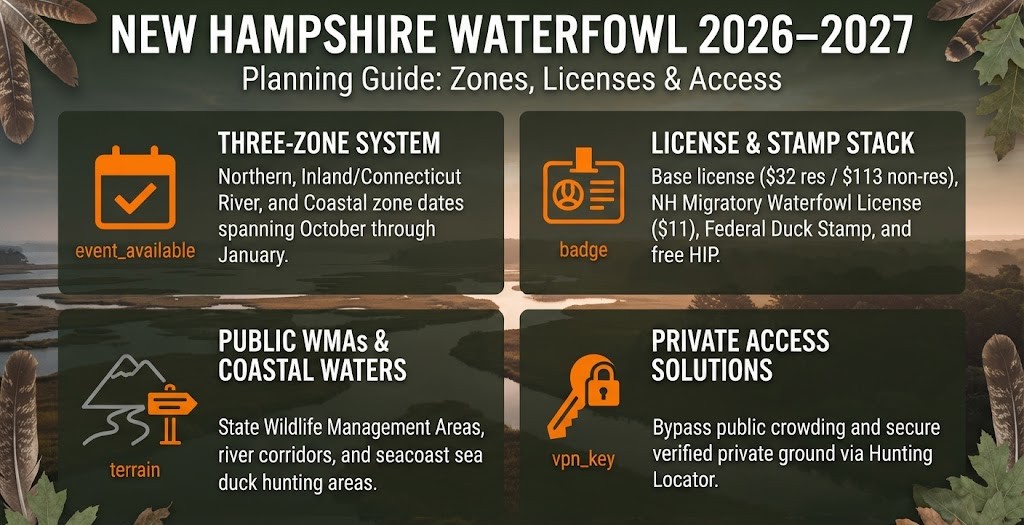
This New Hampshire waterfowl guide pulls together the official 2026–2027 regulations in one place so you don’t have to dig through PDFs and phone trees. All regulatory figures come from NH Fish and Game, but check the current-year digest before you head out — dates and details can shift slightly from year to year.
The goal here is straightforward: combine authoritative state data with practical guidance on legal land access, for residents and out-of-state hunters alike. This guide covers:
- Zone-by-zone 2026–2027 season dates and bag limits
- The complete NH license, stamp, and permit checklist (residents and non-residents)
- Where to hunt — public lands, private leases, and guided hunts — plus tips and gear
For a broader look at how waterfowl fits into the state’s overall hunting calendar, see our New Hampshire waterfowl overview.
Quick Overview: 2026–2027 NH Waterfowl Season at a Glance
New Hampshire sits within the Atlantic Flyway, one of four major migratory bird corridors in North America, which is part of why the state manages seasons by zone rather than a single statewide date. Following the 2026–2027 season announcement from NH Fish and Game, here’s the full rundown of dates, bag limits, and notes.
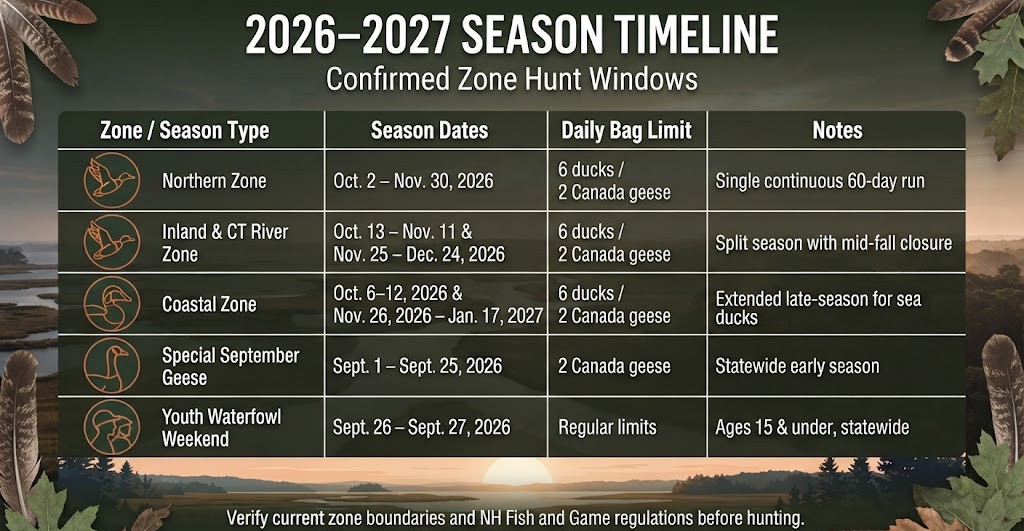
| Zone/Season Type | Dates | Notes |
|---|---|---|
| Northern Zone | October 2 – November 30, 2026 | Single continuous 60-day run, no split |
| Inland & Connecticut River Zone | October 13 – November 11, 2026, and November 25 – December 24, 2026 | Split season with a mid-fall closure |
| Coastal Zone | October 6 – October 12, 2026, and November 26, 2026 – January 17, 2027 | Long late-season window good for sea ducks |
| Special Canada Geese (September) | September 1 – September 25, 2026 | Statewide |
| Youth Waterfowl Weekend | September 26 – September 27, 2026 | Ages 15 and younger, statewide |
| Veteran & Active Military Weekend | January 23 – January 24, 2027 | Statewide, proof of eligibility required |
The regular duck season runs 60 days with a daily bag limit of six birds. The regular Canada goose season also runs 60 days, with a daily bag limit of two. Your legal hunting dates depend entirely on which zone you’re in — that’s the organizing principle behind New Hampshire’s waterfowl regulations.
To hunt waterfowl in New Hampshire at age 16 or older, you’ll need a specific set of credentials, covered in detail below:
- Base NH Hunting, Combination, or Small Game (nonresident) license
- NH Migratory Waterfowl License ($11.00)
- Federal Duck Stamp
- Free H.I.P. permit number
Confirm your zone before booking anything else — the dates and zones are the foundation everything else depends on.
New Hampshire Waterfowl Hunting Seasons by Zone
New Hampshire structures its waterfowl seasons around geographic zones, so the dates that matter to you depend on where you’re set up. The state is divided into the Northern Zone, the Inland and Connecticut River Zone, and the Coastal Zone, with a set of statewide special seasons layered on top. Here’s how each breaks down for 2026–2027.
Northern Zone
The Northern Zone is the simplest to plan around: one continuous window from October 2 – November 30, 2026. No split, no reopening date to track — a straight 60-day run.
Inland & Connecticut River Zone
This zone runs a split season: October 13 – November 11, 2026, followed by a second window from November 25 – December 24, 2026. Hunters sometimes forget the mid-season closure and show up during the gap, so mark both windows separately. Reopening dates have shifted by a day or two in past years, so confirm annually rather than relying on memory.
Coastal Zone
The Coastal Zone opens for a short early window from October 6 – October 12, 2026, then reopens for a much longer stretch from November 26, 2026 – January 17, 2027. That late-season run into mid-January matters if you’re chasing sea ducks, since coastal waters stay huntable well after inland zones have closed.
Special Seasons: September Geese, Youth & Veteran Weekends
Beyond the three main zones, New Hampshire adds several statewide special seasons:
- Special Canada Goose Season: statewide September 1 – September 25, 2026
- Youth Waterfowl Weekend: statewide September 26 – September 27, 2026, for hunters ages 15 and younger
- Veteran & Active Military Weekend: statewide January 23 – January 24, 2027, for hunters licensed in New Hampshire
The Youth Weekend is a low-pressure entry point for introducing a younger hunter to the sport before the general zones open. For the Veteran & Active Military Weekend, participants need proof of eligibility — an active or retired military ID, a National Guard or Reservist ID, a New Hampshire driver’s license showing veteran status, or a Form DD214.
September geese and the youth weekend both open well before the general duck zones, so don’t assume the season starts on the same date everywhere.
New Hampshire Waterfowl Bag & Possession Limits
New Hampshire’s overall duck bag limit of six birds daily contains a web of species-specific sub-limits, and this is where hunters most often run into trouble without realizing it. According to official migratory bag limits published by NH Fish and Game, here’s how those limits break down.
| Species/Category | Daily Bag | Possession | Notes |
|---|---|---|---|
| General Ducks | $6 | $18 | Max 4 mallards (max 2 hens), 2 black ducks, 3 wood ducks, 3 pintails, 2 canvasbacks, 2 redheads, 1 scaup; max 3 scoters/3 long-tailed ducks/3 eiders (max 1 hen); harlequin duck CLOSED |
| Mergansers | $5 | 15 | Additional to general duck limit |
| Coots | $15.00 | $45 | — |
| Sea Ducks | $4.00 | $12 | Part of the general duck bag; species include eider, scoter, long-tailed duck |
| Canada Geese (Regular) | $2 | $6 | — |
| Snow Geese | 25 | No limit | — |
| Brant | 1 | 3 | — |
The harlequin duck season is closed entirely, so know your species before you shoot. Snow geese and brant hunting also carry their own distinct rules within this broader framework — double-check current limits if you’re targeting either species specifically.
New Hampshire Waterfowl Licenses and Permits
Here’s what you need to hunt waterfowl legally in New Hampshire, whether you live here or you’re traveling in for the season. All requirements and costs below come from NH Fish and Game.
New Hampshire Hunting Licenses
Every waterfowl hunter needs a base hunting license first, then adds the NH Migratory Waterfowl License on top. Here’s the full cost breakdown, per New Hampshire license prices.
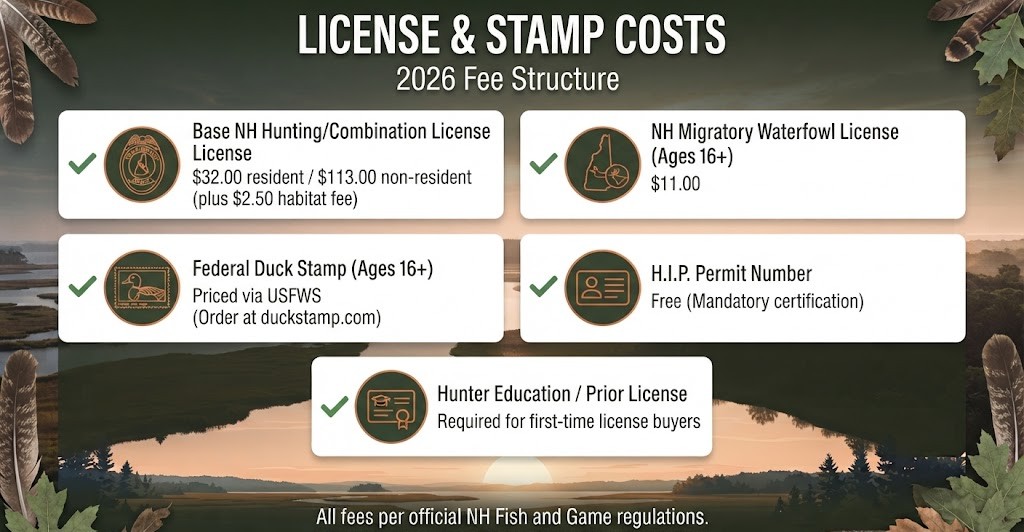
| Credential | Resident | Non-Resident | Notes |
|---|---|---|---|
| Base NH Hunting/Combination License | $32 | $113 | Plus mandatory $2.50 annual wildlife habitat fee |
| NH Migratory Waterfowl License | $11 | $11.00 | Ages 16+ |
| Federal Duck Stamp | Priced via USFWS | Priced via USFWS | Ages 16+ |
| H.I.P. Permit | Free | Free | Certification number required |
Anyone buying a first hunting license in New Hampshire must show a prior license of the same type — from any state, any year — or a hunter education completion certificate. This applies equally to residents and non-residents, so first-timers should complete hunter education before trying to buy a license.
If you’re traveling in from out of state, budget for the $113.00 non-resident base license as your headline cost. Non-residents purchase through the Small Game license option where applicable.
New Hampshire Waterfowl Permits & Stamps
Once your base license is sorted, here’s the sequence for getting fully legal to hunt waterfowl, according to New Hampshire’s waterfowl hunting requirements:
- Add the NH Migratory Waterfowl License ($11, ages 16+) — required in addition to your base hunting license, and what specifically authorizes you to hunt ducks and geese.
- Secure a Federal Duck Stamp — regulated by the U.S. Fish and Wildlife Service, not the state. Many U.S. Post Offices don’t carry it or are frequently out of stock, so order online at duckstamp.com ahead of time.
- Get your free H.I.P. permit number — call 1-800-207-6183 or use the NH Fish and Game online system, at no charge. Write the number on your license once you have it.
Your general hunting license lets you hunt; the migratory waterfowl license is what specifically authorizes you to pursue ducks and geese. You need both, along with the duck stamp and HIP number, before opening day.
Where to Hunt Waterfowl in New Hampshire
Once you’re legally set up, the next question is where to put your boots — or waders — in the water. There are three main paths: free public land, a private lease for consistent access, or a guided hunt for a turnkey experience.
Best Public Lands
New Hampshire offers public Wildlife Management Areas (WMAs) and refuge waters open to waterfowl hunters, a solid starting point if you don’t have access to private land. The tradeoff is real: popular public marshes get crowded fast, especially on opening weekends, which is exactly what pushes a lot of hunters toward private access instead.
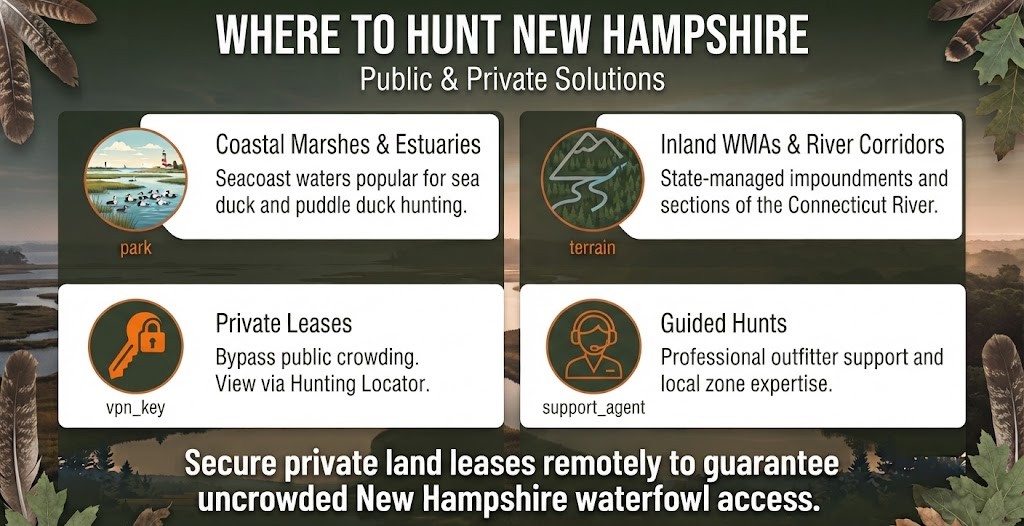
Generally speaking, New Hampshire’s public waterfowl opportunities fall into a few categories:
- Coastal marshes and estuaries along the seacoast, popular for sea duck and puddle duck hunting
- Inland WMA impoundments managed specifically for waterfowl habitat
- River corridors along major waterways, including sections of the Connecticut River
- National refuge waters, such as portions of Umbagog National Wildlife Refuge
Each area carries its own specific regulations, so verify the details for wherever you’re headed in the current NH Hunting & Trapping Digest before you go.
Private Land Hunting with Hunting Locator
Private land offers less pressure, more consistent birds, and the freedom to set up your own blind and decoy spread exactly the way you want it. There are two real options: leasing private land for the season, or buying land outright if you’re ready to invest in a long-term hunting property.
This is where Hunting Locator comes in. It’s a platform built to connect hunters directly with landowners who lease or sell hunting land, so you spend less time scouting for permission and more time hunting. We’ve organized access to New Hampshire waterfowl properties so you don’t have to cold-call landowners or hope a public spot opens up.
Take a look at current New Hampshire waterfowl leases through the Hunting Locator platform and see what’s available this season. If the crowds at popular public marshes are wearing thin, a lease gives you room to breathe. If you’re traveling in from out of state, it’s turnkey access without needing local connections. And if you’re new to the sport without family land to fall back on, leasing is often the most realistic path to quality private hunting ground.
Browse current New Hampshire waterfowl leases and secure your spot before the season fills up.
Guided Hunts
If you’d rather have someone else handle the gear, dogs, calling, and local knowledge, a guided hunt is the turnkey option — especially useful for non-residents or newcomers who want to focus purely on the hunt itself. A good guide service removes the guesswork from an unfamiliar zone.
When evaluating a guide, look for:
- Licensed and insured operation so you’re covered if anything goes sideways
- Provided decoys and blinds so you’re not hauling gear across state lines
- Deep zone familiarity so they know where birds are working that week
- Beginner-friendly instruction if you’re new to calling or setup
- Clear, upfront pricing with no surprise add-ons
If you’d rather run your own hunt on your own schedule, a private lease gives you access to similar quality land without coordinating around someone else’s calendar.
Waterfowl Hunting Tips for a Successful NH Season
A few field-tested fundamentals go a long way, regardless of which zone you’re hunting:
- Scout Before You Set Up: Watch where birds are actually landing in the days before your hunt. Patterns beat guesswork.
- Match Your Decoy Spread to the Zone: Go bigger and more open for coastal sea ducks, tighter for inland impoundments where birds expect a smaller group.
- Hide Well: A solid blind and natural concealment matter more than expensive gear.
- Call With Restraint: Less is often more, especially if you’re newer to this. Master a basic feeding chuckle before attempting complex sequences.
- Hunt the Right Time of Day: Early morning and the last hour before dusk typically produce the most bird movement.
- Dress for Cold Water: Quality waders keep you safe and comfortable through New Hampshire’s late-season cold, especially on long January coastal hunts.
Whatever your setup needs — decoys, blinds, calls, or waders — you’ll find options in our waterfowl gear store.
More Resources from Hunting Locator
Planning more than just a waterfowl trip? Here’s the rest of our New Hampshire hunting library:
- New Hampshire hunting season guide — the master hub covering every season New Hampshire offers.
- New Hampshire waterfowl hunting season — our companion evergreen page on NH waterfowl.
- New Hampshire game bird season — closely related coverage of migratory and upland bird hunting.
- New Hampshire small game season — for rabbit, squirrel, and other small game opportunities.
- New Hampshire turkey season — spring and fall turkey hunting details.
- New Hampshire deer season — the state’s flagship big game season.
- New Hampshire black bear season — everything on bear hunting zones and dates.
- New Hampshire moose season — permit lottery info and season details.
- New Hampshire coyote season — year-round predator hunting guidance.
- New Hampshire hunting leases — browse current private-land listings across every game type.
- The Hunting Locator store — gear for every hunt, waterfowl and beyond.
Frequently Asked Questions
What are the 2026–2027 New Hampshire waterfowl season dates?
Per NH Fish and Game’s 2026–2027 season announcement, the Northern Zone runs October 2 – November 30, 2026. The Inland and Connecticut River Zone runs October 13 – November 11, 2026, and November 25 – December 24, 2026. The Coastal Zone runs October 6 – October 12, 2026, and November 26, 2026 – January 17, 2027.
How much does a non-resident New Hampshire hunting license cost?
A non-resident base hunting license costs $113.00, plus a mandatory $2.50 annual wildlife habitat fee. You’ll also need the $11.00 NH Migratory Waterfowl License and a Federal Duck Stamp, all per NH Fish and Game’s official pricing.
What is a HIP permit and how do I get one in New Hampshire?
A HIP permit is a free Harvest Information Program certification number required for all waterfowl hunters age 16 and older. Get yours online through the NH Fish and Game system or by calling 1-800-207-6183, then write the number on your hunting license.
Where do I buy a Federal Duck Stamp?
The Federal Duck Stamp is regulated by the U.S. Fish and Wildlife Service, not the state, and is required for hunters 16 and older. Many U.S. Post Offices don’t carry it or are frequently out of stock, so order it online in advance at duckstamp.com.
When is the New Hampshire youth waterfowl weekend in 2026?
The Youth Waterfowl Hunting Weekend runs September 26 – September 27, 2026, statewide, and is open to hunters ages 15 and younger.
What is the daily bag limit for ducks in New Hampshire?
The general daily bag limit is 6 ducks with an 18-bird possession limit, but species-specific sub-limits apply within that total — for example, no more than 4 mallards (max 2 hens), and the harlequin duck season is closed entirely. See the bag-limit table above for the full breakdown.
The Final Shot
A good New Hampshire waterfowl season comes down to three things: knowing your zone’s exact dates, completing the full four-credential license stack, and locking down quality land before everyone else does. Get those right, and the rest — decoys, calls, cold mornings on the water — falls into place.
Before you head out, remember that a full summary of season dates and bag limits is published each year in the NH Hunting and Trapping Digest, released every August. Confirm current details against NH Fish and Game directly, since regulations can shift slightly from one season to the next.
This guide consolidates the research so you don’t have to hunt for it yourself. Whether you’re chasing sea ducks on the coast or geese along the Connecticut River, the next step is finding the right access. Browse New Hampshire waterfowl leases or start on Hunting Locator to see what’s available this season.


