This guide covers every confirmed 2026–27 date verified against the latest NJ Fish & Wildlife framework, along with licensing costs, public land options, and private access resources. Whether you’re a longtime Jersey waterfowler or planning your first trip to the coastal marshes, everything you need is here.
Here’s what this guide covers:
- Confirmed 2026–27 season dates & bag limits for every zone and species—ducks, geese, brant, sea ducks, snipe, and more
- Complete license, stamp & certification breakdown with exact costs for residents and non-residents
- Where to hunt—public WMAs, guided options, and how to access private land for a less-pressured experience
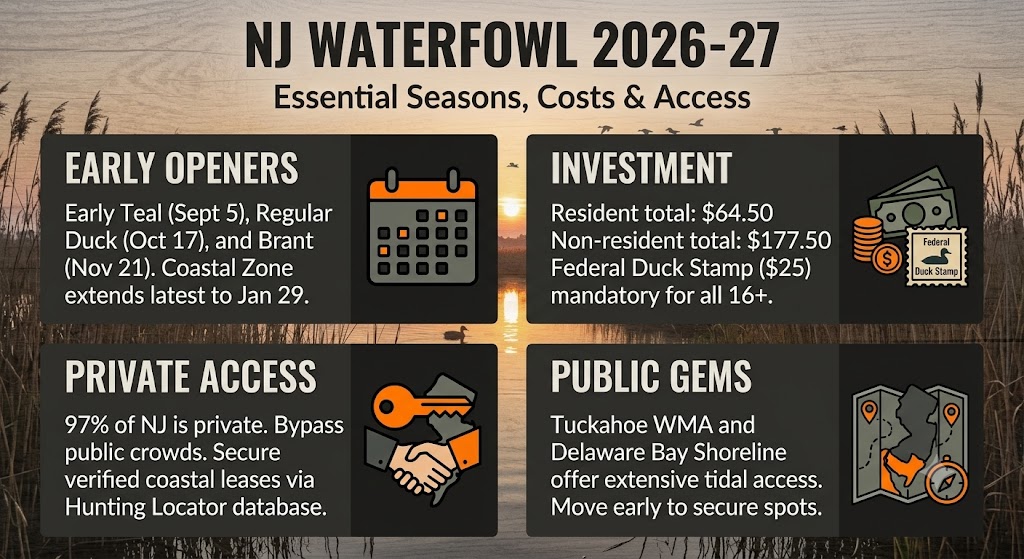
Quick Overview: NJ Waterfowl Seasons & Limits at a Glance
According to NJ Fish & Wildlife, New Jersey divides its waterfowl hunting territory into three zones—North, South, and Coastal—each with its own season calendar. The Coastal Zone runs the latest, extending a few extra days to capture late-migrating birds working through the salt marshes and tidal bays along the Jersey Shore. Which zone you’re hunting determines every legal date you can be in the field.
Before you head out, make sure your kit is ready—get the right gear for NJ waterfowl at the Hunting Locator Store.
2026–27 NJ Waterfowl Master Season Table
| Species | Season Type / Zone | Start Date | End Date | Daily Bag Limit |
|---|---|---|---|---|
| Early Teal | Statewide | Sept 5, 2026 | Sept 26, 2026 | 6 daily |
| Ducks | North Zone (Early) | Oct 17, 2026 | Oct 24, 2026 | 6 daily |
| Ducks | North Zone (Late) | Nov 21, 2026 | Jan 21, 2027 | 6 daily |
| Ducks | South Zone (Early) | Oct 17, 2026 | Oct 24, 2026 | 6 daily |
| Ducks | South Zone (Late) | Nov 21, 2026 | January 21, 2027 | 6 daily |
| Ducks | Coastal Zone | Nov 21, 2026 | Jan. 29, 2027 | 6 daily |
| Scaup | Early Period | Oct 17, 2026 | Oct. 24, 2026 | 1 daily |
| Scaup | Mid Period | November 21, 2026 | December 29, 2026 | 1 daily |
| Scaup | Late Period | Dec 30, 2026 | Jan 21, 2027 | 2 daily |
| Sea Ducks | Same as Duck Zones | Same as Duck Zones | Same as Duck Zones | 7 daily |
| September Canada Goose | Statewide | Aug 31, 2026 | Sept 29, 2026 | 15 daily |
| Canada Goose | North Zone | Nov 26–28, 2026 | Dec 22, 2026 – Jan 21, 2027 | 2 daily |
| Canada Goose | South Zone | Nov 26–28, 2026 | Dec 22, 2026 – Jan 21, 2027 | 2 daily |
| Winter Canada Goose | Special Areas | Jan 22, 2027 | Feb 13, 2027 | 5 daily |
| Brant | North Zone (Split) | Nov 21–28, 2026 | Dec 12, 2026 – Jan 7, 2027 | 2 daily |
| Brant | South Zone (Split) | Nov 21–28, 2026 | Dec 12, 2026 – Jan 7, 2027 | 2 daily |
| Brant | Coastal Zone (Split) | Nov 21–28, 2026 | Dec 23, 2026 – Jan 18, 2027 | 2 daily |
| Light Geese (Snow/Blue) | Regular Season | Oct. 15, 2026 | Feb 13, 2027 | 25 daily |
| Light Geese | Conservation Order | Feb. 15, 2027 | Apr 3, 2027 | No limit |
| Rails & Gallinules | Statewide | Aug 31, 2026 | Nov 8, 2026 | 15 (rails) / 25 (gallinules) |
| Coots | Same as Duck Zones | Same as Duck Zones | Same as Duck Zones | 15 daily |
| Snipe | Statewide | Sept 5, 2026 | Jan 7, 2027 | 8 daily |
| Youth Waterfowl Day | North & South Zones | Oct 10, 2026 | Oct 10, 2026 | Regular limits |
| Youth Waterfowl Day | Coastal Zone | Nov 14, 2026 | Nov 14, 2026 | Regular limits |
| Veterans/Active Military Day | Statewide | Nov 7, 2026 | Nov 7, 2026 | Regular limits |
| Joint Youth & Veteran Day | Statewide | Jan 30, 2027 | Jan 30, 2027 | Regular limits |
Always confirm final dates on the official NJDEP Fish & Wildlife site before opening day—frameworks can shift.
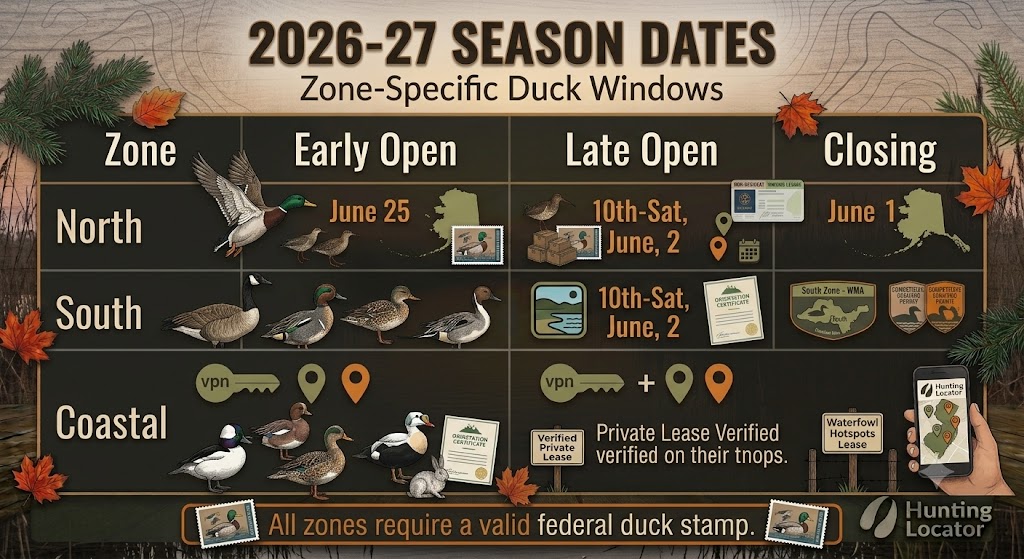
License, Stamp & Certification Requirements at a Glance
Every NJ waterfowl hunter—resident or non-resident—must be fully licensed before setting foot in the marsh. Here’s what you’ll need:
- Hunting License — Required for all hunters; resident and non-resident options available (full cost breakdown below)
- NJ Waterfowl Stamp — Mandatory for all hunters ages 16+; $10 residents / $15 non-residents
- Federal Duck Stamp — Required nationally for all waterfowl hunters ages 16+; $25
- HIP Certification — Required for all migratory bird hunters; $2
- Hunter Education — Required for first-time license buyers before any license can be issued
Full licensing details, costs, and application steps are covered in the licensing section below.
New Jersey Duck Hunting Seasons
New Jersey’s duck seasons run on a split-season structure across three zones, each on its own calendar. The foundational rule to understand before studying the dates: according to NJ Fish & Wildlife, the federal Atlantic Flyway framework sets a 60-day season with a 6-duck aggregate daily bag limit. You can take up to 6 ducks per day total, but specific species carry individual sub-limits that apply within that aggregate—knowing those caps matters as much as knowing the open dates.
Early Teal Season
The early teal season runs statewide from September 5 through September 26, 2026, targeting blue-winged and green-winged teal before the regular migration begins. The daily bag limit is 6 teal; this window is teal-only, and other duck species are not legal. It’s the first duck hunting opportunity of the year in New Jersey and one of the more active ones.
Regular Duck Season (North, South & Coastal Splits)
The regular duck season uses a split structure across all three zones—an early segment and a longer late segment separated by a break of roughly late October through mid-November. The 2026–27 dates:
- North Zone (Early): Oct 17–24, 2026
- North Zone (Late): Nov 21, 2026 – Jan 21, 2027
- South Zone (Early): Oct 17–24, 2026
- South Zone (Late): Nov 21, 2026 – Jan 21, 2027
- Coastal Zone: Nov 21, 2026 – Jan 29, 2027
The break between segments is intentional, designed to align hunting pressure with migration timing. Hunters willing to move between zones can stretch their season considerably: NJ Fish & Wildlife confirms that crossing zone boundaries can yield up to 70 hunting days and 12 different Saturdays during the 60-day season. The Coastal Zone’s later close—January 29 versus January 21—is structured to capture late-migrating birds in the salt marshes.
Within the 6-duck daily aggregate, these species sub-limits apply:
- 4 mallards (1 hen max)
- 2 black ducks
- 2 pintails
- 3 wood ducks
- 2 canvasbacks
- 1 mottled duck
Scaup Sub-Periods
Scaup (bluebills) have a nested season structure within regular duck dates, with bag limits that shift across three distinct periods. All scaup count toward your 6-duck daily aggregate.
| Scaup Period | Start Date | End Date | Daily Bag Limit |
|---|---|---|---|
| Early Period | Oct 17, 2026 | Oct 24, 2026 | 1 daily |
| Mid Period | Nov 21, 2026 | Dec 29, 2026 | 1 daily |
| Late Period | Dec 30, 2026 | Jan 21, 2027 | 2 daily |
The tiered limit reflects federal population management goals for scaup along the Atlantic Flyway. If you’re specifically targeting bluebills, the late period offers the most flexibility at 2 birds per day.
Sea Ducks
New Jersey’s position on the Atlantic Flyway makes it a solid sea duck destination, with scoters (black, surf, and white-winged), long-tailed ducks, and eiders all present during the season. The daily bag limit is 7 per day—the most generous in the duck category. NJ Fish & Wildlife notes that sea ducks may only be hunted when the regular duck season is open in each zone, so their calendar mirrors the regular duck season exactly.
New Jersey Goose, Brant & Other Waterfowl Seasons
Beyond ducks, New Jersey offers a wide range of waterfowl opportunities—from the September goose season to the snow goose Conservation Order that runs into spring. Here’s the full breakdown for geese, brant, and other migratory species.
September Canada Goose Season
The September Canada goose season runs statewide from August 31 through September 29, 2026, with a 15-bird daily bag limit, targeting resident Canada geese before migratory birds arrive from the north.
One planning note worth taking seriously: as the NJ hunting community confirms, resident September honkers tend to concentrate around parks and golf courses rather than public marshes. Productive hunting almost always requires access to private agricultural land. Public areas are technically open, but the birds generally aren’t using them the way they will later in the season. Private land access options are covered in detail later in this guide.
Regular Canada Goose Season
The regular Canada goose season carries a 2-bird daily bag limit, down from September’s 15. Both the North and South Zones follow an identical split structure:
- First Segment: November 26–28, 2026
- Second Segment: December 22, 2026 – January 21, 2027
The split structure reduces pressure during peak migration while still offering hunting through late January. The lower bag limit reflects the shift to migratory birds, which are managed more conservatively than the resident population.
Winter Canada Goose Season
A special Winter Canada Goose season extends hunting in designated special areas, running January 22 through February 13, 2027, with a 5-bird daily bag limit. Confirm specific designated areas with NJDEP Fish & Wildlife ahead of time.
Brant Season
Brant are a coastal specialty, with the season structured as a split across all three zones at a 2-bird daily bag limit:
- North Zone: November 21–28, 2026 and December 12, 2026 – January 7, 2027
- South Zone: November 21–28, 2026 and December 12, 2026 – January 7, 2027
- Coastal Zone: November 21–28, 2026 and December 23, 2026 – January 18, 2027
Brant hunting along the Jersey coast—particularly in Barnegat Bay and the tidal flats of the Delaware Bay shoreline—is among the more challenging waterfowl experiences on the Atlantic Flyway. The Coastal Zone’s extended second segment (closing January 18 versus January 7 for North/South) gives coastal hunters additional late-season opportunity as brant linger in the bays.
Light Geese (Snow/Blue) & Conservation Order
The regular light goose season runs October 15, 2026 through February 13, 2027, with a 25-bird daily limit and no possession limit.
When the regular season closes, the Light Goose Conservation Order runs February 15 through April 3, 2027—with no bag limit. According to NJ Fish & Wildlife, the Conservation Order is a special management action authorized by the Migratory Bird Treaty Act to control overabundant light goose populations. During the Conservation Order, rules that don’t apply in regular seasons are permitted:
- Electronic calls are legal
- Shotguns capable of holding up to 7 shells are permitted
- Extended shooting hours apply
- No bag limit and no possession limit
Rails, Gallinules, Coots & Snipe
New Jersey’s migratory bird season extends well beyond ducks and geese. These species often get overlooked but offer good early- and mid-season opportunities:
- Rails & Gallinules: August 31 – November 8, 2026 | 15 daily (rails) / 25 daily (gallinules)
- Coots: Same dates as the duck season in each zone | 15 daily
- Snipe: September 5, 2026 – January 7, 2027 | 8 daily
Rails are a productive early-season target in NJ’s tidal marshes, offering fast shooting in some of the state’s best habitat. Snipe season’s long run—extending into January—pairs well with late duck and goose hunts.
Youth & Veterans Waterfowl Days
New Jersey sets aside dedicated hunting days for youth hunters and veterans/active military, with regular bag limits applying throughout.
| Special Day | Zone / Area | Date |
|---|---|---|
| Youth Waterfowl Day | North & South Zones | Oct 10, 2026 |
| Youth Waterfowl Day | Coastal Zone | Nov 14, 2026 |
| Veterans/Active Military Day | Statewide | Nov 7, 2026 |
| Joint Youth & Veteran Day | Statewide | Jan 30, 2027 |
NJ Fish & Wildlife confirms that Youth Waterfowl Days fall on the Saturday prior to each zone’s regular duck opener, giving young hunters field time before competition increases. Veterans and active military receive two dedicated statewide days, one concurrent with the joint Youth Day in late January.
New Jersey Waterfowl Licenses and Permits
Getting licensed for New Jersey waterfowl hunting requires several separate credentials, each with its own cost and acquisition process. Here’s what you need to arrive at the marsh fully legal.
New Jersey Hunting Licenses
Every hunter—resident or non-resident—must hold a valid New Jersey hunting license before any stamp or certification can be applied.
| License Type | Eligibility | Cost |
|---|---|---|
| Resident Hunting License | NJ residents, ages 18–64 | $27.50 |
| Senior Resident License | NJ residents, ages 65+ | $15.50 |
| Non-Resident Hunting License | Out-of-state hunters, ages 14+ | $135.50 |
| Youth License | Ages 10–15 | Free |
Before purchasing any license, you’ll need a Conservation ID (CID) from NJDEP Fish & Wildlife. First-time license buyers must also provide proof of completed hunter education before a license will be issued. Once obtained, your NJ hunting license covers all of the state’s waterfowl seasons when paired with the required stamps and certifications below.
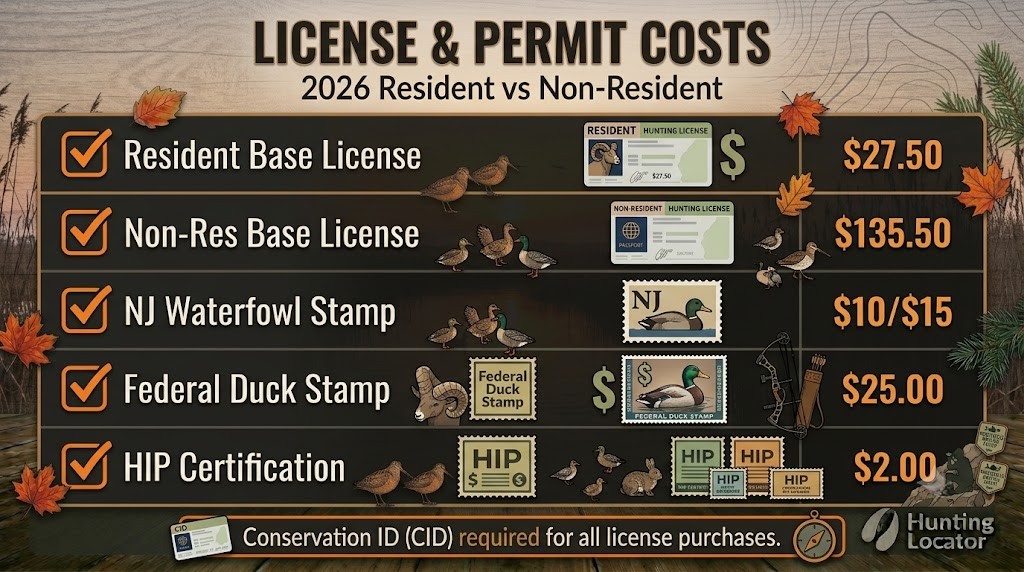
New Jersey Waterfowl Stamps and Permits
Once you have your base hunting license, waterfowl hunters ages 16 and up must obtain the following additional credentials.
NJ Waterfowl Stamp
Required for all hunters ages 16+ pursuing ducks, geese, or other migratory waterfowl in New Jersey.
- Resident: $10.00
- Non-Resident: $15.00
Federal Duck Stamp
Required for all waterfowl hunters ages 16 and older nationwide, regardless of state. Revenue funds wetlands conservation across the country.
- Cost: $25.00 (residents and non-residents)
- Available at most post offices, many sporting goods retailers, and online through the USFWS
HIP Certification
The Harvest Information Program (HIP) certification is a mandatory survey registration required for all migratory bird hunters nationwide. It takes a few minutes to complete and is valid through the end of the migratory bird season.
- Cost: $2.00
- Obtained at the time of license purchase or through the NJ Fish & Wildlife licensing system
New Jersey Waterfowl: Where to Hunt
Finding the right place to hunt is half the equation in New Jersey. The state offers accessible public Wildlife Management Areas, guided operations for hunters who want local expertise, and private land leasing for those who want less pressure and more control.
Best Public Lands
NJ Fish & Wildlife manages over 358,000 acres of Wildlife Management Areas, giving hunters substantial public access across habitats ranging from inland freshwater marshes to tidal bays and coastal flats. Here are the top public land options for NJ waterfowl hunters:
- Tuckahoe WMA — One of NJ’s most productive waterfowl destinations and the site of NJDEP Fish & Wildlife’s first managed waterfowl hunt program through the R3 Program. Located in Cape May County near the coast.
- Delaware Bay Shoreline WMAs — Widely recognized as one of the premier waterfowl hunting locations in New Jersey, the Delaware Bay draws ducks, geese, and brant throughout the season, with multiple WMAs providing shoreline access.
- Barnegat Bay Area — A central coast option with a productive mix of diver and puddle ducks, surrounded by tidal marshes with good blind opportunities.
- Great Bay / Mullica River Marshes — The expansive salt marshes of Great Bay are especially productive for black ducks and teal, with the Mullica River system providing extensive tidal habitat from multiple public access points.
- Maurice River Corridor — The Maurice River and its surrounding marshlands consistently produce good opportunities for ducks and geese across the season, particularly for hunters targeting divers during the late season.
Important WMA Rules: Per NJ hunting regulations, permanent waterfowl blinds—including pit blinds—are prohibited on designated WMAs. Any blind must be portable and completely removed by the end of each hunting day. Blinds left in the field are subject to confiscation. Arrive early—competition for the best spots on public land is real, especially on weekends.
Guided Waterfowl Hunts
For non-resident hunters or anyone who wants to skip years of local scouting, a guided waterfowl hunt is the most direct way to experience New Jersey’s marshes. A knowledgeable local guide brings access, local knowledge, and a fully set spread ready before legal shooting light.
New Jersey has a solid network of waterfowl guides operating across the coastal zone and the Delaware Bay region. When booking a guided hunt, here’s what to look for:
- Species targeting: Coastal guides often specialize in sea ducks, brant, or black ducks; inland guides may focus on puddlers, geese, or mixed-bag hunts
- Access: Many guides hold established relationships with private landowners, giving you productive marsh, farm, and bay habitat unavailable on public land
- What’s included: Most guided day hunts include decoy spreads, calls, boat transportation for coastal hunts, and bird cleaning—confirm inclusions when booking
- Booking timing: NJ’s most sought-after guided dates—especially opening week of the late season—fill months in advance
The Hunting Locator outfitter and guide directory is one of the faster ways to find vetted NJ waterfowl guides operating in your target zone.
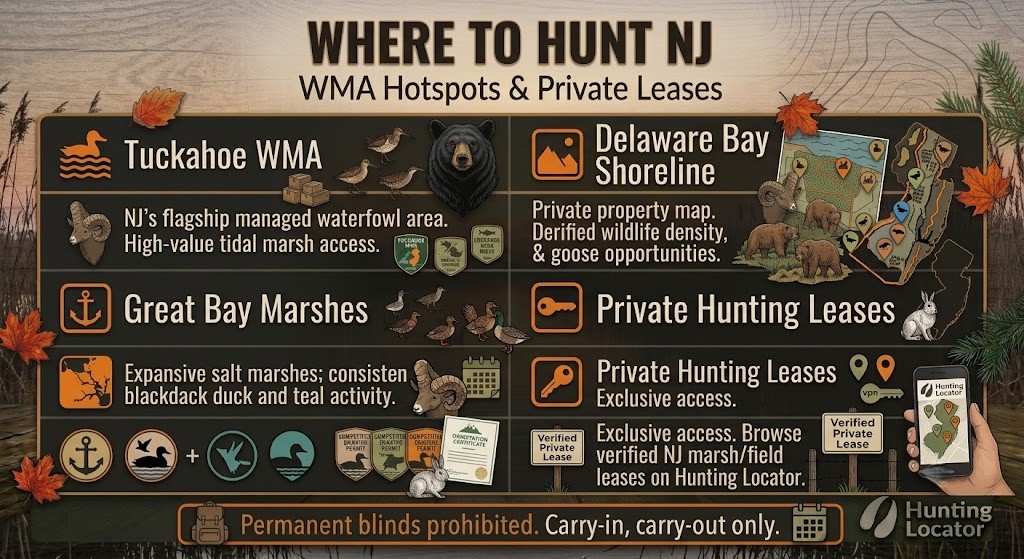
Private Land Hunting with Hunting Locator
For many NJ waterfowl hunters, the real frustration isn’t the regulations—it’s finding land. As hunters throughout the NJ community regularly note, competition runs high on public WMAs, and leasing private land is the most reliable way to secure quality hunting. That’s especially true during the September Canada goose season, where productive hunting practically requires farm access, but it applies across the full season as the best coastal marshes and bay access points draw consistent pressure.
Private land leasing means exclusive access to the habitat that matters most: farm ponds, tidal marshes, coastal bay frontage, and wetland edges that hold birds from September through the Conservation Order. With 80% of New Jersey’s land in private ownership, a substantial portion of quality hunting ground never touches the public system.
Hunting Locator connects hunters with landowners ready to lease or sell. You can browse verified New Jersey hunting property listings—waterfowl-specific marshes, bay access, and farm properties near major flyway corridors—filter by game type, acreage, and county, and contact landowners directly. Browse available New Jersey hunting leases on Hunting Locator and secure your spot before the 2026 season opens.
New Jersey Waterfowl Hunting Tips
Whether you’re hunting public marshes or a private coastal lease, preparation and in-field execution separate good days from slow ones. Here are the most useful tips for waterfowl hunting in New Jersey:
- Know your zone before you pack your gear. Legal hunting dates depend entirely on where you’re hunting, not just the species. Confirm your target area’s zone assignment before finalizing any travel plans.
- Scout tides for coastal and tidal marsh hunting. New Jersey’s productive coastal marshes respond strongly to tide movement. Birds feed and move on tidal cycles, not just sunrise and sunset. Pull tide charts for your target area and time your setup around peak water movement.
- Arrive early on public WMAs—especially on weekends. The best blind locations and access points on popular WMAs fill up well before legal shooting time on Saturday mornings. An early arrival is a requirement for securing a good position on pressured public ground.
- Match your decoy spread to the habitat. Tidal bays call for diver spreads with long anchor lines and proper current positioning; freshwater impoundments and marsh edges favor smaller puddler spreads with landing holes. Bringing the wrong spread is one of the more common mistakes visiting hunters make on their first NJ trip.
- Stay out of the skyline on flat coastal marshes. NJ’s coastal environments are wide-open and low-profile, making hunters visible from long distances. Low-profile layouts, natural grass blinds, and limiting movement during active flights keep birds committed on their final approach.
- Use the Conservation Order to extend your season. The light goose Conservation Order runs through April 3, 2027—no bag limit, electronic calls permitted, extended shooting hours. It’s one of the most underutilized seasons on the NJ calendar.
- Handle licensing early. Your Conservation ID, hunting license, NJ Waterfowl Stamp, Federal Duck Stamp, and HIP certification all need to be in hand before opening day. Early-season guided slots go to hunters who sort this out in July.
- Target black ducks and sea ducks for NJ’s specialty opportunities. Black ducks are a New Jersey stronghold species along the Atlantic Flyway. Combined with the state’s sea duck opportunity—7 per day for scoters, long-tailed ducks, and eiders—NJ offers Atlantic Flyway experiences that are difficult to replicate in most neighboring states.
More Resources from Hunting Locator
- New Jersey Hunting Season Guide — An overview of all NJ hunting seasons, big game through migratory birds, in one place. A good starting point if you’re new to hunting in New Jersey.
- New Jersey Waterfowl Hunting Season — Hunting Locator’s dedicated NJ waterfowl resource with additional tips, species information, and land access guidance.
- New Jersey Deer Hunting Season — Planning a combination deer and waterfowl trip? NJ offers quality whitetail hunting alongside its waterfowl seasons.
- New Jersey Turkey Hunting Season — Spring turkey is one of NJ’s most popular seasons. It pairs naturally with late-season snow goose Conservation Order hunting.
- New Jersey Small Game Hunting Season — Pheasant, rabbit, squirrel, and more—NJ’s small game seasons offer good opportunities to extend your time in the field.
- New Jersey Game Bird Hunting Season — A dedicated resource for upland and game bird hunting in New Jersey, covering pheasant, ruffed grouse, and woodcock seasons.
- New Jersey Furbearer Hunting Season — Covers NJ’s furbearer regulations and opportunities for hunters interested in trapping or hunting furbearers alongside their waterfowl season.
- New Jersey Hunting Leases on Hunting Locator — Browse available private hunting leases in New Jersey—waterfowl properties, farm access, and coastal marshes listed by landowners ready to connect with hunters.
FAQ
When does duck season open in New Jersey in 2026?
The first duck hunting opportunity of 2026 is the Early Teal Season, which opens September 5, 2026 statewide and runs through September 26. The regular duck season opens October 17, 2026 in the North and South Zones (early segment), with the Coastal Zone and late segments beginning November 21, 2026.
What is the duck bag limit in New Jersey for 2026?
The aggregate daily bag limit is 6 ducks, with individual species sub-limits applying within that six: 4 mallards (1 hen max), 2 black ducks, 2 pintails, 3 wood ducks, 2 canvasbacks, and 1 mottled duck. Scaup carry additional restrictions with tiered limits across three sub-periods.
How much does a New Jersey waterfowl hunting license cost?
Total licensing costs depend on residency. A resident hunter (ages 18–64) needs a $27.50 hunting license, $10 NJ Waterfowl Stamp, $25 Federal Duck Stamp, and $2 HIP certification—a $64.50 total. A non-resident pays $135.50 for the base license, $15 for the NJ Waterfowl Stamp, $25 for the Federal Duck Stamp, and $2 HIP—a $177.50 total.
Do I need a Federal Duck Stamp to hunt waterfowl in New Jersey?
Yes. The Federal Duck Stamp is required for all waterfowl hunters ages 16 and older, regardless of state.


