This New York small game guide puts the dates, bag limits, and license requirements in one place, along with a rundown of where you can actually hunt: public Wildlife Management Areas, private leases, or a guided trip.
Every date here is cross-referenced against the New York State Department of Environmental Conservation. Confirm current dates on DEC’s portal before you head afield, since zone boundaries and closing dates can shift year to year. For a deeper species breakdown, see our full NY small game breakdown.
What’s covered below:
- Season dates & bag limits — grouse, rabbit, squirrel, and furbearers broken down by Northern and Southern Zone.
- Licenses, permits & hunter education — resident vs. non-resident costs and what beginners need before their first hunt.
- Where to hunt — public Wildlife Management Areas plus private leases and guided hunts through Hunting Locator.

New York Small Game Season Quick Overview
New York splits its hunting regulations into a Northern Zone and a Southern Zone, and that line governs nearly every season opener and closer in the state. The Northern Zone covers the Adirondacks and North Country; the Southern Zone covers everything south of that line, including areas north of New York City and Long Island.
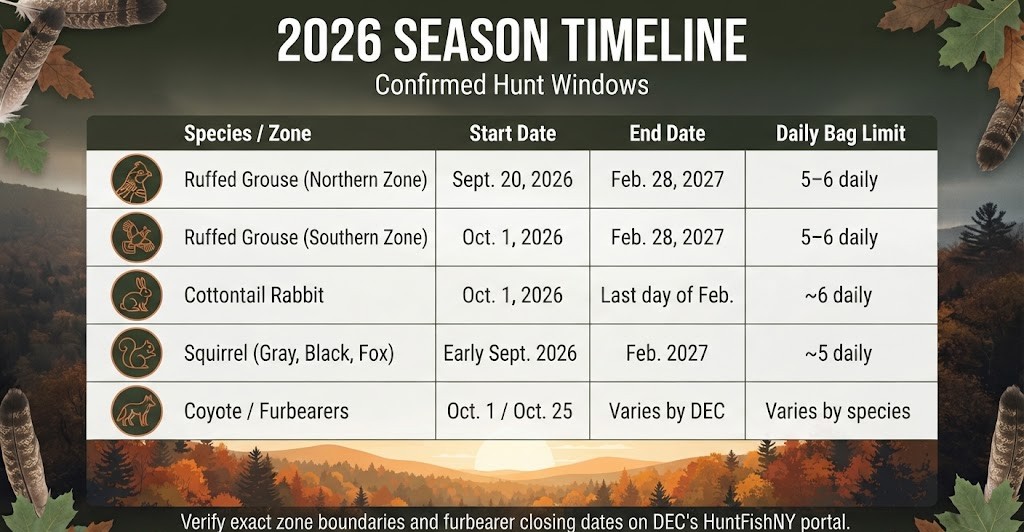
DEC has the final word on dates and limits — confirm current numbers on DEC’s portal before you head out. Here’s the quick-scan table for 2026:
| Species | Start | End | Zone | Daily Bag Limit | Notes |
|---|---|---|---|---|---|
| Ruffed Grouse | Sept 20 | Feb 28, 2026 | Northern | 5–6 (check DEC) | Zone-split start |
| Ruffed Grouse | Oct 1 | Feb 28, 2026 | Southern | 5–6 (check DEC) | North of NYC/Long Island |
| Cottontail Rabbit | Oct 1 | Last day of February | Upstate | ~6 | Standard daily limit |
| Squirrel (Gray, Black, Fox) | Early September | February | Statewide (varies by region) | ~5 | Beginner-friendly |
| Coyote | Oct 1 | See DEC | Statewide | — | Furbearer |
| Fox / Raccoon / Bobcat | Oct 25 | See DEC | Statewide | — | Furbearer start |
| Snapping Turtle | See DEC | See DEC | Statewide | 5 daily / 30 season | Carapace must be 12″+ |
Grouse daily limits typically run 5 or 6 depending on regional guidelines, and furbearer and snapping turtle closing dates vary — check the DEC portal before committing to a hunt plan.
Small game hunting in New York also requires a valid hunting license and, for anyone born on or after September 1, 1949, completed hunter education:
- Hunting license — resident annual runs $15 (ages 12–69).
- Hunter education — mandatory before your first license purchase, no exceptions for residents born after the 1949 cutoff.
- Permits — most small game species need no special tag beyond your base license, but confirm species-specific rules directly with DEC before your hunt.
New York Small Game Hunting Seasons
Zones drive nearly every date on the calendar. Below is a species-by-species walkthrough, starting with the most beginner-friendly options and moving into furbearer and niche seasons.
Squirrel Season (Start Here)
Squirrel season — covering gray, black, and fox squirrels — runs from early September through February, with slight regional variation and a daily bag limit of roughly 5. It’s the easiest entry point into New York small game hunting.
Squirrels are abundant, found in wooded areas, and active throughout the fall, which makes them an ideal beginner-friendly small game target for anyone newly hunter-ed certified.
Cottontail Rabbit Season
Cottontail rabbit hunting runs from October 1 through the last day of February upstate, with a standard daily bag limit of around 6. Rabbits favor brushy edges, overgrown fields, and thick cover — classic upland habitat found across much of the state.
DEC occasionally calls on rabbit hunters for conservation help. Hunters in certain eastern counties can participate in surveys tracking New England cottontail distribution, a small way to contribute to the species you’re pursuing.
Ruffed Grouse Season
Ruffed grouse season is the clearest example of how zones drive New York’s small game calendar. The Northern Zone runs September 20 through February 28, 2026, while the Southern Zone (north of NYC and Long Island) runs October 1 through February 28, 2026. Daily bag limits typically fall at 5 or 6 depending on regional guidelines, so confirm your zone’s exact number before heading out.
For other upland options, see other upland bird seasons across the state.
Furbearer Seasons (Coyote, Fox, Raccoon, Bobcat)
Furbearer season opens in two waves: coyote hunting starts October 1, while fox, raccoon, and bobcat all start October 25. Closing dates vary by species and zone, so check DEC for exact end dates before planning a late-season hunt.
Hunting furbearers with a firearm is a separate pursuit from trapping, which requires its own license. The New York coyote hunting season is one of the earliest furbearer openers and worth circling first on a fall calendar.
Snapping Turtle & Niche Species
Snapping turtle season carries a daily limit of 5 and a season limit of 30, with a carapace requirement of 12 inches or larger. Exact opening and closing dates vary, so check DEC directly if this niche pursuit interests you.
New York Hunting Licenses and Permits
Licensing in New York has a few layers, but the structure is straightforward. A base hunting license covers most small game; species and method only occasionally add another requirement on top.
New York Hunting Licenses
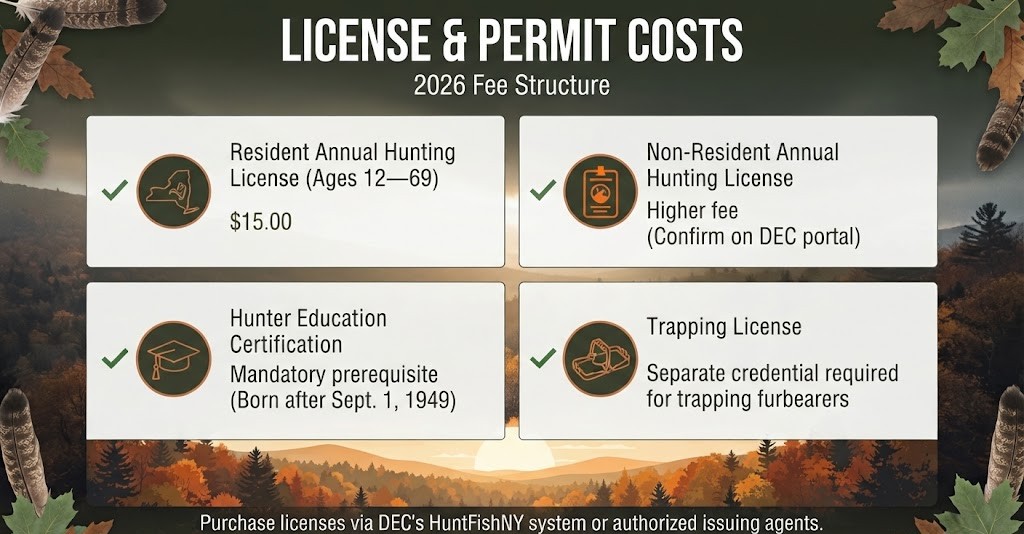
The resident annual hunting license costs $15 for hunters ages 12–69. Non-resident licenses cost significantly more, based on the New York license fee schedule, though current-year figures should be confirmed directly through DEC since fee schedules change.
| License Tier | Resident | Non-Resident |
|---|---|---|
| Annual Hunting (ages 16–69) | $22 | 100 |
| Annual Youth (12-16) | $5 | $5 |
Licenses are available through DEC’s HuntFishNY system or any authorized license-issuing agent statewide. Have your hunter education proof ready before you buy. Once licensed, non-residents hunt under the same season dates and bag limits as residents — there’s no separate non-resident season or limit structure.
Hunter Education & Permits
Any hunter born on or after September 1, 1949 must complete hunter education before purchasing a New York hunting license, with no exception for age or experience level. New York honors hunter education reciprocity from other states and countries meeting IHEA-USA standards, so out-of-state certification typically transfers without a retake.
The sequence to get licensed:
- Complete hunter education — through an approved in-person or online course if you haven’t already.
- Obtain your certificate or proof — keep a copy on hand, physical or digital, for license purchase.
- Purchase your license — through DEC’s HuntFishNY system or a licensed agent.
- Confirm species-specific permits — most small game needs nothing beyond the base license, but trapping furbearers requires a separate trapping license.
For most small game hunters, the base license is all that’s needed. The exception is trapping — if you plan to trap rather than hunt furbearers with a firearm, budget time to secure that separate credential before the season opens.
New York Small Game Where to Hunt
Getting the dates and licensing right is only part of the work. Finding somewhere to actually hunt is the other half. Here’s how public land, private leases, and guided hunts compare across New York.
Best Public Lands
New York has a solid public-land system for small game hunters. As one industry source notes, New York public land access is one of the state’s real strengths — hunters willing to do the map work can build an entire season without owning an acre of ground.
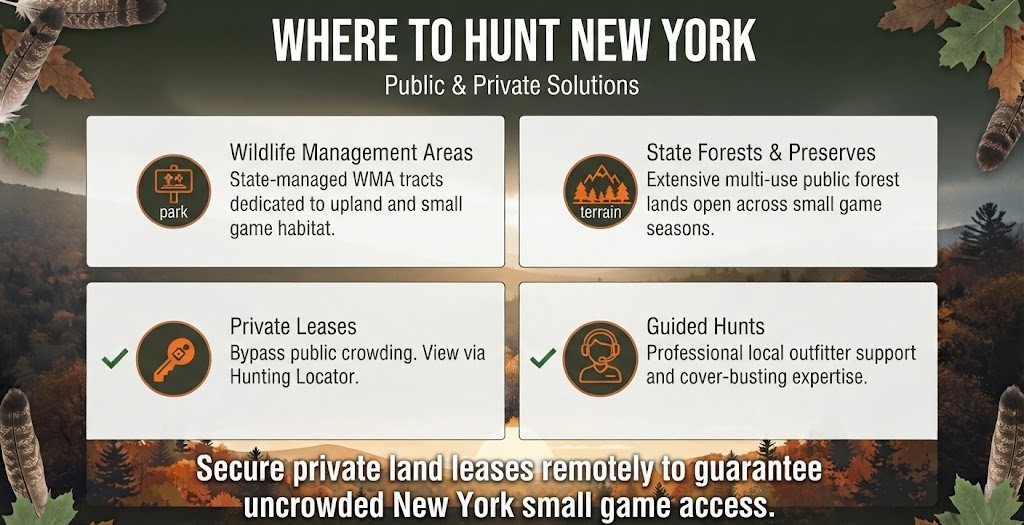
Public access generally falls into a few categories:
- Wildlife Management Areas (WMAs) — dedicated public hunting tracts spread across the state, many managed specifically for upland and small game habitat.
- State Forests — extensive multi-use forest land open to hunting throughout small game season.
- Forest Preserve lands — protected acreage, particularly concentrated in the Adirondack and Catskill regions.
- National Wildlife Refuges — federally managed land offering additional small game opportunity in select areas.
Before heading out, pull up DEC’s public land access maps to confirm boundaries and any area-specific rules. A little scouting goes a long way toward a productive opener.
Private Land Hunting with Hunting Locator
Most of New York’s land is privately owned, and much of the best small game cover — thick rabbit edges, mature grouse woods, undisturbed squirrel timber — sits behind private boundaries. Leasing is one way around the competition for space on crowded public tracts.
Leasing gives you consistent, low-pressure access you can return to season after season, and the ability to pattern game rather than compete with every other hunter working the same parcel. Buying land is the long-term version of the same idea: permanent access, on your terms, for every season going forward.
Hunting Locator connects hunters directly with landowners across New York who are ready to lease or sell hunting ground. Browse listings by acreage, region, and game type, and connect with landowners directly.
You can browse New York hunting leases now to see what’s currently available across the state. The earlier you start looking, the more options you’ll have before the opener.
Guided Hunts
Guided hunts are especially useful for non-resident hunters and beginners who want local knowledge without spending a full season learning the terrain. A good guide compresses years of scouting into a single trip.
What a guided small game hunt typically gets you:
- Local terrain knowledge — a guide already knows where birds and rabbits are holding this season, saving you the trial-and-error.
- Licensing and logistics help — someone who can walk you through non-resident requirements and local rules before you ever step into the field.
- Higher success odds — experienced eyes on unfamiliar cover mean more flushes and more shots.
- A low-friction way to learn a new area — even one guided trip can teach you enough to hunt that region independently next season.
If you’re traveling from out of state and unfamiliar with New York’s terrain, pairing a guided hunt with a private lease or public land scouting trip can shorten the learning curve while still building toward independent access down the road.
Small Game Hunting Tips
Dates and licenses get you legal. The approach and gear are what turn a decent season into a good one.
- Start with squirrels. Abundant, forgiving, and good for building woodsmanship before you chase grouse through thicker cover.
- Learn your zone before opening day. Northern and Southern Zone dates differ — confirm yours on DEC so you’re not a day early or a limit over.
- Dress for New York’s swings. From Adirondack cold to downstate damp, weather and terrain vary widely across the state, so gear for variable terrain matters more than most hunters plan for.
- Match your gear to the game. A light shotgun or a .22 rifle covers most small game situations — pick the tool that fits the cover you’re hunting.
- Respect bag limits and report as required. Know your daily limits, and understand any harvest-reporting rules before you head afield.
When it’s time to fill gaps in your gear closet, the right gear for the pursuit is worth a look — from upland vests and blaze orange to boots built for a full day of cover-busting.
More Resources from Hunting Locator
- Hunting Locator homepage — the platform’s flagship entry point for leases, gear, and guides.
- NY small game hunting season — our full small game breakdown and the closest companion piece to this guide.
- NY hunting season guide — the master hub covering every New York species and season.
- NY coyote hunting season — a deeper dive into the October 1 coyote opener.
- NY game bird hunting season — upland bird opportunities beyond grouse.
- NY turkey hunting season — for hunters looking to add turkey to their season.
- NY waterfowl hunting season — everything you need for ducks and geese.
- NY black bear hunting season — a big game cross-sell for hunters ready to go bigger.
- NY deer hunting season — the state’s flagship big game season.
- Hunting Locator store — gear up for whichever pursuit is next on your calendar.
FAQ
When does small game season open in New York for 2026?
Most small game opens between September 1 and November 1, depending on species and zone. Grouse opens September 20 in the Northern Zone and October 1 in the Southern Zone, while rabbit season opens October 1. Always confirm exact dates on DEC’s official portal before heading afield.
How do Northern and Southern Zone dates differ for grouse?
Northern Zone grouse season opens September 20, while Southern Zone grouse season opens October 1 — both close February 28, 2026. The zone line runs roughly north of New York City and Long Island. Check DEC’s zone map to confirm which zone covers your hunting location.
How much is a New York small game hunting license in 2026?
A resident annual hunting license costs $15 for hunters ages 12–69. Non-resident licenses cost significantly more, so confirm the current non-resident rate directly on DEC’s HuntFishNY portal before your trip.
Do non-residents need New York hunter education?
Yes, hunter education is required for anyone born on or after September 1, 1949. New York honors hunter education certificates from other states and countries that meet IHEA-USA standards, so non-residents can typically purchase a license through DEC’s system with proof of their existing certification.
What small game is easiest for beginners in New York?
Squirrels are the top choice — abundant, active through fall, and found reliably in wooded areas across the state. A .22 rifle or light shotgun works well for this pursuit. Complete hunter education first, then start on accessible public land or a private lease.
What are the bag limits for New York small game?
Typical daily limits include grouse at 5–6 (varies by region), rabbit around 6, squirrel around 5, and snapping turtle at 5 daily with a 30 season limit (12-inch minimum carapace). Always confirm current limits directly with DEC before you head out.
The Final Shot
Planning a New York small game season for 2026 comes down to three things: knowing your zone-based dates, getting your licensing and hunter education squared away, and lining up real access before the opener arrives.
Confirm your zone dates on DEC, sort your license and hunter education requirements, and lock in access before opening day gets crowded. Regulations shift year to year, so the DEC portal remains the last word before you head afield.
Browse New York leases and connect with the land that fits your season.


