Here’s the thing: choosing a rifle scope isn’t rocket science, but the industry sure makes it feel that way. At HuntingLocator, we’ve watched too many hunters get paralyzed by technical jargon when they should be focused on what actually matters for their hunt. As Bushnell explains, “If a scope’s magnification is 8X that means you can see EIGHT TIMES closer than the naked eye”—but there’s a lot more to the story.
This guide cuts through the marketing fluff and gives you what you need to know:
- What those confusing scope numbers actually tell you (and which ones matter most)
- The real differences between reticle types and how to pick the right one
- A straightforward way to match scope specs to your actual hunting conditions
Let’s start with those numbers that seem designed to confuse you.
Decoding the Numbers: What “3-9×40” Actually Means
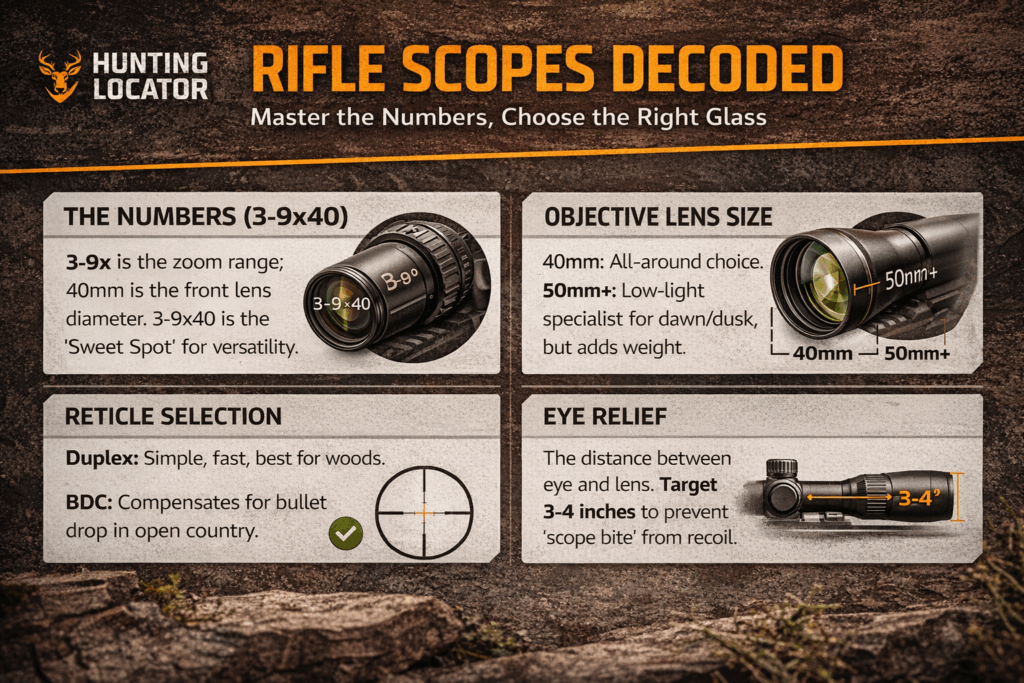
Every scope has a string of numbers that looks like some kind of secret code. It’s not. Once you crack it, everything else makes sense.
Here’s the breakdown:
- 3-9x = Magnification range (you can zoom from 3x to 9x power)
- 40 = Objective lens diameter in millimeters (that’s the big lens up front)
- What it means: At 3x, things look three times closer than with your naked eye. At 9x, nine times closer.
According to American Hunter, understanding these basics is your first step to making a smart purchase instead of getting sold something you don’t need.
Think about it practically. At 3x magnification, you’ve got a wide view that’s perfect for tracking a deer moving through thick brush. Crank it up to 9x, and you can count antler points at 250 yards and place your shot exactly where it needs to go.
The Sweet Spot for Most Hunters: Research consistently shows that “a 3-9×40 scope is the sweet spot: bright, versatile, affordable, and simple to use.” This setup handles everything from dense woods to open fields, morning to evening.
But what about that “40” at the end? That number affects your hunting success more than most people realize.
The Objective Lens: Your Scope’s Light-Gathering Engine
The objective lens is the big glass circle at the front of your scope. It’s basically your scope’s eye, and like any eye, bigger usually means it can see better in dim conditions. As Let’s Go Shooting explains, “The objective lens is the big lens at the front of the rifle scope. It collects and focuses light from the environment and brings it into the scope.”
Here’s why this matters for your hunt: deer move most during those first and last 30 minutes of legal shooting light. A scope that gives you a clear, bright image during these prime times can be the difference between filling your tag and going home empty-handed.
The Trade-offs You Need to Know:
Bigger objective lenses gather more light, creating brighter images when it matters most. Research shows that “A larger objective lens (e.g., 50mm) allows more light to enter, improving clarity and brightness, especially in low-light conditions.”
But there’s a catch. Bigger lenses mean more weight and bulk. If you’re hiking five miles into elk country, every ounce matters. Plus, larger objectives often require higher scope rings, which can mess with your natural shooting position. Common mistakes include “ignoring mounting height since large objective lenses may require higher rings, altering cheek weld.”
Real-World Examples:
- Dawn in the timber: That extra light from a 50mm objective could mean the difference between a clean shot and watching a trophy whitetail disappear into the shadows.
- Mountain hunting: When you’re carrying everything on your back for days, a quality 40mm scope might serve you better than a heavier 50mm version.
Matching Objective Size to Your Hunt
Quick Decision Guide:
- 32-40mm: Daytime hunting, weight matters, shorter shots, budget-friendly
- 42-44mm: All-around choice, handles most conditions, good compromise
- 50mm+: Low-light specialist, stand hunting, long-range open country
Planning a hunt in unfamiliar territory? Hunting experts note that dense woods or brush favour lower magnification and wide fields of view while open plains, mountains, or agricultural fields often benefit from higher magnification optics.
The Exit Pupil Factor
Here’s something most salespeople won’t explain: exit pupil = objective lens diameter ÷ magnification. So a 40mm objective at 4x power gives you a 10mm exit pupil. Your eye can only use about 7mm in low light, so anything above that is wasted. However, as American Hunter points out, “a larger objective does not always mean more light transmission since exit pupil figures are based on objective lens diameter as well as magnification.”
This means a 50mm objective doesn’t automatically give you better low-light performance—it depends on what magnification you’re using.
Want to see these features in action? Check out our rifle scope collection to compare specs and find what works for your hunting style.
Reticle Types Explained: Finding Your Aiming Pattern
The reticle is what you see when you look through your scope—the crosshairs, dots, or lines that help you aim. Many of the best scopes have reticles etched into the glass lens of the scope—this glass-etched construction lasts longer than the old wire crosshairs.
Choosing a reticle is personal. What works perfectly for your buddy might drive you crazy. Understanding your options helps you pick what actually fits YOUR hunting style.
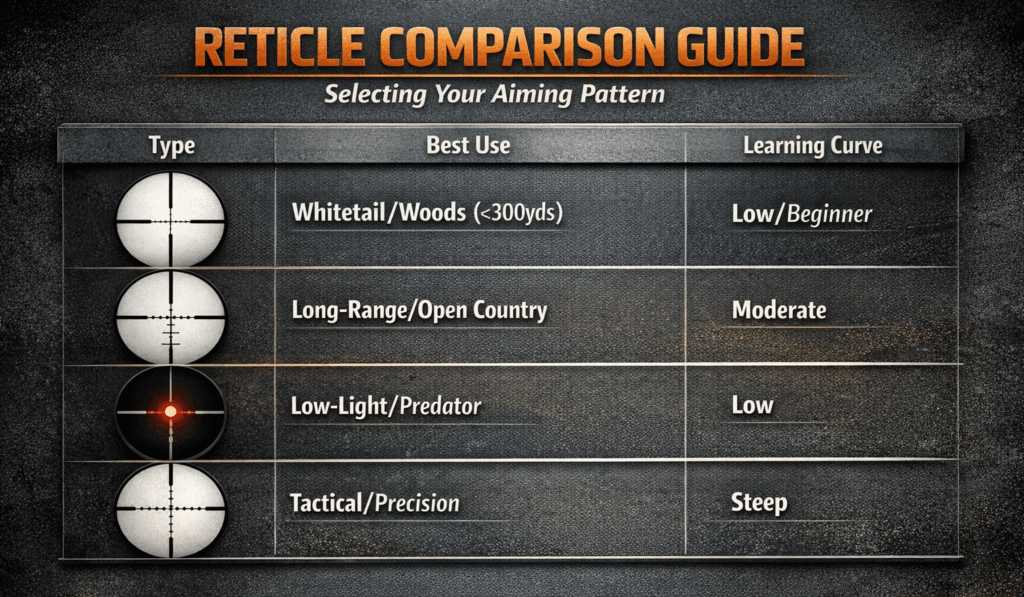
The Duplex Reticle: Keep It Simple
Rocky Mountain Optics confirms that “This is the most common reticle for hunting… Duplex reticles are simple, effective, and excellent for beginners.”
The duplex has thick outer lines that taper to thin crosshairs in the center. The thick parts grab your eye and guide it to center fast. The thin center lets you aim precisely. This design excels when you need quick target acquisition, most hunting shots under 300 yards, and if you prefer simplicity over complexity.
When it shines: A buck steps into your shooting lane at 150 yards. You have maybe three seconds before he’s gone. With a duplex reticle, there’s no thinking required—just center the crosshairs and squeeze.
The BDC Reticle: Built-In Range Compensation
BDC (Bullet Drop Compensator) reticles have extra aiming points below the main crosshair, designed to compensate for bullet drop at longer distances. Bushnell explains that BDC reticles “estimate bullet drop and are best for long-range shooters.”
These work best if you regularly shoot beyond 200 yards, don’t want to mess with turret adjustments in the field, and hunt open country where long shots are common. The catch? BDC reticles are calibrated for specific bullet speeds—they work best when matched to your actual ammunition.
When it shines: You spot a pronghorn at 350 yards across open prairie. With a BDC reticle, you hold on the right hash mark and take the shot without touching your turrets.
Other Reticle Options Worth Knowing
Mil-Dot: More tactical-oriented, uses dots for range estimation and holdovers. Less common for hunting but useful for long-range enthusiasts.
Illuminated Reticles: Research shows that “Illuminated reticles make a difference right at dawn or dusk.” Battery-powered lighting makes the reticle glow for low-light visibility.
MOA Grid Reticles: Complex systems for precise holdovers and wind corrections, typically preferred by precision shooting enthusiasts.
Reticle Comparison at a Glance
| Reticle Type | Best For | Learning Curve | Perfect Hunt |
|---|---|---|---|
| Duplex | Most hunters | Easy | Whitetail in woods, shots under 300 yards |
| BDC | Long-range hunters | Moderate | Western big game, open country |
| Mil-Dot | Precision shooters | Steep | Long-range, tactical applications |
| Illuminated | Low-light hunters | Varies | Dawn/dusk hunting, thick cover |
Still not sure which reticle fits your style? Our scope selection lets you filter by reticle type to narrow down your options.
Safety First: Understanding Eye Relief
Eye relief, as American Hunter defines it, “measures the distance from the eyepiece lens of a scope to the plane behind the lens where the light rays from the exit pupil come into focus.”
In plain English: it’s how far your eye needs to be from the scope to see clearly. Get too close, and recoil can drive the scope into your face—that’s “scope bite,” and it’s as painful as it sounds.
The research shows that “Three inches of eye relief is ideal for most shooting applications, but 3.75 or even 4 inches is not unusual on optics designed for big-bore dangerous game rifles.”
If you’re shooting a magnum caliber with serious kick, don’t mess around—get a scope with generous eye relief. This isn’t about comfort, it’s about not getting hurt.
Matching Your Scope to Your Hunt: A Decision Framework
There’s no “best” scope—only the best scope for how YOU hunt. At HuntingLocator, we help hunters plan trips across different states and terrains. The key is being honest about where and how you actually hunt, not where you think you might hunt someday.
By Terrain Type
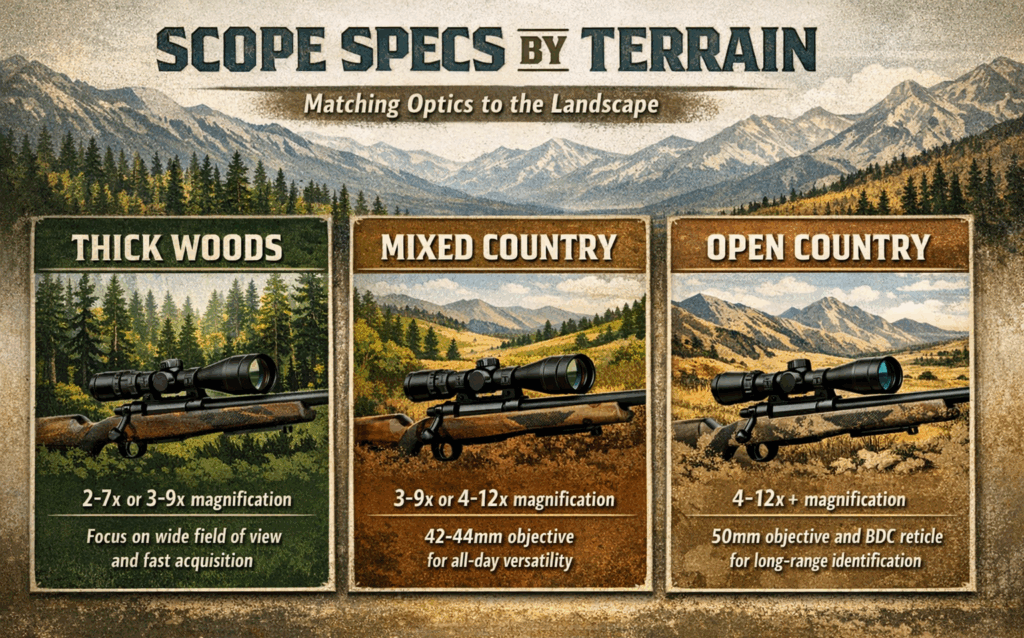
Terrain-Based Recommendations:
- Thick Woods: 2-7x or 3-9x magnification, 40mm objective, duplex reticle. You need wide field of view and fast target acquisition.
- Mixed Country: 3-9x or 4-12x magnification, 40-44mm objective, duplex or BDC reticle. Versatility is key.
- Open Country: 4-12x or higher magnification, 44-50mm objective, BDC or mil-dot reticle. You need magnification for target ID and holdover capability.
By Hunting Style
Specific research shows that “If you hunt deer within 300 yards, a 3–9x or 4–12x scope is ideal. For long-range targets over 800 yards, choose 5–25x or higher.”
Style-Based Recommendations:
- Stand Hunting Whitetails: 3-9×40 with duplex handles most shots from 50-200 yards perfectly
- Western Big Game: 4-12×44 or 4-14×50 with BDC for varied shot distances
- Backcountry Hunting: Weight matters—go with 3-9×40 or compact 2-7×32
Budget Reality Check
Advice of hunters is straightforward: “spend as much as you can afford.” Additional research suggests investing “up to half of your rifle cost on a quality scope.”
Budget Breakdown:
- Under $200: Stick to reliable basics—fixed magnification or simple variable with duplex
- $200-500: Quality variable magnification with BDC options and better glass
- $500+: Premium glass, advanced reticles, superior low-light performance
Essential Scope Accessories and Mounting
A great scope mounted poorly performs worse than a decent scope mounted right. Research emphasizes that “Scope rings and bases should match the model and dimensions of your firearm.”
Mounting Basics
What You Need:
- Scope Rings: Must match your scope tube diameter (1-inch or 30mm most common)
- Scope Bases: Must fit your rifle’s receiver
- Proper Height: Balance objective clearance with comfortable cheek weld
Browse our scope mounts to find the right setup for your rifle and scope combo.
Protection and Care
Hunting conditions are tough on gear, and experts recommend “accessories such as a scope cover, sunshade, and lens cleaning kit to protect and maintain your scope.”
Must-Have Accessories:
- Lens Covers: Keep scratches, moisture, and debris off your glass
- Cleaning Kits: Maintain clear optics throughout your hunt
- Sunshades: Cut glare in bright conditions
Our cleaning kits help keep your optics performing when it matters most.
Building Your Complete Optics System
Your rifle scope is just one piece of the puzzle. Hunting experts note that “For dense woods and whitetail hunting, compact binoculars and low-magnification scopes work well. In pronghorn or mule deer country, spotting scopes and rangefinders become more important.”
The Complete Setup
System Approach:
- Binoculars: For spotting and evaluating game—browse our binoculars
- Rangefinders: Essential for BDC use and ethical shots—check our rangefinders
- Spotting Scopes: For long-range glassing—view spotting scopes
Specialized Options
Advanced Gear:
- Red Dot Sights: Great for close, fast shots—see red dots
- Night Vision: For predator hunting—explore night vision
- Thermal Optics: High-tech hunting tools—view thermal optics
More Resources from Hunting Locator
HuntingLocator has everything you need to succeed in the field, not just gear advice:
- Hunting Binoculars – Complete binocular selection for spotting game across all hunting situations
- Hunting Rifle Scopes – Extensive scope collection with detailed specs to match your hunting needs
- Hunting Range Finders – Precision rangefinders for accurate shot placement
- Hunting Spotting Scopes – High-power spotting scopes for long-range glassing
- Hunting Red Dot Sights – Fast-acquisition red dots for close-range hunting
- Hunting Scope Mounts and Bases – Professional mounting solutions for secure installation
- Hunting Lens Cleaning Kits – Essential maintenance tools for peak optical performance
FAQ
What magnification works best for deer hunting?
For most deer hunting, “If you hunt deer within 300 yards, a 3–9x or 4–12x scope is ideal.” This range covers everything from close timber shots to longer field edges.
How do I know if my objective lens is big enough?
Match it to your hunting conditions. Research shows that “The 40mm objective lens provides a good balance of light transmission and weight” for most situations. Go bigger only if you hunt primarily in low light and don’t mind extra weight.
Should beginners choose duplex or BDC reticles?
For beginners, “Duplex reticles are simple, effective, and excellent for beginners.” Only choose BDC if you regularly shoot past 300 yards and want to learn holdover points.
What’s the real difference between cheap and expensive scopes?
Higher-end scopes “include higher-quality glass, more precise turrets, and better coatings.” You get clearer images, more reliable adjustments, and better low-light performance. But a good $200 scope handles most hunting just fine.
How much eye relief do I actually need?
Eye relief depends on your rifle: “Three inches of eye relief is ideal for most shooting applications, but 3.75 or even 4 inches is not unusual on optics designed for big-bore dangerous game rifles.” More recoil = more eye relief needed.
Can one scope handle different types of hunting?
Absolutely. A versatile setup like “a 3-9×40 scope is the sweet spot: bright, versatile, affordable, and simple to use” handles most hunting from woods to fields effectively.
The Bottom Line
Rifle scopes don’t have to be complicated. Focus on the basics—understanding what those numbers mean, how objective lens size affects your hunting, and which reticle fits your shooting style—and you’ll make a smart choice that serves you well.
The best scope is the one that matches where you actually hunt, fits your budget, and doesn’t overcomplicate your shooting. Whether you’re chasing whitetails in thick timber or planning your first western adventure, the right optics make all the difference between success and missed opportunities.
Ready to upgrade your hunting game? Check out our complete selection! We stock top-quality rifle scopes, precision rangefinders, and reliable mounting systems to set you up for success in the field.


