Oregon issues roughly 2,500 pronghorn antelope tags per year across the state, and the best rifle units can take 25–30+ preference points to draw. For most hunters, the hardest part of an Oregon pronghorn hunt isn’t the stalk across sagebrush flats—it’s getting drawn. The May 15 application deadline applies to the 2026 season, and there’s no late entry.
This guide covers what you need before and after you apply: season dates, fees, draw mechanics, land access, and gear. It’s organized for residents stacking preference points, non-residents planning a first trip, and first-time hunters figuring out where to start.
Here’s what you’ll find:
- Season dates & fees at a glance — quick-reference tables for every hunt type, weapon, and hunter category
- How the draw works — the May 15 deadline and the 75%/25% preference-point system explained
- Where to hunt — public land options, private-land leases, and guided hunt opportunities across Oregon’s best antelope country
Oregon Antelope Season 2026: Quick Overview
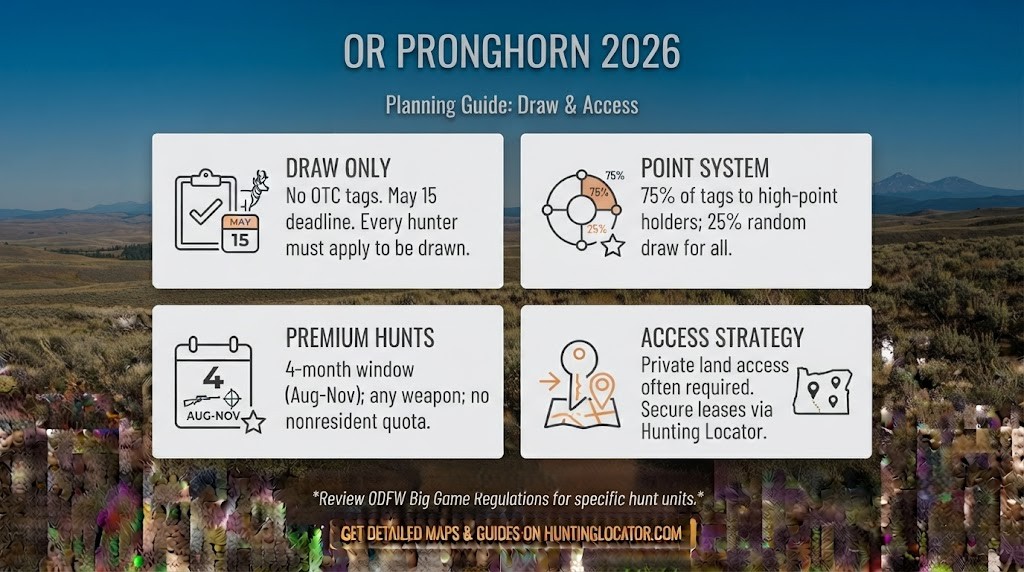
All Oregon pronghorn antelope hunts are controlled (limited entry) draws. There are no over-the-counter tags. Every hunter—resident or non-resident, archery or rifle—must apply and be drawn. The application deadline is May 15, 2026 at 11:59 PM PT. Miss that date and your 2026 season is over.
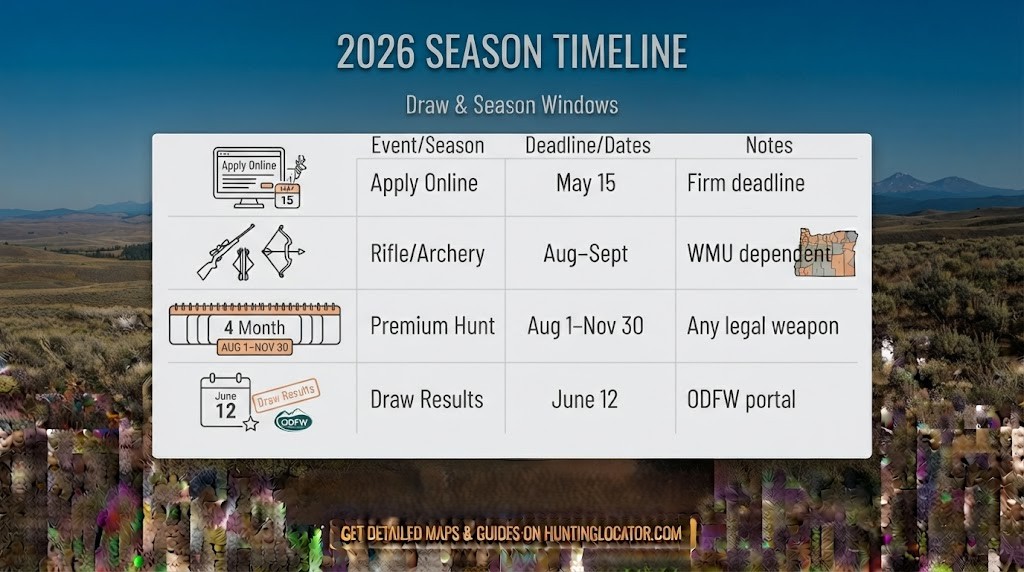
Most seasons run during August and September, with premium tags offering an extended window. For a full look at Oregon’s broader big game season calendar, pronghorn planning starts here.
| Season Type | Dates | Bag Limit | Notes |
|---|---|---|---|
| Rifle (controlled) | Primarily August–September | 1 pronghorn (usually buck only) | Exact dates vary by WMU; check ODFW Big Game portal |
| Archery (controlled) | Primarily August–September | 1 pronghorn (usually buck only) | Varies by unit and weapon type |
| Youth (controlled) | Primarily August–September | 1 pronghorn (may allow either-sex) | Youth-specific hunts available through ODFW |
| Premium Hunt | August 1 – November 30, 2026 | 1 pronghorn (either-sex) | Any legal weapon; separate application required; no non-resident quota |
Important: Hunters may only obtain and possess one valid pronghorn tag per annual hunting season, regardless of hunt type. While ODFW restructured Eastern Oregon deer hunts from WMUs to new deer hunt areas for 2026, the antelope WMU structure is unchanged for this cycle.
License, Permit & Education Requirements
Before you apply, confirm you’ve met every requirement:
- Hunting License Required First — You must purchase an annual Oregon hunting license before submitting a controlled hunt application. No license, no application.
- Controlled Hunt Application — Submit by May 15, 2026 at 11:59 PM PT. A $10 application fee per species is required at submission.
- Hunter Education — Hunters 17 and younger must have a hunter education certificate before purchasing a license, unless they are ages 9–15 and enrolled in the youth mentor program.
- Tag Purchase After Draw — Successful applicants purchase their pronghorn tag after draw results are posted. You have until the day before the earliest hunt period opens to complete that purchase.
Oregon Antelope Hunting Seasons
Oregon offers multiple pronghorn hunt types organized by weapon category and hunter classification, all governed by the controlled-hunt draw. According to ODFW, almost all seasons occur in August and September, with hunters advised to prepare for dry conditions and potential fire restrictions.
Rifle Season
Oregon’s rifle antelope seasons run primarily during August and September, with exact dates determined by Wildlife Management Unit (WMU). The top units—including Beatys Butte, Juniper, Hart Mountain, Whitehorse, and Warner—require 25 to 30+ preference points for rifle tags, placing them among the most competitive draws in the western United States.
The wait reflects what those tags deliver. Rifle success rates in Oregon’s top antelope units often run 80% or better, with some units approaching 100% harvest success. Once you draw a rifle tag in a premium unit, your odds of tagging out are strong. Applying consistently each year is the most reliable way to get there.
Archery Season
Archery antelope seasons fall within the same August–September window under the same controlled-hunt draw process. The practical difference is in point requirements: reaching Oregon’s best units with 80-inch-plus trophy potential via archery takes approximately 10+ preference points, compared to 20+ for rifle tags in those same units. For hunters willing to pursue pronghorn with a bow across open sagebrush, that’s a meaningfully shorter wait. The field challenge is higher, but the draw timeline is often shorter.
Youth & Premium Hunts
Two specialized categories warrant separate attention.
Youth Hunts offered by ODFW may include either-sex tags, giving young hunters the opportunity to pursue does or bucks depending on the specific unit. Hunters 17 and under must complete hunter education before purchasing a license, unless enrolled in the youth mentor program (ages 9–15). Youth seasons fall within the same August–September window as adult controlled hunts.
Premium Hunts are a distinct category with four defining characteristics:
- 4-month season window — August 1 through November 30, 2026
- Either-sex bag limit — hunt bucks or does depending on conditions
- Any legal weapon — rifle, archery, or muzzleloader
- No non-resident quota — Oregon issues one premium hunt per unit for antelope with no non-resident quota, making them one of the few realistic pathways for out-of-state hunters
Premium hunts require a standalone application, and preference points, landowner preference tags, and guide and outfitter tags are not available for these draws—they go through a separate drawing process.
Oregon Antelope Licenses and Permits
Hunting Oregon pronghorn requires two separate purchases: an annual hunting license (bought before applying) and a pronghorn-specific tag (purchased only if drawn). Both are required, and neither substitutes for the other.
Oregon Hunting Licenses
The fee structure below reflects the 2026 figures.
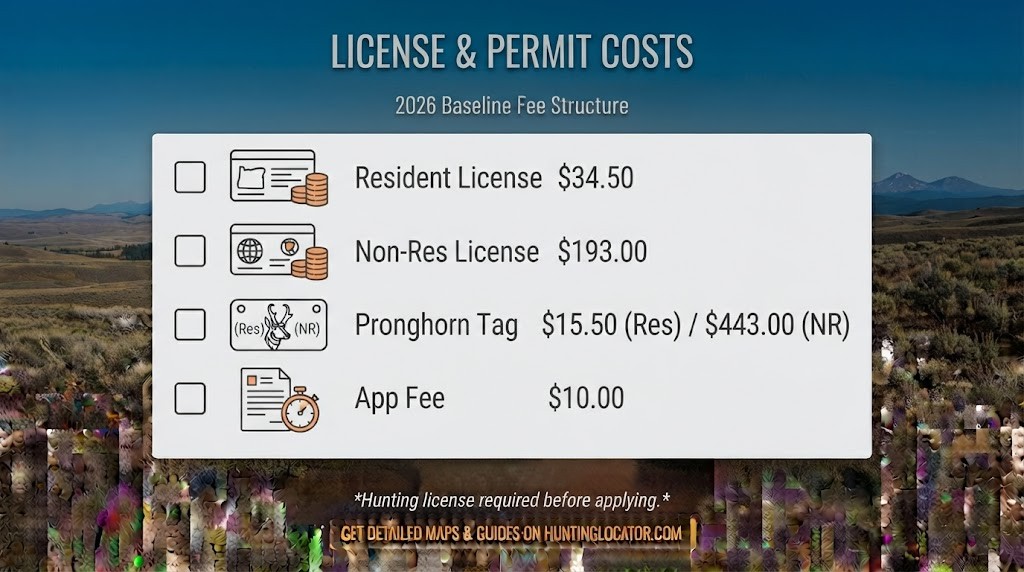
| Fee Type | Resident | Non-Resident |
|---|---|---|
| Annual Hunting License | $35 | $193.00 |
| Pronghorn Tag (if drawn) | $16 | $443 |
| Controlled Hunt Application Fee | $10 | $10 |
The hunting license must be purchased before you can submit a controlled hunt application—it’s a prerequisite. Licenses and tags are available through the ODFW licensing system and authorized license agents statewide. Non-resident hunters should note that the $193 license cost is in addition to the $443 tag fee if drawn—account for both before applying.
Oregon Hunting Permits & Application Process
Oregon’s controlled hunt draw uses a preference point hybrid system. The mechanics: 75% of tags go to applicants with the most preference points; 25% are awarded randomly among all first-choice applicants, regardless of points held. This hybrid system is confirmed by both ODFW and independent application resources.
Steps to complete your 2026 Oregon antelope application:
- Buy your Oregon hunting license (required before applying) — Resident: $34.50 | Non-Resident: $193.00
- Submit your controlled hunt application by May 15, 2026 at 11:59 PM PT with the $10 per-species application fee via the ODFW online system
- Correct any application errors through May 25, 2026 — a correction window is available after the deadline
- Check draw results by June 12, 2026 — successful applicants will be notified through ODFW’s system
- Purchase your pronghorn tag if drawn — you have until the day before your earliest hunt period opens to complete this purchase
Preference Point Strategy: Several things about Oregon’s system aren’t obvious from the regulations alone:
- Every year you do not draw your first-choice hunt, you receive a preference point for that series. Draw your tag and your points reset to zero.
- Points are affiliated with a hunt series, not a specific hunt location number—switching target units doesn’t forfeit accumulated points.
- The maximum preference points a hunter can hold in 2026 is 33 for antelope, increasing by one per year.
- Hunters pursuing pronghorn are advised to apply every year—or purchase a point-saver—to accumulate points even in years when drawing seems unlikely.
- If you’re sitting on 20+ antelope points, experienced advisors recommend waiting until early May to observe horn growth before finalizing your unit choice.
Non-Resident Alert: ODFW caps non-resident antelope tags at 3% of the total annual allocation. In practice, approximately 26 non-resident antelope tags were issued in a recent season. Getting into the best units via rifle tags requires 20+ preference points even for non-residents. Premium hunt tags carry no non-resident quota, making them a more accessible option for out-of-state hunters who qualify.
Oregon Antelope: Where to Hunt
Oregon’s pronghorn range across the Columbia Plateau and the high desert shrublands of eastern Oregon—open sagebrush country that requires good optics, a land access plan, and some logistical preparation before you head out.
Best Public Lands for Oregon Antelope
Most Oregon antelope hunts are located on public land with good road access, though “good” is relative. Those roads can be rough, many units are miles from the nearest town, and services in southeastern Oregon are sparse. Fuel up, carry spare tires, and prepare for true high-desert conditions.
The strongest public land opportunities concentrate in the state’s southeastern corner:
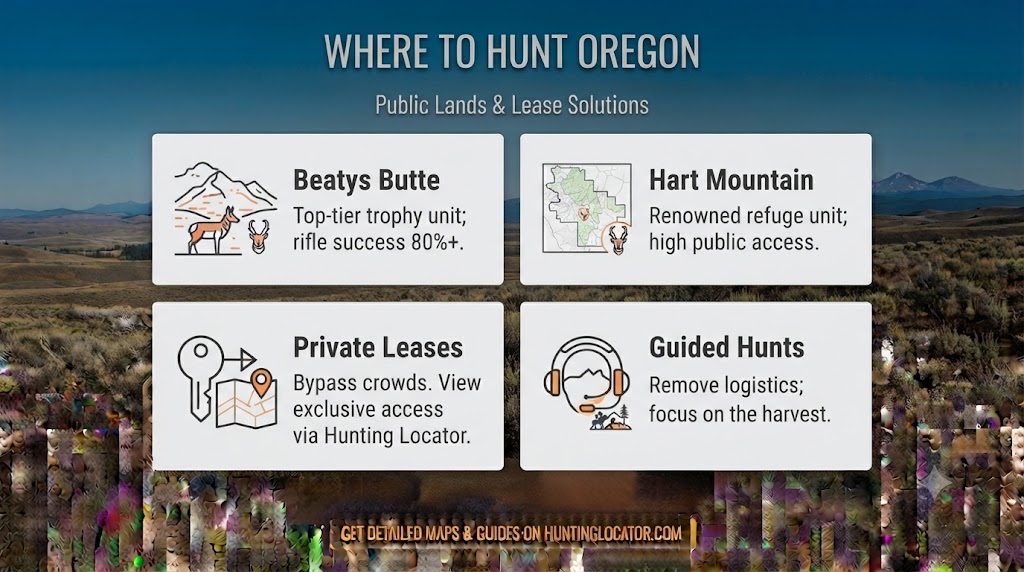
- Beatys Butte Unit — One of Oregon’s top trophy antelope units with solid public land access; rifle tags require 25–30+ preference points
- Hart Mountain Unit — Home to the Hart Mountain National Antelope Refuge and some of Oregon’s most recognized pronghorn terrain
- Warner Unit — Strong trophy potential with a mix of BLM and refuge land; competitive draw odds for rifle hunters
- Whitehorse Unit — Solid public land access in southeastern Harney County; part of the core trophy antelope zone
- Juniper Unit — Rounds out the top-tier southeastern Oregon pronghorn units; multiple weapon types available depending on the year
Oregon manages antelope through science-based population controls that keep trophy quality consistent across most units, so drawing any tag in a managed unit gives you a genuine trophy opportunity.
One caveat worth noting: some units contain significant private agricultural land that pronghorn are reluctant to leave. In units like the E Interstate area, pronghorn exist primarily on private land within the hunt area—making private land access not just convenient, but often necessary for a successful hunt.
Private Land Hunting with Hunting Locator
When the pronghorn in your unit have settled into private agricultural fields—and in some units they regularly do—public land access alone may not be enough. Hunting Locator connects hunters with landowners willing to lease or sell hunting access, with a vetted database of available properties and direct contact with landowners who are open to hunters.
For Oregon antelope hunters, browse available Oregon hunting leases on Hunting Locator to find private land options near your target units. Whether you’re looking to lease for a single season or explore purchasing hunting property in Oregon’s prime antelope country, Hunting Locator connects you with landowners who share your commitment to ethical, quality hunting.
Guided Antelope Hunts
For first-time antelope hunters, non-residents unfamiliar with Oregon’s southeastern terrain, or families planning a youth hunt, a guided pronghorn hunt is worth considering. A knowledgeable guide brings unit-specific scouting, established land access relationships, and field experience that takes years to develop independently.
Hunting Locator connects hunters with experienced outfitters and guides through its outfitter directory. A guided hunt makes the most sense if any of the following apply:
- You’re a non-resident hunting Oregon for the first time and want to make the most of a $443 tag
- You’re planning a youth hunt and want professional support for the experience
- You drew a premium hunt tag and want local guidance across the full August 1–November 30 season
- You’re hunting a unit with significant private land where outfitters have established landowner relationships
- You want to focus on hunting rather than logistics
Oregon Antelope Hunting Tips
Pronghorn are the fastest land animals in North America, with eyesight that rivals an 8x binocular. Hunting them in Oregon’s high desert requires a different approach than most big-game hunting. The following tactics and tools consistently produce results, along with recommended gear from the Hunting Locator store:
- Glass before you move — Pronghorn detect movement at long distances across open terrain. Set up on a high point early, glass thoroughly, and plan your stalk before leaving cover. Quality binoculars and a spotting scope are essential for Oregon’s sagebrush country. Find optics at the Hunting Locator store.
- Prioritize opening day — An estimated 90% of Oregon resident hunters harvest their antelope within the first two days of the season. Get to your unit the night before opener, glass at first light, and be ready to move quickly.
- Use terrain for cover on your stalk — Oregon’s desert looks flat from a distance but contains washes, ridges, and draws that provide concealment. Plan your approach around these features, stay low, and move from downwind—pronghorn use scent as well as sight.
- Prepare for heat and distance — Most antelope units are large desert areas miles from the nearest town. Carry more water than you think you’ll need, use sun protection, and pack for warm temperatures even in September. Browse hunting apparel and essentials at the Hunting Locator store.
- Match your caliber to the terrain — Oregon’s open ground means shots can extend well beyond what timber hunters are used to. A flat-shooting rifle capable of ethical performance at 300–400 yards gives you the range the country demands. Practice at distance before your season. Check the Hunting Locator store for rifle and ammunition options.
- Plan your field care in advance — Antelope meat spoils quickly in warm August temperatures. A quality cooler, meat bags, and a solid ice plan should be sorted before you leave camp.
- Secure land access before you apply — eRegulations specifically warns applicants: do not apply unless you have access to a place to hunt. Sort out public land scouting, private land access, or a guided arrangement before submitting your application, not after you draw.
More Resources from Hunting Locator
- Oregon Hunting Season Guide — An overview of all Oregon hunting seasons; a useful starting point for full-season planning
- Oregon Elk Hunting Season — Controlled hunt details and land access options for Oregon elk
- Oregon Deer Hunting Season — Season dates, unit information, and access strategies for Oregon mule deer and blacktail
- Oregon Bighorn Sheep Hunting Season — A detailed guide to one of Oregon’s most coveted controlled-draw species
- Oregon Mountain Goat Hunting Season — Planning information for Oregon’s mountain goat tags
- Oregon Black Bear Hunting Season — Season dates, zones, and tactics for black bear hunting across Oregon
- Oregon Cougar Hunting Season — Regulations, tags, and access information for Oregon mountain lion hunting
- Oregon Waterfowl Hunting Season — Duck and goose seasons, zones, and land access options for Oregon waterfowl hunters
- Oregon Game Bird Hunting Season — Pheasant, quail, chukar, and upland bird season information for Oregon hunters
- Oregon Turkey Hunting Season — Spring and fall turkey seasons, zones, and tactics across Oregon
- Oregon Hunting Leases — Browse available private land leases in Oregon, filtered by location and game type
- Hunting Locator Store — Gear, optics, clothing, and accessories for your Oregon pronghorn hunt
Frequently Asked Questions
When is the Oregon antelope controlled hunt application deadline for 2026?
The application deadline is May 15, 2026 at 11:59 PM PT. This date is confirmed by ODFW as the firm deadline for all big game controlled hunt applications. Miss it and you cannot apply for the 2026 season. A correction window runs through May 25, 2026 for applicants who need to fix errors on already-submitted applications.
How does Oregon’s preference point system work for pronghorn?
Oregon uses a preference point hybrid system: 75% of controlled hunt tags go to applicants with the most preference points, while the remaining 25% are distributed randomly among all first-choice applicants. Every year you don’t draw your first-choice hunt, you earn one preference point for that series. Draw your tag and your points reset to zero. The maximum preference point total for antelope in 2026 is 33 points.
How many Oregon pronghorn tags are available to non-residents?
Very few. ODFW caps non-resident antelope tags at 3% of the total annual allocation, which in practice meant approximately 26 non-resident antelope tags issued in a recent season. Getting into the best units via rifle tags requires 20+ preference points even for non-residents. Premium hunt tags carry no non-resident quota, making them a more accessible option for out-of-state hunters.
What is the difference between a standard controlled hunt tag and a premium hunt tag?
A standard controlled hunt tag covers a specific hunt period (primarily August–September) for a designated weapon type and unit. A premium hunt tag offers more flexibility: an August 1–November 30, 2026 season, either-sex bag limit, and any legal weapon—all in a single tag. Premium hunts require a separate application, and preference points, landowner preference tags, and guide and outfitter tags are not available for premium hunts. One premium tag is issued per unit.
Do I need hunter education to apply for an Oregon antelope tag?
It depends on your age. Hunters 17 and younger must have a hunter education certificate before purchasing a hunting license—the only exception is hunters ages 9–15 enrolled in the youth mentor program. Adult hunters (18+) are not required to complete hunter education to purchase a license, but must have a valid license before submitting a controlled hunt application.
Should a first-time applicant bother applying for Oregon antelope even with low draw odds?
Yes—and starting early matters. ODFW advises hunters pursuing pronghorn to apply every year, even when drawing seems unlikely. Every unsuccessful application adds a preference point, improving your odds in future years. The 25% random draw allocation also gives every applicant a legitimate chance regardless of points held. Beginning that accumulation now is the most useful thing a new applicant can do for their long-term Oregon antelope prospects.
Planning Ahead
Oregon’s May 15 application deadline is the first decision point for a 2026 pronghorn hunt, but the useful work—identifying your target unit, confirming land access, and understanding the draw mechanics—happens before you submit. Whether you’re a resident working toward a top-tier rifle unit, a non-resident looking at the premium hunt pathway, or a first-time applicant starting your preference point accumulation, the process rewards early preparation.
Hunting Locator supports that process at each stage—from browsing Oregon hunting leases near your target units, to finding an outfitter for a guided pronghorn hunt, to outfitting yourself through the Hunting Locator store.


