This Oregon Bighorn Sheep Season Guide for 2026 covers season dates, draw mechanics, license and permit costs, where to hunt on public and private land, and field tips for Oregon’s sheep country. Whether you’re a resident who has been applying for years, a non-resident building toward a sheep slam, or a first-timer trying to understand how controlled draws work, the information here applies to you. We track the regulations, the units, and the Oregon bighorn sheep hunting season details so you can focus on the hunt.
Here’s what this guide covers:
- Season dates & draw reality — when you can hunt and how Oregon’s controlled draw works
- Costs & application mechanics — resident vs. nonresident license fees, application costs, and tag prices side by side
- Where to hunt — public land units, private lease access, and guided hunt options
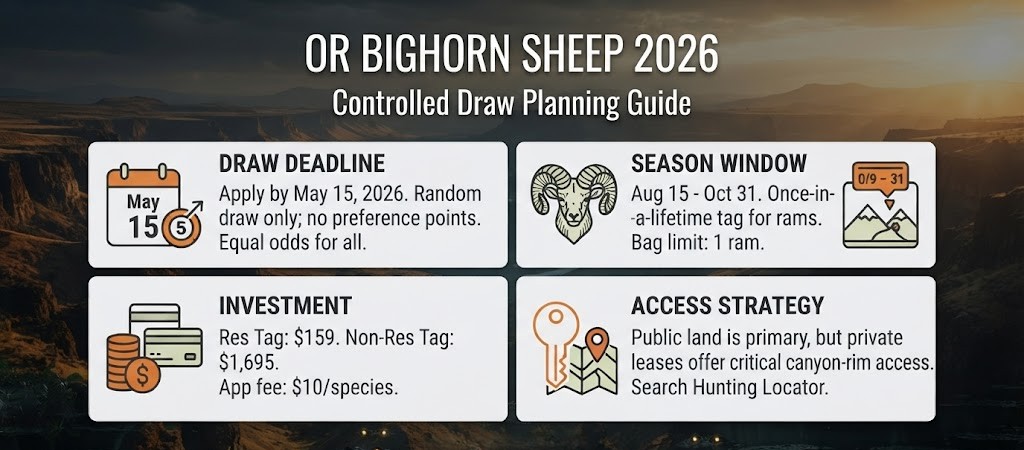
Quick Overview: Oregon Bighorn Sheep Season at a Glance
Oregon bighorn sheep hunting is strictly controlled — there are no over-the-counter tags, and every hunter who takes the field draws through a random lottery administered by ODFW. The general season runs August 15 through October 31 with a bag limit of 1 ram, and according to the Oregon Hunters Association, 136 bighorn sheep tags will be offered statewide in 2026. Of those, just 9 are allocated to nonresidents.
| Species | Season Type | Start Date | End Date | Bag Limit | Notes |
|---|---|---|---|---|---|
| Bighorn Sheep | General (Controlled Hunt) | Aug 15 | Oct 31 | 1 ram | Once-in-a-lifetime ram tag; pure random draw, no preference points |
Before you can hunt bighorn sheep in Oregon, you need to complete several steps in order:
- Annual hunting license — required before applying for any controlled hunt; residents pay $39.00, nonresidents pay $193.00
- Controlled hunt application — $10 per species (increased for 2026), submitted by the May 15 deadline online or through a licensed sales agent
- Tag fee — paid only if drawn; residents pay $159.00, nonresidents pay $1,695.00
- Orientation module — the online orientation is required for ewe and goat tag holders and strongly recommended for ram hunters
The most important thing to understand: this is a controlled hunt, not an over-the-counter season. You apply, you wait, and — if drawn — you hunt.
Oregon Bighorn Sheep Hunting Seasons
For bighorn sheep, “season” doesn’t mean what it means for deer or elk. There’s no tag available at the license counter. ODFW manages bighorn sheep through a controlled hunt system — a structured draw that allocates a fixed number of tags each year. Understanding the three core elements of that system is the foundation of any sound application strategy.
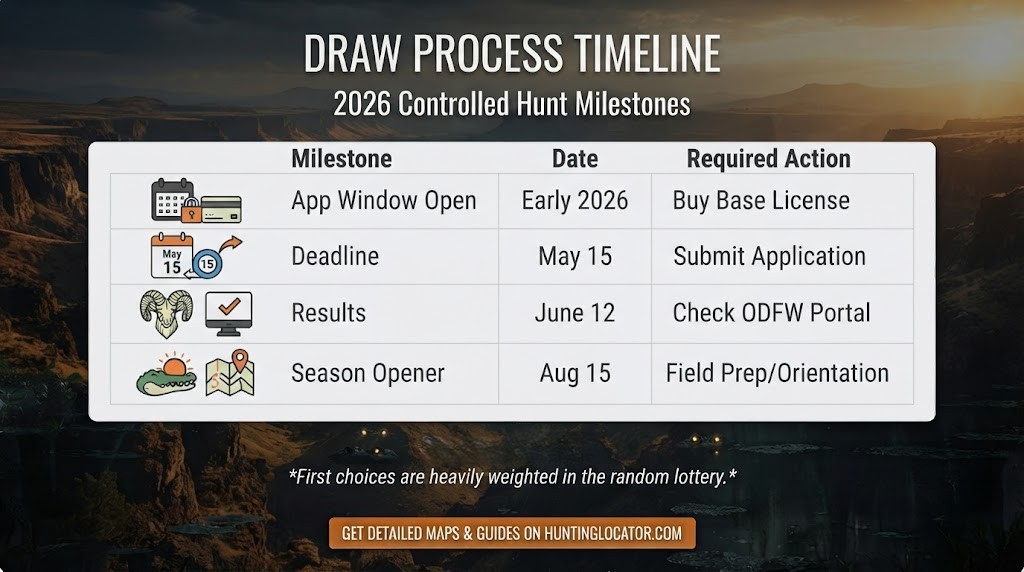
The General Season (Aug 15 – Oct 31)
The general controlled hunt season runs from August 15 through October 31, with a bag limit of 1 ram — a 77-day window. Late summer brings rams into predictable patterns across high ridges and canyon rims, while fall brings cooler temperatures and more active animals.
Specific hunt-unit dates fall within this general frame, so drawn hunters should confirm their unit’s exact dates in the ODFW big game regulations. The length of the season gives you room to plan around weather, work, and logistics, but that flexibility is not a reason to delay preparation.
The Controlled Hunt Draw — No Preference Points
GOHUNT confirms that “there is no point system for bighorn sheep or mountain goats in Oregon. Every applicant is on an equal playing field.” A first-year applicant and a 30-year veteran have identical odds. Consistent annual applications matter more than years of waiting. Key draw facts for 2026:
- Application deadline: May 15, 2026, at 11:59 p.m. PT — online or at a licensed sales agent
- Results available: By June 12, 2026
- Hunt choices: Up to five per application; first choices are heavily weighted in the draw
- Draw odds: resident odds fall “between a tenth and a half of a percent” across most units; nonresident odds sit “between a tenth and two-tenths of a percent”
- Best resident odds (Rocky Mountain): GOHUNT notes Unit 60 Bear Creek at approximately 0.22%
- Best resident odds (California): Unit 43 Biggs/W Deschutes River No. 3 hunt at approximately 0.90%
Once-in-a-Lifetime: The Ram Tag Rule
ODFW is unambiguous: bighorn sheep ram tags are “once-in-a-lifetime — you can only draw the tag once.” Harvest a ram in Oregon, and that opportunity is gone permanently.
One nuance worth knowing: per ODFW’s orientation guidance, ewe tags do not count as a once-in-a-lifetime draw. Hunters who have already harvested a ram may still apply for ewe hunts, so engagement with sheep hunting doesn’t have to end after a single ram tag.
Oregon Bighorn Sheep Licenses and Permits
Every Oregon bighorn sheep applicant follows the same sequence: purchase a base hunting license, pay the controlled hunt application fee, and — if drawn — pay the tag fee. The costs are straightforward, but the resident vs. nonresident difference is significant.
Oregon Hunting Licenses & Fees
| Fee Category | Resident | Nonresident |
|---|---|---|
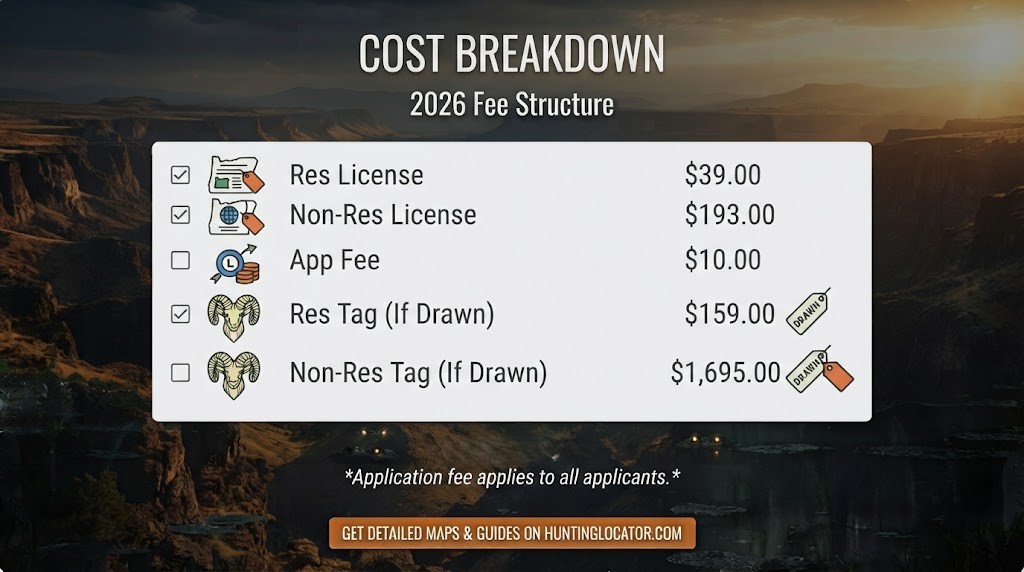
| Annual Hunting License | $39 | $193.00 |
| Controlled Hunt Application | $10 | $10.00 |
| Tag Fee (if drawn) | $159 | $1,695 |
For residents, the total out-of-pocket cost if drawn is $208.00. For nonresidents, that figure reaches $1,898.00. The Oregon Hunters Association confirms the controlled hunt application fee increased to $10 for 2026, with scheduled $1 increases in both 2028 and 2030.
Oregon Bighorn Sheep Permits & Application Process
Tag Allocation for 2026
The Oregon Hunters Association reports that the full 2026 bighorn sheep tag pool breaks down as follows:
- 81 California bighorn ram tags across 27 California bighorn hunts
- 50 California bighorn ewe tags
- 5 Rocky Mountain bighorn ram tags across 3 Rocky Mountain hunts
- 136 total bighorn sheep tags statewide
Nonresident Tag Allocation
Oregon law mandates that “no less than 5% and no more than 10% of all bighorn sheep tags will be issued to nonresidents.” In practical terms for 2026, GOHUNT confirms that 9 nonresident tags are available:
- 1 Rocky Mountain bighorn ram tag — Bear Creek Unit
- 5 California bighorn ram tags — John Day, E. Deschutes, E. Beatys, and S. Central Units
- 3 California bighorn ewe tags — John Day River and Deschutes River Units
How to Apply
- Purchase your hunting license — residents ($39.00) or nonresidents ($193.00) must have a valid annual license before submitting any application
- Choose your hunt numbers — list up to five hunt choices per application; first choices are heavily weighted, so prioritize carefully
- Submit your application — online through ODFW or at a licensed sales agent by May 15, 2026, at 11:59 p.m. PT
- Pay the application fee — $10.00 per species at the time of application
- Wait for results — draw results available by June 12, 2026
- Pay the tag fee if drawn — $159.00 residents / $1,695.00 nonresidents
- Complete the orientation module — ODFW requires the online orientation for ewe and goat tag holders; ram hunters are strongly encouraged to complete it as well
Post-Harvest Requirements
ODFW mandates that all successful hunters have their sheep head checked — ram horns must be pinned and ewe horns branded by ODFW. Hunters must check out through the local ODFW office in the district where the hunt occurred within 72 hours of completing the hunt.
Oregon Bighorn Sheep: Where to Hunt
Oregon’s bighorn sheep country spans canyon walls, volcanic rimrock, high-desert basins, and alpine ridges. Knowing where sheep live, where you can legally access that ground, and what access options exist will shape your entire hunt plan.
Best Public Land Areas for Oregon Bighorn Sheep
Most of Oregon’s bighorn sheep habitat falls within BLM-administered canyon country and public land units with substantial open access. ODFW confirms that Oregon’s bighorn populations divide by subspecies and geography:
- Rocky Mountain bighorn sheep — approximately 800–1,000 animals across 11 herds, concentrated in the northeast corner of the state in the Snake River canyon systems and the alpine terrain of the Wallowa Mountains
- California bighorn sheep — approximately 3,700–4,200 animals across 32 herds, found throughout central and southeast Oregon; the state’s dominant subspecies by population
Key public land units with confirmed access percentages:
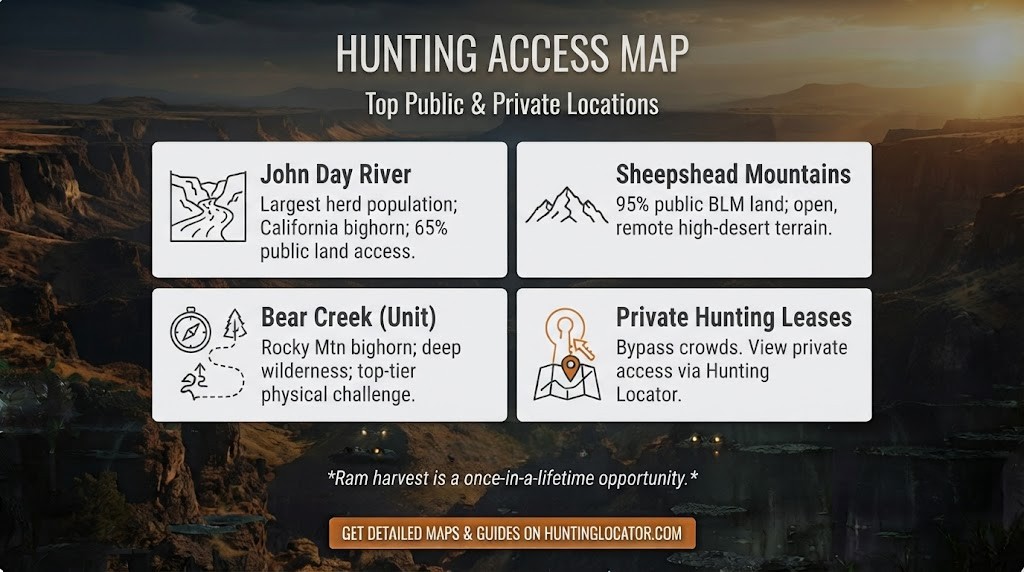
- John Day River (Hunts 543A1, 543A2, 543A3) — 65% public lands; supports the largest California bighorn herd in the state with an estimated 650 animals
- Sheepshead Mountains (Hunts 568A1, 568A2) — 95% public lands; strong BLM access across open high-desert terrain
- E. Whitehorse (Hunts 568B1, 568B2) — 90% public lands; remote southeast Oregon canyon country
- Steens Mountain (Hunts 569A1, 569A2) — 75% public lands; strong California bighorn presence on a well-known Oregon landmark
- Bear Creek Unit (Rocky Mountain) — primary Rocky Mountain bighorn unit; sheep located 10+ miles from the trailhead, requiring exceptional physical fitness or horse access
One planning note worth attention: Oregon’s statewide snowpack in early 2026 was unusually low — approximately 2.9 inches SWE, the lowest recorded since modern SNOTEL records began and nearly 30% lower than the previous record low in 2015. Hunters planning canyon and high-desert hunts should account for potential effects on summer and fall water sources and animal distribution.
Private Land Hunting with Hunting Locator
Public land gets you into sheep country, but private land can get you into better-positioned sheep country. In canyon units like the John Day, private land along rimtops and canyon edges can provide glassing advantages and access corridors that adjacent BLM ground doesn’t offer. Outfitters operating in the John Day unit have secured private leases specifically to give hunters elevated canyon access unavailable on the public side of the fence.
For hunters who draw an Oregon bighorn tag and want to explore private land options — whether leasing seasonal access or purchasing hunting property — Hunting Locator’s Oregon lease listings are a good starting point.
Hunting Locator connects hunters with landowners who are ready to lease or sell. The platform gives you direct access to Oregon landowners with properties that may border or adjoin quality sheep habitat — ground that doesn’t appear in a standard BLM map search. Filter by location, acreage, and game type to find options that fit your specific unit and budget. For a once-in-a-lifetime tag, the access question deserves a real answer.
Guided Hunts for Oregon Bighorn Sheep
For many hunters — especially nonresidents navigating unfamiliar canyon terrain — a guided bighorn sheep hunt is worth considering. The logistical demands of remote sheep country are real, and experienced local guides bring knowledge of specific units that takes years to develop independently.
Key reasons hunters choose guided Oregon sheep hunts:
- Terrain familiarity — guides operating in specific units know the canyon systems, water sources, and ram movement patterns in ways that are difficult to replicate through research alone
- Private land access — some outfitters have secured private leases that provide glassing and access advantages unavailable on public land
- Physical support — the Bear Creek Rocky Mountain unit requires sheep to be located 10+ miles from the trailhead; horse-supported access through an outfitter is a practical option for hunters who need it
- Trophy assessment — field-judging legal rams in steep canyon terrain is a specialized skill; a guide who knows the herd’s rams by sight is a genuine asset
When evaluating guided hunt options, look for outfitters with unit-specific experience in either California bighorn canyon units (John Day, Deschutes, Steens) or the Rocky Mountain units in northeastern Oregon. Hunting Locator connects hunters with professional Oregon hunting guides and outfitters.
Bighorn Sheep Hunting Tips
Oregon’s bighorn sheep country demands more preparation than most big game hunts. From physical conditioning to optics selection, the details matter in terrain where a mile of canyon wall can separate a successful stalk from a blown opportunity.
- Start conditioning months before the season — guides and experienced hunters consistently emphasize that sheep country is unforgiving. Build leg and core strength, practice steep-terrain hiking with a loaded pack, and develop sustained cardiovascular endurance. If covering rugged miles isn’t comfortable before the season, the terrain will limit the hunt before a ram ever comes into view.
- Invest in quality optics before anything else — sheep hunting is largely a glassing exercise. A quality spotting scope and high-end binoculars are necessary, not optional. The Hunting Locator store carries optics and gear suited for open-country, long-range applications.
- Learn to field-judge rams before you draw — the once-in-a-lifetime designation means there are no second chances on a ram. Study curl percentage, mass, and brooming. Build that judgment now, well before you’re in the field under pressure.
- Scout your unit before the season opens — ODFW’s population data gives you a starting point, but boots-on-ground scouting is more valuable. Identify water sources, bedding terrain, and midday travel corridors. Hunters who fill tags usually knew where the rams were before August 15.
- Understand your subspecies and terrain — California bighorn in central Oregon occupy canyon rims and basalt ridges; Rocky Mountain bighorn in the northeast favor steep canyon walls and alpine transitions. Your approach, stalk route, and shooting distances will differ significantly between these environments. Gear up accordingly at the Hunting Locator store.
- Plan your post-harvest logistics in advance — ODFW requires ram horns to be pinned and check-out completed through the local ODFW office within 72 hours. In remote canyon country, that timeline requires advance planning. Know your nearest ODFW office and build your pack-out and transportation plan before you leave the trailhead.
- Consider a guide for your first sheep hunt — even experienced big game hunters find sheep country demanding. A guide with unit-specific experience can improve your odds of a successful, ethical harvest and help you make the most of a tag that won’t come around again.
More Resources from Hunting Locator
- Oregon Hunting Season Guide — complete overview of all Oregon hunting seasons, dates, and regulations
- Oregon Bighorn Sheep Hunting Season — Hunting Locator’s species hub for Oregon bighorn sheep with additional planning resources
- Oregon Mountain Goat Hunting Season — companion guide for Oregon’s other once-in-a-lifetime controlled species, with similar draw mechanics and terrain
- Oregon Elk Hunting Season — Oregon’s most-pursued big game species; useful context for hunters planning multi-species trips
- Oregon Antelope Hunting Season — another controlled hunt species with open-country tactics and eastern Oregon terrain overlap
- Oregon Deer Hunting Season — deer season guide for hunters planning additional tags around a sheep draw
- Oregon Black Bear Hunting Season — bear seasons often overlap with sheep country
- Oregon Cougar Hunting Season — cougar seasons and habitat overlap with sheep canyon country in Oregon
- Oregon Turkey Hunting Season — spring turkey hunting for hunters building a full-season calendar
- Oregon Game Bird Hunting Season — upland and game bird seasons across Oregon
- Oregon Waterfowl Hunting Season — waterfowl season dates and regulations
- Oregon Hunting Leases on Hunting Locator — browse available private land leases across Oregon, filterable by location and game type
Frequently Asked Questions
Do I need preference points to apply for an Oregon bighorn sheep tag?
No. Oregon does not use a preference point system for bighorn sheep. The draw is a pure random lottery — every applicant has equal odds each year, regardless of how many times they’ve applied. This distinguishes Oregon’s sheep draw from most other western states.
Can I apply for both Rocky Mountain and California bighorn sheep in the same year?
Yes, but they are separate hunt series. You can list up to five hunt choices per application within each series. Both subspecies occupy different geographic regions of Oregon — Rocky Mountain bighorn in the northeast, California bighorn in central and southeast Oregon — and they are managed and drawn separately.
If I draw a bighorn ewe tag, does that use up my once-in-a-lifetime designation?
No, the once-in-a-lifetime rule applies only to ram tags. Ewe tags do not count toward the once-in-a-lifetime limit. Hunters who have previously harvested an Oregon bighorn ram may still apply for ewe hunts in future years.
What happens if I draw a tag but can’t complete the hunt?
If you draw a tag and choose not to hunt or are unsuccessful, your once-in-a-lifetime status may still be affected for ram tags — consult ODFW directly for the current policy on tag surrenders and status. After a successful hunt, all hunters must check out through the local ODFW office within 72 hours and have their horns pinned (rams) or branded (ewes).
How do I maximize my chances in Oregon’s sheep draw if there are no preference points?
Apply every year and list multiple hunt choices strategically, placing your first choice on the unit that best matches your priorities — whether that’s draw odds, trophy quality, or terrain you’re prepared to hunt. Unit 43 Biggs/W Deschutes River No. 3 is having some of the better California bighorn resident draw odds (around 0.90%), and Unit 60 Bear Creek for Rocky Mountain bighorn (around 0.22%). Since the draw is random, applying consistently every year is the most reliable long-term approach.
Is guided hunting worth it for Oregon bighorn sheep?
For most hunters — particularly non-residents unfamiliar with Oregon’s canyon terrain — a guide offers meaningful advantages. Experienced outfitters operating in units like the John Day River have secured private land access to canyon rims unavailable on public land. For the Bear Creek Rocky Mountain unit, sheep may be located 10+ miles from the trailhead, making horse-supported outfitter access a practical necessity for some hunters. Given the once-in-a-lifetime nature of the tag, many hunters find a guided hunt worthwhile.
Closing Notes
An Oregon bighorn sheep tag is among the rarest opportunities in western big game hunting, and the application process costs relatively little. The draw is fair, the season window is long enough to accommodate real planning once you’re drawn, and the work that separates prepared hunters from unprepared ones happens well before results come out in June.
Lock in your application before the May 15, 2026 deadline, explore Oregon private land lease opportunities on Hunting Locator, gear up at the Hunting Locator store, and build a hunt plan before your name comes up.


