Smart pack organization isn’t about being obsessive—it’s about being ready. When everything has its place in your hunting backpack and you can grab what you need without thinking, you stay focused on what matters: the hunt itself.
Here’s what we’ll cover to get your pack dialed in:
- A simple 3-zone system that works whether you’re out for the day or deep in the backcountry for a week
- Gear lists broken down by category so you never forget the essentials
- Field-tested tips that keep your most important stuff within arm’s reach
Before we dive into packing strategies, though, let’s talk about the prep work that happens before you even touch your gear.
Know Before You Go: Essential Pre-Hunt Preparation
The slickest pack organization in the world won’t save you if you’re missing your license or hunting the wrong unit. Whether you’re staying local or crossing state lines, getting your homework done prevents expensive mistakes and keeps you legal.
Regulations Check: Your First Line of Defense
Here’s a reality check: hunting licenses and tags run anywhere from $25 to $300 depending on what you’re after and where you’re hunting. Non-resident fees? They’ll make your wallet cry. But that’s nothing compared to what happens when you mess up the rules.
Hunting safety experts put it bluntly: “Not being aware of local regulations could result in a years-long hunting suspension.” We’re talking about losing your hunting privileges entirely, not just paying a fine.
Wildlife agencies see it constantly—hunters who thought they knew the rules facing serious consequences. Sometimes it’s as simple as your home state’s hunter safety course not being recognized where you want to hunt.
Do your regulation homework early. Some states have waiting lists that stretch 3-5 years for premium tags. Create a checklist for your specific hunt and double-check everything with the local wildlife agency.
Scouting & Habitat Preparation
Real scouting starts long before you set foot in the woods. You’re looking for the basics: where they eat, how they travel, and what sign they’re leaving behind. Tracks, rubs, scat—it all tells a story.
Professional guides swear by digital scouting first: “Utilize online maps, satellite imagery, hunting forums, and hunting apps to research potential hunting areas.” It’s amazing what you can learn from your couch.
Good GPS and navigation tools make scouting way more effective. But here’s the thing—navigation experts always stress backup plans: “A GPS device is great, but carry a compass as a backup. Knowing how to use both is essential for hunting in the backcountry.”
Quick tip: Hunting out of state? Local experts recommend reaching out to wildlife agencies, guides, or local hunters for intel on recent game movements and any curveballs you might face.
Physical & Gear Readiness
Mountain hunting will humble you fast if you’re not in shape. But even easier terrain demands gear that works when you need it.
Smart hunters start their gear check weeks ahead: “Make a list of everything needed weeks before the hunt and inspect gear condition to ensure everything is in good shape and have time to replace anything that needs replacing.”
Physical prep matters, but so does having your equipment organized and accessible. That’s where the real magic happens.
The Organizational Framework: How to Pack Your Hunting Bag
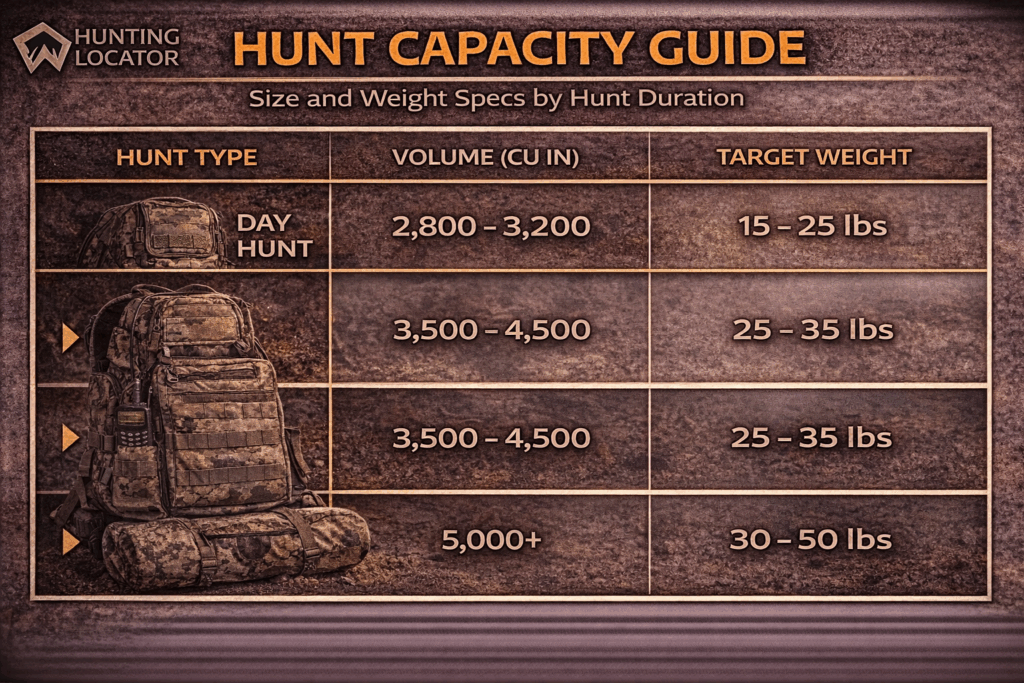
Weight matters, sure. Professional outfitters suggest keeping multi-day packs between 30-50 pounds, while day packs should stay in the 15-25 pound range. But here’s what they don’t always mention: organization beats weight savings every time. A 40-pound pack that’s organized right will feel better and perform better than a 30-pound disaster.
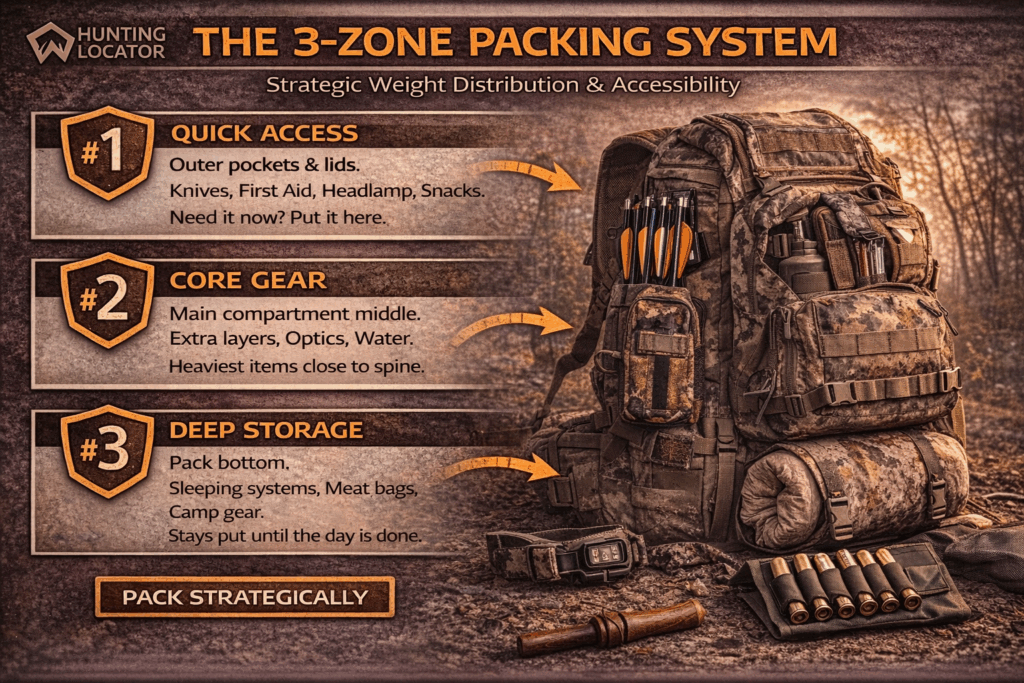
The 3-Zone Organization System
Stop thinking about your pack as one big storage container. Think of it as three distinct zones, each with a specific job:
Zone 1 – Quick Access (outer pockets, hip belt, top lid) Stuff you need constantly or in a hurry. Knife, first aid basics, calls, extra ammo, snacks, headlamp. If you might need it without warning, it lives here.
Zone 2 – Main Compartment (the big middle section) Your core gear that comes out at specific times. Extra layers, food, water, optics, shelter. Important stuff, but you know when you’ll need it.
Zone 3 – Deep Storage (pack bottom, against your back) Heavy items you won’t touch often. Sleeping system, meat bags, camp gear. This stuff stays put most of the time.
Weight distribution pros have figured out the physics: “Keep the heaviest items as close to your back as possible, and in the middle to upper-third of the pack, vertically.” Your back will thank you, and you’ll stay balanced.
Pack Capacity Guidelines
Getting the size right prevents both overpacking and running out of room:
| Hunt Type | Pack Size (Cubic Inches) | Target Weight |
|---|---|---|
| Day Hunt | 2,800-3,200 | 15-25 lbs |
| Overnight | 3,500-4,500 | 25-35 lbs |
| Multi-Day Backcountry | 5,000+ | 30-50 lbs |
Data from FORLOH Equipment Research
The right pack size is your foundation. Check out quality hunting backpacks to find what fits your hunting style.
Core Gear Checklist: Category-by-Category Organization
Experienced hunters know that “assembling the set of gear that works best for you can take time and plenty of testing.” This isn’t about having the most gear—it’s about having the right gear, organized so you can use it.
Clothing & Layering System
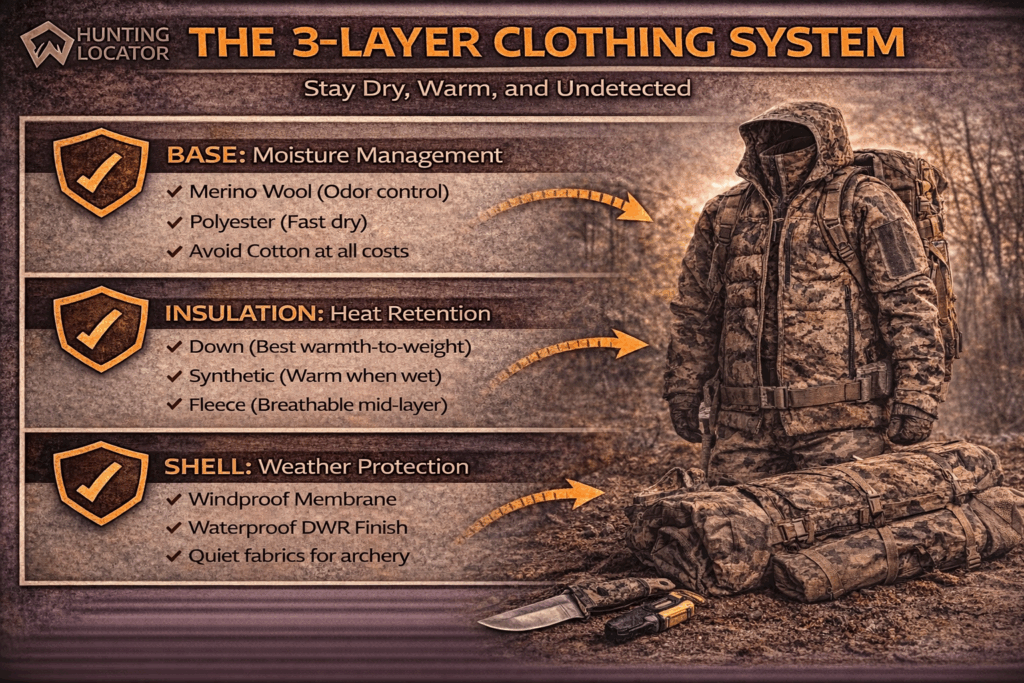
Layering isn’t rocket science, but getting it wrong will ruin your hunt. Research shows the fabric choice matters: “Base layer fabrics include synthetics like polyester and nylon, or natural fibers like merino wool. Merino excels at managing odor and retains most of its insulating properties when wet, though synthetics dry faster and offer better durability.”
The three-layer system handles whatever weather throws at you:
Base Layer: Moisture-wicking synthetic or merino wool (top and bottom) Insulating Layer: Fleece, down, or synthetic fill jacket Outer Layer: Waterproof/windproof shell
Don’t Leave Home Without:
- Hunting boots (broken in properly—blisters end hunts)
- Extra socks (wool or synthetic, never cotton)
- Gloves (lightweight pair plus insulated backup)
- Head covering (conditions dictate beanie, balaclava, or cap)
- Blaze orange (check local requirements—some states are strict)
Weaponry & Ammunition Organization
Safety experts hammer this point: “Practice with your chosen setup well before season.” Your weapon is only as good as your familiarity with it.
Ammunition research points to proven performers: “Popular calibers like .243 Winchester, .308 Winchester, and .30-06 Springfield provide stopping power with manageable recoil for most big game situations.”
Weapon System Checklist:
- Primary weapon (cleaned, sighted, function-checked)
- Ammunition/arrows (enough for the hunt plus extras)
- Backup ammo (separate storage location)
- Basic cleaning kit (field maintenance only)
- Shooting support (sticks/bipod if you use them)
Keep your primary ammo accessible but secure. Store backup supplies separately—losing all your ammo to one mishap is a hunt-ender.
Navigation & Safety Essentials
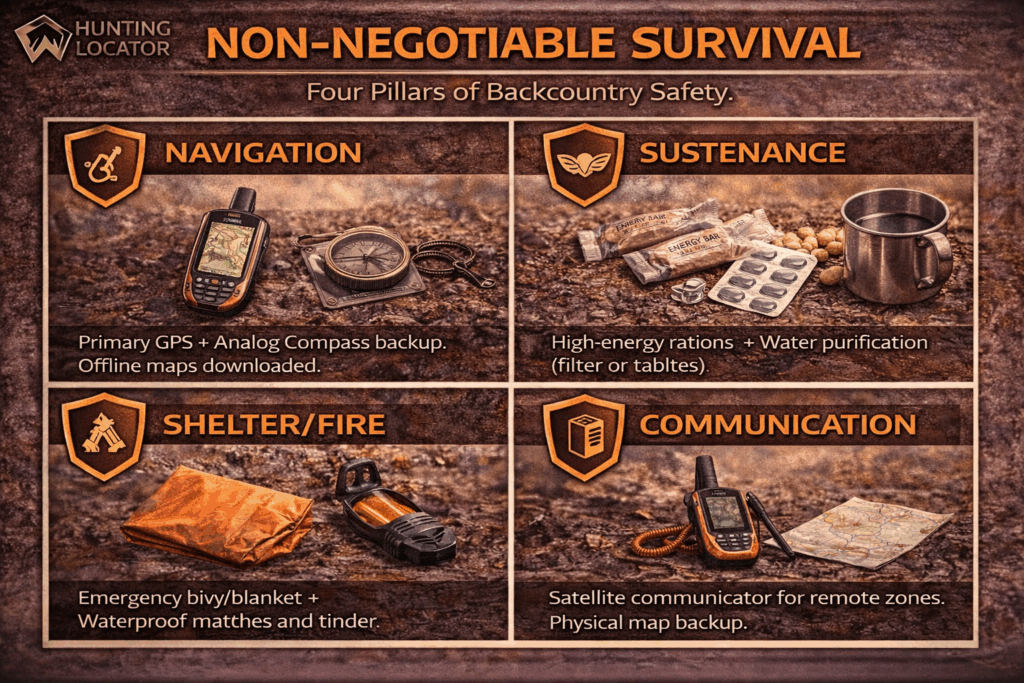
Getting lost or hurt in the backcountry transforms a hunting trip into a survival situation fast. Navigation pros always preach redundancy: “A GPS device is great, but carry a compass as a backup. Knowing how to use both is essential for hunting in the backcountry.”
Safety & Navigation Must-Haves:
- GPS device or hunting app (charged, offline maps downloaded)
- Compass (analog backup that never needs batteries)
- Physical map of your hunting area
- First aid kit (bandages, antiseptic, pain meds, emergency supplies)
- Emergency communication (satellite communicator for remote areas)
- Headlamp/flashlight (extra batteries mandatory)
- Fire-starting supplies (waterproof matches, lighter, tinder)
- Emergency shelter (space blanket or lightweight bivy)
- Water plus treatment (filter or purification tablets)
Quality GPS and navigation gear is worth every penny. A solid first aid kit belongs in every hunting pack, period.
Field Dressing & Game Processing Tools
Harvesting game is just the beginning. Having the right tools organized and ready keeps meat quality high and makes the work manageable. Knife experts note that “every hunter should carry a knife. Some prefer fixed blades, some prefer folding knives, and others carry multi-tools.”
Field Processing Essentials:
- Quality hunting knife (sharp, reliable, easy to reach)
- Backup blade or replacement blades
- Portable knife sharpener
- Game bags (multiple sizes for different cuts)
- Latex or nitrile gloves (bring extras)
- Paracord or rope (hanging, dragging, securing loads)
- Bone saw (for larger game breakdown)
- Zip ties or tags (harvest documentation)
A sharp, dependable hunting knife is non-negotiable. Quality game processing tools make post-harvest work faster and cleaner.
Tactics & Strategy: How Organization Supports Hunting Success
Having great gear means nothing if you can’t deploy it when the moment arrives. Smart organization supports your hunting strategy instead of fighting against it.
Peak Activity & Timing Considerations
Most game follows predictable patterns—early morning and late evening movement, midday bedding. Your gear organization should match these rhythms. Keep calls, rangefinders, and ammo in outer pockets for silent, quick access. Items needed for shot preparation should be reachable with one hand.
Wind & Scent Control Strategy
Scent control experts put it simply: “Game animals survive with their nose, so you have to scent-mask to avoid giving yourself away.” Organize your scent control arsenal for easy access throughout the hunt:
- Scent elimination sprays (quick-access outer pocket)
- Cover scents (match your terrain and target species)
- Scent-free storage bags (for contaminated clothing)
- Wind detection powder (lightweight, always accessible)
Professional scent elimination products help you stay undetected. Quality hunting scents and lures work with wind patterns instead of against them.
The Approach: Equipment for Getting Close
Different hunting methods demand different organizational priorities:
Stand Hunting Setup: Comfort items within silent reach (seat cushion, hand warmers, snacks). Optics and calls positioned for no-noise access. Safety gear properly secured but available.
Still-Hunting Setup: Pack movement must be silent. Essential items distributed across multiple access points. Emergency gear secured but reachable.
Quality shooting sticks and bipods provide the stability you need for clean shots.
Post-Harvest Care: The Work After the Shot
Making the shot is just the start of a new phase. Your pack organization needs to support efficient field care that preserves meat quality and gets your harvest home safely.
Tracking & Recovery
Blood trailing requires specific tools ready for immediate use:
- Bright flashlight or headlamp (blood looks different under artificial light)
- Marking tape (mark your trail and recovery route)
- Gloves (for safe handling during recovery)
- Sharp knife (for examining additional sign)
Reliable hunting flashlights are essential for tracking in low light.
Field Dressing Efficiency
Knife specialists recommend that “a sharp knife is essential for field dressing your game. A basic knife with a gut hook will do for beginners, but an entire kill kit can be handy as you gain experience.”
Organize field dressing tools in one dedicated kit:
- Primary knife (accessible and razor-sharp)
- Backup cutting tools
- Game bags (various sizes)
- Rope for hanging or dragging
- Clean water for rinsing
Transport & Processing Preparation
Getting your harvest from field to freezer safely requires planning and proper equipment organization. Cold weather hunters should consider hand warmers to maintain dexterity during processing work.
More Resources from Hunting Locator
Take your hunting game to the next level with these additional resources:
- GPS and Navigation – Professional navigation tools and mapping solutions to keep you oriented and mark key locations.
- Face Paint – Complete concealment solutions for close-range hunting where every detail counts.
- Survival and First Aid – Essential safety equipment and emergency supplies for backcountry hunting.
- Game Processing – Professional-quality tools for efficient field dressing and meat processing.
FAQ
How much should my hunting pack weigh for a day hunt?
Professional outfitters recommend keeping day packs between 15-25 pounds total. This includes everything—gear, water, food—while keeping you mobile and reducing fatigue during long days afield.
What’s the most important organizational principle for hunting packs?
Gear organization experts emphasize frequency-based organization: “Organizing your pack in layers based on how often you need each item is simple but effective.” Frequently used items go in outer pockets; less-used gear goes deeper.
Should I organize gear differently for different hunting methods?
Absolutely. Hunting specialists recommend that hunters “create separate zones for different hunting seasons or specific hunting methods.” Stand hunting needs different accessibility than still-hunting or calling setups.
How do I prevent losing small items in my hunting pack?
Experienced hunters suggest including “a list in their gear totes to make sure all necessary gear is accounted for.” Use dedicated pouches for small items and stick to consistent placement habits.
What gear should always be in quick-access pockets?
Field organization experts recommend keeping “frequently used items like ammo, knives, multi-tools, and first aid kits in the top layer or outer compartments” for immediate access when needed.
How often should I reorganize my hunting pack?
Gear maintenance specialists note that “seasonal adjustments must be made to rotate your gear to meet the changing hunting landscape.” Review and adjust your system before each season and after every hunt.
The Final Shot
Smart pack organization turns hunting from a gear-wrestling match into smooth, confident pursuit. The system we’ve outlined here—from pre-hunt prep through post-harvest care—ensures you’re ready when opportunities present themselves. Every minute you spend organizing your pack saves time in the field when seconds count.
Your hunting success starts with preparation. And preparation starts with having the right gear organized the right way.
Ready to upgrade your hunting setup? Check out our complete selection of hunting accessories, navigation tools, and field processing equipment to ensure your success in the field.


