This Pennsylvania migratory bird guide pulls together the finalized dates, license requirements, and access options in one place. It covers the Pennsylvania Game Commission‘s official 2026-27 season dates, set under U.S. Fish and Wildlife Service frameworks, along with two changes worth knowing before you load up: the Atlantic Population Canada goose season has grown from 30 to 45 days with the bag limit rising from 1 to 3 birds, while Sunday hunting for migratory birds remains closed statewide. Whether you’re a longtime Pennsylvania resident, a non-resident planning a trip, or new to hunting altogether, the information below should cover what you need.
Before the season dates, it’s worth mentioning gear — you can gear up at the Hunting Locator store for shotguns, decoys, and the rest, and Hunting Locator is a useful resource for hunting access across the state generally.
This guide covers:
- Confirmed 2026-27 season dates and bag limits for every migratory bird species Pennsylvania offers, from mourning doves to diving ducks
- The license, permit, and Federal Duck Stamp steps required to legally hunt migratory birds this season
- Where to hunt — public State Game Lands, private leases, and guided access options
Start with the fast-reference details below.
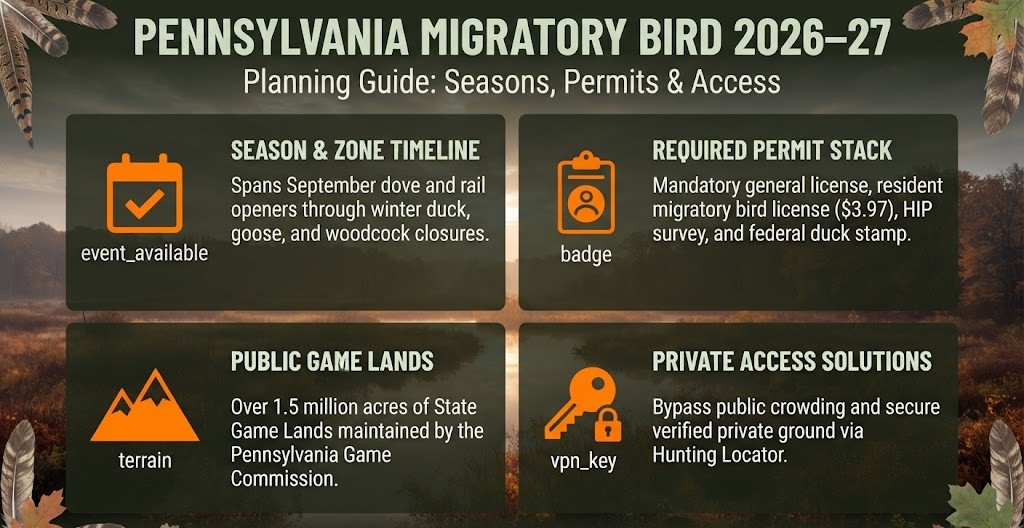
Quick Overview: 2026-27 PA Migratory Bird Seasons at a Glance
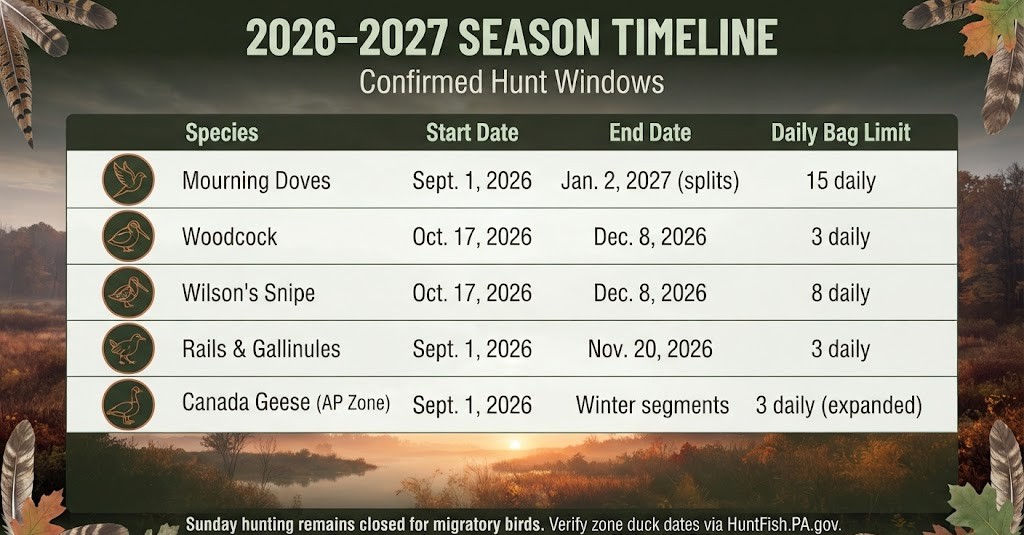
Every date and limit below comes directly from the Pennsylvania Game Commission’s finalized 2026-27 regulations. Ducks, mergansers, and coots run on a zone system, covered in more detail further down, so the dates in the table are intentionally general for those species.
| Species | Season Dates | Daily Bag Limit | Possession Limit | Notes |
|---|---|---|---|---|
| Mourning Doves | Sept. 1–Nov. 27 and Dec. 18–Jan. 2 | $15 | 45 | Split into two segments |
| Woodcock | Oct. 17–Dec. 8 | $3.00 | 9 | Single continuous season |
| Wilson’s Snipe | Oct. 17–Dec. 8 | $8 | 24 | Runs alongside woodcock |
| Gallinules & Rails (Virginia and Sora) | Sept. 1–Nov. 20 | 3 | 9 | Aggregate or single species |
| Canada Geese (most areas, early season) | Sept. 1–25 | 8 | — | Later winter segments also apply |
| Ducks, Mergansers, Coots | Split zones (North, South, Northwest, Lake Erie), generally Oct.–Jan. | Varies by zone | Varies by zone | See zone breakdown below |
Two changes worth flagging for 2026-27: the Pennsylvania Game Commission expanded the Atlantic Population Canada goose season in southeastern PA from 30 to 45 days and raised the daily bag limit from 1 to 3 birds. Sunday hunting remains closed for migratory game birds this season — a 2025 law gave the Commission authority to add Sundays, but the Board opted to keep the closure in place for now. For more on migratory bird hunting in Pennsylvania, see our full migratory bird hub.
Before heading afield, here’s what’s required:
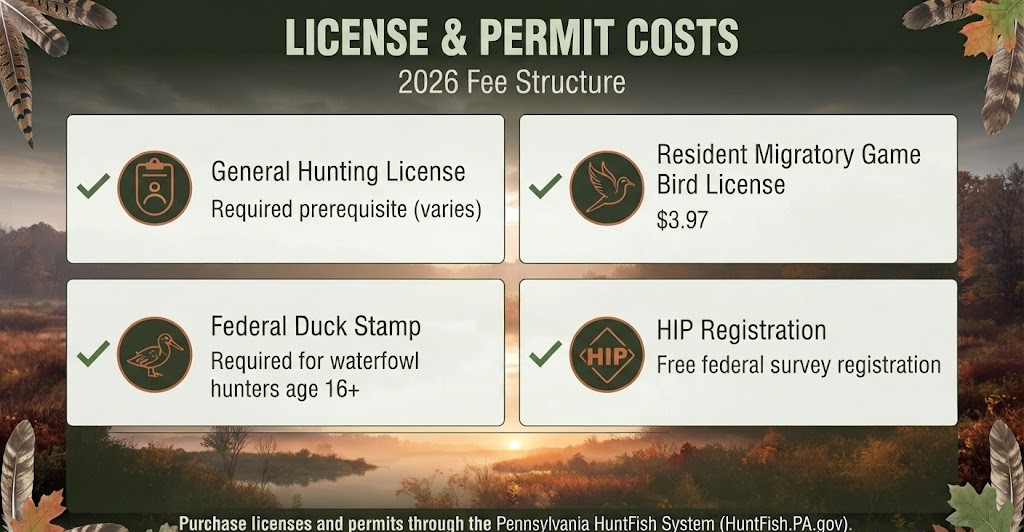
- Resident Migratory Game Bird License: $3.97, required for all migratory bird hunters in Pennsylvania
- General Hunting License: required as a prerequisite before you can add the migratory game bird license
- Federal Duck Stamp: required for all waterfowl hunters age 16 and older, available as an E-Stamp or physical stamp
- Permits purchased via: the Pennsylvania HuntFish System (HuntFish.PA.gov)
- HIP registration: the Harvest Information Program, a quick federal survey registration required of all migratory bird hunters
Pennsylvania Migratory Bird Hunting Seasons by Species
Every date below is set by the Pennsylvania Game Commission within U.S. Fish and Wildlife Service frameworks. Sunday hunting stays closed for migratory birds across the board in 2026-27.
Mourning Dove Season
Pennsylvania’s mourning dove season runs Sept. 1–Nov. 27 and again Dec. 18–Jan. 2, a two-part window that bridges early fall into the new year. The daily bag limit is 15 birds, with a possession limit of 45. The split structure gives you an early crack at doves feeding on harvested grain fields, then a second chance once winter weather starts moving birds around. Mark both segments on your calendar — missing the second window is a common mistake.
Woodcock Season
Woodcock hunting in Pennsylvania runs Oct. 17–Dec. 8, with a daily bag limit of 3 birds and a possession limit of 9. This window lines up with peak woodcock migration through the state, and it’s a solid option if you enjoy hunting thick cover with a dog.
Wilson’s Snipe Season
Wilson’s snipe season runs the same Oct. 17–Dec. 8 window as woodcock, with a more generous daily bag limit of 8 birds and a possession limit of 24. Snipe hunters typically work wet meadows and marsh edges, different habitat than woodcock even though the calendar dates match.
Rails & Gallinules Season (Virginia and Sora)
Rails and gallinules hunting in Pennsylvania — covering Virginia rail and sora — runs Sept. 1–Nov. 20, with a bag limit of 3 daily and 9 in possession, whether you take a single species or a mix of the two. It’s an early-fall season that rewards hunters willing to work marsh edges before the bigger-name species take over.
Canada Goose Seasons
In most areas outside the Atlantic Population Zone, the early Canada goose season runs Sept. 1–25 with an 8-bird daily limit, followed by later winter segments. Southeastern Pennsylvania looks different this year.
The headline change: in the Atlantic Population Zone, the Pennsylvania Game Commission expanded the regular season from 30 days to 45 days and raised the daily bag limit from 1 bird to 3 birds. The shift is driven by improved population estimates on the birds’ Quebec breeding grounds, and it’s exactly the kind of update that makes checking current-year regulations worth the five minutes before you head out.
Duck, Merganser & Coot Seasons (Zone-Based)
Duck hunting in Pennsylvania runs on a zone system. The state splits it into four zones — North, South, Northwest, and Lake Erie — and season dates vary depending on which zone your hunting spot falls into. A duck zone is simply a geographic region with its own season dates and framework, set to match local migration timing.
Generally, PA duck hunting zones run from October through January, with exact dates depending on the zone. The North Zone, for example, illustrates the split-season structure common across zones, with separate early and late segments rather than one continuous run. Because specifics shift zone to zone, confirm your exact boundaries and dates through the Pennsylvania Game Commission or HuntFish.PA.gov before you hunt. For a deeper breakdown of duck, merganser, and coot regulations, see our Pennsylvania waterfowl season guide.
One compliance note that applies across every zone: non-toxic shot — ammunition made without lead, like steel shot — is required for all waterfowl hunting in Pennsylvania. It’s a federal requirement meant to protect birds and wetlands from lead poisoning, and it applies no matter which duck zone you’re hunting.
Pennsylvania Migratory Bird Licenses and Permits
This section is the pre-hunt checklist, sourced directly from the Pennsylvania Game Commission and U.S. Fish and Wildlife Service.
Pennsylvania Hunting Licenses
Here’s how the licensing structure breaks down for residents and non-residents:
| License/Permit | Who Needs It | Cost |
|---|---|---|
| General Hunting License | All hunters (prerequisite for migratory license) | Varies by residency |
| Resident Migratory Game Bird License | All resident migratory bird hunters | $3.97 |
| Non-Resident Hunting License + Migratory License | All non-resident migratory bird hunters | Check current pricing |
| Federal Duck Stamp | Waterfowl hunters age 16+ | Set federally |
The Resident Migratory Game Bird License costs $3.97, but it can’t be purchased on its own — it requires a General Hunting License first. Non-residents need the same combination: a general Pennsylvania hunting license plus the migratory game bird license. Exact non-resident pricing wasn’t confirmed in our research, so check HuntFish.PA.gov for current fees before budgeting a trip. The Federal Duck Stamp is a federal conservation stamp that funds wetland habitat, required for every waterfowl hunter 16 and older, residents and non-residents alike.
The Sunday hunting closure applies to every hunter in Pennsylvania, resident or visiting, so plan field days around Monday through Saturday. For the full picture of Pennsylvania’s hunting seasons across every species, see our complete PA hunting season guide.
Pennsylvania Hunting Permits & Purchase Steps
Getting legal to hunt migratory birds in Pennsylvania comes down to a straightforward sequence:
- Buy your general hunting license — this is the foundation every other permit builds on.
- Add the Migratory Game Bird License ($3.97) — this covers doves, woodcock, waterfowl, and the rest of the migratory species lineup.
- Purchase your Federal Duck Stamp — required if you’re 16 or older and hunting waterfowl specifically.
- Register for HIP — the Harvest Information Program, a quick federal survey registration that identifies migratory bird hunters for USFWS harvest data.
You can handle all four steps through the Pennsylvania HuntFish System at HuntFish.PA.gov, online or through an authorized issuing agent. If you’re new to hunting, hunter education is generally a factor in getting your first license, but since the exact current requirement wasn’t confirmed in our research, verify the specifics directly through HuntFish.PA.gov or the Pennsylvania Game Commission before starting the process.
Where to Hunt Migratory Birds in Pennsylvania
Once the paperwork’s squared away, the question becomes where to actually hunt. Pennsylvania offers three paths — public land, private leases, and guided hunts — each with its own tradeoffs in cost, pressure, and exclusivity. Hunting Locator can help with all three.
Best Public Lands (State Game Lands)
Pennsylvania offers an enormous amount of public hunting ground through its State Game Lands system, managed by the Pennsylvania Game Commission for wildlife management and lawful hunting. The Commission manages more than 1.5 million acres of state game lands across the Commonwealth, a genuinely large, free-access option for migratory bird hunters.
Public land comes with tradeoffs worth planning around:
- Scout early and expect company: Popular waterfowl and dove spots get pressured fast once the season opens, so get eyes on the ground before opening day, arrive early, and have a backup spot in mind.
- Confirm your zone: Since duck seasons vary by zone, make sure the game land you’re targeting falls where you think it does.
- Check current maps: Boundaries and access points can shift, so confirm current details through the Game Commission’s mapping resources before you go.

Private Land Hunting with Hunting Locator
If public land pressure isn’t your style, private land changes the equation — less competition, better setups near roost sites and feeding areas, and more exclusivity. Private access generally comes in two forms: leasing a property for the season, or buying land outright for long-term control over your hunting ground.
This is where Hunting Locator comes in. It’s a platform connecting hunters directly with landowners across Pennsylvania who are ready to lease or sell hunting land, which cuts down on the scramble of losing a spot to someone who got there first or scrambling for access the week before opening day. You can browse Pennsylvania hunting leases to see current listings pulled straight from landowners across the state.
Securing your ground before opening day means spending the season hunting instead of searching. Whether you want a season-long lease on a productive wetland or are ready to buy land outright, Hunting Locator puts you in direct contact with the landowners who make it possible.
Guided Hunts
For hunters who want local knowledge and ready-made access without the legwork, guided and outfitted waterfowl hunts are the highest-service option available. This works especially well for non-residents unfamiliar with Pennsylvania’s zones and terrain, or beginners who’d rather learn from someone experienced than figure it out solo. Hunting Locator’s platform and Pennsylvania lease network can help connect you with guided and outfitter access alongside private land options.
Migratory Bird Hunting Tips
A few field-tested habits separate a productive hunt from a frustrating one, whether it’s your first season or your twentieth:
- Scout Before You Shoot: Find feeding and flight patterns in the days before opening day. Birds establish routines fast, and knowing where they’re moving beats guessing.
- Hunt the Right Hours: Doves and ducks move on predictable schedules — early morning and late afternoon are consistently the best windows.
- Use Decoys & Blinds: Decoys draw birds into range while blinds keep you hidden until the shot presents itself. Both are legal tools that improve your odds, especially for waterfowl.
- Match Your Gear to the Bird: A 12- or 20-gauge shotgun handles most migratory bird hunting in Pennsylvania, but non-toxic shot is legally required for all waterfowl — lead shot isn’t an option.
- Know Your Limits & Report Bands: Keep your daily bag and possession limits straight for whatever you’re hunting, and report any banded bird you harvest — that data helps wildlife managers set future seasons.
When it’s time to fill gaps in your gear closet, gear up at our store for shotguns, decoys, blinds, and everything else you need for the season.
More Resources from Hunting Locator
Keep planning your PA season with these related guides:
- Pennsylvania Hunting Season Guide — a master overview of every hunting season Pennsylvania offers, useful if you’re planning a multi-species year.
- Pennsylvania Migratory Bird Hunting Season — our dedicated hub for migratory bird regulations and updates.
- Pennsylvania Waterfowl Hunting Season — a deeper dive specifically into duck, goose, and other waterfowl regulations.
- Pennsylvania Small Game Hunting Season — a natural next stop if you’re also chasing rabbits, squirrels, or grouse.
- Pennsylvania Turkey Hunting Season — plan your spring or fall turkey hunt alongside your bird season.
- Pennsylvania Deer Hunting Season — everything you need for Pennsylvania’s biggest hunting season.
- Pennsylvania Black Bear Hunting Season — season dates and strategy for bear hunters.
- Pennsylvania Elk Hunting Season — details on the state’s limited, highly sought-after elk season.
- Pennsylvania Coyote Hunting Season — a look at year-round coyote hunting opportunities across the state.
FAQ
When does dove season open in Pennsylvania for 2026?
Pennsylvania’s 2026-27 mourning dove season runs Sept. 1–Nov. 27 and again Dec. 18–Jan. 2, with a daily bag limit of 15 birds and a possession limit of 45, according to the Pennsylvania Game Commission. The split structure gives you two distinct windows to hunt within the same season.
How much does a Pennsylvania migratory game bird license cost in 2026?
The Resident Migratory Game Bird License costs $3.97, purchased through HuntFish.PA.gov. You’ll need a General Hunting License first, since the migratory license can only be added on top of that base license.
Do non-residents need a Federal Duck Stamp to hunt waterfowl in PA?
Yes. Every waterfowl hunter age 16 and older needs a Federal Duck Stamp, regardless of residency, in addition to a Pennsylvania hunting license and migratory game bird license. This applies whether you’re a lifelong resident or visiting for a single trip.
Is Sunday hunting allowed for migratory birds in 2026-27?
No. The Pennsylvania Game Commission kept Sunday hunting closed for migratory game birds in 2026-27, even though a 2025 law gave the Commission new authority to allow it. The Commission cited public feedback and survey data, and says it will revisit the issue for the 2027-28 season.
What is non-toxic shot and why is it required?
Non-toxic shot refers to ammunition made without lead — typically steel — and it’s required nationwide for waterfowl hunting to prevent lead poisoning in birds and wetland ecosystems. Pennsylvania mandates non-toxic shot for all waterfowl hunting, so lead shot isn’t a legal option in the field.
What changed for Canada goose season in Pennsylvania this year?
In the Atlantic Population Zone covering southeastern Pennsylvania, the Pennsylvania Game Commission expanded the regular Canada goose season from 30 days to 45 days and increased the daily bag limit from 1 bird to 3 birds. The change reflects improved goose population estimates on their Quebec breeding grounds.
How does a non-resident find legal hunting access in Pennsylvania?
Non-residents can hunt Pennsylvania’s public State Game Lands, secure a private lease, or book a guided hunt. If you want direct access to landowners offering leases across the state, Hunting Locator’s Pennsylvania leases page is built specifically to connect you with current opportunities.
The Final Shot
A solid 2026-27 migratory bird season in Pennsylvania comes down to a few things: knowing your dates, squaring away your license, permit, and Duck Stamp, locking in somewhere to hunt, and showing up with the right gear.
The next steps are straightforward: confirm your zone and exact dates, complete your purchases through the Pennsylvania HuntFish System, and secure your hunting ground before opening day. Every regulatory detail in this guide comes from the Pennsylvania Game Commission and U.S. Fish and Wildlife Service.
Browse Pennsylvania hunting leases to lock in your ground, stock up at the Hunting Locator store for whatever your gear bag is missing, and check the other resources above when you’re ready to plan your next hunt.


