This exact moment happens to hunters everywhere, and it’s sparked one hell of a debate. Recent surveys show 78% of hunters who made the switch to red dots got faster at finding their target, but plenty of old-school hunters still swear their iron sights are all they’ll ever need. Your choice here can make or break your hunt.
Maybe you’re wondering if it’s time to modernize your setup. Or you’re putting together your first serious hunting rifle. Could be you’re planning a hunt where gear failure would ruin everything. Whatever brought you here, this guide will help you pick the right sighting system for how you actually hunt:
- Real-world performance comparison between red dots and iron sights
- A simple decision framework based on your hunting style and experience
- Everything you need to know about preparation, gear, and field tactics
Let’s dig into what really matters when that shot opportunity presents itself.
Why Your Sighting System Actually Matters in Close-Quarters Hunting
Close-quarters hunting means shots under 100 yards in heavy cover—thick woods, dense brush, anywhere game can appear and vanish in seconds. We’re talking whitetails in hardwood bottoms, hogs in palmetto thickets, or any situation where you might get surprised by game at close range.
This isn’t like open-country hunting where you’ve got time to set up and dial in magnification. Here, everything happens fast. You need speed, awareness, and the ability to get on target quickly when visibility sucks. Deer move most during dawn and dusk when light gets tricky, which makes low-light performance crucial.
Your sighting choice matters because you’re dealing with moving targets, tiny shooting windows, and situations where a follow-up shot might save your hunt. Iron sights are like driving stick—dead reliable but you better know what you’re doing. Red dots are more like having power steering—they make things easier but add complexity.
Both can work great for close-quarters hunting. They just excel in different ways.
Red Dots vs. Iron Sights: How They Actually Stack Up
There’s no universal winner here. The right choice depends on how you hunt, your experience level, and what conditions you face most often.
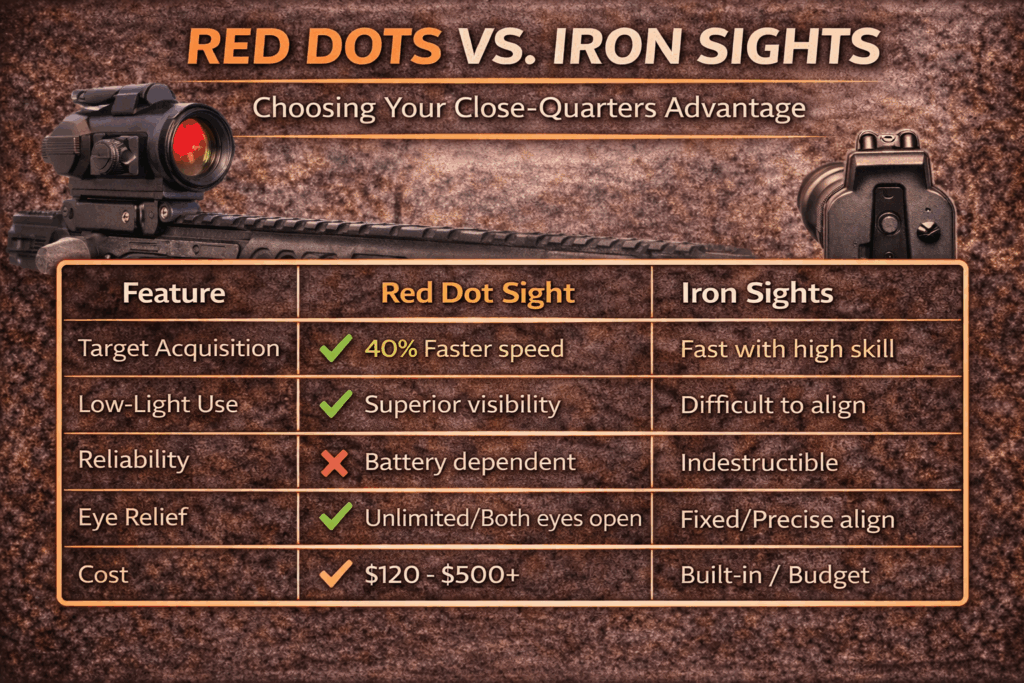
| What Matters | Red Dot Sights | Iron Sights |
|---|---|---|
| Speed to Target | Faster for most hunters | Great with lots of practice |
| Low-Light Shooting | Much better visibility | Gets tough when light fades |
| Reliability | Good with quality units | Bulletproof—no batteries |
| Cost | $120-$500+ investment | Basically free |
| Learning Curve | Pretty easy for most | Takes real practice to master |
| Battery Life | Yes—better plan for it | What batteries? |
| Added Weight | 2-12 ounces | Zero |
| Weather Issues | Fine with good optics | Couldn’t care less |
Getting on Target Fast
Studies comparing red dots to traditional scopes found hunters cut their target acquisition time by 40%. When a hog explodes from cover or a deer gives you a three-second window, that time difference can be everything.
But don’t assume iron sights are slow. Research actually shows iron sights can be slightly faster on close targets if you’ve got your fundamentals down. The key word is “if”—it takes serious practice to get there.
When the Light Gets Tough
This is where red dots really shine. The main advantage in low light is that red dots have a bigger aperture than peep sights, so you can actually see what you’re shooting at when iron sights would leave you guessing. Since most game moves during dawn and dusk, this advantage hits right where it counts.
Good hunting red dots let you adjust brightness across multiple levels. You can dial way down for early morning without washing out your sight picture. Iron sights? They get harder to line up as conditions get dim.
Reliability When It Counts
Iron sights are built into your rifle, so they handle drops, weather, and abuse better than anything electronic. No batteries to die, no electronics to fail, no glass to fog up. They’re the gold standard for “it just works.”
Modern hunting red dots have gotten way better though. Quality optics handle temperatures from -40°F to 160°F while holding zero, and current models give you 20,000+ hours of battery life with auto-shutoff features.
Lots of hunters solve the reliability question by running red dots with backup iron sights. You get the speed advantage with a failsafe.
What It’ll Cost You
Iron sights are the budget option—they come with your rifle or cost almost nothing to add. Quality hunting red dots require real investment. Entry-level options like the SIG Romeo5 start under $120, while premium Aimpoint or Trijicon units can hit $500+.
The Aging Eyes Reality
This is something many experienced hunters face eventually. Red dots stay sharp even with astigmatism-correcting glasses, without the starburst effect you get from cheap optics. The unlimited eye relief also eliminates the precise head positioning iron sights demand.
Which System Fits Your Hunting?
Instead of picking a winner, here’s how to decide based on your actual situation:
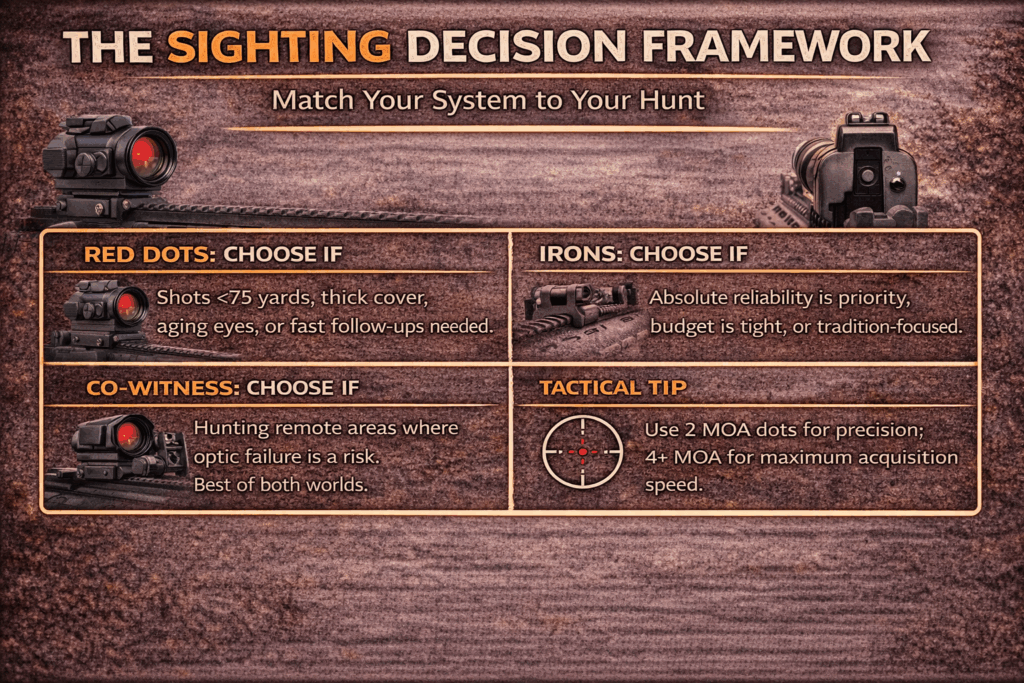
Go with Red Dots If:
- Most of your shots happen under 75 yards in thick cover
- Your vision isn’t what it used to be and iron sight alignment is getting tough
- You hunt hogs, deer drives, or anything requiring fast follow-ups
- You want both-eyes-open shooting for better awareness
- You’re willing to invest in quality optics and stay on top of battery maintenance
Stick with Iron Sights If:
- You’ve got years of practice and your current setup works
- Absolute reliability matters more than convenience
- You hunt in conditions where you don’t trust electronics
- Budget constraints make quality red dots impractical
Consider Co-Witness Setup If:
- You want red dot speed with iron sight backup
- You’re transitioning but want familiar reference points
- You hunt remote areas where optic failure would end your trip
If you’re leaning toward trying red dots, check out our red dot collection to see what works with your rifle and budget.
Getting Ready: The Stuff That Actually Matters
Your optic choice is just one piece of a successful hunt. Good preparation separates great hunts from frustrating ones, especially when you’re heading somewhere new or planning an out-of-state trip.
Know the Rules
Always check state and local hunting regs before your hunt, especially as a non-resident. Standard red dots are legal pretty much everywhere for all seasons, but some restrictions exist for specialized optics. Not all states allow thermal for hunting, and those that do often limit which species or restrict by season.
Non-resident hunters should verify legal equipment and seasons with the wildlife agency well before your trip. Get licenses and tags early to avoid last-minute headaches.
Scout Smart
Focus on finding close-quarters opportunities—funnels, thick bedding areas, travel corridors in timber where your sight choice will matter. Look for tracks, rubs, scrapes, and feeding sign that shows regular game movement through low-visibility areas.
Use GPS and mapping apps to identify potential stand locations and shooting lanes. Quality range finders help you pre-mark distances so you know exactly when game enters your effective range.
Get Your Gear Right
Close-quarters hunting often means still-hunting through thick cover, so decent physical conditioning helps. More importantly, make sure your gear is reliable and matches the conditions you’ll face.
Essential Gear: What You Actually Need
Here’s what experienced close-quarters hunters prioritize beyond their sighting system:
Optics and Sighting
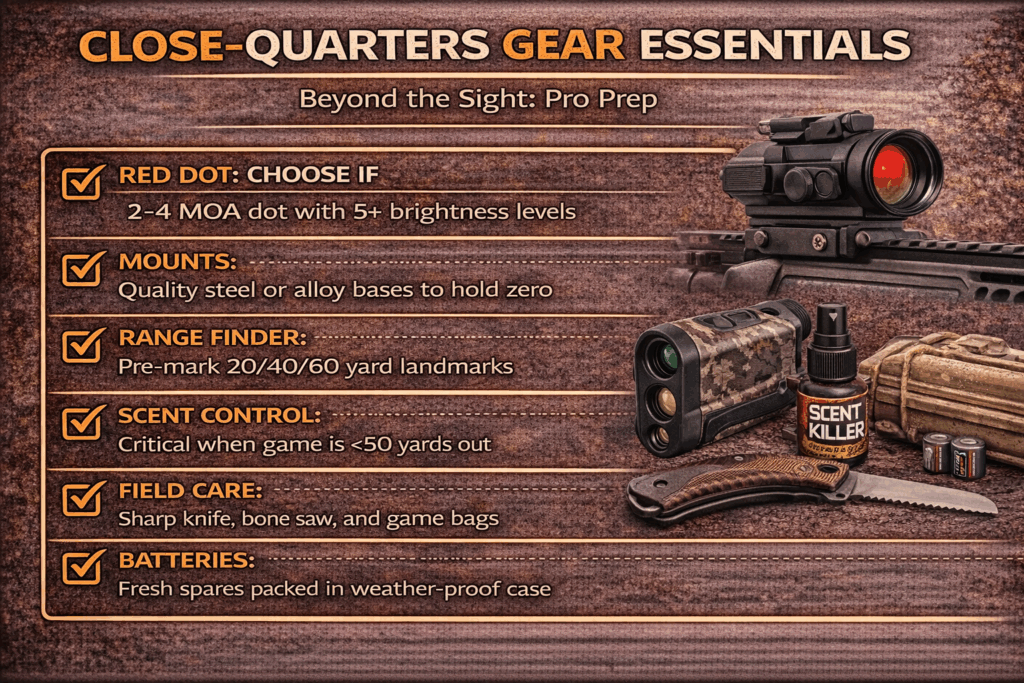
If you’ve decided on red dots, look for adjustable brightness (5+ levels), proven durability, and appropriate dot size. 2-4 MOA dots work well for hunting—a 2 MOA dot covers about 2 inches at 100 yards, giving you precision without covering your target.
Ready to look at options? Our red dot sight collection has proven hunting optics across different price points. For situations needing magnification, consider rifle scopes for longer shots.
Don’t cheap out on mounting—quality scope mounts and bases keep your zero through recoil and field abuse.
Support Gear That Matters
Navigation and Safety:
- GPS unit or phone with offline maps
- Backup compass
- First aid kit for your hunting area
- Emergency communication for remote locations
Field Care Tools:
- Sharp, reliable knife
- Disposable gloves
- Game bags for meat protection
- Bone saw for bigger game
Scent Control:
Scent management becomes critical at close range—less margin for error when game is 50 yards out. Pay attention to wind direction and use quality scent control products.
Building your gear list? Browse our hunting optics to find sighting solutions that match your style and budget.
Field Tactics: Making Your Shot Count
Your sighting system choice directly affects how you approach close-quarters hunting.
Prime Time Windows
Most close-quarters action happens during dawn and dusk when game is moving—exactly when red dots’ low-light advantages shine. Plan your hunting around these peak periods and make sure your sights perform when conditions get dim.
Getting Close
Still-Hunting:
Move slow through thick cover, stopping frequently to scan for movement. Red dots excel here because both-eyes-open shooting maintains peripheral vision while staying ready for quick shots.
Stand Placement:
Position stands to cover funnels and travel corridors where shots will be close and potentially fast. Pre-range key landmarks and shooting lanes.
Shot Placement:
Regardless of your sighting system, focus on ethical shots in vital zones. Close-quarters shots often present different angles than open-country hunting, so practice from various positions and know your effective range limits.
After the Shot: Finishing the Job
Tracking and Recovery
Even perfect shots require tracking skills. Mark your shooting position and where the animal was when shot. Look for blood sign and follow established tracking principles—patience usually pays off.
Field Care
Quick, proper field dressing preserves meat quality and makes transport easier. Work efficiently but carefully, especially in warm weather. Have a plan for getting your harvest from field to freezer.
More Resources from Hunting Locator
Boost your hunting success with our complete gear selection:
- Hunting Binoculars – Critical for scouting and game ID in thick cover
- Hunting Spotting Scopes – Perfect for long-range scouting and shot verification
- Hunting Range Finders – Essential for knowing exact distances
- Hunting Rifle Scopes – When you need magnification for longer shots
- Hunting Night Vision – For legal night hunting applications
- Hunting Thermal Optics – Advanced detection where permitted
FAQ
Which is more accurate – red dots or iron sights?
Both deliver excellent hunting accuracy when properly zeroed and used within effective range. Field tests show hunters using red dots hit 90% of targets up to 250 yards, while experienced iron sight shooters achieve similar results at close range. Match the system to your skill level and hunting conditions.
How long do red dot batteries actually last?
Quality hunting red dots provide 20,000+ hours of battery life with modern power management. Most hunters replace batteries before each season regardless of remaining life to ensure field reliability.
Can I run both red dots and iron sights?
Absolutely. Co-witness setups let you use red dots with backup iron sights, giving you electronic optic speed with iron sight reliability as backup. Many hunters prefer lower-third co-witness that doesn’t obstruct the red dot view.
Are red dots legal everywhere for hunting?
Standard red dots are legal for hunting in virtually all states and seasons. Some states restrict thermal and night vision optics though. Always verify local hunting regulations before heading out, especially when hunting out of state.
What red dot size works best for hunting?
2-4 MOA dots work well for hunting. A 2 MOA dot covers roughly 2 inches at 100 yards—precise aiming without obscuring your target. Larger dots (4-6 MOA) offer faster acquisition but may cover more target at longer ranges.
Do red dots help hunters with vision problems?
Red dots stay sharp even with astigmatism-correcting glasses without the starburst effect from cheap optics. They also offer unlimited eye relief, making them excellent for hunters with age-related vision changes or glasses wearers.
Bottom Line
Choosing between red dots and iron sights for close-quarters hunting isn’t about finding the “perfect” system. It’s about finding what works for your hunting style, conditions, and experience level. Both have put meat in freezers for generations of successful hunters.
If you’re an experienced hunter with solid iron sight skills, there’s nothing wrong with sticking with what works. If you’re dealing with vision changes, hunt in tough low-light conditions, or want the fastest possible target acquisition, red dots offer real advantages worth considering.
The most important thing isn’t which sighting system you choose—it’s how well you know your equipment and practice with it before season. Whether you’re lining up iron sights or putting a red dot on target, consistent practice and understanding your limits will serve you better than any gear upgrade.
Ready to gear up for your best close-quarters season yet? Check out our store! We stock top hunting optics, range finders, and mounting systems to set you up for success in the field.


