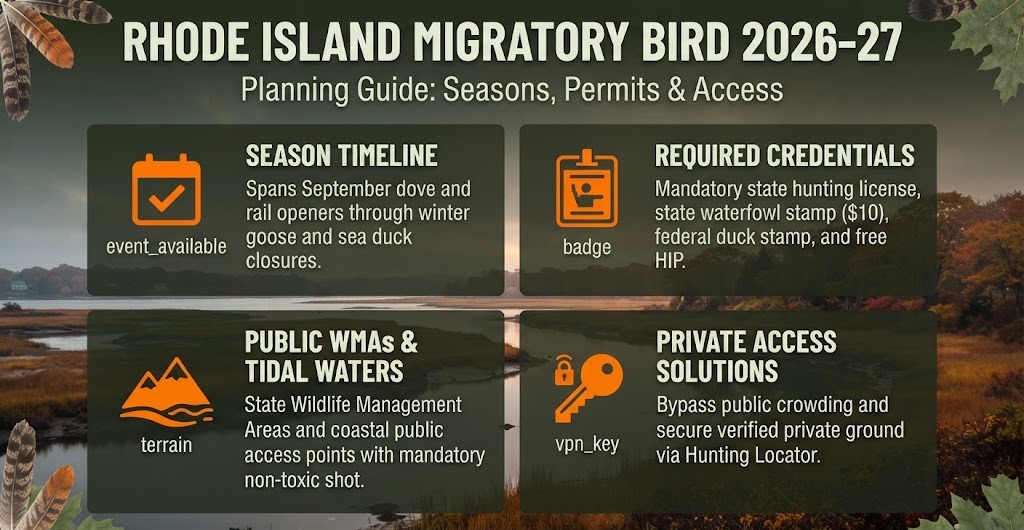
This Rhode Island migratory bird guide pulls together the season dates, bag limits, licenses, and land access options for the 2026–2027 migratory bird seasons — the kind of information that otherwise takes a dozen browser tabs to piece together. Whether you’re a lifelong Rhode Island hunter or planning a first trip across state lines, it covers what residents and non-residents need for a legal, well-planned season.
Here’s what’s covered below:
- Season dates and bag limits for every migratory species Rhode Island hunters pursue, from mourning dove to sea ducks
- The full license and permit stack — what residents and non-residents each need, and what it costs
- Where to hunt — public land, private leases, and guided hunt options across the state
For more species-specific detail, see our migratory bird deep-dive. Dates first.
Quick Overview: 2026–2027 RI Migratory Bird Seasons at a Glance
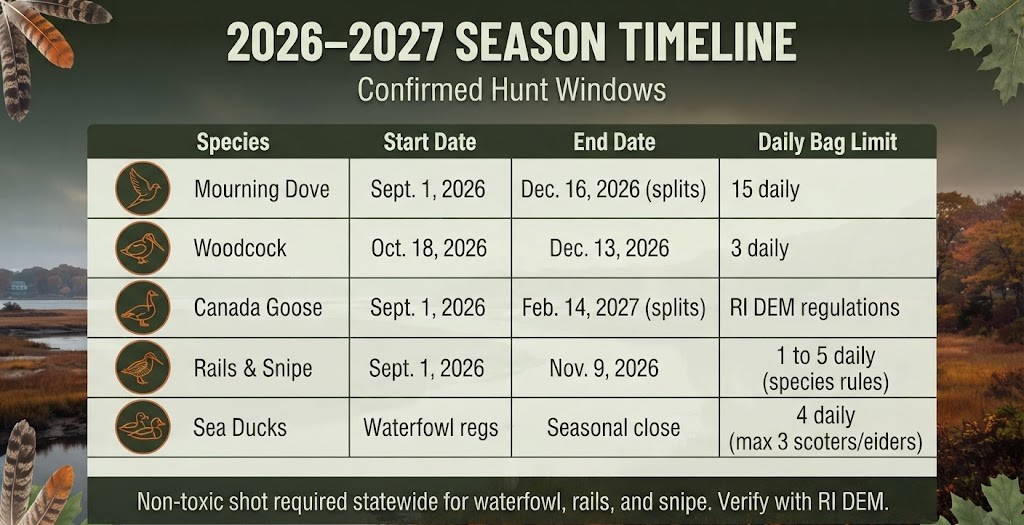
The table below consolidates season dates and daily bag limits for every huntable migratory species in Rhode Island. Seasons are subject to regulatory changes, so confirm final dates with the Rhode Island Department of Environmental Management (RI DEM) before heading afield.
Rhode Island Migratory Bird Season Guide for 2026 — Quick Reference
| Species | Season Type | Dates | Daily Bag Limit | Notes |
|---|---|---|---|---|
| Mourning Dove | Split Season | Sept 1–30 & Oct 18–Dec 16 | 15/day | HIP required; non-toxic shot required where posted on WMAs |
| Woodcock | Regular | Oct 18–Dec 1 | 3/day | HIP required |
| Canada Goose | Early Season | Sept 1–30 | See RI DEM regulations | Early split |
| Canada Goose | Regular Season | Nov 22–30 & Dec 6–Jan 25 | See RI DEM regulations | Regular split |
| Canada Goose | Late Season | Jan 31–Feb 14 | See RI DEM regulations | Late split |
| Rails (King/Clapper) | Regular | Sept 1–Nov 9 | 1/day | Non-toxic shot required |
| Rails (Sora/Virginia) | Regular | Sept 1–Nov 9 | 3/day (singly or aggregate) | Non-toxic shot required |
| Snipe | Regular | Sept 1–Nov 9 | 5/day | Non-toxic shot required |
| Sea Ducks | Regular | See RI DEM waterfowl regulations | 4/day (max 3 scoters, 3 eiders, 1 hen eider) | Coastal; non-toxic shot required |
| Pintail | Within duck season | See RI DEM regulations | 3/day | Recently increased to 3 for this cycle |
For seasons beyond migratory birds — deer, turkey, small game, and more — the full RI season guide covers the rest of the calendar.
Before hunting any of these birds, you’ll need a handful of credentials:
- Hunter Education — a one-time certification required before you can buy your first Rhode Island hunting license.
- RI Hunting License — resident or non-resident, with pricing covered below in the Licenses section.
- State Waterfowl Stamp — required for anyone hunting ducks, geese, or sea ducks.
- Federal Migratory Bird Hunting Stamp (Duck Stamp) — required for hunters age 16 and older, and must be signed in ink.
- HIP Permit (Harvest Information Program) — a free registration that lets the U.S. Fish and Wildlife Service track migratory bird harvest nationwide.
Rhode Island Migratory Bird Hunting Seasons
Here’s the detail behind that table, species by species. One rule applies across the board: non-toxic shot — steel or other approved non-lead materials — is required statewide for waterfowl, rails, and snipe, including in tidal waters.
Mourning Dove Season
Rhode Island’s mourning dove season runs in two parts: September 1–30 and October 18–December 16, with a daily bag limit of 15 birds. It’s one of the most popular openers in the state — accessible and fast-paced, and a reasonable entry point for hunters newer to migratory birds.
Canada Goose Season (Early, Regular & Late Splits)
Canada goose hunting breaks into three windows: the Early Season runs September 1–30, the Regular Season covers November 22–30 and December 6–January 25, and the Late Season runs January 31–February 14. See our RI waterfowl season guide for a full rundown of duck and goose timing across the state.
The three splits give visiting hunters several windows to plan a trip around; missing the early season still leaves the regular and late splits open. Bag limits vary by split, so confirm specifics with RI DEM before you go, and consider a guided goose hunt if you’re new to the state (more on that below).
Woodcock, Rails, Snipe & Sea Ducks
Beyond dove and goose, Rhode Island offers a handful of lesser-known migratory bird opportunities:
- Woodcock — October 18–December 1, 3/day
- Rails (King/Clapper) — September 1–November 9, 1/day
- Rails (Sora/Virginia) — September 1–November 9, 3/day (singly or aggregate)
- Snipe — September 1–November 9, 5/day
- Sea Ducks — 4/day, with no more than 3 scoters and 3 eiders, and a max of 1 hen eider
For exact sea duck season dates and the new sea duck regulations covering scaup and merganser updates this cycle, along with Rhode Island sea duck rules generally, check these resources before planning a coastal hunt.
Regulations Every Migratory Hunter Must Know
A handful of rules apply across every migratory bird season in Rhode Island, beyond dates and bag limits:
- Non-toxic shot is mandatory for waterfowl, rails, and snipe statewide, including tidal waters — and all shot larger than BB is prohibited, per the Rhode Island non-toxic shot rule.
- Possession limits equal three times the daily bag limit unless otherwise stated, while your field possession limit equals your daily bag limit — see the official RI possession limits for the full legal language.
- Shotguns must be plugged to hold no more than three shells.
- Baiting is prohibited — hunting over a baited area is a serious violation.
- Keep one fully feathered wing attached to migratory birds during transport for identification.
Regulations are updated regularly, so cross-check with RI DEM’s official regulations before opening day. A few changes worth flagging for this cycle: the pintail bag limit has increased to 3, Durfee Hill is now permanently closed, hunting guides must obtain a new free Guide Permit, Simmons Mill WMA no longer requires decoys, and the restriction on hunting more than 10 feet above mean high tide at Prudence Island has been lifted. Migratory bird hunters are also encouraged to report any bands they recover, which supports national conservation tracking efforts.
Rhode Island Hunting Licenses and Permits
Legal migratory bird hunting in Rhode Island requires a layered set of credentials — a base license, plus stamps and permits depending on what you’re hunting. Here’s what each one costs and where to get it.
Rhode Island Hunting Licenses
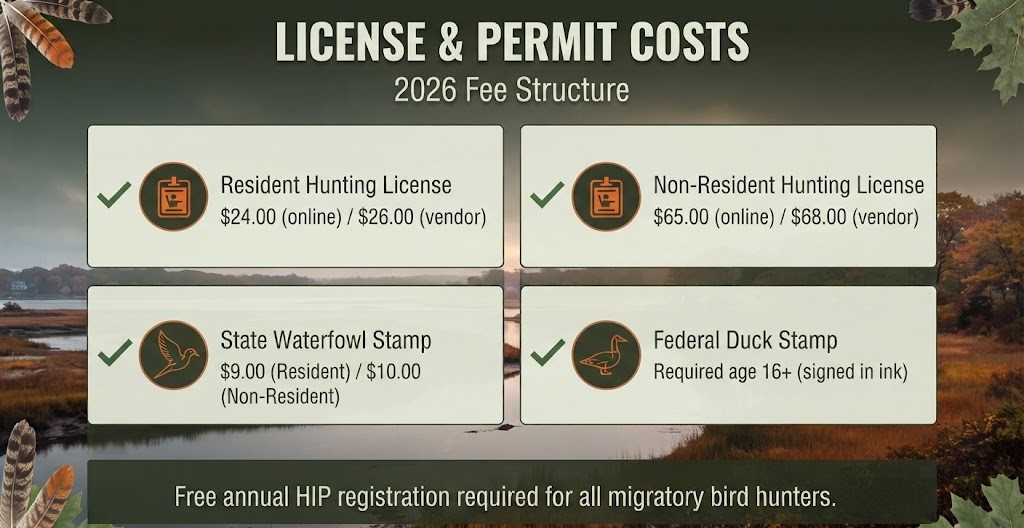
The table below breaks down every license, stamp, and permit needed, whether you’re a Rhode Island resident or crossing state lines to hunt here.
| License/Stamp | Resident | Non-Resident | Notes |
|---|---|---|---|
| Hunting License | $24.00 (online) / $26.00 (vendor) | $65.00 (online) / $68.00 (vendor) | Online is cheaper for both |
| State Waterfowl Stamp | $9.00 (online) / $9.50 (vendor) | $10.00 | Required for waterfowl hunters |
| HIP Permit | Free | Free | Required for all migratory bird hunters |
| Federal Duck Stamp | Check USFWS pricing | Check USFWS pricing | Required age 16+; must be signed in ink |
Non-resident total-cost estimate: For a non-resident traveling in to hunt waterfowl, budget at least around $75 before the federal stamp — the $65 online non-resident license plus the $10 non-resident waterfowl stamp. Add the federal Duck Stamp (confirm current pricing with the U.S. Fish and Wildlife Service) and the free HIP registration, and you’re legal to hunt.
Buying online is generally cheaper and faster than buying at a vendor, and it lets you finish this well before opening day rather than scrambling the week of. Double-check current fees and any regulatory updates with RI DEM before finalizing your season plans.
Rhode Island Hunting Permits & Stamps
Getting fully legal to hunt migratory birds in Rhode Island follows a simple sequence:
- Complete hunter education — required if this is your first RI hunting license.
- Buy your RI hunting license — online or at an authorized vendor.
- Add the State Waterfowl Stamp — required if you’re hunting ducks, geese, or sea ducks.
- Purchase the Federal Duck Stamp — required for hunters 16 and older; confirm current pricing with the USFWS and sign it in ink.
- Register for your free HIP permit — every season, before you hunt.
HIP, the Harvest Information Program, is a free registration that helps the U.S. Fish and Wildlife Service estimate migratory bird harvest nationwide. It doesn’t carry over between seasons — you register fresh each year, though the process takes just a few minutes online. Between hunter education, your license, and these stamps, most of the work is a one-time setup followed by a quick annual refresh.
Rhode Island Migratory Bird: Where to Hunt
Rhode Island is the smallest state in the country, and quality public hunting access fills up fast, especially around opening weekend. That’s a large part of why many hunters — residents and visitors alike — look beyond public land for more reliable ground. Browse available Rhode Island hunting leases to see what private access looks like before committing to the crowds.
Best Public Lands
Rhode Island does offer public wildlife management areas worth scouting for migratory bird hunting:
- Simmons Mill WMA — a solid waterfowl option, and decoys are no longer required to hunt there this cycle.
- Prudence Island — waterfowl hunting access with the previous 10-foot mean-high-tide restriction now lifted, opening up more usable water.
- Other RI Wildlife Management Areas — check the current RI DEM WMA list for additional dove fields, marshes, and coastal access points open to migratory bird hunters.
Durfee Hill is now permanently closed, so don’t plan a trip around it. Public WMAs elsewhere in Rhode Island tend to fill up quickly near opening day, which is one reason private land access is worth considering.

Private Land Hunting with Hunting Locator
Leasing or buying private land for migratory bird hunting changes the equation. Instead of competing with a crowd of hunters for the same public marsh, you get consistent access to ground you can scout, pattern, and return to season after season, building real knowledge of where birds feed, rest, and fly.
That’s the gap the Hunting Locator platform was built to close. It connects hunters directly with landowners across Rhode Island who are ready to lease or sell their land for hunting, without a middleman or guesswork about who actually owns the property. If you’ve lost access to a spot you counted on, or you’re tired of competing for space on crowded public land, this is one way to find your next place to hunt. Browse current Rhode Island hunting leases to see what’s available now, whether you’re after a small marsh parcel for dove and goose hunting or a larger tract with multiple habitat types.
For non-resident hunters, this addresses a common headache with out-of-state trips: you can lock in access before you leave home instead of arriving and hoping public land has room. Once your ground is secured, the right gear makes the most of it — more on that in the Tips section below.
Guided Hunts
Guided hunts tend to make the most sense for two types of hunters: non-residents who want turnkey access without scouting a new state themselves, and beginners who want an experienced hand showing them the ropes.
A guide handles the scouting, decoy placement, calling, and legal setup, so you can focus on learning the fundamentals in the field rather than working them out through trial and error. For visiting hunters, a guide’s local knowledge of goose flight patterns and duck loafing areas can turn a short trip into a productive one.
Even on a guided hunt, having your own well-fitted gear — a shotgun you’re comfortable with, the right shot, proper footwear — makes things smoother. And if a guided hunt gives you a taste for a location you want to return to on your own terms, that’s the point to look at securing your RI access through a private lease.
Migratory Bird Hunting Tips
A little preparation goes a long way toward a productive season. These are the fundamentals that tend to separate a good hunt from a slow one:
- Scout Before Opening Day — Pattern feeding and flight lines in the days leading up to the opener. Look for active dove fields and goose loafing spots so you’re not guessing on morning one.
- Match Your Shot & Choke — Waterfowl, rails, and snipe all require approved non-toxic shot — no lead. Make sure your shells and choke combination are dialed in before the season starts.
- Dial In Your Decoy Spread — For geese and ducks, a realistic, well-placed decoy spread is often the difference between birds committing and birds flaring off.
- Stay Hidden — A solid blind setup and effective camouflage keep you undetected as birds work your spread or approach a field.
- Pick the Right Shotgun — A reliable 12- or 20-gauge shotgun handles most migratory bird hunting situations, from doves to geese, and is a sensible starting point if you’re building your first kit.
- Learn Basic Calls — Simple, well-timed calling consistently outperforms constant, indiscriminate noise. A few solid calls at the right moment beat nonstop calling.
- Dress for the Conditions — Early-season dove hunts and late-season sea duck trips call for very different gear. Layer accordingly and invest in waterproof boots for wet marsh conditions.
Once you know what you need, gearing up is the easy part. Head over to the right gear to hunt this species — from shotguns and shells to decoys, blinds, and cold-weather layers — and get squared away before opening morning.
More Resources from Hunting Locator
Planning a season takes more than one guide, and there’s a full library covering every angle of hunting in Rhode Island and beyond:
- The Hunting Locator hub — your home base for finding hunting access nationwide, from lease listings to outfitter connections.
- Rhode Island hunting leases — browse current RI leases and connect directly with landowners.
- Complete RI hunting season guide — the parent guide covering every season in the state.
- RI migratory bird season details — the companion deep-dive into dove, waterfowl, and more.
- Rhode Island waterfowl season guide — a closer look at ducks, geese, and sea ducks specifically.
- Rhode Island deer season guide — for hunters also planning a big-game season.
- RI small game season guide — covering rabbit, squirrel, and other small game.
- Rhode Island predator hunting guide — coyote and other predator seasons in the state.
- Rhode Island turkey season guide — spring and fall turkey hunting details.
- Shop hunting gear — gear up for your next hunt with everything from shotguns to blinds.
Frequently Asked Questions
What are the Rhode Island dove season 2026 dates?
Rhode Island’s mourning dove season runs September 1–30 and again October 18–December 16, with a daily bag limit of 15 birds. HIP registration is required to hunt dove. Confirm exact dates with RI DEM before opening day, since regulations can shift.
How much does a non-resident Rhode Island hunting license cost?
A non-resident hunting license costs $65.00 online or $68.00 at a vendor. If you’re hunting waterfowl, you’ll also need the $10 non-resident state waterfowl stamp, a federal duck stamp (check current USFWS pricing), and a free HIP permit registration.
What are the Canada goose season splits in Rhode Island?
Rhode Island runs three goose splits: Early Season (September 1–30), Regular Season (November 22–30 and December 6–January 25), and Late Season (January 31–February 14). Bag limits vary by split, so confirm current figures with RI DEM before you hunt.
Do I need a federal duck stamp and a state waterfowl stamp?
Yes — waterfowl hunters need both. The State Waterfowl Stamp costs $9.00–$9.50 for residents or $10.00 for non-residents, and the Federal Migratory Bird Hunting Stamp is required for hunters 16 and older, signed in ink, with pricing confirmed through the USFWS. A free HIP permit is also required.
What is the HIP permit and is it required in Rhode Island?
HIP stands for Harvest Information Program — a free registration required for anyone hunting migratory birds in Rhode Island, including dove, woodcock, and waterfowl. It helps the U.S. Fish and Wildlife Service estimate harvest nationwide, and you must register again each season before you hunt.
What non-toxic shot rules apply to RI migratory bird hunting?
Non-toxic shot — no lead — is required statewide for waterfowl, rails, and snipe, including in tidal waters, per the official RI possession limits and related state regulations. Shot larger than BB is prohibited across the board for these species.
What are the shooting hours and possession limits?
Possession limits equal three times your daily bag limit, while your field possession limit equals your daily bag limit. For exact shooting hours, check the official RI hunting abstract directly, since these can be updated season to season and shouldn’t be assumed.
The Final Shot
A solid migratory bird season in Rhode Island comes down to three things: knowing your dates and limits, carrying the right licenses and stamps, and having reliable ground to hunt on.
Regulations shift from year to year, so treat this guide as a starting point rather than the final word — verify current dates and rules with RI DEM before you head afield. From here: browse Rhode Island hunting leases, connect with a landowner, and get your access sorted before opening morning arrives.


