South Carolina gives hunters access to over 1 million acres of public hunting land spread across four game zones. Each zone has its own personality—from coastal plain dove fields where you’ll burn through shells on opening day to mountain hardwoods where patient squirrel hunters clean up all season long. Whether you’ve been hunting the Palmetto State for decades or you’re planning your first trip from out of state, this guide cuts through the bureaucratic noise to get you hunting.
Here’s what we’re covering in this South Carolina small game guide:
- Season dates, bag limits, and permit requirements for dove (all three splits), squirrel, rabbit, and quail
- Licensing breakdown that actually makes sense, including what non-residents really pay
- Where to hunt guide covering public lands, private leases, and guided options
No fluff, no “delving into the world of small game hunting.” Just the information you need to plan successful hunts from September’s dove opener through March’s final squirrel hunt.
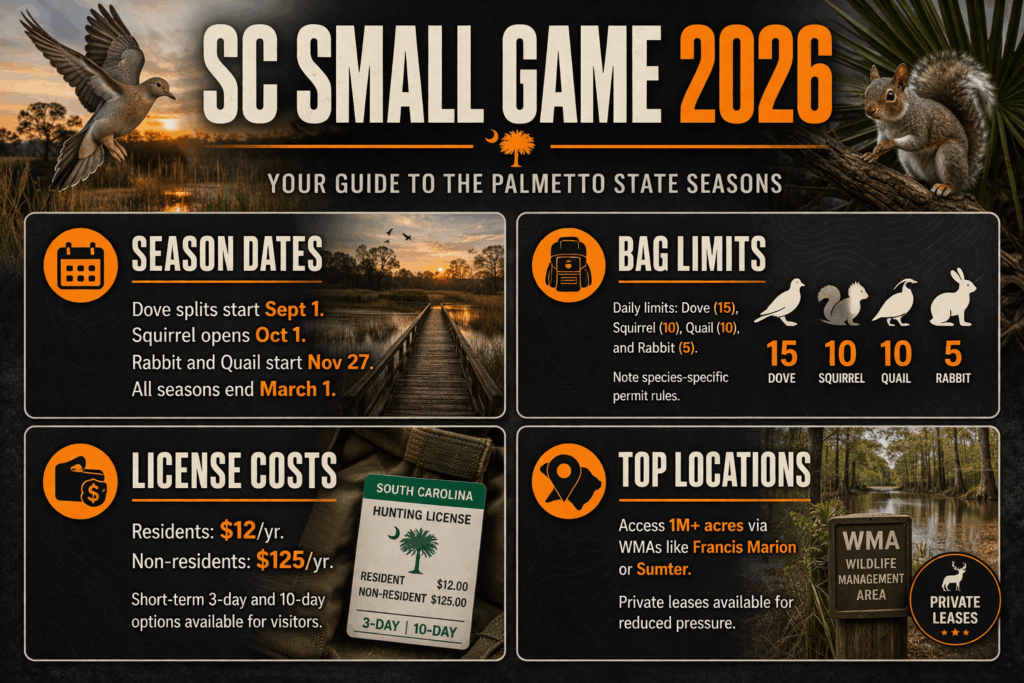
Quick Overview of SC Small Game Seasons 2026
These dates come straight from SCDNR regulations for 2025-2026/2026-2027 seasons. Regulations can shift, so double-check with SCDNR before your hunt, but this gives you the framework for planning.
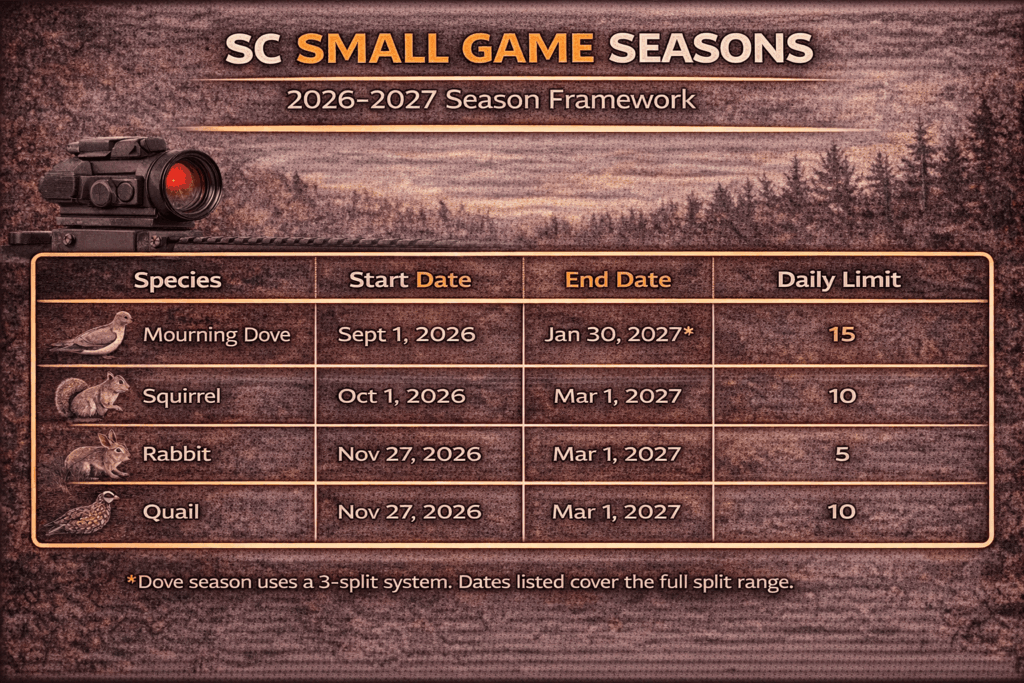
| Species | Season Type | Start Date | End Date | Daily Bag Limit | Key Notes |
|---|---|---|---|---|---|
| Mourning Dove | Split 1 | Sep 1, 2026 | Oct 3, 2026 | 15 | Migratory Bird Permit required |
| Mourning Dove | Split 2 | Nov 14, 2026 | Nov 28, 2026 | 15 | Migratory Bird Permit required |
| Mourning Dove | Split 3 | Dec 21, 2026 | Jan 30, 2027 | 15 | Migratory Bird Permit required |
| Squirrel | Regular Season | Oct 1, 2026 | Mar 1, 2027 | 10 | Longest season; rifles/shotguns permitted |
| Rabbit | Regular Season | Nov 27, 2026 | Mar 1, 2027 | 5 | Dogs permitted on most WMAs |
| Quail | Regular Season | Nov 27, 2026 | Mar 1, 2027 | 10 | Wild populations limited; preserve hunting popular |
License requirements before you head out:
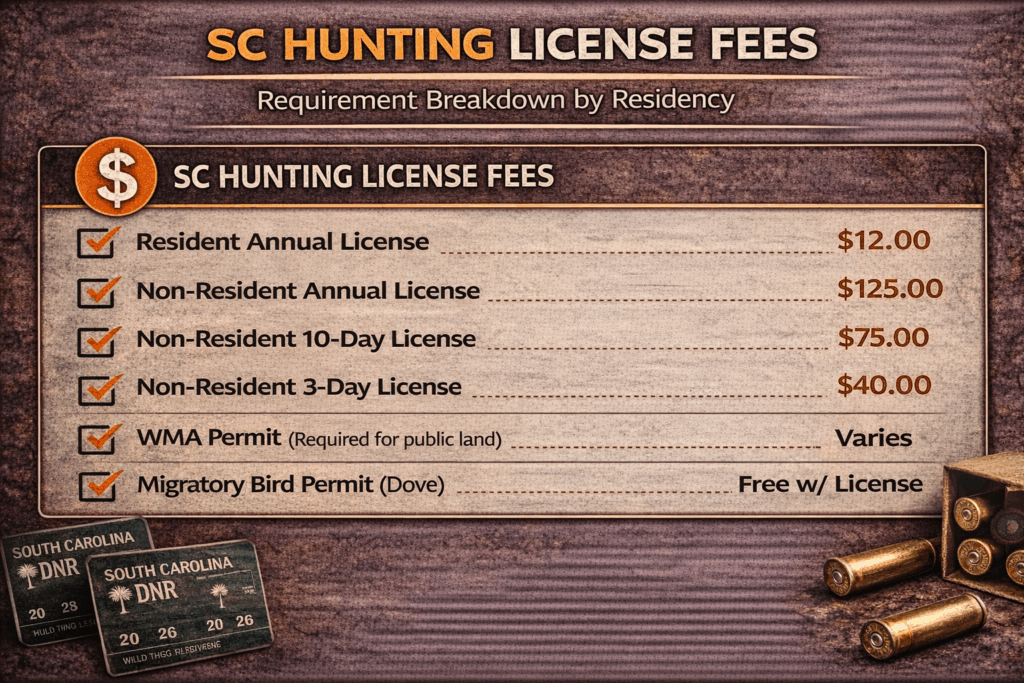
- Hunting License: Everyone 16+ needs one; residents pay $12/year, non-residents pay $125/year (or $75 for 10-day, $40 for 3-day)
- WMA Permit: Required for Wildlife Management Areas; additional fee beyond your hunting license
- Migratory Bird Permit: Required for dove hunting; includes HIP registration, usually no extra cost
- Hunter Education: Mandatory if you were born after June 30, 1979—complete an approved course before buying your license
- Where to Buy: Go Outdoors SC app, gooutdoorssouthcarolina.com, or sporting goods stores
Mourning Dove Hunting Seasons
Dove hunting is South Carolina’s small game bread and butter. Thousands of hunters hit agricultural fields and managed dove areas across all four game zones, and the three-split system gives you multiple chances to fill your limit. Unlike other small game, doves need that Migratory Bird Permit on top of your regular license—check our South Carolina migratory bird hunting guide for the permit details.
Split 1: September 1 – October 3, 2026
Opening split hits when resident birds mix with early migrants. That 15-bird daily limit becomes very achievable if you find productive fields. Weather’s still warm, so afternoon shoots work best—doves feed heavily before roosting.
SCDNR’s public dove fields peak during this split but get hammered with pressure. Show up early for decent spots, and weekday hunts beat weekend crowds every time.
Split 2: November 14 – November 28, 2026
Two weeks of cooler weather hunting with birds shifting to different food sources. Harvested grain fields and food plots unavailable during split one become productive. This overlaps with deer season and other small game, making it perfect for combo trips. Just remember the increased orange requirements and higher hunting pressure on public land.
Split 3: December 21, 2026 – January 30, 2027
The longest split runs through holidays into late January, keeping that 15-bird limit throughout. Cold weather concentrates birds around reliable food sources. Most hunters ignore this split while chasing deer and ducks, which means less pressure on public dove fields and better opportunities for hunters who show up.
Squirrel Hunting Season
Five full months of squirrel hunting from October 1, 2026 through March 1, 2027. That’s South Carolina’s longest small game season with a generous 10-squirrel daily bag limit. You’ll hunt through dramatic changes—thick October foliage that hides everything to bare winter branches where spotting becomes easy but requires different tactics.
Regular Season: October 1, 2026 – March 1, 2027
Early October demands patience and sharp eyes with full foliage providing cover. As leaves drop through November and December, spotting gets easier but squirrels adapt their patterns. Both .22 rifles and shotguns work well, though many hunters prefer rifles for precision and less meat damage.
Traditional dog hunting remains popular and legal on most WMAs—a Southern hunting method that’s been passed down for generations. Prime habitat means mature hardwood forests with oak, hickory, and beech trees. Francis Marion National Forest’s 636,681 acres and Sumter National Forest’s mountain and piedmont regions offer exactly that.
Small game hunting builds fundamental skills like tracking, calling, stalking, and marksmanship—making squirrel season perfect for new hunters developing their abilities.
Rabbit Hunting Season
Rabbit season opens November 27, 2026 and runs through March 1, 2027, with a 5-rabbit daily limit. Perfect timing with quail season and significant overlap with late deer season for multi-species hunting trips.
Regular Season: November 27, 2026 – March 1, 2027
Late November opener brings comfortable hunting weather when rabbits actively move for food sources. That conservative 5-rabbit limit reflects the species’ ecosystem importance and ensures sustainable harvest.
Traditional beagle hunting involves dogs pushing rabbits in wide circles back to waiting hunters—social hunting that builds camaraderie and teaches patience. Without dogs, still-hunting works great around brushy field edges, briar patches, overgrown fencerows, and early successional areas where rabbits find food and cover.
Many WMAs actively manage rabbit habitat through controlled burns, timber cuts, and food plots that create the thick, low cover rabbits need.
Quail Hunting Season
Quail season runs November 27, 2026 through March 1, 2027, with a 10-bird daily limit. Here’s the reality: wild quail populations in South Carolina have crashed over recent decades, making wild bird hunting tough on public lands.
Regular Season: November 27, 2026 – March 1, 2027
Season dates and bag limits apply to wild birds, but most South Carolina hunters pursue quail at licensed shooting preserves with released birds. Preserve hunting offers reliable action and excellent introduction to bird hunting with pointing dogs, teaching gun handling, shot placement, and dog work fundamentals.
For wild bird hunting, you need private lands with intensive habitat management—young pine plantations with controlled burns, native grass plantings, and brush management creating the open understory quail require.
The overlap with rabbit season works perfectly since habitat management benefiting quail often supports rabbit populations too.
South Carolina Small Game Licenses and Permits
License requirements vary by residency, age, and target species. All licenses are available through the Go Outdoors SC app or gooutdoorssouthcarolina.com for immediate access.
South Carolina Hunting Licenses
Everyone 16+ needs a hunting license, with type and cost depending on residency status. South Carolina offers options for residents and visiting hunters with different trip lengths and budgets.
| License Type | Residency | Duration | Cost | Best For |
|---|---|---|---|---|
| Annual Hunting License | Resident | 1 year | $12.00 | SC residents hunting throughout the season |
| Annual Hunting License | Non-Resident | 1 year | $125.00 | Out-of-state hunters making multiple trips |
| 10-Day Hunting License | Non-Resident | 10 consecutive days | $75.00 | Non-residents planning an extended trip |
| 3-Day Hunting License | Non-Resident | 3 consecutive days | $40.00 | Non-residents on a quick weekend hunt |
Non-residents hunting WMA lands should budget $165-$200 total, depending on license duration and WMA permit fees. That investment gets you access to over 1 million acres of public hunting land across diverse ecosystems.
Born after June 30, 1979? You need hunter education before buying any hunting license. South Carolina accepts in-person and online courses—check SCDNR’s website for approved options and schedules.
South Carolina Hunting Permits
Beyond your basic license, certain activities need additional permits. For small game hunters, the big one is the WMA permit for Wildlife Management Areas.
WMA permits are required beyond your hunting license for any Wildlife Management Area hunting. This permit provides access to over 1 million acres of public land managed specifically for wildlife habitat and hunting opportunities. Fees vary but represent excellent value considering the acreage and habitat management provided.
Dove hunters need a Migratory Bird Permit with HIP registration. Usually issued at no extra cost with your hunting license, but legally required for all migratory bird hunting. The HIP survey helps biologists track harvest data and manage populations across flyways.
Waterfowl hunters need additional stamps ($15.50 State Duck Stamp plus $30 Federal Duck Stamp), but these don’t apply to the small game species covered here.
All permits available through Go Outdoors SC app or gooutdoorssouthcarolina.com, plus some sporting goods stores. Unlike big game tags requiring applications and drawings, small game licenses and permits are over-the-counter—buy and hunt the same day.
Where to Hunt Small Game in South Carolina
South Carolina offers small game hunting across over 1 million acres of public land, from coastal dove fields to mountain hardwood forests perfect for squirrels. Public lands, guided hunts, or private leases—the Palmetto State has options for every hunting style and budget.
Best Public Lands
South Carolina’s public hunting lands offer excellent small game opportunities across diverse ecosystems, managed specifically for wildlife habitat and hunting access. Affordable hunting for residents and non-residents, though popular areas see heavy pressure during peak seasons.
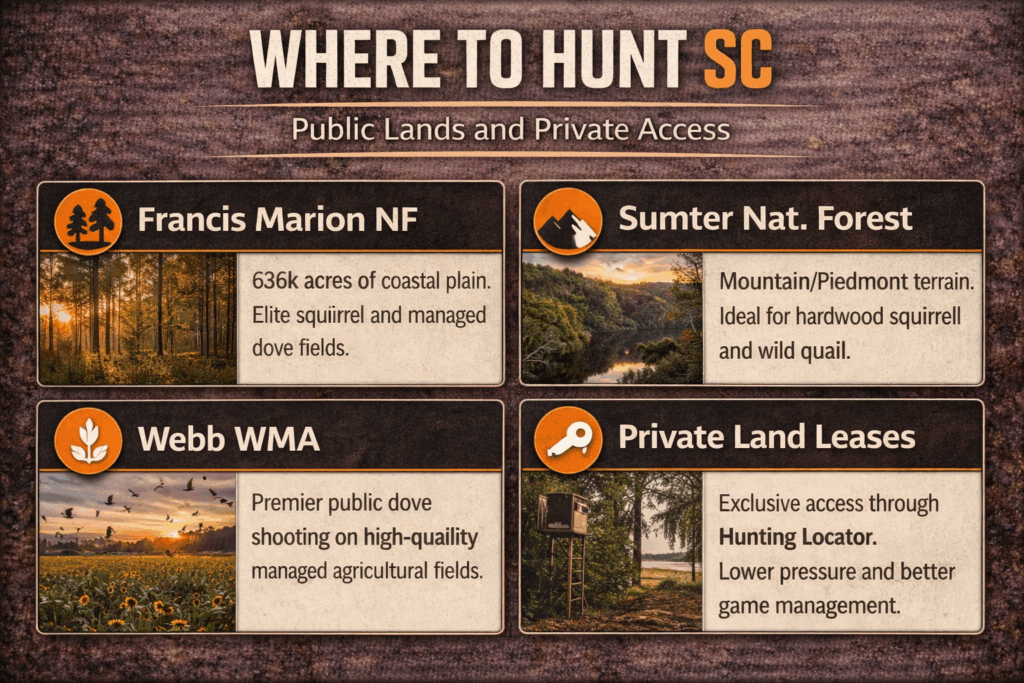
- Francis Marion National Forest – 636,681 acres of coastal plain forest with excellent squirrel hunting in mature hardwoods, managed dove fields, and rabbit habitat in early successional areas
- Sumter National Forest – Mountain and piedmont regions providing diverse habitat from oak-hickory ridges for squirrels to managed openings attracting dove and quail
- Santee National Wildlife Refuge – Managed dove fields and excellent squirrel hunting in bottomland hardwoods, with less pressure due to specific hunt dates and regulations
- Webb Wildlife Management Area – Known for excellent dove shooting on managed fields, plus quality squirrel hunting in mixed pine-hardwood stands
- Pee Dee Station WMA – Diverse small game opportunities including managed dove fields, rabbit habitat in early successional areas, and squirrel hunting in mature timber
Guided Hunts
Professional outfitters provide valuable services for hunters unfamiliar with South Carolina terrain, those without private land access, or hunters wanting to maximize success on limited time. Guided small game hunts typically focus on dove hunting over managed fields or preserve-style quail hunting with trained pointing dogs.
Most guided dove hunts operate on private agricultural lands with planted food plots designed to attract birds. These operations provide blinds, decoys, and local knowledge of flight patterns that dramatically improve success rates, especially for non-resident hunters unfamiliar with the area.
Quail hunting guides typically run preserve-style hunts with released birds and trained pointing dogs, offering excellent introduction to upland bird hunting techniques. These guided experiences teach proper gun handling, shot placement, and dog work while providing reliable action for all skill levels.
Private Land Hunting
Private land hunting offers reduced pressure, better game management, and often higher success rates compared to public lands. South Carolina hunters access private lands through day-use fees, seasonal leases, or land purchases, with lease hunting becoming increasingly popular as public land pressure grows.
Leasing private land provides exclusive or semi-exclusive access to properties managed specifically for wildlife habitat. Lease agreements typically run annually and may include multiple species hunting rights, camping privileges, and habitat improvement opportunities. Quality leases often feature food plots, timber management, and water sources designed to concentrate game.
For hunters considering long-term private land access, purchasing hunting property represents the ultimate investment in hunting opportunity. Rural land prices vary significantly across South Carolina’s regions, from coastal plain agricultural areas to mountain forest properties, each offering different small game hunting characteristics.
Hunting Locator serves as your comprehensive platform for connecting with landowners throughout South Carolina offering hunting leases and land sales. Our database includes detailed property information, habitat descriptions, species availability, and direct contact with verified landowners, streamlining the process of securing quality private hunting access. Whether you’re seeking a weekend dove lease or multi-species property for the entire season, Hunting Locator’s South Carolina listings provide the private land access that transforms good hunting into exceptional experiences.
Small Game Hunting Tips
Success in South Carolina’s small game hunting requires understanding each species’ behavior, habitat preferences, and effective hunting techniques. These proven strategies help you make the most of your time afield, whether targeting opening day doves or late-season squirrels.
- Scout Before Season – Visit potential hunting areas during off-season to identify game signs, food sources, and travel patterns. Look for dove feeding areas in agricultural fields, squirrel nests in hardwood trees, and rabbit runs along field edges.
- Time Your Hunts – Most small game species are most active during early morning and late afternoon feeding periods. Plan hunts around these peak activity times for best success rates.
- Master Camouflage – Small game animals have excellent eyesight and spook easily from movement. Use natural cover, wear appropriate camouflage, and minimize unnecessary movement while hunting.
- Learn to Call – Squirrel calls, rabbit distress calls, and dove decoys can significantly improve success. Practice calling techniques before season and use sparingly to avoid overcalling.
- Choose Right Equipment – Match firearm and ammunition to species. .22 rifle works excellently for squirrels, while 20 or 12-gauge shotgun is ideal for dove, rabbit, and quail hunting.
- Study Weather Patterns – Weather significantly affects small game behavior. Overcast days often provide better hunting than bright, sunny conditions, and animals are more active before weather fronts move through.
- Practice Shooting Skills – Small game presents challenging shots, often at moving targets. Regular practice at the range with realistic scenarios improves field success and ensures clean, ethical shots.
More Resources from Hunting Locator
Expand your South Carolina hunting knowledge with these comprehensive guides and resources from Hunting Locator, designed to help you make the most of the Palmetto State’s hunting seasons.
- South Carolina Hunting Season Overview – Complete guide to all hunting seasons, including dates, regulations, and planning tips for multi-species trips
- SC Deer Hunting Guide – Detailed coverage of South Carolina’s premier big game hunting, including archery, rifle, and muzzleloader seasons across all game zones
- South Carolina Turkey Season – Everything about spring and fall turkey hunting, from calling techniques to the best WMAs for gobblers
- South Carolina Waterfowl Hunting – Complete guide to duck and goose hunting seasons, including coastal marshes, inland impoundments, and licensing requirements
- South Carolina Hog Hunting – Year-round hunting opportunities for wild hogs, including public land options and private lease recommendations
- South Carolina Hunting Land Leases – Browse available hunting leases across the state, with detailed property information and direct landowner contact
FAQ
When do South Carolina small game seasons open in 2026?
Mourning dove season opens first on September 1, 2026, followed by squirrel season on October 1, 2026. Rabbit and quail seasons both open November 27, 2026. Each species has different season lengths, with squirrel offering the longest season running through March 1, 2027.
Do I need a special permit to hunt doves in South Carolina?
Yes, dove hunting requires a Migratory Bird Permit beyond your regular hunting license. This permit includes HIP registration and is typically issued at no additional cost when you purchase your hunting license. All migratory bird hunters must complete the HIP survey to help wildlife biologists track harvest data.
What’s the difference between resident and non-resident hunting license costs?
Residents pay $12 for annual hunting licenses, while non-residents have three options: $125 annual, $75 for 10-day, or $40 for 3-day licenses. Non-residents also need WMA permits to hunt public lands, making total cost approximately $165-$200 depending on license duration.
Can I hunt small game on private land without a WMA permit?
Yes, WMA permits are only required for Wildlife Management Areas and other designated public hunting lands. Private land hunting with landowner permission only requires a valid South Carolina hunting license and species-specific permits (like Migratory Bird Permit for doves).
Are there hunter education requirements for small game hunting?
Anyone born after June 30, 1979 must complete a state-approved hunter education course before purchasing a hunting license in South Carolina. This applies to residents and non-residents. The course covers wildlife management, conservation, firearms safety, hunting ethics, and regulations.
What are the bag limits for each small game species?
Daily bag limits: mourning dove (15), squirrel (10), rabbit (5), and quail (10). These limits apply statewide and remain consistent throughout each species’ respective seasons. Possession limits may differ from daily bag limits, so check current regulations for complete details.
The Final Shot
South Carolina’s 2026 small game seasons offer something for every hunter—from opening day dove shoots to quiet late-season squirrel hunting in winter hardwoods. With proper planning using this guide’s season dates, licensing information, and hunting location recommendations, you’re equipped to make the most of every opportunity the Palmetto State provides.
Small game hunting success comes down to understanding that each species requires different approaches, timing, and locations. Whether you’re working public WMAs, exploring private leases, or booking guided hunts, the foundation remains the same: respect for the resource, adherence to regulations, and appreciation for South Carolina’s rich hunting heritage.
Ready to secure private hunting access for the 2026 season? Explore South Carolina hunting leases and connect directly with landowners offering quality small game hunting opportunities across the state. Your best hunting season yet is just a lease agreement away.


