Whether you’re a resident confirming this year’s dates, a non-resident mapping out a trip, or a first-timer trying to do things by the book, our trusted hunting companion is built to handle the planning so you can focus on the hunting.
Here’s what’s covered:
- Season dates & bag limits — every 2026 method-season broken down, plus the 2-antlered-deer rule explained.
- Licenses, permits & education — resident and non-resident costs, plus what beginners need before heading into the woods.
- Where to hunt — public WMAs and private leases, including how to find quality Tennessee ground through Hunting Locator.
Start with the quick-reference version below for dates, costs, and rules at a glance.
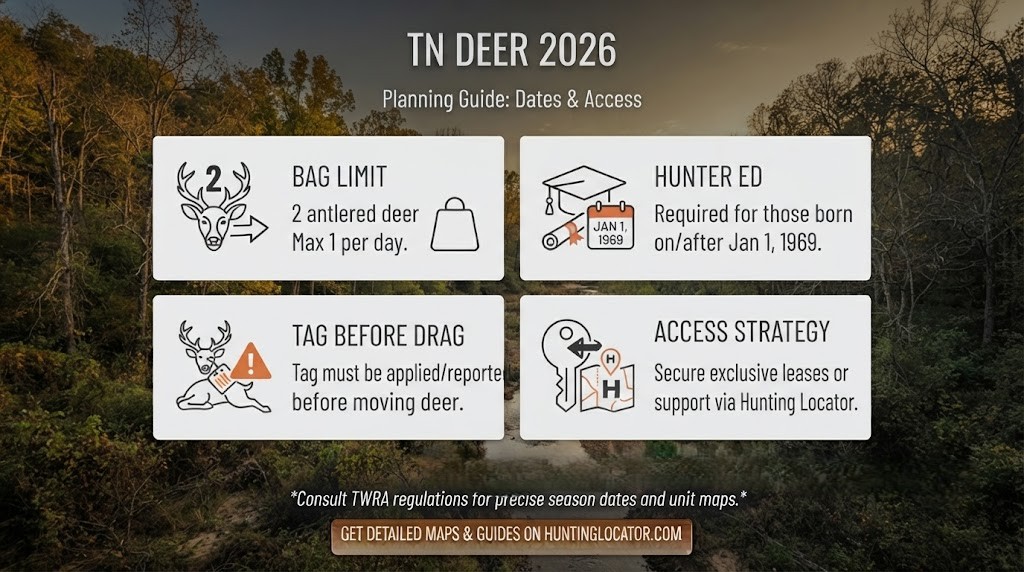
Quick Overview: Tennessee Deer Season 2026 at a Glance
The table covers every 2026 Tennessee deer season by hunting method; the list below it covers licensing basics. Doe limits vary by Deer Management Unit (DMU), which we break down later in this guide.
| Season Type | Start Date | End Date | Bag Limit / Notes |
|---|---|---|---|
| Archery | Sept. 26, 2026 | Oct. 30, 2026 | 2 antlered total, max 1/day* |
| Young Sportsman | Oct. 31, 2026 | Nov. 1, 2026 | Youth ages 6–16, adult required |
| Muzzleloader/Archery | Nov 7, 2026 | Nov 20, 2026 | 2 antlered total, max 1/day |
| Gun/Muzzleloader/Archery | Nov 21, 2026 | Jan 3, 2027 | 2 antlered total, max 1/day |
Season dates can vary by Deer Management Unit — always verify with TWRA before you hunt.
Beyond the dates, you’ll need the right paperwork before heading afield:
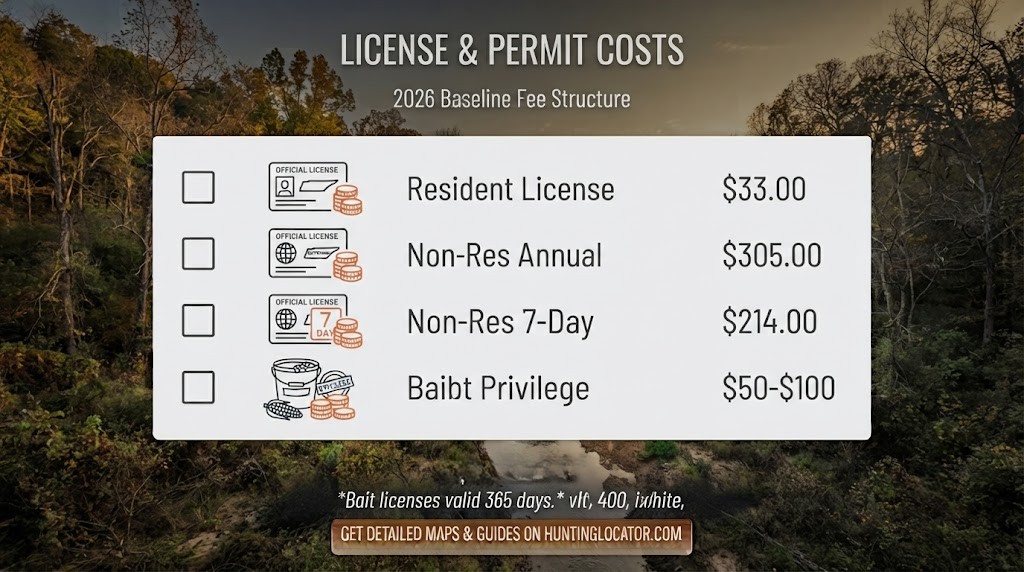
- Resident All Game License — $33 (includes big game).
- Non-Resident Annual All Game — $305; Non-Resident 7-Day All Game — $214.
- Deer Bait Privilege License — $50 residents / $100 non-residents (valid 365 days).
- Hunter Education — required for anyone born on or after January 1, 1969.
- Bag Limit — 2 antlered deer, no more than 1 per day.
For a broader look at everything Tennessee has in season this year, see our full Tennessee hunting season guide. If securing ground is on your list, start browsing Tennessee hunting leases now rather than in August.
Tennessee Deer Hunting Seasons
Tennessee’s whitetail season is structured around four method-based segments rather than one blanket date range. How these line up against the rut — which typically peaks in mid-November — matters when you’re deciding when to burn vacation days. Tennessee sits in the heart of the whitetail belt, and areas like the Caney Fork River bottomlands in Smith County are known for holding mature bucks that only show themselves once the rut kicks in.
For unit-specific regulations and harvest data, our detailed Tennessee deer season breakdown covers ground this overview doesn’t.

Archery Season (Sept. 26 – Oct. 30, 2026)
Archery season is both the official opener and the longest early-season window on the calendar. This bow-only stretch is good for patterning deer before gun pressure changes their movement. Early mornings and evenings near food sources tend to produce the most consistent action before the woods get busy.
Young Sportsman Hunt (Oct. 31 – Nov. 1, 2026)
This two-day season is reserved for hunters ages 6–16 and requires a non-hunting adult (21 or older) to accompany them in the field. It’s an entry point for new hunters — no prior experience required, just a willing mentor.
Muzzleloader/Archery Season (Nov. 7 – Nov. 20, 2026)
This season lands in the pre-rut buildup, when buck movement starts to increase. TWRA rules also allow single-shot rifles using straight-walled cartridge ammunition (.35 caliber or larger) on private land only during Nov. 14–20, 2026, adding a legal option during that window.
Gun/Muzzleloader/Archery Season (Nov. 21, 2026 – Jan. 3, 2027)
This is the longest, highest-opportunity segment of the year. Gun, muzzleloader, and archery are all legal throughout this stretch, and it covers peak rut activity into the late season. For a non-resident planning one trip to Tennessee, this window offers the most flexibility and the best odds.
Tennessee Deer Licenses and Permits
Before you can legally hunt any of the seasons above, you need the right license in hand. Here’s what residents and non-residents will pay in 2026, and what else is required beyond the basic license.
Tennessee Hunting Licenses
| License / Permit | Resident | Non-Resident |
|---|---|---|
| Annual All Game (includes big game) | $33 | $305 |
| 7-Day All Game | — | $214 |
| Deer Bait Privilege License (valid 365 days) | $50 | $100 |
For non-residents planning a shorter trip, the 7-Day All Game license at $214 fits a focused, week-long hunt, while the $305 annual option makes more sense for multiple trips or an extended stay. Our non-resident license cost breakdown walks through this comparison in more detail.
A Social Security Number is required to purchase a license under federal law, so have that ready. If you’re planning to hunt a Wildlife Management Area, you’ll likely need an additional non-quota big-game permit on top of your base license. License costs and requirements can shift year to year, so it’s worth confirming details at the point of purchase.
Tennessee Hunting Permits & Requirements
A handful of permits and requirements apply depending on how and where you plan to hunt:
- Hunter Education — required for anyone born on or after January 1, 1969; a one-year exemption lets you hunt while completing the course.
- Deer Bait Privilege License — available July 22, 2026 on GoOutdoorsTennessee.com; limited to corn, wheat, and grains that must be scattered, and valid on private land only — not on WMAs or in CWD-positive counties.
- WMA Non-Quota Big-Game Permit — needed for many WMA big-game seasons; some specific hunts operate on a quota-draw system requiring a separate application.
- Tag Before You Drag — every deer must be tagged before you drag it, physically or via smartphone, before midnight on the day it’s taken, with E-check reporting handled through Go Outdoors TN.
- DMU Doe Limits — DMUs 1–3 allow up to 3 does per day, while DMUs 4–6 allow 2 for the season (4 for archery-only hunters). All units share the same 2-buck limit statewide.
All licenses and permits are purchased through GoOutdoorsTennessee.com. If you’re new to the process: complete hunter education first, buy your license, add any permits you need, then confirm the tagging requirement before your first hunt.
Where to Hunt Deer in Tennessee
Knowing the dates and having the right paperwork covers half the equation — the other half is where you’re actually going to hunt. Tennessee hunters generally have three options: public Wildlife Management Areas, private land leases, and guided hunts. Each has its trade-offs.
Best Public Lands (WMAs)
Tennessee manages a large public WMA system, and deer hunting is permitted across most of these properties. Public land access is a real option, but it comes with realities worth knowing before you commit your season to it.
- WMA access basics — most WMA deer hunts require a non-quota big-game permit, while some higher-demand hunts operate on a quota-draw system requiring a separate application.
- Pressure reality — the most popular public WMAs see heavy hunting pressure, especially during gun season, so don’t expect solitude on opening weekend.
- Scouting matters — success on public ground comes down to setting up near food sources, travel corridors, and bedding areas, with wind direction factored into every decision.

Private Land Hunting with Hunting Locator
Public land pressure is exactly why many hunters look to private ground for a more consistent, controlled season. Losing access to a lease — or never finding one in the first place — is one of the most common frustrations we hear from hunters, and it’s a big part of why our platform exists.
Hunting Locator connects hunters with private land throughout Tennessee. The platform features vetted properties from small parcels to large ranches, with direct landowner contact and transparent pricing. Whether you’re looking to lease ground for this season or explore purchasing land for long-term access, both paths are available through the same search.
Leasing gives you seasonal flexibility without a long-term commitment; buying builds equity in a property you can manage and improve over years of hunting. Either way, the process starts with knowing what’s actually available — connecting directly with Tennessee landowners who are ready to lease or sell, without the guesswork or cold calls. Search by acreage, game type, and location, and reach out directly — no middleman, no bidding wars.
Browse Tennessee deer hunting leases and lock down your spot before the September 26 opener.
Guided Hunts
For some hunters — especially non-residents unfamiliar with Tennessee terrain, or first-timers who want mentorship — a guided hunt can be the right call.
- When a guided hunt makes sense — if you’re traveling from out of state and don’t know the ground, or you’re new to hunting and want an experienced set of eyes alongside you, a guide can shorten the learning curve.
- Guided vs. lease trade-off — a guided hunt offers turnkey support (scouting, stands, sometimes lodging), while a lease gives you freedom, privacy, and value across multiple seasons rather than one hunt.
- Do your due diligence — before booking, confirm the outfitter’s licensing and ask what’s included — lodging, stand access, meals — so there are no surprises on arrival.
Tennessee Deer Hunting Tips
Timing and positioning matter as much as marksmanship, especially once the rut lines up with the gun opener. Here’s what separates a productive season from a frustrating one.
- Hunt the rut — the rut typically peaks in mid-November, overlapping the Nov. 21 gun opener, so plan to be in the woods during this stretch if you want the best odds at a mature buck.
- Play the wind — deer rely heavily on their sense of smell, so wind direction should influence every stand and blind placement.
- Time your sits — deer are most active at dawn and dusk, particularly once cooler fall temperatures set in, so plan your longest sits around those windows.
- Scout smart — set up near food sources, travel corridors, and bedding areas, and use trail cameras ahead of the season to pattern deer before you draw back or pull the trigger.
- Stay safe & seen — Tennessee requires 500 square inches of hunter orange on your head and chest during any gun or muzzleloader season, and a fall-restraint harness is essential if you’re hunting from an elevated stand.
- Gear up right — quality optics, trail cameras, stands, blinds, and safety harnesses all affect how your season plays out.
If your setup is missing anything, you can gear up at our store and get equipment sorted before opening day.
More Resources from Hunting Locator
Deer season isn’t the only hunt worth planning for in Tennessee this year. If you’re chasing more than one species, here’s where to look next.
- Hunting Locator homepage — search leases, gear, and guides by state and species, all in one place.
- Tennessee hunting season guide — the complete statewide season overview across every major game species.
- Tennessee deer season deep-dive — extended detail on deer regulations, units, and harvest reporting.
- Hunting Locator store — gear for every season and species, from optics to tree stands.
Planning to hunt other Tennessee species this year? These guides break down the details:
- Tennessee turkey season — spring and fall turkey dates and bag limits.
- Tennessee waterfowl season — duck and goose season planning.
- Tennessee black bear season — bear hunting zones and dates.
- Tennessee elk season — details on the state’s limited elk hunt.
- Tennessee small game season — rabbit, squirrel, and other small game dates.
- Tennessee furbearer season — trapping and furbearer season details.
- Tennessee game bird season — quail, grouse, and upland bird hunting.
Frequently Asked Questions
When does Tennessee deer season open in 2026?
Archery season opens Sept. 26, 2026, and runs through Oct. 30. Gun/muzzleloader/archery season — the longest and most flexible segment — runs Nov. 21, 2026, through Jan. 3, 2027. Exact dates can vary slightly by Deer Management Unit, so confirm with TWRA before you head out.
What is the Tennessee deer bag limit for 2026?
Statewide, hunters can take 2 antlered deer, with no more than 1 per day. Doe limits vary by DMU — units 1–3 allow up to 3 does per day, while units 4–6 allow 2 for the entire season (4 for archery-only hunters).
How much is a Tennessee hunting license in 2026?
Residents pay $33 for an Annual All Game license, which includes big game. Non-residents pay $305 for the Annual All Game license or $214 for a 7-Day All Game license. The Deer Bait Privilege License runs $50 for residents and $100 for non-residents.
Do I need hunter education to hunt deer in Tennessee?
Yes — anyone born on or after January 1, 1969, must carry proof of completed hunter education while hunting. If you haven’t finished the course yet, a one-year exemption lets you hunt legally while you complete the requirement.
Where can I find private land to hunt deer in Tennessee?
Hunting Locator’s Tennessee deer hunting leases page features vetted private properties across the state, with direct landowner contact and transparent pricing — no bidding wars or middlemen involved.
Is deer baiting legal in Tennessee for 2026?
Yes, on private land only, and only with a Deer Bait Privilege License available starting July 22, 2026, through GoOutdoorsTennessee.com. Bait is limited to corn, wheat, and grains that must be scattered, and baiting is not allowed on WMAs or in CWD-positive counties.
The Final Shot
The 2026 Tennessee deer season offers a full slate of opportunity: archery opens Sept. 26, gun season carries you from Nov. 21 into the new year, and the bag limit sits at 2 antlered deer for the entire season. Residents can get licensed for $33, while non-residents choose between the $305 annual or the $214 week-long option depending on how the trip shapes up. The rules and dates are set — the remaining variable is where you’ll be standing when the woods go quiet at first light.
From here, it comes down to three things: renew or buy your license, confirm your specific DMU rules with TWRA, and lock in your hunting ground before competition for good land picks up. Hunting Locator connects you directly with landowners across Tennessee who are ready to lease or sell.
You’ve got the dates, the costs, and the regulations. Now start planning your season and turn this guide into an actual plan on the ground.


