As Outdoor Life notes, quality bow cases shield your equipment “from the elements, pets, kids, airline baggage handlers, bumpy rides, and pretty much any other hazard you can and can’t think of.” Modern compound bows cost $1,500-$3,000+, plus your trip investment in tags, travel, lodging, and outfitter fees. A damaged bow doesn’t just cost money—it costs the hunt itself.
Here’s what you’ll learn:
- Hard vs. soft case fundamentals and when each makes sense
- Essential features for airline travel vs. truck transport
- Price tier recommendations from budget-friendly to premium
Let’s start with the fundamental choice every traveling bowhunter faces.
Understanding Your Options: Hard Cases vs. Soft Bow Cases
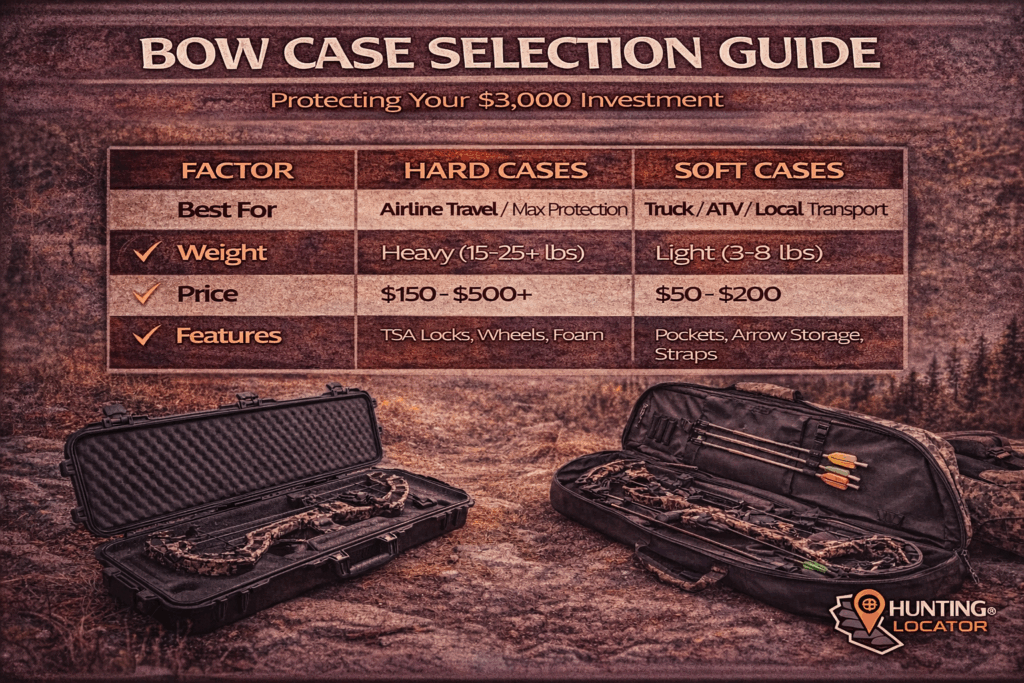
The core trade-off is straightforward: Outdoor Life explains that “hard cases offer more protection against hard knocks, but they’re bulky and cumbersome to carry. Soft cases are portable and easy to maneuver inside a vehicle with other gear, but lack the extra protection of hard cases.”
Hard cases feature rigid exteriors (typically high-impact plastic) with foam interiors, designed for maximum protection against severe impacts. Soft cases use padded fabric construction, prioritizing lighter weight and often including exterior pockets for accessories. Hybrid cases combine rigid panels with soft exteriors, offering a middle-ground approach.
Match your choice to your hunting style:
- Flying to Colorado for elk? You need airline-grade hard case protection.
- Driving to your lease every weekend? A quality soft case offers convenience without overkill.
- Mix of both? Consider a hybrid or invest in both types.
For hunters who fly to their destinations, hard cases aren’t optional—they’re essential.
Hard Bow Cases: Maximum Protection for Air Travel
Airline baggage handlers aren’t known for gentle treatment. A hard-sided case is your bow’s best defense against the realities of checked luggage. Even with their superior protection, Outdoor Life notes that “even though airline-grade cases have interior padding, it’s inadequate [alone], and stuffing clothes around cams and sights will further protect your gear from rough handling.”
Essential Features for Airline Travel
When selecting a hard case for air travel, prioritize these critical features:
- TSA-Approved Locks: Divebomb Industries emphasizes that “TSA-approved locks should be used for your bow case, as non-TSA locks may lead to delays and inspections by TSA officials.”
- Pressure Equalization Valves: These automatic purge valves prevent pressure buildup during altitude changes—a must-have feature that Gear Junkie confirms comes standard on quality airline cases.
- Wheels: Archery 360 warns that “most airline-travel bow cases have built-in wheels, but double-check before ordering, and avoid those that don’t.” Navigating airports without wheels is miserable.
- Foam Interior: Look for high-density pluck foam that allows custom fitting. Outdoor Life explains that quality “cases feature high-density pluck to fit foam, allowing you to custom-fit your specific bow for ultra protection.”
- Airline Dimension Compliance: Outdoor Life notes that “bags are considered oversize if they measure over 62 linear inches (combined length, width, and depth), and most bows fit inside cases that don’t exceed that limit.”
Trusted Hard Case Brands
Pelican has earned its reputation as the premium choice. Archery Talk confirms that “Pelican has been the industry leader in building cases to protect delicate electronic gear” and built their bow case line with the same durability standards.
SKB brings decades of experience to the market. Archery Talk notes that “SKB has been making cases since 1977.” Their standout benefit: Archery Talk reports that “SKB offers $1,500 contents damage insurance with their cases”—significant value for expensive setups.
Plano offers popular mid-range options spanning multiple price points. However, some users report durability concerns: Outdoor Life mentions that “Velcro straps on a Plano case stopped working after 2 years.”
Price Tiers: What to Expect
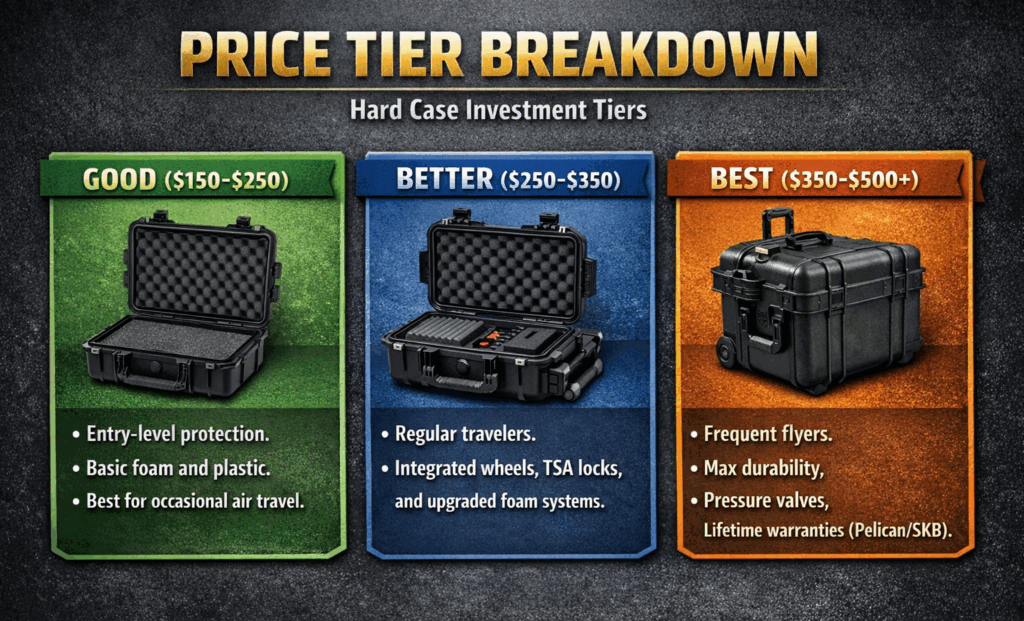
Quality hard cases follow a clear pricing structure:
| Price Tier | Range | Features | Best For |
|---|---|---|---|
| Good | $150-$250 | Entry-level protection, basic foam, may lack premium features | Occasional air travel |
| Better | $250-$350 | Better foam systems, integrated wheels, TSA locks | Regular travelers |
| Best | $350-$500+ | Maximum durability, customizable foam, pressure valves, warranties | Frequent flyers, premium setups |
Field & Stream confirms that “most quality, airline-ready hard cases will wear price tags over $300.” Remember Outdoor Life’s perspective: “Keep in mind, whatever you spend on a case is likely to pale in comparison to what you’ve invested in the contents it’s carrying.”
Ready to find the right hard case for your setup? Browse our complete selection of bow and crossbow cases to compare options, dimensions, and features for your specific bow.
Soft Bow Cases: Practical Protection for Road Warriors
Not every hunt requires airline-grade protection. If you’re driving to your hunting spots—whether that’s a 30-minute trip to your lease or a weekend road trip across state lines—a quality soft case offers the right balance of protection and convenience.
When Soft Cases Make Sense
Soft cases excel in specific scenarios:
- Regular trips to local hunting spots via truck
- ATV/UTV transport to remote areas where weight matters
- Hunters who need quick access and easy carry
- Budget-conscious hunters who don’t fly with their bow
Archery Talk confirms this logic: “If you only drive with your bow from home to your hunting spot, you don’t need a case suited for airline travel.”
Key Features for Soft Cases
When evaluating soft cases, prioritize these features:
- Padding Quality: Look for reinforced padding in high-impact areas (cams, limbs, sight). Outdoor Life notes that “soft cases meet most archers’ needs as they’re lighter than hard cases, protect your bow from nicks and dings, and help organize your gear.”
- Arrow Storage: Many soft cases include built-in arrow compartments—a convenience hard cases often lack.
- Exterior Pockets: Organization for releases, rangefinders, and archery accessories adds practical value.
- Carry Options: Shoulder straps, backpack straps, or handles affect how you’ll transport the case from truck to stand.
- Weather Resistance: Water-resistant materials protect against rain and snow during transport.
Price Expectations for Soft Cases
Outdoor Life explains that “bow cases usually cost anywhere from $50 to several hundred dollars, depending on the material used and added features.” Soft cases typically fall in the $50-$150 range for quality options.
For hunters who don’t fly, investing $75-$125 in a quality soft case often makes more sense than $300+ on a hard case they’ll rarely need.
Whether you need a lightweight soft case for truck transport or a rugged option for ATV access, explore our bow and crossbow cases to find the right fit for how you hunt.
Hard vs. Soft: Quick Comparison
| Factor | Hard Cases | Soft Cases |
|---|---|---|
| Best For | Airline travel, maximum protection | Truck/ATV transport, convenience |
| Protection Level | Excellent—survives baggage handlers | Good—prevents nicks, dings, weather |
| Weight | Heavier (15-25+ lbs empty) | Lighter (3-8 lbs) |
| Storage | Limited pockets, foam interior | Multiple pockets, arrow compartments |
| Price Range | $150-$500+ | $50-$200 |
| Portability | Wheels help; bulky | Easy to carry; fits in vehicles |
| Airline Approved | Yes (most models) | Some rated; most are not |
Decision Framework: Choose hard if you fly even once a year—the cost of a damaged bow far exceeds the case investment. Choose soft if you exclusively drive and value convenience and organization.
Choosing the Right Case for Your Situation
Match your case selection to your hunting style with these scenario-based recommendations:
Best for the Out-of-State Trip Planner: Hard case with TSA locks, wheels, and pressure equalization. Brands: Pelican, SKB. Budget: $300-$450.
Best for the Serious Local Hunter: Quality soft case with good padding and arrow storage. Budget: $75-$150.
Best for the New Bowhunter: Start with a solid soft case in the $60-$100 range. Deer Hunting Guide advises that “beginners should prioritize essentials like padding, secure closures, and a snug fit over fancy extras.”
Best for Hunters Who Do Both: Own both types. Use soft case for regular local hunting; reserve hard case for air travel. Total investment: $400-$600 covers both needs well.
Sizing Guidance
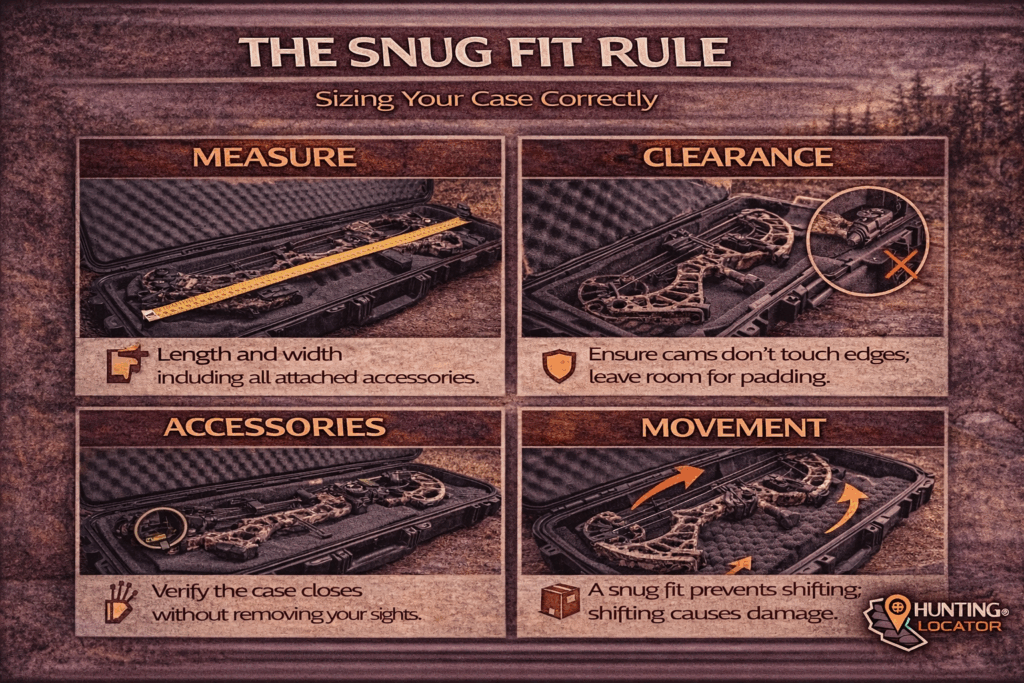
Deer Hunting Guide emphasizes that you should “measure your bow’s length and width, as a snug fit reduces movement and keeps your bow safe.” A case that’s too large allows dangerous shifting; too small won’t fit your setup with accessories attached.
Make sure your case accommodates your archery sights without requiring removal—repeatedly detaching and reattaching sights affects accuracy.
Beyond the Case: Preparing for Your Hunt
Your bow case is just the foundation of successful hunting trip preparation. Here’s your complete gear checklist:
Essential Archery Equipment
- Bow Maintenance Tools: Allen wrenches, string wax, spare nocking points
- Sight and Rest Backup: Carry backup arrow rests and sight pins
- Release Aid: Pack your primary release plus a backup bow release aid
- Stabilization: Ensure your bow stabilizers are properly secured for transport
Arrow and Broadhead Preparation
Your arrows and broadheads require special attention. Pack broadheads separately from arrows during air travel, and always carry extras. Practice with your hunting setup before departure—not at your destination.
Use archery targets to maintain your accuracy leading up to your hunt. A perfectly protected bow means nothing if you haven’t practiced with your travel setup.
More Resources from Hunting Locator
Expand your hunting preparation with these essential resources:
- Complete Archery Equipment – Browse our full selection of bows, accessories, and gear for every hunting situation
- Archery Accessories – Find releases, arm guards, quivers, and essential small gear
- Bow and Crossbow Cases – Compare hard, soft, and hybrid cases from top manufacturers
- Arrows, Points and Broadheads – Complete arrow systems for every game species
- Archery Sights – Single-pin, multi-pin, and adjustable sights for precise shot placement
FAQ
What’s the difference between TSA-approved and airline-approved bow cases?
TSA-approved refers to the locking mechanism—TSA agents can open and inspect without cutting your locks. Airline-approved means the case meets size, weight, and construction standards for checked baggage. Divebomb Industries confirms that using non-TSA locks “may lead to delays and inspections by TSA officials.”
Can I use a gun case for my bow?
While some gun cases might fit a bow, they’re not designed for archery equipment’s unique shape and delicate components. Bow-specific cases provide proper cam protection, sight clearance, and often include arrow storage that gun cases lack.
How do I know if my bow will fit in a specific case?
Deer Hunting Guide advises to “measure your bow’s length and width” before purchasing. Measure your bow at its longest and widest points with all accessories attached. Compare these measurements to the case’s internal dimensions, allowing extra space for padding.
Are soft cases really adequate for truck transport?
Yes, for vehicle transport. Outdoor Life explains that “soft cases meet most archers’ needs as they’re lighter than hard cases, protect your bow from nicks and dings, and help organize your gear.” The key is matching protection level to actual risk.
What should I do if my bow case is damaged during airline travel?
Document damage immediately with photos and file a claim with the airline before leaving the airport. Archery Talk warns that “airlines will only reimburse used equipment value and take a huge hit on your investment.” This is why quality cases and proper packing matter.
Should I remove my sight and rest before traveling?
For hard cases with proper foam fitting, accessories can typically stay attached. For soft cases or loose-fitting hard cases, removing delicate components reduces damage risk. However, repeatedly detaching and reattaching archery sights affects accuracy, so practice with your travel configuration.
The Final Shot
Your bow represents more than just equipment—it’s your connection to the hunt, your investment in pursuing the game you’re passionate about, and often the difference between success and disappointment in the field. The right case protects not just your gear, but your entire hunting experience.
Whether you choose a rugged hard case for airline adventures or a convenient soft case for local expeditions, remember that quality protection pays for itself the first time it prevents damage. Don’t let a preventable equipment failure cut short the hunt you’ve been planning all year.
Ready to gear up for your best hunting season yet? Visit our store today! We stock the best archery equipment, protective cases, and essential accessories to ensure your success in the field.


