After helping thousands of hunters find the right land and equipment for successful trips, we know that confidence in your broadhead translates directly to confidence in the field.
According to Iron Will Outfitters, “For most bowhunters, broadhead selection is a matter of personal preference based on experience, the speed of the arrow and the game being sought.”
Here’s what we’ll cover:
- The real differences between fixed, mechanical, and hybrid broadheads (and when each one shines)
- Species-specific recommendations that actually matter in the field
- How to match your broadhead to your bow setup for clean, ethical kills
Let’s cut through the marketing hype and get to what really works.
Understanding Broadhead Types: Fixed, Mechanical, and Hybrid
Walk into any archery shop and you’ll face walls of broadheads, each promising to be the ultimate hunting solution. But strip away the marketing and you’re really looking at three fundamental approaches to arrow design. As HuntWise explains, “We’ll cover three types: fixed blade, mechanical, and hybrid.”
Think of it this way: fixed blades are the reliable pickup truck of broadheads, mechanicals are the sports car, and hybrids are trying to be both. Each has earned its place in hunters’ quivers for good reasons.
Fixed Blade Broadheads
Fixed blade broadheads are beautifully simple—sharp steel blades permanently locked in place, ready to cut from the moment they leave your bow. No springs, no moving parts, no “what ifs.” According to Tooth of the Arrow, “Fixed blade is recommended to new archers because they simply work” and “Fixed blade broadheads are the best option, because they have a lower failure rate than mechanical broadheads.”
Here’s why fixed blades have survived decades of “revolutionary” new designs:
- They punch through anything – Heavy bone, thick hide, whatever’s in their path
- Zero failure rate – What you see is what you get, every single time
- Work with any bow – Whether you’re pulling 45 pounds or 75, they’ll do their job
- Battle-tested reliability – Your grandfather probably used them, and they still work
The trade-off? They’re pickier about bow tuning. HuntWise notes that “Because the blades are fixed in position, they are more likely to catch air and cause the arrow to drift away from where a field point would impact.”
If you’re shooting a lower-poundage bow, Bass Pro recommends that “bowhunters with slower shooting speeds (created by lower draw weights) should use fixed-blade broadheads of 1-1/4″ or less to improve penetration.”
Mechanical Broadheads
Mechanicals are the engineering marvels of the broadhead world. Blades fold back during flight, then snap open on impact like a deadly flower blooming in reverse. HuntWise explains that “Mechanical broadheads generally fly better than fixed blades because of their more streamlined profile” and are often advertised as “field point accurate.”
The advantages are compelling:
- Massive wound channels – We’re talking 1.5″ to 2.25″ of cutting diameter
- Fly like field points – Less bow tuning, more time hunting
- Forgiving accuracy – Great for hunters still perfecting their shot
- Blood trails you can follow in the dark – Literally
But here’s the non-negotiable requirement: HuntWise emphasizes that “This style should only be used on bows with a draw weight of fifty-five pounds or greater to ensure there is enough kinetic energy for the blades to deploy and have sufficient penetration.”
MeatEater puts it plainly: “Mechanical broadheads typically offer larger cutting diameters and fly more like field points, but this accuracy comes at a tradeoff in penetration.”
Hybrid Broadheads
Hybrids are the “why not both?” answer to the fixed vs. mechanical debate. They combine small fixed “bleeder” blades with expanding mechanical blades. Outdoor Life describes them as having “the reliability of fixed blade heads with the wide cut of mechanicals.”
What you get:
- Insurance policy – If the mechanical blades fail, the fixed blades keep working
- Bigger holes – Still get that expanded cutting diameter
- Versatile performance – One broadhead for multiple game species
- Growing fan base – More hunters are discovering their benefits each season
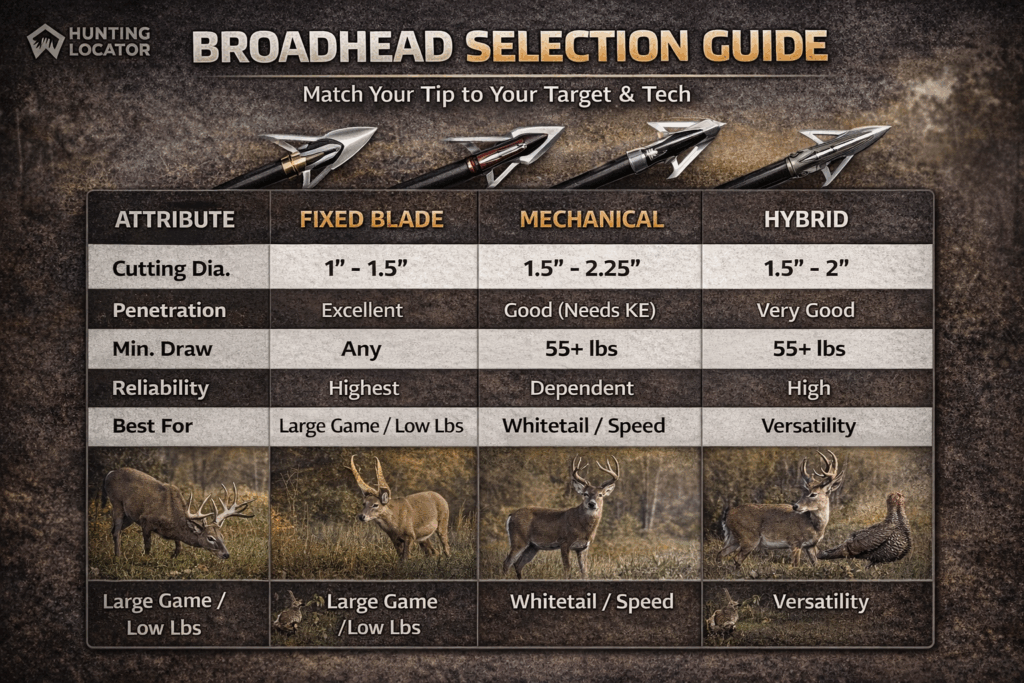
Broadhead Comparison Table
| Attribute | Fixed Blade | Mechanical | Hybrid |
|---|---|---|---|
| Cutting Diameter | 1″ – 1.5″ typical | 1.5″ – 2.25″ | 1.5″ – 2″ |
| Penetration | Excellent | Good (with adequate KE) | Very Good |
| Tuning Difficulty | Higher | Lower | Moderate |
| Minimum Draw Weight | Any | 55+ lbs recommended | 55+ lbs recommended |
| Reliability | Highest (no moving parts) | Dependent on deployment | High |
| Best For | Large game, lower-poundage bows | Whitetail, high-speed setups | Versatile hunting |
⚠️ Check Your State Regulations: Some states mandate minimum cutting diameters or prohibit certain broadhead types. Always verify legal requirements before your hunt—regulations vary significantly between states and game species.
Ready to see what’s available? Browse our selection of proven broadheads across all three categories. We stock the ones that actually work in the field.
Matching Your Broadhead to Your Game
Here’s where theory meets reality: the animal you’re hunting should dictate everything about your broadhead choice. A whitetail’s thin skin and moderate bone structure presents completely different challenges than an elk’s thick hide and massive shoulder bones.
Whitetail Deer: The Forgiving Target
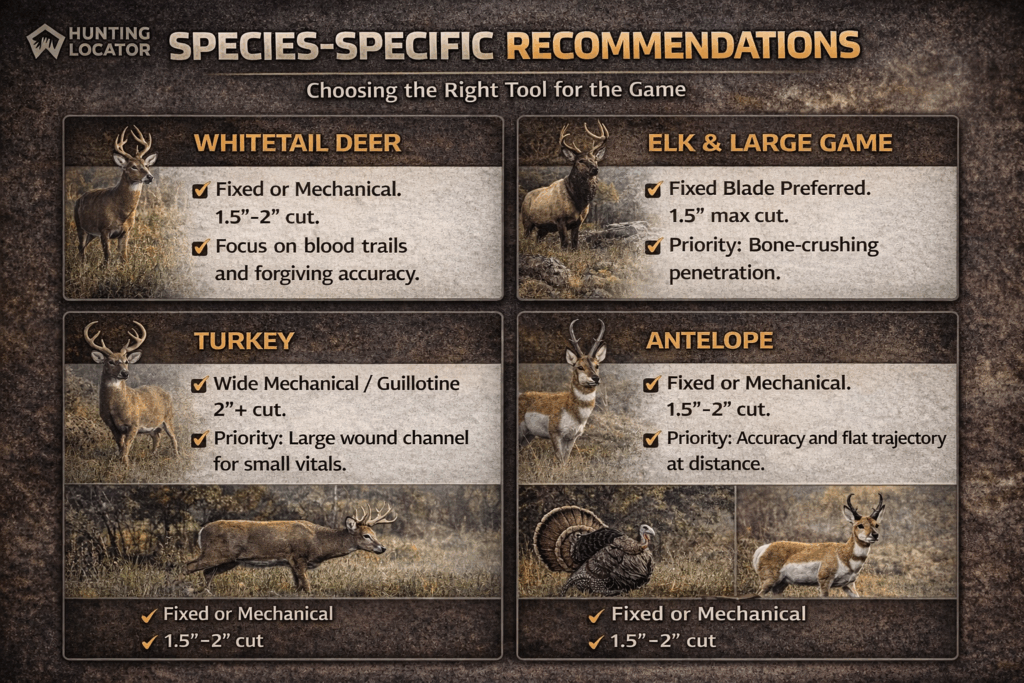
Whitetails are the bread and butter of North American bowhunting, and thankfully, they’re pretty accommodating when it comes to broadhead selection. Miss Pursuit recommends that “For deer and antelope, you can use fixed-blade broadheads with a cutting width of about 1.5 to 2 inches.”
For whitetails, you’ve got options:
- Fixed Blade: Perfect if you’re shooting under 55 lbs or want maximum penetration through shoulder shots
- Mechanical: Popular choice for the big blood trails and easier tuning (just make sure you’ve got 55+ lbs of draw weight)
- Hybrid: Solid middle ground that covers most hunting scenarios
MeatEater breaks it down practically: “For bowhunters with lower-poundage rigs… fixed-blade broadheads are usually the top choice, while those who want a more forgiving setup and big holes in bucks might prefer mechanicals.”
Elk and Large Game: When Penetration Rules Everything
Elk hunting separates the pretenders from the contenders in broadhead design. These animals are built like tanks, and your broadhead needs to punch through accordingly. Iron Will Outfitters emphasizes that “Elk have thick muscle structure and dense bones” and “the entire front of the arrow must be strong enough to pass through heavy elk scapula bones.”
For elk, fixed blade broadheads aren’t just preferred—they’re essential. goHUNT recommends that “The 1.5-inch cutting diameter is preferred for elk because it yields better penetration potential compared to larger 1.75-inch and 2-inch models.”
Arrow weight becomes critical here. Grit Outdoors specifies that “For big game hunting find an arrow with between 8.5 and 10.5 grains per inch with a minimum of a 400 spine. This will give your broadhead more than enough weight pushing it to drive it deep into your target.”
Turkey and Small Game
Turkey hunting flips the script entirely. You’re dealing with smaller vital zones, incredibly mobile targets, and often taking head/neck shots that demand instant results. Wide-cutting mechanicals or specialized guillotine-style heads designed specifically for turkeys usually deliver the best results.
Species Selection Quick-Reference Matrix
| Game Animal | Recommended Type | Cutting Diameter | Grain Weight | Key Priority |
|---|---|---|---|---|
| Whitetail Deer | Fixed or Mechanical | 1.5″ – 2″ | 100-125 gr | Blood trail |
| Mule Deer | Fixed or Mechanical | 1.5″ – 2″ | 100-125 gr | Penetration at distance |
| Elk | Fixed Blade preferred | 1.5″ (max 2″) | 100-125 gr | Penetration through bone |
| Moose | Fixed Blade | 2″ – 2.5″ | 125 gr | Maximum penetration |
| Turkey | Wide Mechanical/Guillotine | 2″+ | 100 gr | Large wound channel |
| Antelope | Fixed or Mechanical | 1.5″ – 2″ | 100 gr | Accuracy at distance |
Planning your next hunt? Check out our archery equipment collection for broadheads matched to every game animal on this list, plus all the supporting gear you’ll need.
Technical Considerations: Dialing In Your Setup
Once you know what you’re hunting and which broadhead type makes sense, the technical specs become your roadmap to success. Get these details right, and your broadhead will perform exactly as designed. Get them wrong, and even the best broadhead becomes a liability.
Grain Weight: The Sweet Spot
The broadhead weight game has settled into some pretty predictable patterns over the years. NABowhunter reports that “Today, most hunting arrows weigh between 450 and 500 grains. While the broadhead itself matters, more bowhunters are sticking with a 100-grain broadhead for all their hunting.”
Your main options:
- 85-100 grains: Speed demons who want flat trajectories
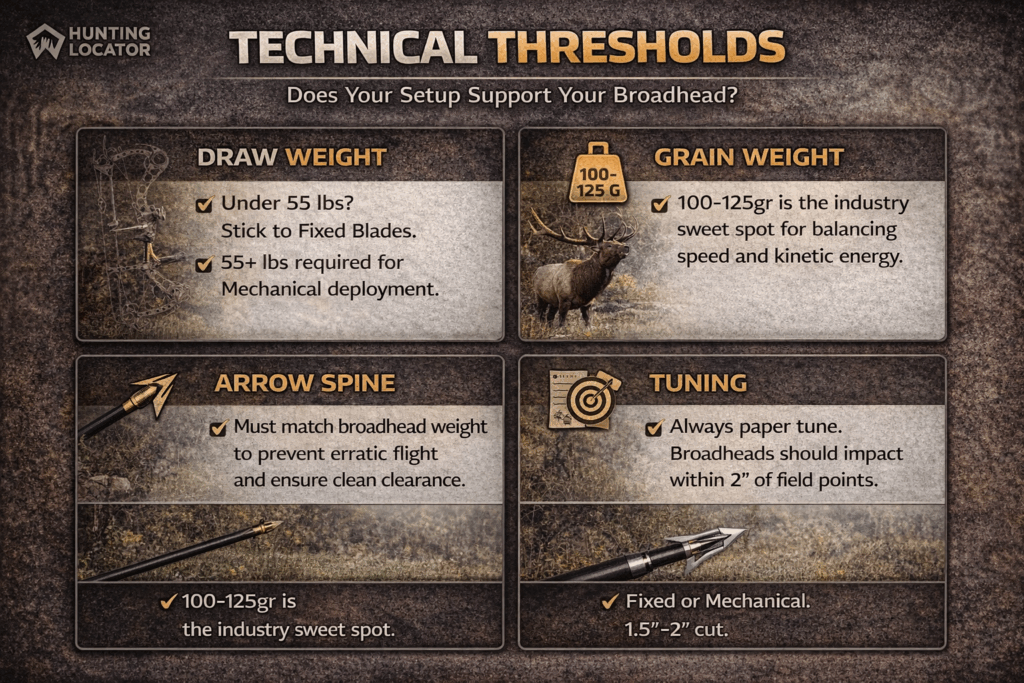
- 100-125 grains: The sweet spot most hunters land on
- 125+ grains: Heavy hitters maximizing penetration and kinetic energy
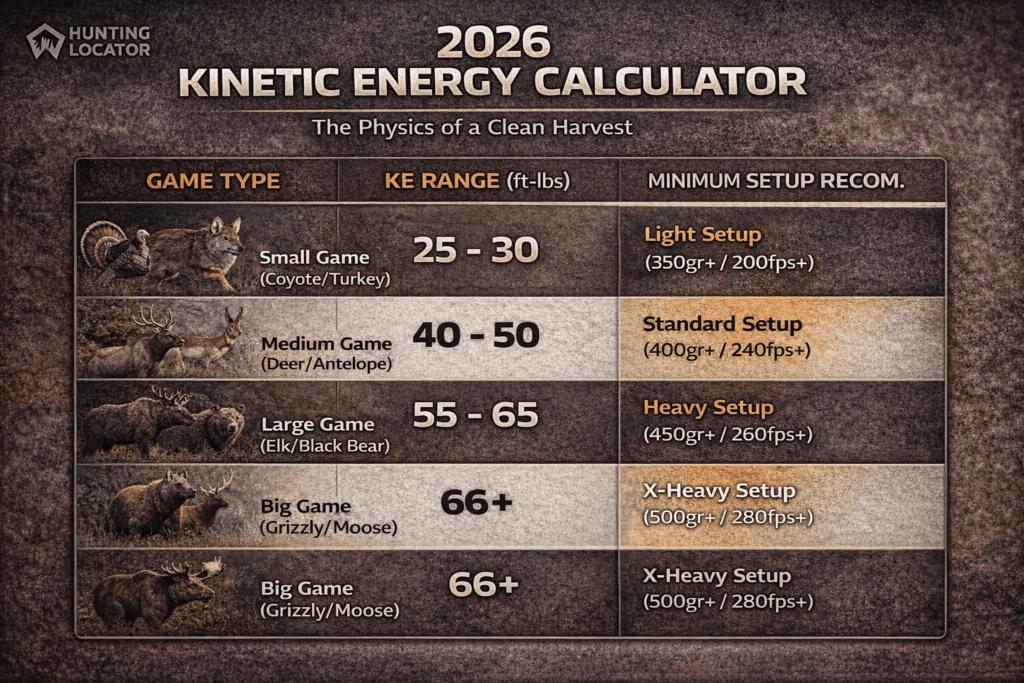
Draw Weight and Kinetic Energy Requirements
Your bow’s draw weight isn’t just a number—it determines which broadheads will actually work for you. This isn’t marketing fluff; it’s physics.
The hard rules:
- Under 55 lbs: Stick with fixed blades for reliable performance
- 55+ lbs: Now you can consider mechanicals and hybrids
- 65+ lbs: High-performance mechanicals with large cutting diameters become viable
Cutting Diameter Considerations
Bigger cutting diameter sounds better, right? Not always. It’s about finding the right balance between wound channel size and penetration for your specific hunting situation.
Diameter guidelines:
- 1″ – 1.25″: Maximum penetration for tough game or lower draw weights
- 1.5″: The Goldilocks zone for most hunting
- 1.75″ – 2″: Great for whitetails and similar-sized game
- 2″+: Specialized situations where you need maximum cutting surface
Bow Tuning and Compatibility
Even the world’s best broadhead will fail you if your bow isn’t properly tuned. HuntWise emphasizes that “You must practice with your broadheads before going hunting to ensure that they fly the same as your field points.”
Your tuning checklist:
- Match arrow spine to your broadhead weight
- Check rest alignment for clean arrow clearance
- Test broadhead flight against field points
- Fine-tune sight pins as needed
Technical Specifications Comparison
| Specification | Entry Level | Intermediate | Advanced |
|---|---|---|---|
| Draw Weight | 45-55 lbs | 55-65 lbs | 65+ lbs |
| Arrow Weight | 350-400 grains | 400-450 grains | 450+ grains |
| Broadhead Options | Fixed blade primarily | All types viable | All types, large mechanicals |
| Cutting Diameter | 1″ – 1.5″ | 1.5″ – 2″ | Up to 2.25″ |
| Tuning Complexity | Moderate | Moderate to High | High |
Get your technical setup dialed in with quality components from our archery accessories collection. From arrow rests to bow stabilizers, we stock what you need for broadheads that fly true.
Essential Gear for Broadhead Success
Your broadhead is the tip of the spear, but it’s only as good as everything behind it. From the arrow shaft to your release aid, every component in your setup affects how that broadhead performs when it counts.
Arrow Selection and Compatibility
Your arrow is your broadhead’s delivery system, and compatibility between these two components makes or breaks accuracy. Grit Outdoors specifies that “For big game hunting find an arrow with between 8.5 and 10.5 grains per inch with a minimum of a 400 spine.”
What matters in arrow selection:
- Proper spine rating matched to your draw weight and arrow length
- Adequate total weight for kinetic energy transfer
- Quality construction that won’t fail when you need it most
- Correct length for your draw and broadhead combination
Sight Systems for Precision
Broadhead accuracy demands sight systems that let you make precise adjustments and maintain consistent aiming points. Quality archery sights become even more critical when you’re hunting larger game where shot placement can mean the difference between a clean kill and a wounded animal.
Release Aids and Consistency
Any inconsistencies in your release get magnified when you switch from field points to broadheads. Quality bow release aids help ensure you’re delivering that broadhead exactly where you’re aiming, shot after shot.
Practice and Preparation Equipment
Tooth of the Arrow recommends a specific practice routine: “When first getting a bow built in the late winter, take the first 2-3 full sessions to shoot with field points only and get each pin dialed in like a laser. As soon as you know that your bow is completely sighted in, add a single practice broadhead to your quiver.”
Quality archery targets designed for broadhead practice help you maintain your equipment while building the confidence that comes from consistent accuracy.
Storage and Transportation
Proper broadhead storage protects your investment and keeps everyone safe. Hunter-Ed recommends to “Store broadheads in a protective case to prevent damage and ensure safety, especially if young children are on the property.”
Bow and crossbow cases protect your complete setup during transport, ensuring your carefully tuned system arrives at your hunting location ready to perform.
More Resources from Hunting Locator
At HuntingLocator, we’re committed to supporting your hunting success beyond just equipment selection. Our comprehensive resources help you prepare for every aspect of your hunting adventures:
- Complete Archery Equipment Collection – Everything you need for bowhunting success, from entry-level setups to professional-grade equipment
- Arrows, Points, and Broadheads – Carefully curated selection of proven broadheads and compatible arrows for every hunting situation
- Archery Accessories – The small details that make big differences in field performance
- Archery Sights – Precision aiming systems for ethical shot placement
- Arrow Rests – Critical components for consistent arrow flight and broadhead accuracy
FAQ
What’s the most important factor when choosing a broadhead?
Your target game species should drive everything else. Iron Will Outfitters notes that “For most bowhunters, broadhead selection is a matter of personal preference based on experience, the speed of the arrow and the game being sought.” Match your broadhead type and specs to what you’re actually hunting, not what looks coolest in the package.
Can I use mechanical broadheads with a 50-pound bow?
Nope. Mechanicals need adequate kinetic energy for reliable blade deployment, and 50 pounds just doesn’t cut it. HuntWise specifically states that mechanical broadheads “should only be used on bows with a draw weight of fifty-five pounds or greater to ensure there is enough kinetic energy for the blades to deploy and have sufficient penetration.”
How do I know if my broadheads are flying accurately?
Simple test: shoot broadheads and field points at the same aiming point. Tooth of the Arrow emphasizes that “You must practice with your broadheads before going hunting to ensure that they fly the same as your field points.” They should impact within 2-3 inches of each other at your maximum hunting range.
What cutting diameter should I choose for elk hunting?
For elk, penetration trumps cutting diameter every time. goHUNT recommends that “The 1.5-inch cutting diameter is preferred for elk because it yields better penetration potential compared to larger 1.75-inch and 2-inch models.” You need to punch through heavy bone, not create the biggest possible hole.
Should beginners start with fixed blade or mechanical broadheads?
Fixed blades are the better learning choice. Tooth of the Arrow recommends that “Fixed blade is recommended to new archers because they simply work” and “Fixed blade broadheads are the best option, because they have a lower failure rate than mechanical broadheads.” That said, if you’ve got 55+ pounds of draw weight and struggle with bow tuning, mechanicals can be more forgiving.
How often should I replace or sharpen my broadheads?
Replace them when they’re dull, damaged, or after a successful harvest. Hunter-Ed suggests using the rubber band test—a sharp blade should easily slice through a rubber band. Many modern broadheads have replaceable blades, so you can maintain peak sharpness without buying completely new heads.
The Final Shot
Choosing the right broadhead isn’t about finding the “perfect” option—it’s about understanding your hunting situation and matching your equipment accordingly. Whether you’re after whitetails in familiar territory or planning that once-in-a-lifetime elk hunt, the fundamentals stay the same: match your broadhead type to your draw weight, select cutting diameter based on your target species, and practice with whatever you plan to hunt with.
The broadhead decision comes down to honest assessment. What are you hunting? What’s your bow setup? What are your shooting conditions? Fixed blades offer reliability and penetration. Mechanicals provide accuracy and large wound channels. Hybrids try to give you both. Your success depends on choosing the broadhead that fits your specific needs and practicing until you’re confident in its performance.
Ready to gear up for your best hunting season yet? Visit our archery equipment store today! We stock proven broadheads, reliable sights, and quality accessories that deliver when it matters most.


Mechanicals are fine until they don’t deploy and you’re stuck chasing a wounded animal.