Here’s the truth: most first-time bowhunters buy way too much archery gear and still miss the essentials that actually matter. This checklist focuses on what you genuinely need for a successful first hunt, not what the marketing wants you to think you need. Beginning bowhunters can be overwhelmed by gear options, but understanding essential equipment ensures a successful start and helps avoid unnecessary purchases.
What you’ll find here:
- Legal requirements you must handle before buying anything
- Complete gear checklist organized by actual importance
- Field tactics and post-harvest essentials for hunt completion
But first, let’s tackle the boring stuff that could land you in legal trouble if you skip it.
Know Before You Go: Essential Prep
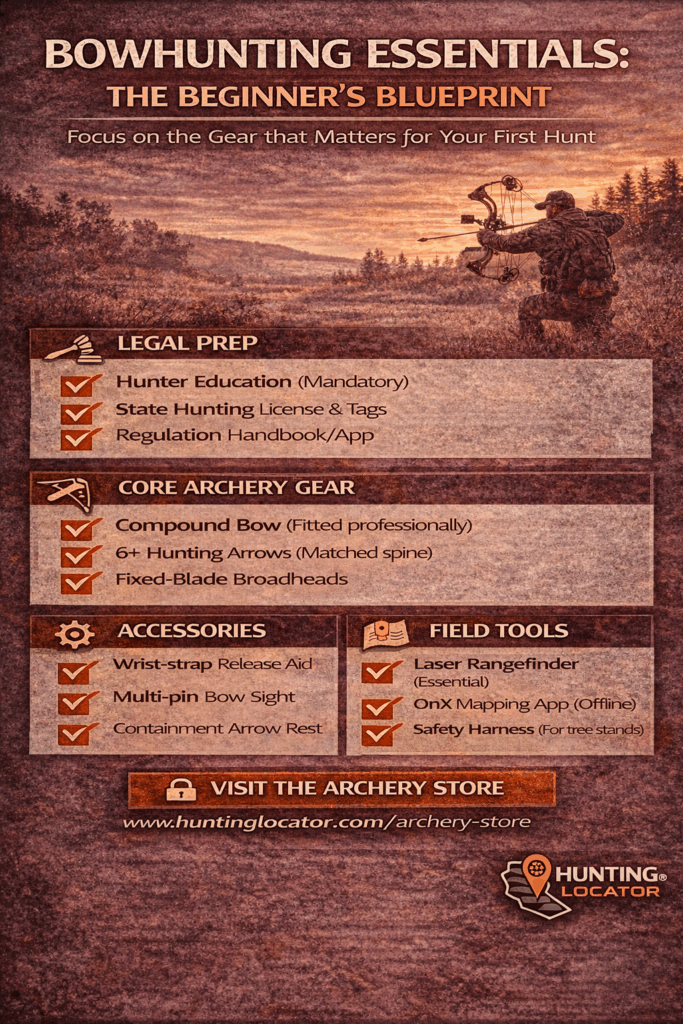
Too many beginners rush straight to the fun part (buying gear) and completely ignore the legal requirements. Big mistake. Your state’s regulations directly impact what equipment you can legally use, when you can hunt, and what species you can pursue.
Regulations Check
All states require hunter-education certification, but most don’t require bowhunter-education certification. Take both courses anyway. You’ll learn critical safety skills, hunting ethics, and state-specific regulations that affect your gear choices. Minimum draw weights, broadhead restrictions, and legal hunting hours all vary by state.
Legal Requirements You Can’t Skip:
- Hunter education certification (mandatory everywhere)
- Bowhunter education (some states require it, others don’t)
- Valid hunting license for your state
- Species-specific tags (deer, elk, turkey, etc.)
- Current regulation handbook or app
Money-Saving Tip: Non-resident licenses cost way more and often have application deadlines months ahead of hunting season. Plan accordingly.
License and Tag Acquisition
To hunt legally in the United States, you must have a hunting license from the state where you’re hunting. Most states let you buy online through their fish and game websites, which is way easier than driving to a license agent.
Keep both digital copies on your phone and physical copies in your pack. Game wardens can ask to see them anytime, and “I forgot it at home” isn’t a valid excuse.
Scouting & Habitat: Finding Your Hunting Ground
Your hunting location determines half your gear needs. Hunting thick timber requires different equipment than hunting open farmland. For whitetail deer, look for transition zones between woods and fields, oak ridges dropping acorns, and creek bottoms with heavy cover.
What you’re looking for:
- Fresh tracks: Clear prints in mud, sand, or soft dirt
- Rubs: Trees with bark scraped off from antlers
- Scrapes: Bare dirt patches with overhanging branches
- Game trails: Worn paths connecting bedding to feeding areas
- Fresh droppings: Recent scat indicates active area use
GPS and Mapping Tools
The OnX app was the most used tool for navigating unfamiliar territory. GPS apps help you scout from your couch, mark promising locations, track property boundaries, and find your way back in the dark.
Critical Step: Download offline maps before you hunt. Cell towers are rare in good hunting spots.
Physical & Gear Readiness
Bowhunting demands more from your body than rifle hunting. You need to draw 40+ pounds smoothly and silently, often from awkward positions. Practice drawing from sitting, kneeling, and twisted positions. Build endurance for all-day sits in cold weather.
Core Archery Gear Checklist: What You Actually Need
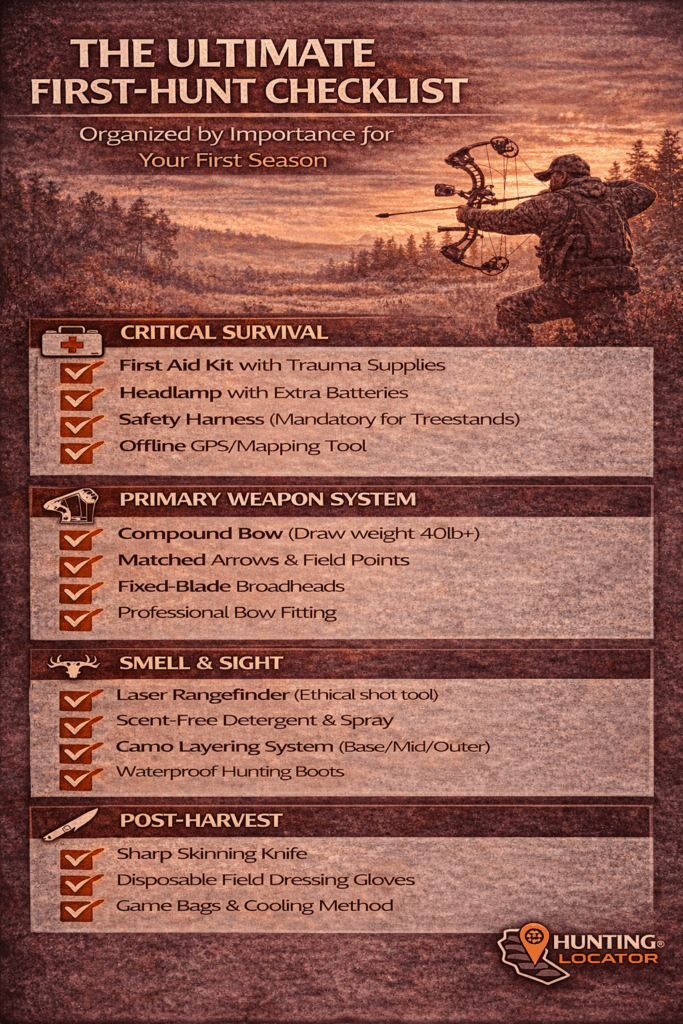
This gear list is organized by priority, not alphabetically. Start at the top and work your way down as your budget allows. Your first season should focus on learning rather than having the latest and greatest everything.
The Bow: Your Primary Weapon
For beginners, compound bows are recommended. Ready-to-hunt (RTH) packages are perfect for someone wanting to start immediately. These include sight, rest, stabilizer, and quiver—everything needed to start shooting arrows downrange.
Draw Weight Reality Check: Most beginners start around 40–50 pounds, depending on strength and state minimums. Most states require at least 40 pounds for deer hunting.
Budget Truth: Brand new compound bows easily cost $1,000. Used bows from local shops are usually smarter for beginners learning what they actually prefer.
Non-Negotiable Step: Get professionally fitted at an archery shop. Wrong draw length or draw weight kills accuracy and can injure you.
Check our archery equipment selection for quality bow options that won’t break the bank.
Arrows, Broadheads & Points
Arrow “spine” measures shaft stiffness. Your bow’s poundage and your draw length determine what spine you need. Most beginners use 28-30 inch arrows.
Broadheads turn practice arrows into hunting arrows. Field points are for target practice only. Fixed-blade broadheads are more forgiving for beginners than mechanical ones.
Arrow & Broadhead Must-Haves:
- Hunting arrows (buy at least 6, matched to your bow specs)
- Fixed-blade broadheads (easier for beginners than mechanicals)
- Field points for practice (same weight as your broadheads)
- Arrow wraps or bright fletching (helps find arrows after shots)
Browse our arrows, points, and broadheads collection for reliable options from trusted manufacturers.
Bow Accessories: Sights, Rests & Releases
Sights provide aiming reference points and dramatically improve accuracy. A quality sight is one of your best accuracy investments. Check our archery sights selection for dependable options.
Arrow rests support your arrow during the shot. Containment rests (Whisker Biscuit style) forgive minor form mistakes that drop-away rests won’t. See our arrow rests collection for beginner-friendly choices.
Release aids improve accuracy and prevent finger pain when shooting compound bows. Browse our bow release aids to find your preferred trigger style.
Bow Accessory Priorities:
- Multi-pin bow sight (3-5 pins covers most hunting distances)
- Containment arrow rest (more forgiving than drop-away rests)
- Wrist-strap release aid (most popular style for hunting)
- Peep sight (usually included with RTH packages)
- Stabilizer (reduces vibration and improves balance)
- Bow quiver (carries arrows—bow-mounted or hip-mounted)
Clothing & Layering System
Moisture-wicking base layers go under everything to keep you dry and comfortable. The three-layer system adapts to changing conditions:
- Base Layer: Wicks sweat away from skin
- Mid Layer: Provides insulation based on temperature
- Outer Layer: Camo pattern for your terrain, quiet fabric for movement
Clothing Priorities:
- Moisture-wicking base layers (top and bottom)
- Insulating mid-layer (fleece, down, or synthetic fill)
- Camo outer layer in local pattern
- Quality hunting boots with ankle support and proper insulation
- Lightweight gloves (early season) or insulated gloves (late season)
- Face mask or camo face paint
- Camo hat or head covering
Proper footwear means boots with Gore-Tex or similar waterproof barrier. Wool socks keep feet dry even when wet.
Rangefinder & Optics
You absolutely need a rangefinder. Archery demands precise distance knowledge—a 5-yard mistake can mean the difference between a clean kill and a wounded animal.
Optics Essentials:
- Rangefinder (non-negotiable for ethical shots)
- Binoculars (helpful for spotting and identifying game)
Safety & Navigation Essentials
Bowhunting begins and ends with safety. Safety gear is mandatory, including trauma supplies.
Safety & Navigation Must-Haves:
- First aid kit (include trauma supplies and self-adhesive wrap)
- Cell phone (emergency communication)
- GPS device or smartphone with offline maps
- Compass (backup navigation when electronics fail)
- Headlamp with extra batteries
- Safety harness (mandatory for tree stand hunting)
Tactics & Strategy: Hunting Successfully
Game animals move most during the first and last hours of daylight. This makes dawn and dusk your prime hunting windows for archery success.
Wind & Scent Control
Wind direction makes or breaks archery hunts. At typical bow ranges (under 40 yards), animals can easily smell you if the wind’s wrong. Scent control becomes more critical than rifle hunting because you need animals much closer.
Scent control that actually works:
- Always hunt with wind blowing from animal toward you
- Wash hunting clothes in scent-free detergent
- Store clean hunting clothes in scent-proof containers
- Apply scent-eliminating spray before and during hunts
Shot Placement & Ethics
Arrows kill through blood loss, not shock like bullets. This makes shot placement absolutely critical. Aim for the vital zone behind the front shoulder, targeting heart and lungs. Practice shooting from sitting, kneeling, and other positions you’ll use while hunting.
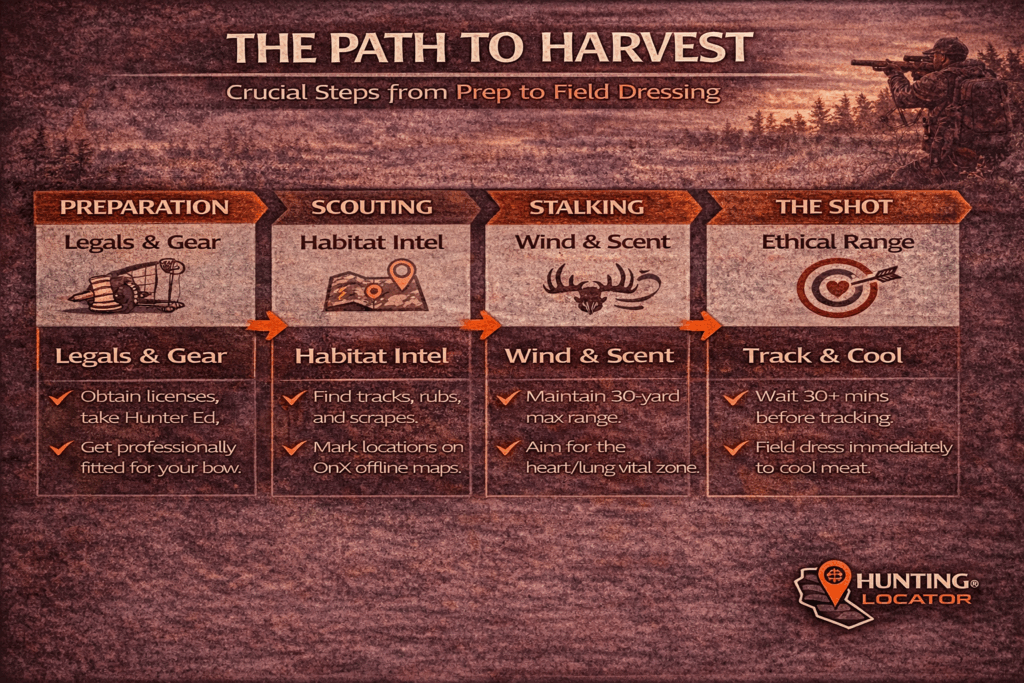
Never shoot beyond your effective range. For most beginners, this means 30 yards maximum until you can consistently group arrows in a 6-inch circle.
Post-Harvest Care: The Work After the Shot
Making a good shot is just the beginning. Proper post-harvest care honors the animal and preserves meat quality for your family.
Tracking & Recovery
After shooting, mark exactly where the animal stood and where you shot from. Wait at least 30 minutes before tracking (longer for questionable shots). Look for blood, hair, and arrow pieces to confirm hit placement.
Follow blood trails methodically, marking each spot. If the trail gets difficult, expand your search in the animal’s last known direction.
Field Dressing & Transport
Field dress immediately to start cooling the meat. Bow hunters need larger knives for field dressing tasks.
Field dressing essentials:
- Sharp skinning knife
- Bone saw (for larger game)
- Disposable gloves
- Game bags or coolers
- Ice or other cooling method
Get meat to a processor or your home setup quickly, keeping it cool throughout transport.
More Resources from Hunting Locator
Expand your archery knowledge and gear options with these additional resources:
- Archery Accessories – Arm guards, finger tabs, and bow squares
- Archery Targets – Practice targets for accuracy development
- Bow Stabilizers – Reduce bow torque and improve stability
- Bow Cases – Protect your investment during transport
FAQ
What’s the minimum draw weight needed for deer hunting?
Most states require 40 pounds minimum for deer. Check your specific state regulations since requirements vary. Most beginners start around 40–50 pounds based on strength and local laws.
Should I buy a new or used bow for my first hunt?
New compound bows easily cost $1,000. Used bows from local shops are usually better for beginners. Quality used equipment lets you learn without massive financial commitment.
Do I need special certification for bowhunting?
All states require hunter education, but most don’t require bowhunter education. Take both courses anyway for comprehensive preparation and safety knowledge.
What’s the difference between fixed-blade and mechanical broadheads?
Fixed-blade broadheads stay open during flight, offering reliability and deep penetration. Mechanical broadheads deploy on impact, creating larger wound channels but needing more kinetic energy. Fixed-blade heads are recommended for beginners due to reliability.
How much should I budget for my first archery hunting setup?
Complete ready-to-hunt packages with used bows start around $400-600. New setups easily reach $1,000+. Focus on essentials first: bow, arrows, broadheads, sight, rest, and release aid.
When should I start practicing before hunting season?
Start practicing immediately after getting your equipment properly tuned. Most experts recommend at least 2-3 months of regular practice before your first hunt.
The Final Shot
Your first archery hunt marks the start of something bigger than just hunting. It connects you with nature in ways most people never experience, challenges skills you didn’t know you had, and provides the most organic, sustainable meat possible.
The gear in this checklist will serve you well, but success comes from preparation, practice, and persistence more than expensive equipment. Start with essentials, master your equipment, and upgrade gradually as you gain experience.
Every expert bowhunter started exactly where you are now—excited, determined, and ready to learn something completely new.
Ready to gear up for your first archery season? Visit our archery equipment store today! We stock quality bows, arrows, broadheads, sights, and accessories to set you up for success in the field.


