This Washington deer season guide pulls the confirmed dates and requirements into one place, whether you’ve hunted the same Eastern Washington draw for a decade or you’re after a Columbia blacktail for the first time.
The Hunting Locator platform team pulled together the confirmed 2026 season dates, checked them against WDFW guidance, and organized everything for residents and non-residents alike. The state’s deer hunting breaks down into three subspecies, two regions, and three weapon methods each. In Washington, where you hunt determines what you hunt and when, and once that’s clear, the rest of the season planning follows.
Here’s what’s covered below:
- Confirmed 2026 season dates for black-tailed, mule, and white-tailed deer by weapon method
- License and permit costs for residents and non-residents, plus education requirements
- Where to hunt — public land, private leases, and guided options
Quick Overview
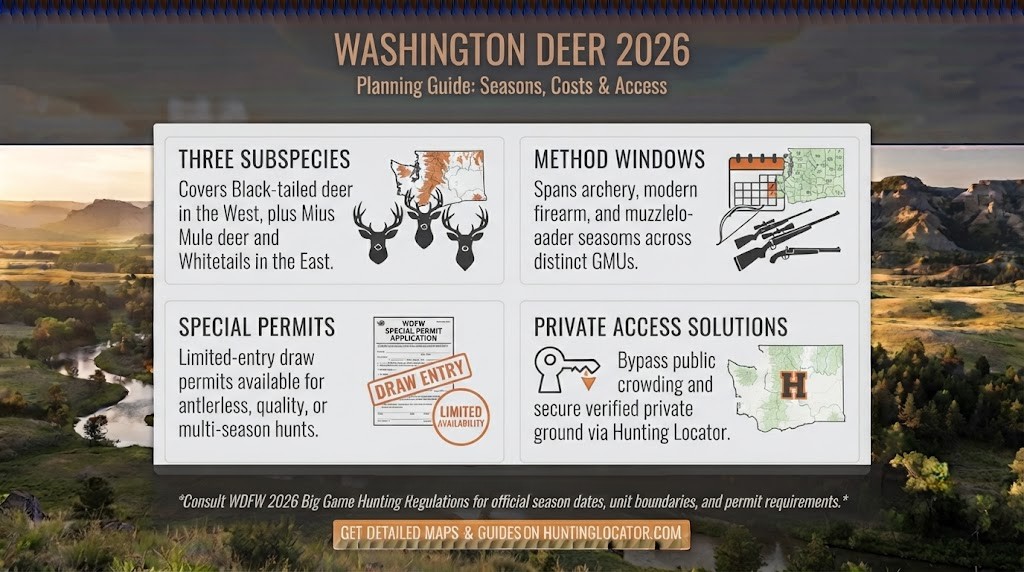
Black-tailed deer are found in Western Washington; mule deer and white-tailed deer are Eastern Washington species. Each runs three method windows — archery, modern firearm, and muzzleloader — with exact dates varying by species and region. The table below covers every confirmed 2026 date.
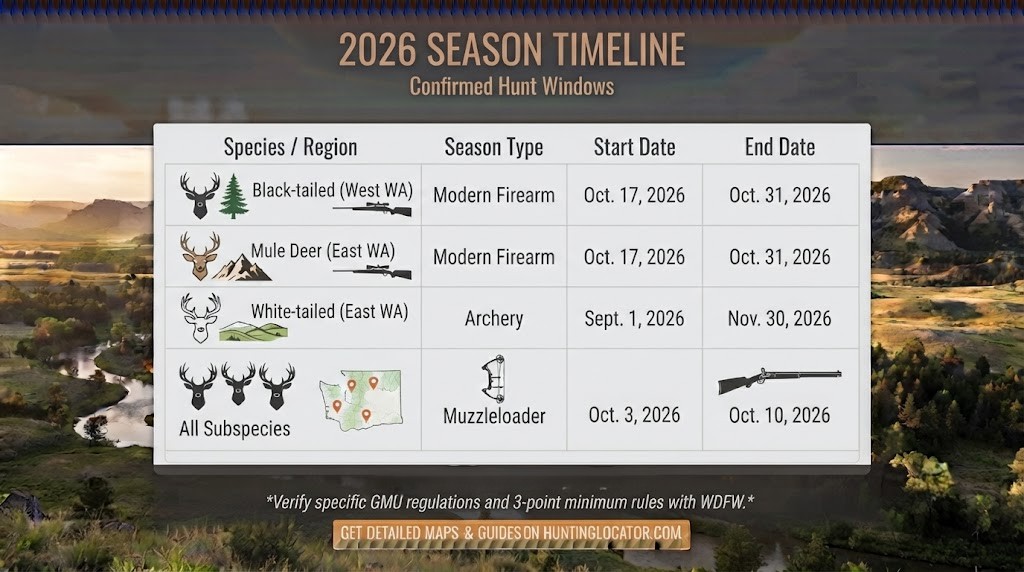
| Species | Season Type | Start Date | End Date | Bag Limit |
|---|---|---|---|---|
| Black-tailed Deer | Modern Firearm (West WA) | Oct. 17, 2026 | Oct. 31, 2026 | 1 deer (buck or doe with permit) |
| Black-tailed Deer | Archery (West WA – Early) | Sept. 1, 2026 | Sept. 30, 2026 | 1 deer |
| Black-tailed Deer | Archery (West WA – Late) | Nov. 1, 2026 | Dec. 31, 2026 | 1 deer |
| Black-tailed Deer | Muzzleloader (West WA) | Oct. 3, 2026 | Oct. 10, 2026 | 1 deer |
| Mule Deer | Modern Firearm (East WA) | Oct. 17, 2026 | Oct 31, 2026 | 1 deer (3-point min or antlerless w/permit) |
| Mule Deer | Archery (East WA – Early) | Sept. 1, 2026 | Sept. 30, 2026 | 1 deer |
| Mule Deer | Archery (East WA – Late) | 1-Nov-26 | Nov 30, 2026 | 1 deer |
| Mule Deer | Muzzleloader (East WA) | 3-Oct-26 | Oct. 10, 2026 | 1 deer |
| White-tailed Deer | Modern Firearm (East WA) | 17-Oct-26 | Oct. 31, 2026 | 1 deer (buck or antlerless w/permit) |
| White-tailed Deer | Archery (East WA) | Sept. 1, 2026 | Nov. 30, 2026 | 1 deer |
| White-tailed Deer | Muzzleloader (East WA) | 3-Oct-26 | Oct. 10, 2026 | 1 deer |
Deer seasons vary by GMU, and some special permit hunts run Aug. 1–Nov. 15. Confirm your specific GMU rules with WDFW before you hunt.
A few prerequisites to clear before acting on any of those dates:
- Hunter education: Hunter education is required for anyone born after Jan. 1, 1972 before they can buy their first Washington hunting license.
- License: A valid Washington hunting license paired with a deer transport tag for your chosen weapon method.
- Special permits: A separate limited-entry draw for antlerless, quality, or multi-season hunts beyond your general tag.
- Harvest reporting & tagging: Tag your deer immediately and complete tagging and harvest reporting through WDFW’s system within the required window.
Washington Deer Hunting Seasons by Species
Every deer species in Washington follows the same basic structure — archery, modern firearm, and muzzleloader windows — but exact dates, antler restrictions, and GMU rules shift by subspecies and region. Knowing your region is the first step to reading these seasons correctly.
Black-tailed Deer Season (Western Washington)
Blacktail is the Western Washington subspecies, and its habitat — dense, wet timber with limited visibility — shapes how these seasons are structured. Archery opens with an early window from Sept. 1 to Sept. 30, 2026, then reopens for a long late window from Nov. 1 to Dec. 31, 2026, both with a 1-deer bag limit. Modern firearm season runs Oct. 17–31, 2026, allowing one deer, buck or doe with the appropriate permit. Muzzleloader season is a tighter window, Oct. 3–10, 2026, also for 1 deer.
Western Washington also carries some Columbia blacktail trophy potential worth knowing about — the current Boone and Crockett record blacktail was taken near Olympia, which makes this a region worth targeting for non-residents chasing a trophy-class buck rather than just a tag.
Mule Deer Season (Eastern Washington)
Mule deer occupy Eastern Washington’s open, rolling country, a contrast to the timber blacktails call home. Archery runs an early window from Sept. 1 to Sept. 30, 2026, and a late window from Nov. 1 to Nov. 30, 2026, each allowing 1 deer. Modern firearm season runs Oct. 17–31, 2026, with a key restriction: bucks must meet a 3-point minimum (at least three points on one antler side), or you can take an antlerless deer with the appropriate permit. Muzzleloader season runs Oct. 3–10, 2026 for 1 deer.
The 3-point minimum applies broadly across Washington’s 100, 200, and 300-series GMUs, but exact rules can vary by unit. Confirm your specific GMU with WDFW before you head out.
White-tailed Deer Season (Eastern Washington)
Whitetail are concentrated in northeastern Washington, where dense brush and river bottoms give them cover mule deer lack. Archery runs one long window, Sept. 1 to Nov. 30, 2026, for 1 deer. Modern firearm season is Oct. 17–31, 2026, allowing a buck or an antlerless deer with permit. Muzzleloader season runs Oct. 3–10, 2026 for 1 deer.
Certain GMUs apply a 3-point minimum to whitetail bucks as well, and antlerless harvest is permit-only in many units. Confirm your GMU’s specific rules with WDFW before opening day.
Washington Deer Licenses and Permits
Getting legal to hunt in Washington follows a simple sequence: buy your license and tag first, then decide whether a special permit fits your season plan. Here’s what each step costs and requires.
Washington Hunting Licenses
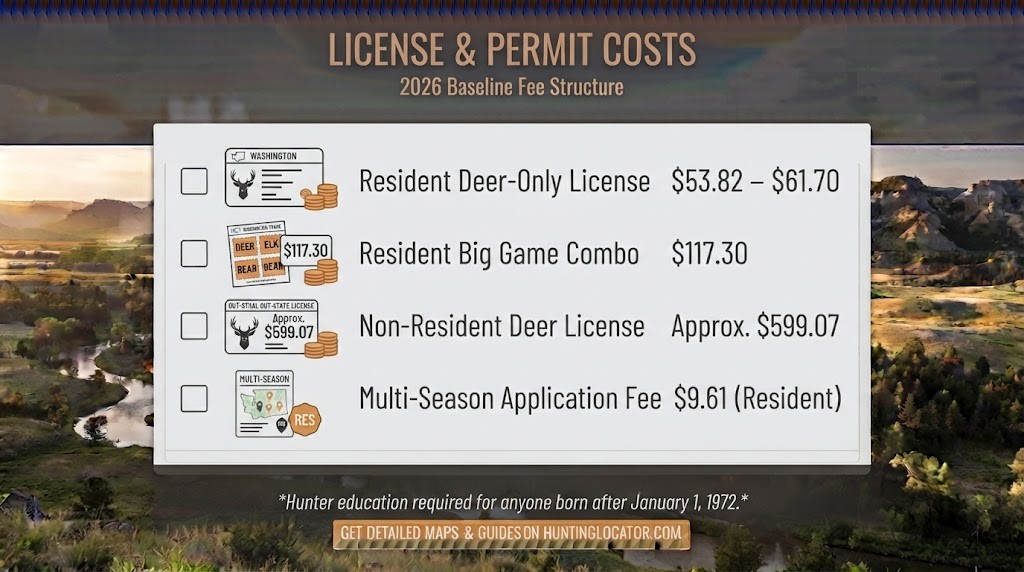
Washington offers deer-only licenses for hunters focused solely on deer season, along with combo licenses that bundle multiple species for hunters chasing more than one tag. Here’s how the main options break down for 2026:
| License / Tag Type | Approximate 2026 Cost | Notes |
|---|---|---|
| Resident Deer-Only Tag/License | ~$53.82–$61.70 | For in-state hunters targeting deer only |
| Non-Resident Deer Tag/License | ~$599.07 | Includes general deer tag for open seasons |
| Multi-Season Application / Special Permit Fee | ~$9.61 | Resident application fee for multi-season hunts |
| Resident Big Game Combo | $117.30 | Multi-species option covering more than deer |
| Non-Resident Deer + Elk Combo | ~$1,020.06 | Bundled option for traveling hunters |
For hunters planning to pursue more than deer this season, bundled tags like the Big Game Combo or Deer + Elk combo can save money over buying licenses separately. The $117.30 Big Game Combo figure comes from our Washington hunting seasons overview, which breaks down multi-species options in more detail. WDFW is the final authority on current-year pricing, so confirm costs before you buy.
Washington Hunting Permits
Beyond your base license, Washington offers special permits for hunters who want more than a standard general-season tag. These limited-entry draws cover antlerless hunts, quality/trophy hunts, and multi-season access, and they’re applied for through WDFW’s “WILD” portal rather than purchased over the counter like a general tag.
For anyone hoping to apply for 2026: the 2026 special-permit application window opened April 27 and closed May 27, 2026. If you missed it, start planning now for the 2027 cycle rather than waiting until late spring.
One option worth understanding regardless of the special-permit deadline is the multi-season deer permit, which lets you pursue deer across archery, muzzleloader, and modern firearm windows in a single season rather than being locked into one method. The resident application fee runs about $9.61, and multi-season application dates typically run from Dec. 1 through Mar. 31 — worth marking on the calendar ahead of the 2026 season if you want this flexibility next time.
General tags are over-the-counter and available to anyone with a valid license, while special permits are a separate draw layered on top for expanded or restricted opportunities. Both are legitimate paths; the right one depends on your goals and your GMU.
Washington Deer: Where to Hunt
Where you hunt determines what and when, and in Washington that choice comes down to three paths: public land, private leases, and guided hunts. Each offers a different balance of cost, access, and control.
Best Public Lands
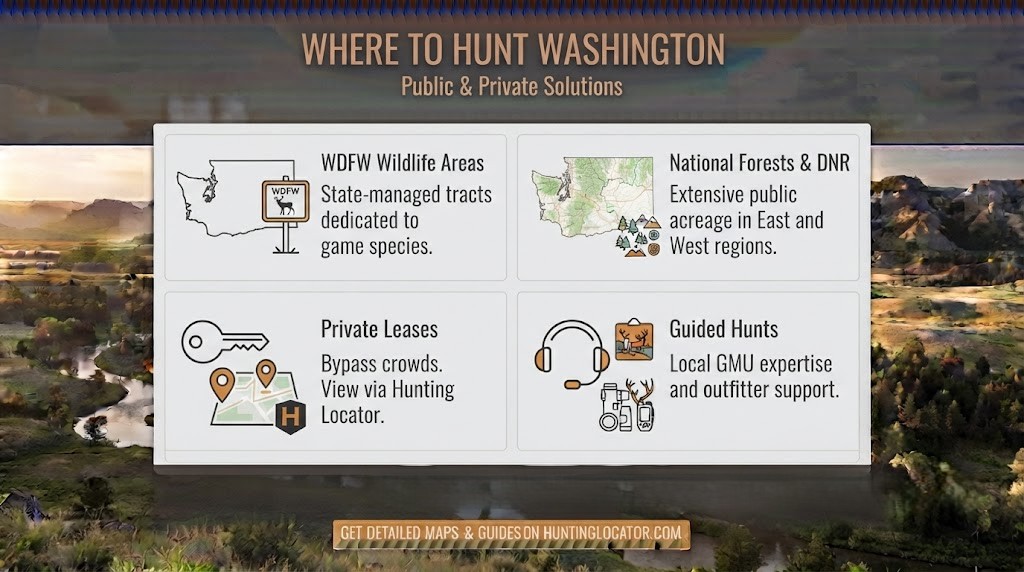
Public land is Washington’s free-access option, including WDFW-managed wildlife areas, Department of Natural Resources (DNR) land, and national forest acreage spread across both sides of the state. These lands are open to any licensed hunter, making them the natural starting point if you’re not ready to invest in a lease.
- WDFW wildlife areas — managed specifically for game species, with access tied to your GMU
- DNR-managed forest land — large multi-use tracts open to hunting across much of the state
- National forest land — extensive acreage in both Western and Eastern Washington, often bordering GMUs with strong deer numbers
- WDFW GMU maps — the best tool for locating exactly which public units are open near you
Public land is the low-cost entry point, especially useful for hunters just getting started. The trade-off, particularly in popular GMUs during modern firearm season, is hunting pressure and competition for the same ground other hunters are scouting.
Private Land Hunting with Hunting Locator
Private land solves the biggest frustration of public-land hunting: pressure. Less competition typically means better odds, more predictable deer patterns, and hunting ground you can get to know season after season. There are two ways to secure that access — leasing land for the season or buying property outright — and both are viable depending on your goals and budget.
Hunting Locator was built to solve the hardest part of hunting: access. Rather than cold-calling landowners or hoping a lease listing on a forum is still current, the platform connects hunters directly with Washington landowners who are ready to lease or sell their land. Every recommended lease in this guide comes exclusively from verified Washington listings, so the information stays current.
When you’re ready to lock in ground for the 2026 season, browse Washington deer leases and see what’s currently available near your target GMU. Whether you’re a non-resident unfamiliar with Washington’s public land system, or a resident who’s lost access to a longtime spot, this is where you secure a Washington hunting lease without the guesswork.
Guided Hunts
A guided hunt trades some of the planning and legwork for local expertise, which can make a real difference for hunters new to Washington’s terrain or new to hunting altogether. Guides bring GMU-specific knowledge, handle much of the field logistics, and generally improve odds compared to hunting unfamiliar ground solo.
- Local GMU knowledge — guides know deer movement patterns and terrain specific to their unit
- Gear and logistics support — many outfits handle transport, field dressing, and processing logistics
- Higher success odds for newcomers — especially valuable for non-residents unfamiliar with Eastern or Western Washington terrain
- Mentorship for beginners — a guided hunt can function as hands-on learning alongside someone experienced
Guided hunts are worth considering for non-residents planning a single trip who want to make the most of limited time in the field, or for newer hunters who want mentorship built in. If you’re newly licensed, Washington also offers a one-year Hunter Education Deferral Program that pairs new hunters with an experienced hunter — a similar mentorship concept worth exploring as you plan your first season.
Deer Hunting Tips
A successful 2026 season comes down to a handful of fundamentals done consistently. Here’s what matters most heading into opening day.
- Scout Before the Season: Use e-scouting tools to study terrain and travel corridors, then get boots on the ground before opening day to confirm what you’re seeing on the map.
- Know Your GMU Rules: Antler restrictions like the 3-point minimum and antlerless-by-permit rules vary by unit — always confirm your specific GMU with WDFW before you hunt.
- Match Your Method to the Season: Choosing between archery, muzzleloader, and modern firearm windows — or applying for a multi-season permit — can extend your days afield.
- Play the Wind and Terrain: Western Washington’s dense timber calls for a different approach than Eastern Washington’s open country, so adjust your strategy to the region you’re hunting.
- Gear Up Right: Quality optics, layered clothing for shifting fall weather, and a reliable pack make a real difference in the field. Shop deer hunting gear before the season opens.
- Tag and Report Promptly: Tag your deer immediately after harvest and complete your WDFW harvest report within the required timeframe to stay compliant.
More Resources from Hunting Locator
Beyond season dates and licenses, Hunting Locator offers additional tools for planning a hunt and finding access wherever you’re headed next.
- The Hunting Locator homepage — the platform hub for finding hunting access nationwide, from leases to outfitters
- Washington hunting leases — browse currently available private-land leases across the state
- The Hunting Locator store — gear for your 2026 hunt, from optics to layering essentials
- Washington hunting seasons overview — our broader guide to Washington’s hunting seasons beyond deer
Planning a hunt in another state? Explore our Maryland guides:
- Maryland hunting leases — private-land access opportunities in Maryland
- Maryland deer season guide — Maryland deer season dates and regulations
- Maryland elk season guide — Maryland’s elk hunting season information
- Maryland turkey season guide — Maryland turkey season dates
- Maryland waterfowl season guide — Maryland waterfowl hunting information
- Maryland small game guide — Maryland small game and upland bird seasons
- Maryland full season guide — the complete Maryland hunting season overview
Frequently Asked Questions
How much does a non-resident Washington deer tag cost in 2026?
A non-resident deer-only license runs approximately $599.07. For hunters planning more than one species, bundled options like the Deer + Elk combo run about $1,020.06. See non-resident Washington license costs for a full cost breakdown by tag type.
Is hunter education required to hunt deer in Washington?
Yes. Anyone born after Jan. 1, 1972 must complete a state-approved hunter education course before purchasing their first Washington hunting license. Confirm that hunter education is required for your situation before you buy.
What’s the difference between a general deer tag and a special permit?
A general tag is available over the counter to any licensed hunter for open general seasons. A special permit is a separate, limited-entry draw for antlerless, quality, or multi-season hunts, applied for through WDFW’s WILD portal.
When does the 2026 modern firearm deer season open?
Modern firearm season opens Oct. 17, 2026, and runs through Oct. 31 for black-tailed, mule, and white-tailed deer alike. Dates and antler restrictions vary by GMU, so confirm your specific unit’s rules with WDFW before you hunt.
Do I need to report my deer harvest in Washington?
Yes. Hunters must tag their harvested deer immediately and complete tagging and harvest reporting through WDFW’s system within the required timeframe. Skipping this step is a compliance issue, not an optional formality.
What is a multi-season deer permit?
A multi-season permit is a special application that lets you pursue deer across archery, muzzleloader, and modern firearm windows within a single season rather than committing to one method. The resident application fee is about $9.61, and multi-season application dates run from Dec. 1 through Mar. 31.
The Final Shot
Washington’s 2026 deer season comes down to a framework covered above: blacktail in the West, mule deer and whitetail in the East, and three method windows to choose from for each. From here, the path forward is straightforward: confirm your license and hunter education status, lock in your species and method dates, then secure the ground you’ll actually hunt.
Every date in this Washington Deer Season Guide for 2026 comes from confirmed regulatory data, but GMU-specific rules shift constantly, so double-check your unit with WDFW before opening morning. Hunting Locator built this guide to organize that information in one place, and access to quality hunting ground matters as much as getting the dates right. When you’re ready to stop hunting for access and start hunting deer, browse Washington deer leases and get your 2026 season locked in.


