This Wyoming deer guide covers the dates, the resident-versus-nonresident cost breakdown, and where to line up access before opening day. Wyoming’s rules shift by hunt area, so confirm your specific area with the Wyoming Game and Fish Department (WGFD) before finalizing anything.
Here’s what’s below:
- Season dates & structure — archery vs. general, bag limits, and how rules shift by hunt area.
- Licenses, permits & fees — the resident vs. nonresident split, permit types, and the draw.
- Where to hunt — public land, private leases, and guided options to secure your access.
For the wider picture beyond deer, Hunting Locator’s broader Wyoming hunting guide covers the state’s full range of big game seasons. If deer is your focus, here are the essentials, starting with the quick-reference facts.
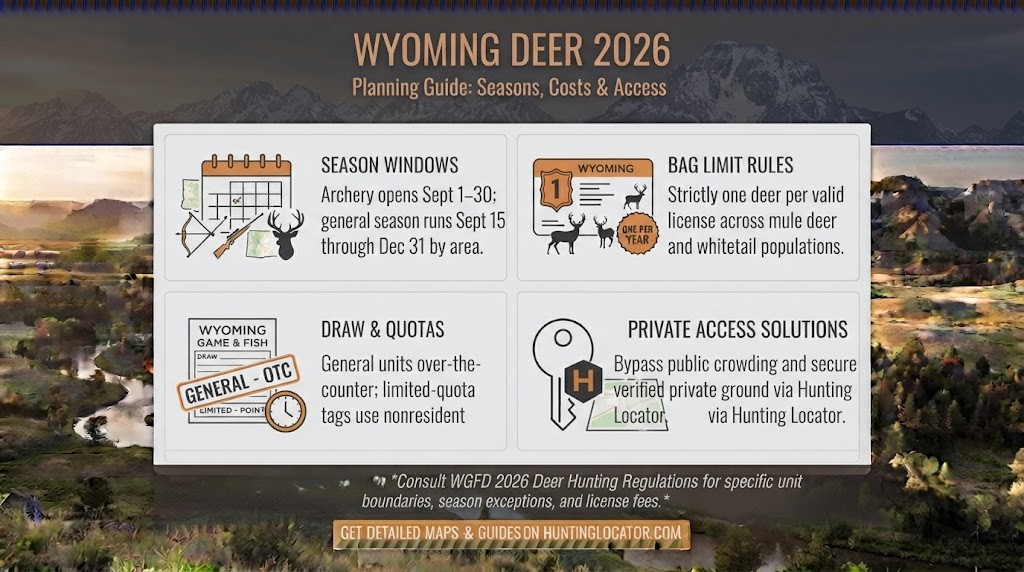
Quick Overview: Wyoming Deer Season 2026 at a Glance
Wyoming manages two native deer species, mule deer and whitetail, and the bag limit is the same for both: one deer per license. Mule deer dominate most of the state; whitetail hold strong in the northeast and along river corridors. Here’s the season snapshot.
| Species | Season Type | Start Date | End Date | Bag Limit | Notes |
|---|---|---|---|---|---|
| Deer | Archery | Sep 1, 2026 | Sep. 30, 2026 | One deer per license; varies by area/license | Dates and limits vary by hunt area |
| Deer | General (varies by area) | Sep 15, 2026 | Dec 31, 2026 | One deer per license; varies by area/license | Confirm your specific hunt area with WGFD |
Wyoming’s deer seasons vary significantly by area, so treat the dates above as a starting framework rather than the final word for your unit. Verify your specific hunt area with WGFD before locking in travel plans or time off work.
Before any of this, you’ll need a few things in place:
- Hunting license — every deer hunter needs a valid deer license matched to residency status and hunt area.
- Conservation stamp — a mandatory $12.50 stamp required for all hunters (verify the current fee with WGFD before purchasing).
- Hunter education — most new hunters must complete an approved hunter education course; check WGFD for the requirement that applies to you.
- Permit type — your permit dictates what you’re allowed to harvest, from any-deer licenses to reduced-price antlerless tags, covered in the licensing section below.
For more detail on how these seasons play out across Wyoming’s regions, Hunting Locator’s detailed Wyoming deer season breakdown is a useful companion read.
Wyoming Deer Hunting Seasons
Wyoming structures its deer seasons around weapon type and hunt area, with archery opening ahead of the general season. The one-deer-per-license rule applies regardless of species or method. Mule deer dominate most of the state, while whitetail concentrate in the northeastern Black Hills region and along river and creek corridors — worth factoring in when you decide where to apply.
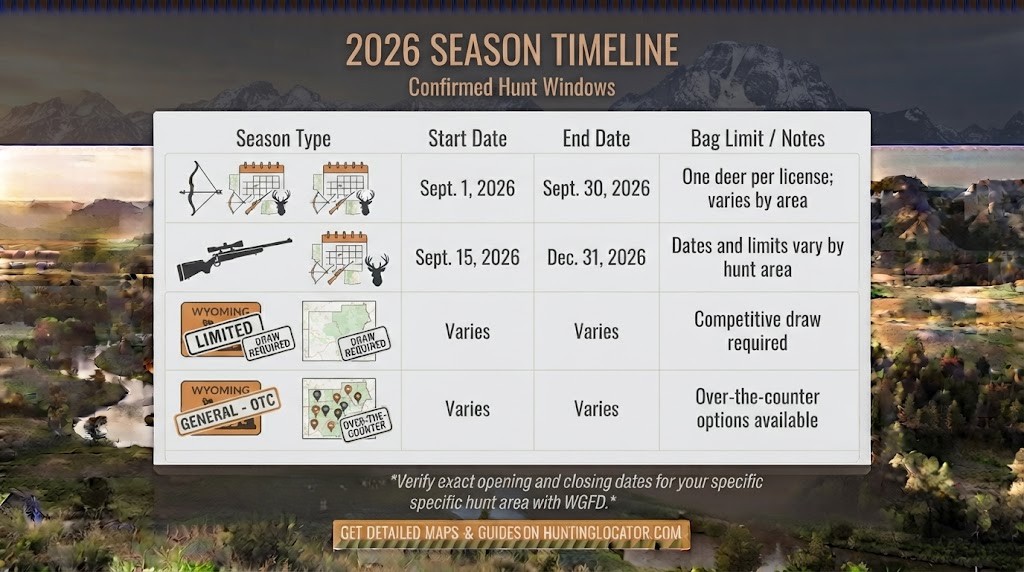
Archery Season (Sept 1–30, 2026)
Archery season runs September 1 through September 30, 2026, giving bowhunters a dedicated month before general rifle hunters enter the field. In many areas this window overlaps with the early general season, so check your unit’s specific structure. Wyoming allows compound bows or crossbows during archery season.
September timing works in bowhunters’ favor for another reason: early rut behavior often kicks in during this window, which tends to mean more deer movement and more daylight opportunities.
General Season (Sept 15–Dec 31, 2026)
The general season runs September 15 through December 31, 2026, though exact dates depend on your hunt area. “General” means any hunter holding a valid general license can hunt that area, with no draw required. Within that broad window, rut activity concentrates deer movement into specific weeks, and those weeks shift depending on unit and elevation.
Don’t assume the full September 15–December 31 window applies to your area. Confirm the exact opening and closing dates for your hunt area with WGFD before locking in flights, lodging, or time off.
General vs. Limited-Quota Areas
Wyoming deer hunting splits into two structures once you get to specific units. General areas accept any hunter with a valid license — no draw needed. Limited-quota areas require a competitive draw, and Wyoming combines these general and limited quota areas throughout the state depending on the unit.
Draw odds vary considerably by area, and some of the most sought-after units require multiple preference points before you’ll draw a tag. This shapes almost every nonresident’s planning process, and it’s covered in more detail in the licensing section.
One more note for responsible hunters: if you harvest a deer in one of Wyoming’s Chronic Wasting Disease (CWD) focus areas, testing is strongly encouraged. It’s a simple step that protects the herd and the hunting tradition for everyone who comes after.
Wyoming Deer Licenses and Permits
Licensing is where most hunters, especially first-timers and out-of-staters, start feeling overwhelmed. Wyoming splits its system between residents and nonresidents, each with different costs, application windows, and levels of complexity.
Wyoming Deer Hunting Licenses
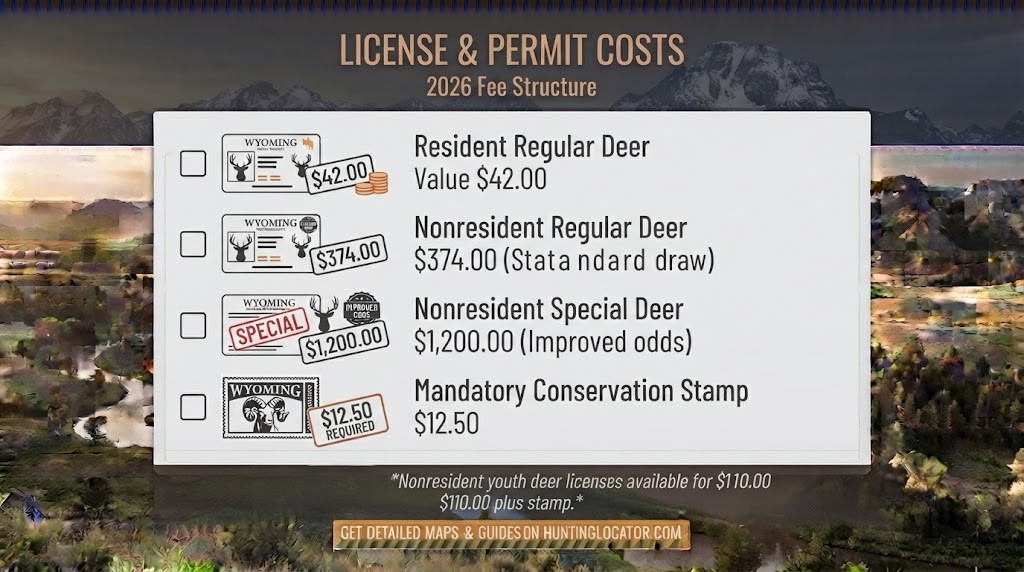
Current fee structure for Wyoming deer licenses:
| License Type | Fee | Who It’s For |
|---|---|---|
| Resident Regular Deer | $42.00 | Wyoming residents |
| Resident Reduced-Price Doe/Fawn | Varies by local regulation (lower tier) | Residents targeting antlerless deer |
| Nonresident Regular Deer | $374 | Out-of-state hunters (standard draw) |
| Nonresident Special Deer | $1,200.00 | Out-of-state hunters seeking better draw odds |
| Nonresident Youth Deer | $110 | Out-of-state youth hunters |
| Conservation Stamp | $13 | Mandatory for all hunters |
Fees can shift year to year, so verify current pricing directly with WGFD before purchasing anything.
A few things worth understanding before you buy: Wyoming residents can typically purchase general deer licenses over the counter without going through the draw, a real advantage if you’re hunting a general area. Nonresidents face a tradeoff — the Regular license at $374 gets you into the draw at standard odds, while the Special license at $1,200 improves your odds significantly. Which one makes sense depends on how badly you want a specific unit. The $110 Nonresident Youth Deer license is also worth knowing about as an entry point for introducing younger hunters to Wyoming.
Wyoming Deer Hunting Permits & the Draw
Your permit type determines what you’re allowed to harvest, so it’s worth understanding the categories before you apply:
- Type 1/2 — covers any deer or antlered deer, depending on the specific designation.
- Type 6/7/8 — reduced-price antlerless, doe, or fawn licenses tied to specific quota areas.
Residents may apply for up to two reduced-price doe/fawn licenses, which is a reasonable way to fill the freezer while keeping costs down.
For nonresidents, the draw and preference point system needs the most attention. Wyoming uses a preference-point system for nonresident deer applicants, meaning your odds of drawing a limited-quota tag improve the longer you’ve applied without success. Limited-quota licenses go through this competitive draw, while general areas skip the draw entirely — any valid license holder can hunt them.
Application timing generally opens early in the year and closes around June 1, but exact 2026 deadlines should be confirmed directly with WGFD. Purchase your license and submit your application through WGFD directly; they’re the sole authority on Wyoming hunting licenses, applications, and deadlines.
Where to Hunt Deer in Wyoming
A license and permit only get you halfway there. Where you actually hunt, and whether you have secured, reliable access, is what determines whether your season ends in success or frustration.
Best Public Lands
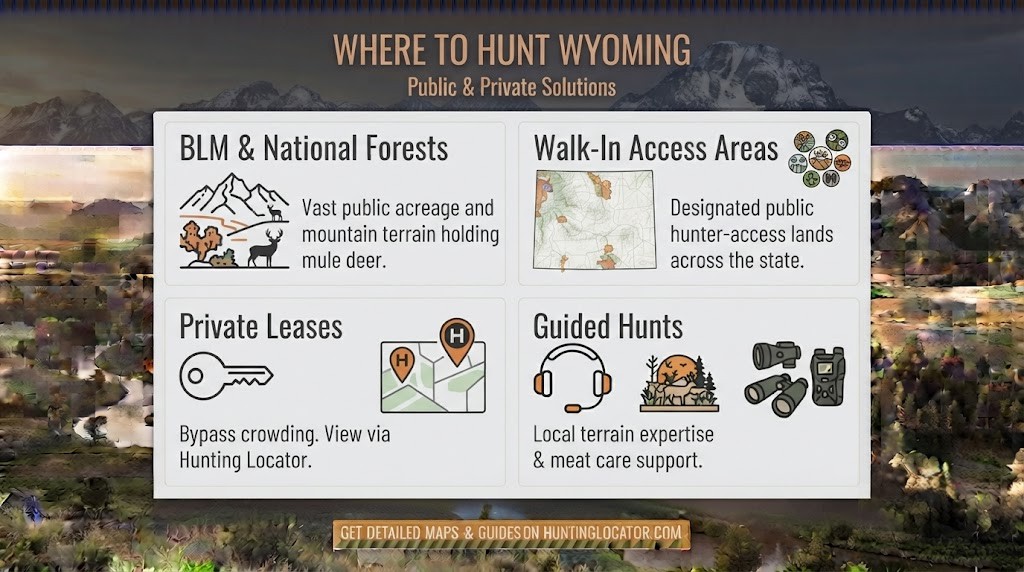
Wyoming offers substantial public hunting ground. Main options include:
- BLM land — vast tracts of public acreage spread across the state, much of it open to deer hunting.
- National Forest land — mountain and foothill terrain that holds strong deer habitat, especially for mule deer.
- Walk-in / public-access areas — designated hunter-access lands specifically opened for public hunting.
General units draw heavy resident pressure, and popular public areas can get crowded fast once the season opens. If you’re heading into an area with limited public access, secure permission or confirm access before you apply for a tag, so you don’t end up holding a license with nowhere to hunt.
Private Land Hunting with Hunting Locator
Leasing private land is a direct answer to crowding and draw uncertainty. Many of Wyoming’s best deer hunting areas, particularly whitetail habitat in agricultural regions, sit on private ranches. Private land leasing costs typically run a few dollars per acre annually depending on game quality and access exclusivity. Buying land outright is also worth exploring if you want long-term, permanent access rather than a seasonal arrangement.
This is the problem Hunting Locator was built to solve. As a platform, we connect hunters directly with landowners offering everything from day-use permissions to long-term exclusive leases, cutting out the guesswork of public land crowding and draw uncertainty. Instead of hoping you draw a tag for a good unit and then scrambling for access, you can line up land first and hunt with confidence.
If access is the piece still unresolved in your season planning, browse Wyoming hunting leases and see what’s open near your target units.
Guided Hunts
For hunters new to Wyoming terrain, especially non-residents unfamiliar with unit boundaries and the state’s varied landscape, a guided hunt can be worth the investment. Guides typically bring local unit knowledge, established land access, and hands-on help once you’ve made your harvest.
- Local terrain expertise — guides know the unit’s terrain, deer movement patterns, and where pressure tends to build.
- Established land access — many guides already have relationships with landowners or hold access to private ground.
- Meat care assistance — a mature Wyoming buck can yield roughly 60–70+ pounds of boneless meat, and guides often assist with quartering and proper field care so nothing goes to waste.
A guided hunt isn’t necessary for every hunter, but if you’re unfamiliar with Wyoming’s terrain, weather, or unit-specific quirks, it’s worth weighing against a self-guided trip.
Wyoming Deer Hunting Tips
Preparation is often the difference between filling your tag and going home with a story about the one that got away. A few tips that matter most:
- Hunt the rut smart — time your general-season days around rut activity for better mule deer movement and more daylight opportunities.
- Layer for variable weather — Wyoming fall can swing from warm afternoons to hard freezes within the same week, so pack layers you can add or shed quickly.
- Control your scent — approach from downwind and manage your scent carefully, especially when pursuing pressured whitetail in river corridor habitat.
- Learn your unit boundaries — study hunt-area maps and access points before opening day so you’re not wasting daylight figuring out where you’re allowed to be.
- Gear up before you go — reliable optics, sturdy boots, and the right layers matter more than almost anything else on a Wyoming hillside. Gear up at the store before the terrain and weather test your setup.
More Resources from Hunting Locator
Wyoming offers strong hunting well beyond deer season. Here’s where to go next depending on what you’re after.
- Start here: Visit the Hunting Locator homepage for the full platform experience, or head to the Hunting Locator store to gear up for your next hunt.
- Other Wyoming Big Game Guides:
- Wyoming elk hunting guide — season dates and access info for one of Wyoming’s most iconic hunts.
- Wyoming moose season guide — everything you need for this limited-quota pursuit.
- Wyoming antelope hunting guide — a Wyoming specialty with strong public and private access options.
- Wyoming bighorn sheep guide — for hunters chasing one of the state’s most prized tags.
- Wyoming mountain goat guide — rugged terrain, rugged rewards.
- Predators:
- Wyoming black bear guide — season structure and tactics for spring and fall bear hunting.
- Wyoming grizzly bear guide — current regulations and considerations.
- Wyoming gray wolf guide — what hunters need to know about wolf season in the state.
- Bird & Small Game:
- Wyoming turkey season guide — spring gobbler tactics and season dates.
- Wyoming small game guide — rabbits, squirrels, and other small game opportunities.
- Wyoming waterfowl guide — duck and goose season info across the state’s flyways.
Frequently Asked Questions
What are the Wyoming deer season dates for 2026?
Archery season runs September 1–30, 2026, and general season runs September 15 through December 31, 2026. Exact dates vary by hunt area, so confirm your specific unit’s schedule with WGFD before finalizing travel plans.
How much does a nonresident Wyoming deer license cost in 2026?
Nonresident Regular Deer licenses cost $374, while the Special Deer license runs $1,200 for improved draw odds. Add the mandatory $12.50 conservation stamp, or $110 for the Nonresident Youth Deer license. Verify current fees with WGFD before purchasing.
What is the Wyoming conservation stamp and who needs it?
The conservation stamp is a mandatory $12.50 fee required for all Wyoming hunters, funding conservation efforts across the state. Confirm the current fee amount with WGFD, since pricing can be adjusted year to year.
What’s the difference between a Type 1/2 and a Type 6/7/8 deer license?
Type 1/2 licenses cover any deer or antlered deer harvest rights. Type 6/7/8 licenses are reduced-price options limited to antlerless, doe, or fawn harvest, tied to specific quota areas. Availability depends on your hunt area, so check with WGFD for what applies to your unit.
How does the Wyoming deer draw and preference point system work?
Limited-quota licenses are awarded through a competitive draw, with preference points improving nonresident odds over time. General areas skip the draw entirely and are open to any valid license holder. Confirm exact 2026 application deadlines directly with WGFD.
Do I need to lease private land, or is public land enough?
Public land — BLM, National Forest, and walk-in areas — is available and legitimate, but general units often see heavy crowding once the season opens. Leasing private land offers less pressure and more predictable access. If crowding concerns you, browse available Wyoming leases to see what fits your target units.
The Final Shot
Wyoming’s 2026 deer season comes down to three things: knowing your dates (archery September 1–30, general September 15–December 31), understanding which license tier and permit type fits your situation, and locking in access early. Hunters who wait until the last minute on any of these tend to spend their season scrambling instead of hunting.
The next steps are straightforward. Confirm your exact hunt area and dates with WGFD, choose the license type that matches your residency status and goals, and secure where you’ll actually be hunting before the crowds show up.
Hunting Locator is built to simplify that last piece by connecting hunters directly to land. If access is still the open question in your planning, browse Wyoming leases and lock in your access before the season gets underway.


