This Wyoming elk guide covers season dates, license costs, permit deadlines, and where to hunt, for both residents and non-residents. The goal is to put what you need in one place instead of a dozen browser tabs. Hunting Locator built this guide, along with the tools behind it, to make that planning faster.
Here’s what’s covered:
- 2026 season dates by method — archery and general season windows, plus bag limits for each license type.
- License and permit costs — resident and non-resident fees, application deadlines, and how the draw process works.
- Where to hunt — public land strategy, private land leases, land purchases, and guided-hunt options.
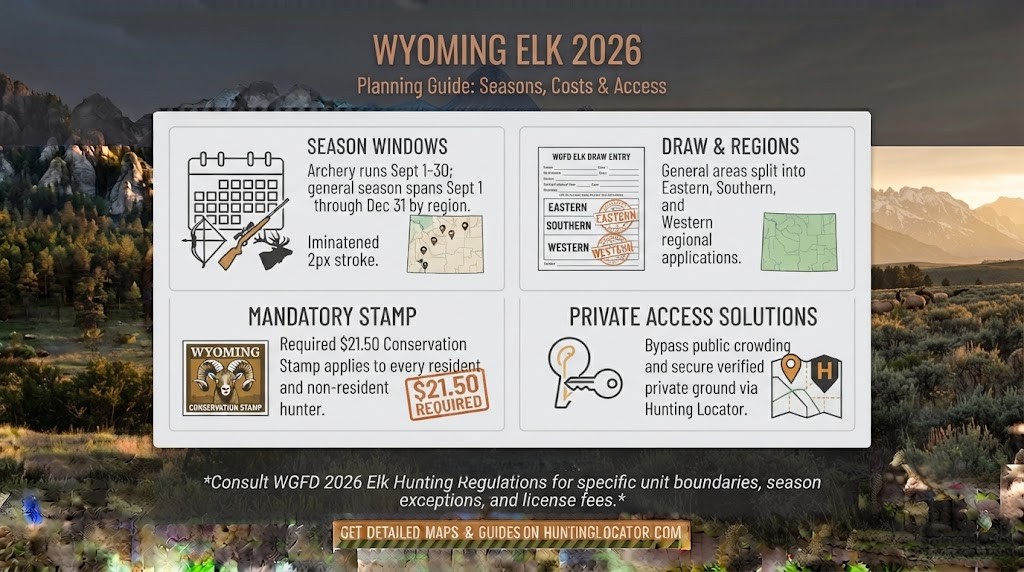
Quick Overview
Wyoming elk hunting is broken into numerous hunt areas, each with its own season dates, quotas, and antler restrictions. Treat the table below as a planning snapshot, not the final word for your unit, and confirm exact dates for your specific hunt area before finalizing plans.
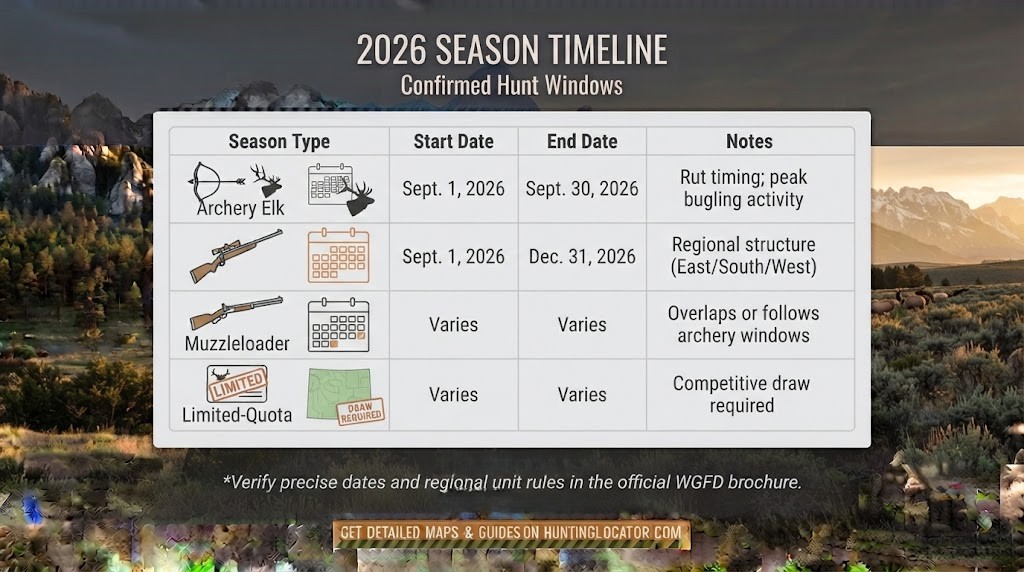
| Species | Season Type | Start Date | End Date | Bag Limit |
|---|---|---|---|---|
| Elk | Archery | Sep 1, 2026 | Sep 30, 2026 | Varies by area/license |
| Elk | General (varies by area) | Sep 1, 2026 | Dec 31, 2026 | 1 elk per license |
*Dates marked with an asterisk are general season windows that vary by hunt area. Confirm exact opening and closing dates for your specific unit in the official 2026 elk regulations published by the Wyoming Game and Fish Department (WGFD).
Before you can hunt, you’ll need to clear a short list of licensing and education requirements:
- A valid elk license — either a full-price license (any elk) or a reduced-price license (cow/calf only), depending on your goals and what you draw.
- A Wyoming Conservation Stamp — $21.50, required for every elk hunter, resident and non-resident alike.
- An application fee — $5 for residents, $15 for non-residents, paid when you submit your license application.
- Hunter education verification — if you’re new to hunting, confirm Wyoming’s hunter education requirement directly with WGFD before you apply, since requirements can depend on your age and hunting history.
For area-specific quirks and quota details, see our full Wyoming elk hunting season breakdown.
Wyoming Elk Hunting Seasons
Wyoming structures its elk hunting around two main season types — archery and general — and exact dates shift depending on the hunt area. WGFD sets and finalizes these dates each year, so the windows below are a planning framework, not a substitute for checking your specific unit.
Archery Season
Wyoming’s 2026 archery elk season runs September 1 through September 30, with bag limits that vary by area and license type. This window lines up with the rut: bulls typically start bugling in early September, with activity picking up through mid-to-late September as the rut peaks. That makes it the most effective stretch of the season for calling in a bull with a bow.
Archery success depends heavily on getting close during this window, when bulls are more vocal and more willing to respond to calls. Keep that timing in mind as you plan your hunt and gear.
General Season
The general elk season runs September 1 through December 31, 2026, though exact opening and closing dates vary by hunt area, and the bag limit is 1 elk per license. Starting in 2024, WGFD restructured general elk areas into three regions — Eastern, Southern, and Western — so applicants now apply for one region rather than for all general areas statewide.
That regional structure affects how you plan your application, particularly if you’re a non-resident weighing which part of the state fits your budget and timeline. Wyoming’s general season units remain the main opportunity for DIY elk hunters, giving both residents and traveling hunters a legitimate shot at public-land success without needing a limited-quota draw.
Season Notes & Method Variations
Some hunt areas offer additional method-specific opportunities beyond archery and general rifle seasons, such as muzzleloader seasons, which typically overlap with or closely follow the archery window. Equipment rules and exact dates vary by area, so check WGFD’s regulations for your unit before committing to a method. Dates vary by hunt area — verify with WGFD before building your season around any specific date.
Wyoming Elk Licenses and Permits
Residency status is the biggest factor driving what you’ll pay and how you’ll apply for an elk license. A full-price license opens the door to any elk, including a trophy bull, while a reduced-price license restricts you to cow-and-calf — a good fit if you’re hunting to fill the freezer rather than chase antlers. All figures below come from WGFD as the official source for 2026 costs.
Wyoming Elk Hunting Licenses
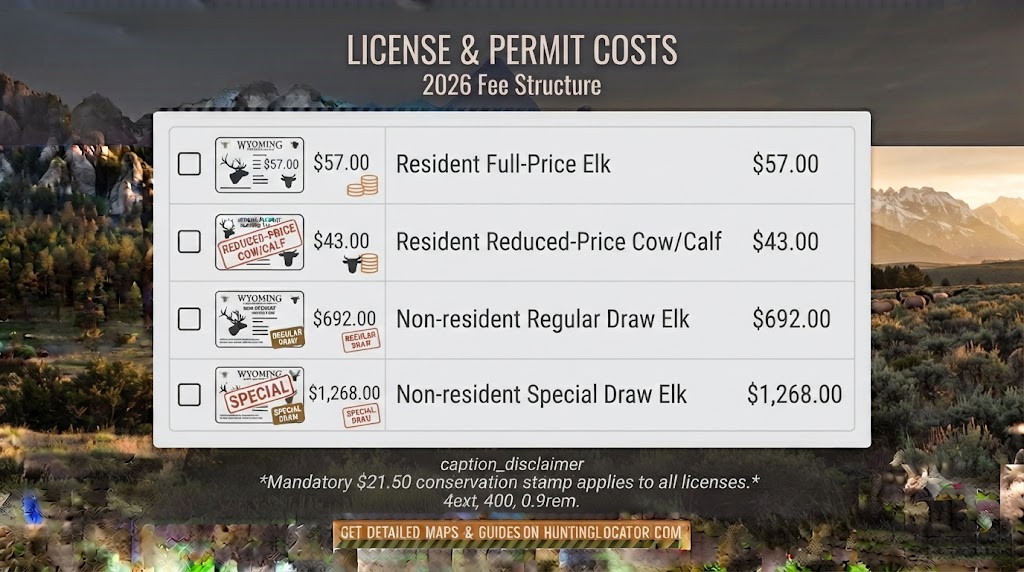
Here’s how the license types and their costs break down for 2026:
| License Type | Residency | Cost | Bag Limit |
|---|---|---|---|
| Full-Price Elk License (Types 1, 2, 9, or General) | Resident | $57 | 1 elk |
| Reduced-Price (Cow/Calf) License (Types 6, 7, 8) | Resident | $43 | 1 cow or calf |
| Full-Price Elk License — Regular Draw | Nonresident | $692 | 1 elk |
| Full-Price Elk License — Special Draw | Nonresident | $1,268 | 1 elk |
| Reduced-Price (Cow/Calf) License | Nonresident | $288 | 1 cow or calf |
For residents on a budget, the $43 reduced-price cow/calf license paired with an over-the-counter general license is one of the more accessible ways to fill a Wyoming freezer. For non-residents, the gap between the Regular Draw ($692) and Special Draw ($1,268) is worth understanding early, since it affects both draw odds and total trip budget.
Full-price and reduced-price licenses combine toward the total number of elk licenses any one person may hold in a calendar year. Verify the current per-person limit with WGFD before applying for multiple licenses.
Wyoming Elk Hunting Permits & Application Process
Getting your elk license squared away involves more than picking a license type — there’s a required stamp, application fees, and a timeline to hit. Here’s how the process breaks down:
- Add the Wyoming Conservation Stamp to your budget. Every elk hunter, resident or non-resident, must carry a valid Conservation Stamp costing $21.50. This stamp funds wildlife conservation efforts across the state and is required in addition to your license.
- Budget for the application fee. Residents pay $5 to apply; non-residents pay $15.
- Know the 2026 application windows. Applications opened January 2, 2026, with the non-resident elk deadline landing on February 2, 2026, at 11:59 p.m. MT (submitted online). Resident limited-quota elk applications were due June 1, 2026. A leftover elk, deer, and antelope draw runs June 22–26, 2026, for any tags that go unclaimed.
- Understand which draw system applies to you. Non-residents compete through a preference point system, with a maximum of 20 preference points heading into the 2026 draw. Residents can purchase general elk licenses over-the-counter, while limited-quota resident tags are issued through a random draw with no point system involved.
If you’re reading this after a 2026 deadline has passed, this annual cadence still holds as a template — WGFD runs this cycle every year.
Where to Hunt Elk in Wyoming
Wyoming’s public land — 48% federal and 5.6% state-owned — makes it one of the most access-rich elk states in the country. Knowing where that access exists, and how to secure more reliable ground, still takes some legwork. For a broader look at what the state offers hunters across species, check out our hunting in Wyoming overview. Below are the three main paths: public land, private leases, and guided hunts.
Best Public Lands
Wyoming’s public land backbone gives DIY hunters real options, whether you’re hunting BLM ground, National Forest, or state-owned parcels:
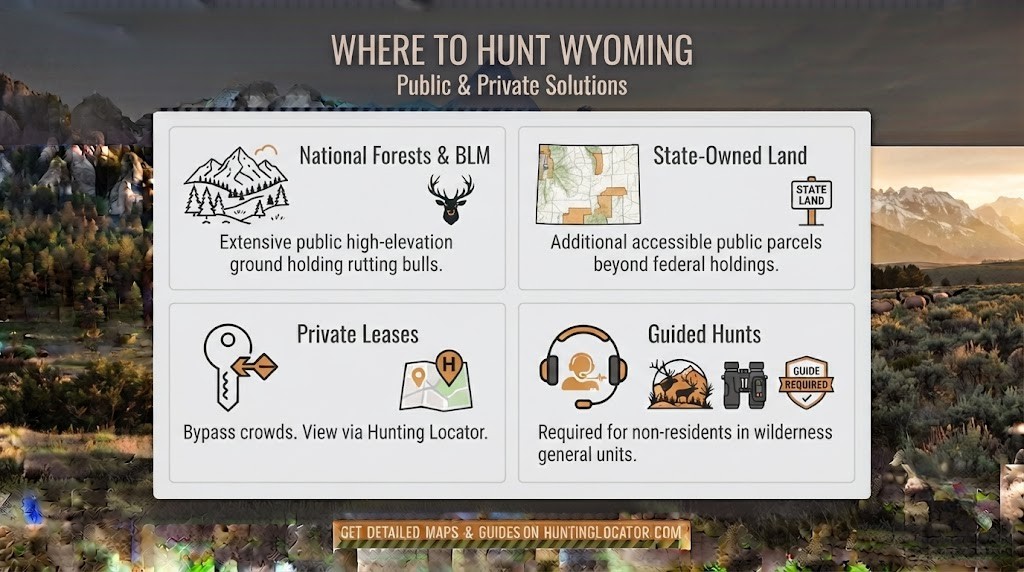
- BLM land — vast stretches of Bureau of Land Management ground are open to elk hunting across much of the state, particularly in central and western Wyoming.
- National Forest land — Wyoming’s national forests offer extensive elk habitat, especially in higher-elevation areas where bulls retreat during the rut.
- State-owned public land — Wyoming’s 5.6% state-owned land adds another layer of legal, accessible ground beyond federal holdings.
Before heading out, use the official WGFD Hunt Planner to research hunt-area maps, drawing odds, and public-access details for your target unit. It’s the most reliable starting point for matching your license to a specific piece of ground.
Public land is genuinely abundant in Wyoming, but that doesn’t mean it’s uncrowded. Popular units can see real hunting pressure during peak weeks, and access to the best ground isn’t guaranteed just because it’s technically open to the public. Private land access exists to fill that gap.
Private Land Hunting with Hunting Locator
When public ground gets crowded, or a unit’s best pockets sit behind private boundaries, securing your own access changes the equation. Whether you’re looking to lease ground for the season or buy land outright as a long-term investment, private access addresses the two biggest headaches hunters face every year: not knowing where to go, and not having enough time to find out.
Hunting Locator connects hunters directly with landowners who are ready to lease or sell their ground for hunting, without cold calls to strangers or wasted scouting trips on land that turns out to be off-limits. Browse listings, connect with landowners, and secure your ground on your own timeline.
Wyoming’s current lease listings are live on Hunting Locator’s Wyoming leases page, covering ground across the state’s elk country. For a non-resident planning an expensive out-of-state trip, a secured lease de-risks that investment by giving you legal, confirmed access before you book a flight. For a resident hunting close to home, a lease means reliable ground season after season, without competing for the same public pull-offs every opening weekend.
Browse current Wyoming elk leases and see what’s available for your 2026 season.
Guided Hunts
Guided and semi-guided hunts solve a real problem for two types of hunters: newcomers who want to learn the terrain and technique from someone who knows it, and time-limited non-residents who can’t afford a season’s worth of scouting trips. A good guide brings local knowledge of terrain, elk behavior, and shot placement that can shortcut years of trial and error.
Worth knowing before you decide: WGFD requires non-residents hunting wilderness general units to do so with a licensed outfitter or a Wyoming resident acting as a licensed guide. That requirement isn’t optional in those specific areas, so factor it in if a wilderness unit is on your radar. Whether guided or DIY makes more sense elsewhere in the state depends on your budget, your timeline, and how much you value the learning curve versus the shortcut.
Elk Hunting Tips
A successful Wyoming elk season comes down to preparation as much as luck. These tips will help you make the most of your 2026 hunt, whatever license you’re carrying:
- Hunt the Rut: Time your archery hunt for mid-to-late September, when bulls are bugling hardest and most responsive to calls. This is your best window for calling in a bull at close range.
- Scout Before Season: Use the WGFD Hunt Planner to study maps ahead of time, then put boots on the ground before opening day to confirm elk sign and travel patterns in your unit.
- Know Your Unit Boundaries: Confirm your hunt area’s exact lines and season dates in the WGFD regulation brochure well before opening day — boundary mistakes are an easy, avoidable way to end your season early.
- Match License to Goal: Choose a full-price tag if you’re chasing any elk, including a bull, or a reduced-price cow/calf tag if your priority is filling the freezer efficiently.
- Prepare for Backcountry Conditions: Dress in layers for swinging mountain temperatures, carry quality optics for glassing distant herds, and have a solid meat-care and pack-out plan ready before you pull the trigger or release an arrow.
Whether you need better glass for spotting bulls across a basin, a reliable elk call for rut season, or pack-out gear for the walk back to the truck, you can gear up at the Hunting Locator store.
More Resources from Hunting Locator
Wyoming elk season is one piece of a larger hunting calendar, and Hunting Locator’s Wyoming content covers the rest of it. Here’s where to go next:
- Wyoming elk hunting season deep-dive — a closer look at elk-specific season details beyond what’s covered here.
- Hunting in Wyoming — a broader state overview if you’re planning hunts beyond elk.
- Browse Wyoming hunting leases — the full list of current private land leasing opportunities across the state.
- Hunting Locator store — gear and equipment to outfit your next Wyoming hunt.
Explore other Wyoming seasons:
- Deer — season dates and licensing for Wyoming’s mule deer and whitetail hunts.
- Antelope — everything you need for Wyoming’s abundant pronghorn seasons.
- Moose — a guide to Wyoming’s limited-quota moose opportunities.
- Black bear — spring and fall black bear season details.
- Grizzly bear — current regulations and season status.
- Bighorn sheep — a look at Wyoming’s premier sheep hunting.
- Mountain goat — details on this challenging high-country hunt.
- Gray wolf — season and regulation information.
- Turkey — spring turkey season planning.
- Small game — Wyoming’s small game opportunities.
- Waterfowl — duck and goose season details across the state.
Frequently Asked Questions
How much does a nonresident Wyoming elk license cost in 2026?
A non-resident full-price elk license costs $692 through the regular draw or $1,268 through the special draw, plus a required $21.50 conservation stamp and a $15 application fee. A non-resident reduced-price cow/calf license costs $288. These figures come from WGFD as the official 2026 pricing structure.
What does a resident Wyoming elk license cost?
A resident full-price elk license costs $57, while a reduced-price cow/calf license costs $43. Both require the $21.50 conservation stamp, and applications carry a $5 fee. General licenses are available over-the-counter for residents, making this one of the more accessible license paths in the state.
When does Wyoming elk season open in 2026?
Archery season opens September 1 and runs through September 30, 2026. General season runs September 1 through December 31, 2026, though exact dates vary by hunt area. Confirm area-specific dates in the WGFD 2026 elk regulation brochure before finalizing your plans.
What’s the difference between a full-price and reduced-price elk license?
A full-price license (Types 1, 2, 9, or General) generally allows you to harvest any elk, including a bull. A reduced-price license (Types 6, 7, or 8) restricts you to 1 cow or calf elk per license — the choice between a trophy-bull hunt and a freezer-focused meat hunt.
How does the Wyoming elk application and draw process work?
Non-residents apply online by the deadline (Feb. 2 for 2026) and compete through a preference point system, with a maximum of 20 points heading into the 2026 draw. Residents can buy general licenses over-the-counter, while limited-quota resident tags are drawn randomly with no point system involved, according to WGFD.
Do I need a conservation stamp to hunt elk in Wyoming?
Yes. Every elk hunter, resident or non-resident, must carry a valid Wyoming Conservation Stamp costing $21.50. The stamp funds wildlife conservation efforts across the state and is required in addition to your elk license, per WGFD regulations.
What else can I hunt in Wyoming?
Beyond elk, Wyoming offers seasons for deer, antelope, and moose, along with bear, sheep, and waterfowl opportunities. Check the More Resources section above for the full lineup of Hunting Locator’s Wyoming season guides.
The Final Shot
A successful 2026 Wyoming elk season comes down to three things: knowing your season dates, budgeting for the right license plus required add-ons, and locking down land access before opening week. This guide covers all three. Verify final area-specific dates and rules in the official WGFD 2026 elk regulation brochure before finalizing your plans, since hunt-area details can shift year to year.
Hunting Locator gathers what you need to know and can connect you directly to the ground you need to hunt it. When you’re ready, browse current Wyoming elk leases to lock in your access, and gear up at the Hunting Locator store before opening day.


