Hunters who assume this season looks like previous years will find otherwise. This guide covers what you need to plan a legal hunt in 2026, whether you’re a Montana resident or an out-of-state hunter deciding whether the trip is worth the cost.
This guide addresses both residents planning their annual season and nonresidents evaluating the combination license process. The 2026 changes are real: access is tighter and nonresident tags are harder to draw. Jump to whatever section is most relevant to your situation.
- Season Dates & Methods — Every 2026 window from archery to muzzleloader, plus shoulder and backcountry seasons.
- Licenses, Tags & the 2026 Changes — What residents and nonresidents need, exact costs, and the April 1 deadline.
- Where to Hunt — Public land options, private land access through Hunting Locator, and guided hunt considerations.
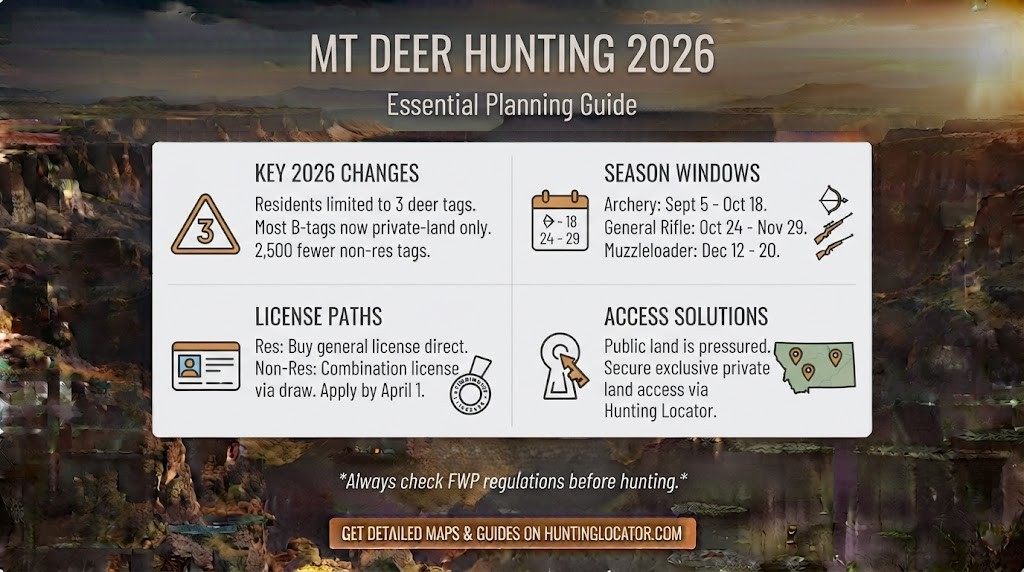
Quick Overview: Montana Deer Season 2026 at a Glance
Here’s a fast-reference summary for the 2026 Montana deer season. Across all seasons, legal shooting hours run ½ hour before sunrise to ½ hour after sunset.
🚨 Key 2026 Regulatory Changes Montana FWP made three significant changes for 2026–2027 that every hunter should understand before applying: – Residents can now buy only three deer licenses — down from eight in prior seasons. – Most mule deer B licenses are now valid on private land only — public land antlerless mule deer opportunities are now far more limited. – Roughly 2,500 fewer nonresident deer licenses are available due to new sales caps addressing overcrowding on public lands.
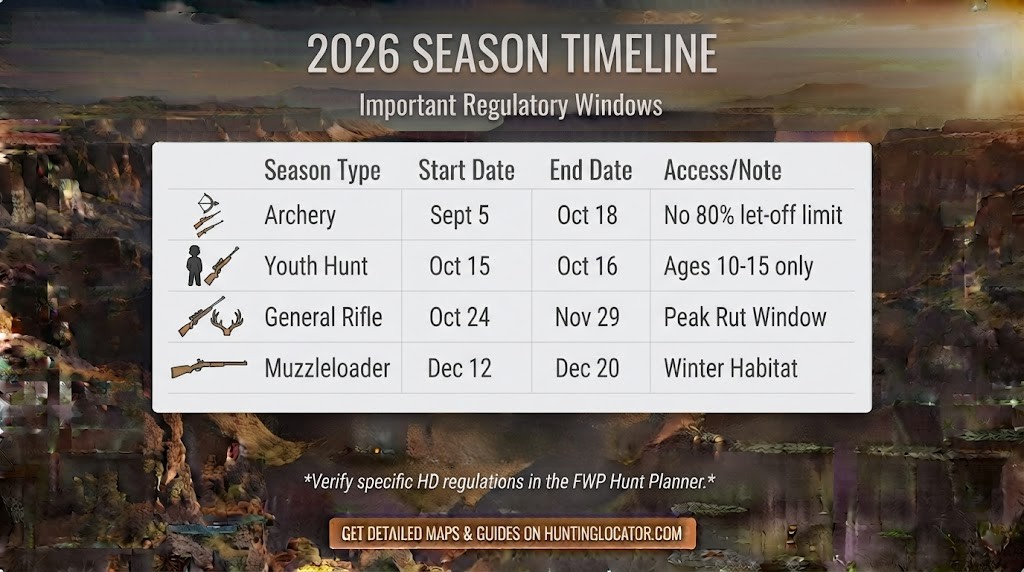
| Season Type | Dates (2026) | Bag Limit |
|---|---|---|
| Archery | Sept 5 – Oct 18, 2026 | 1 buck per season |
| Youth Two-Day Hunt | Oct 15 – 16, 2026 | Per license |
| General Rifle | Oct 24 – Nov 29, 2026 | 1 deer per license |
| Muzzleloader | Dec 12 – 20, 2026 | Per license/district |
| Backcountry Archery (HDs 150, 280, 316) | Sept 5 – Sept 13, 2026 | Per regulations |
| Backcountry General (HDs 150, 280, 316) | Sept 14 – Nov 29, 2026 | Per regulations |
| Shoulder Seasons (Select HDs) | Aug 14, 2026 – Feb 14, 2027 | Varies by district |
Before you head afield, confirm these requirements:
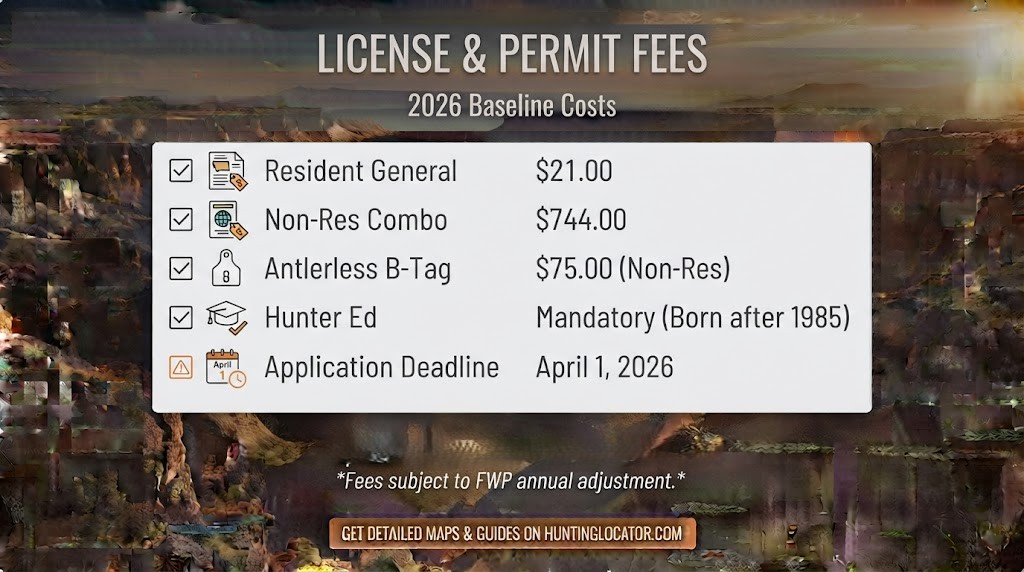
- Hunter Education — If you were born on or after January 1, 1985, you must complete a hunter education course before purchasing a Montana hunting license. This applies to residents and nonresidents alike.
- License vs. Tag — A license authorizes you to hunt; a tag is the document you attach to your harvested animal. You need both.
- Application Deadline — The Montana deer application deadline is April 1, 2026 — a hard cutoff, especially for nonresidents applying through the draw.
- Resident vs. Nonresident Pathways — Residents purchase a general deer license directly; nonresidents must draw a combination license through the annual application process (details in the Licenses section below).
- Verify Before You Apply — Confirm time-sensitive details directly with Montana FWP before submitting any application.
Montana Deer Hunting Seasons
Montana’s season structure runs from early September through mid-February — one of the longest deer hunting windows in the West. The state holds both mule deer and whitetail, with mule deer dominant on the eastern plains and whitetails concentrated along river bottoms and creek drainages. For a species-level breakdown, see the Montana deer hunting season guide. Below is what you need to know about each 2026 season window.
Archery Season
Montana’s archery deer season runs September 5 through October 18, 2026, with a bag limit of 1 buck per season. Deer are in summer patterns early on and shift toward pre-rut behavior as October approaches.
One equipment change for 2026: Montana removed the 80% let-off limit on bows, giving bowhunters more flexibility than in prior seasons. The archery window also opens weeks before rifle pressure begins, when deer movement is still predictable.
Youth Two-Day Hunt
Montana’s Youth Two-Day Hunt runs October 15–16, 2026 — one week before the general rifle opener. Eligibility requirements are specific:
- Licensed hunters ages 12–15 who have completed hunter education, accompanied by a non-hunting adult at least 18 years of age
- Apprentice hunters ages 10–15 who are properly certified and licensed, accompanied by a non-hunting adult mentor at least 21 years of age
- This hunt is for deer only — elk hunting is prohibited during this window
The timing gives young hunters a lower-pressure experience before the general season crowds arrive, and is a practical entry point for families new to Montana deer hunting.
General Rifle Season
The general rifle season runs October 24 through November 29, 2026, with a bag limit of 1 deer per license. The 37-day season overlaps directly with peak rut, when buck movement is at its annual high and encounter opportunities increase.
Eastern Montana regions 6 and 7 draw the majority of nonresident deer hunting pressure, with more than 11,000 nonresident deer tags sold in those two regions alone in recent seasons. For most nonresidents who draw a combination license, this is the window their trip is built around.
Muzzleloader Season
Montana’s muzzleloader season runs December 12–20, 2026 — nine days in winter, with bag limits per license and district. By December, deer are concentrated in winter habitat: feeding areas, sheltered draws, and south-facing slopes where snow conditions are more manageable. The season demands preparation, but delivers a quieter hunting experience than the crowded fall windows.
Backcountry & Shoulder Seasons
Montana offers two additional season structures for hunters willing to work for the opportunity.
Backcountry Seasons apply to hunting districts 150, 280, and 316. Archery runs September 5–13 and the general backcountry season runs September 14 through November 29, 2026. The terrain is demanding and access is genuinely remote, but deer in these units see far less hunting pressure than those in the general season areas.
Shoulder Seasons run August 14, 2026 through February 14, 2027 in select hunting districts where FWP is actively managing deer numbers. Rules and species restrictions vary significantly by district. These extended seasons give resident hunters access to deer and reduced competition that doesn’t exist in the standard season structure. Confirm your specific HD’s regulations directly with Montana FWP before making plans.
Montana Deer Licenses and Permits
Your license authorizes you to hunt; your tag goes on the animal. You need both before you head afield. This section covers what you need, what it costs, and how to get it.
Montana Hunting Licenses
The resident and nonresident pathways differ substantially, and understanding that distinction upfront matters.
Residents purchase a general deer license directly — no draw required for the general season. The process is straightforward, though 2026 regulatory changes cap resident purchases at three deer licenses, down from eight in prior years.
Nonresidents face a different system. Montana limits nonresident big game access through a draw — there is no over-the-counter pathway for deer. Nonresidents must apply during the March 1 – April 1, 2026 window and draw a combination license through a random computer drawing. Those who draw hunt with less pressure than equivalent over-the-counter destinations — the draw system limits total nonresident hunters in any given season.
| License / Tag Type | Resident Fee | Nonresident Fee |
|---|---|---|
| General Deer License / Tag | $16 | N/A (see Combination) |
| Deer Combination License (General) | N/A | $744 |
| Deer Combination License (Youth) | N/A | $448 |
| Deer B Tag (Antlerless / Private Land) | $10 | $75 |
A few notes on the fee structure:
- The nonresident combination license bundles deer hunting privileges with additional Montana hunting and fishing rights. It is a Montana requirement for all nonresident big game hunters.
- Nonresidents must hold a big game or deer combination license to apply for a B (antlerless) license — you cannot apply for a B tag without the combination license.
- Montana residents age 17 and under, holders of a disabled resident conservation license, or residents age 62 and older may qualify for a reduced-fee license tier — confirm current pricing directly with FWP.
- Always verify current fee structures at fwp.mt.gov before purchasing.
Montana Deer Permits
Beyond the general license, Montana’s permit system adds additional layers of opportunity — and complexity — for both residents and nonresidents.
The B License (Antlerless Tag): The B License is an antlerless deer license valid during a specific time period and in a particular hunting district or group of districts. Applicants pay the full license fee, which includes a $5 nonrefundable application fee. For 2026, the significant change is that most mule deer B licenses are now restricted to private land only. If you’re planning on a B tag for public land antlerless hunting, confirm your specific district’s rules before applying.
The Draw System & Preference Points: Montana’s nonresident draw uses a preference point system. Notably, 25% of all big game combo tags are issued to applicants with no preference points, so first-year applicants have a real chance at drawing. Applications open online March 1, 2026 at 5:00 a.m. MST, with a hard deadline of April 1, 2026.
Landowner Permits: In Montana, 15% of all permits for elk and deer can go to landowners. The landowner draw takes place before the regular draw, and any special permit that a nonresident landowner draws counts against the 10% nonresident quota for that unit.
Where to Buy: All licenses and tags are purchased through the Montana FWP online licensing portal at fwp.mt.gov. In-state license vendors may also be available, but the online system is most reliable for time-sensitive applications.
Montana Deer Hunting: Where to Hunt
Montana spans over 147,000 square miles, and access strategy matters as much as timing. Options range from vast public land to leased private ground, with guided hunts available for nonresidents who want logistics handled. Here’s how to think through your access plan for 2026.
Best Public Lands for Deer Hunting in Montana
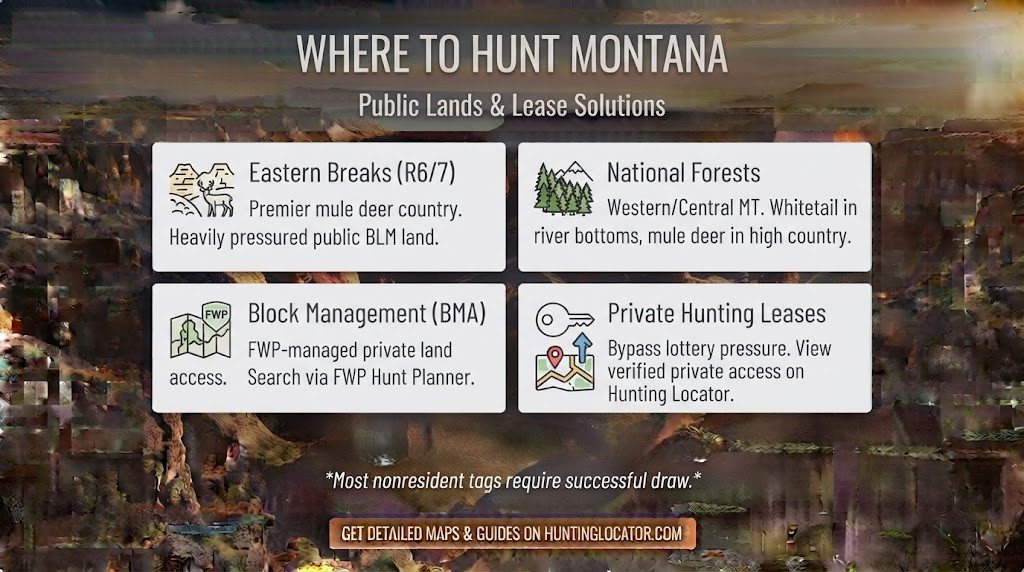
Montana offers nearly 16 million acres of national forest and over 8 million acres of BLM land. The challenge isn’t finding public land — it’s finding ground that isn’t already heavily hunted.
Finding a 150-inch mule deer buck on public land is harder today than it’s been at any point in the last decade, particularly in eastern Montana where population and hunting pressure have compounded. Hunters who scout thoroughly still find quality deer on public ground every season, but the work is real. Top public land options include:
- National Forest Land — Montana’s national forests cover the western and central mountains, offering whitetail habitat in river drainages and mule deer in transition zones. The Bitterroot, Gallatin, Lewis and Clark, and Custer Gallatin National Forests all hold deer.
- BLM Land (Eastern Montana) — The breaks country along the Missouri and Yellowstone Rivers is Montana’s best mule deer country. Eastern regions 6 and 7 draw the most nonresident mule deer hunting pressure, and that pressure has grown in recent years.
- Block Management Areas (BMAs) — Montana FWP’s Block Management Program opens private land to public hunting through voluntary landowner agreements. BMAs are scattered statewide and can provide good hunting, though availability changes annually. Check the Montana FWP Hunt Planner for current BMA locations in your target district.
- State Trust Lands — Montana’s state trust land is open to public hunting with a Conservation License and tends to get less attention than federal land, which can mean less pressure.
- Wildlife Management Areas (WMAs) — FWP-managed WMAs are designed for wildlife habitat and hunting access, often adjacent to larger public land blocks.
For district-level research, use the Montana FWP Hunt Planner for public land boundaries, and supplement with onX Hunt for parcel-level ownership detail.
Private Land Hunting with Hunting Locator
The largest bucks in most Montana hunting districts spend most of their time on private ground. Access to private land is typically built through landowner relationships developed over the spring and summer — a slow process that’s difficult for self-guided nonresidents and residents new to an area.
A hunting lease provides legal, exclusive access to private property for a defined season, without the years of relationship-building that informal access usually requires. Hunting Locator’s Montana lease listings connect hunters directly with landowners across the state who are ready to lease for the 2026 season. The platform lets you search by location, acreage, and game type — whether you’re looking for river-bottom whitetail ground, eastern Montana mule deer country, or a multi-species property covering deer, elk, and upland birds. For hunters interested in a longer-term commitment, Hunting Locator also lists Montana hunting properties for sale.
Browse available Montana hunting leases and secure access before the season opens.
Guided Hunts in Montana
For nonresidents especially, a guided deer hunt removes most of the logistical friction — land access, scouting, field care, and local knowledge come with the package.
Montana does not require nonresidents to hire a guide to hunt deer, which distinguishes it from some other Western states. That said, guided hunts offer real advantages for hunters new to Montana’s terrain, working on a short timeline, or targeting a specific class of buck. Key details:
- Cost Range — Guided deer hunt packages in Montana start around $8,450 per hunter for a quality outfit, with prices varying by species, duration, and region. This typically includes lodging, meals, field care, and in-area transportation.
- Private Land Access — Established outfitters have landowner relationships built over years or decades. Booking a guided hunt often means access to ground that isn’t available through any other channel.
- Nonresident Draw Still Required — Even with a guide booked, nonresidents must draw their combination license through the April 1 application process. Your outfitter will typically help navigate this, but the draw is your responsibility.
- Finding Reputable Guides — Hunting Locator’s outfitter and guide directory lists Montana guide services and makes it easier to compare options before booking.
Deer Hunting Tips for Montana Success
Montana rewards preparation. Whether you’re hunting mule deer in the breaks or whitetails along a cottonwood-lined river bottom, showing up ready matters. Here are practical tips for a successful 2026 season, along with gear from the Hunting Locator store:
- Scout Early — Mule deer and whitetail patterns shift significantly between early season and the rut. Use satellite imagery and mapping apps to identify food sources, water, and terrain pinch points before the opener. Hunters who fill tags on opening day started scouting in August.
- Know Your District — Regulations, seasons, and bag limits vary across Montana’s hunting districts. Download your district’s specific regulations from Montana FWP and read them before you hunt.
- Dress for Montana Weather — October and November can move from mild afternoons to blizzard conditions within a day. A layering system built around merino wool base layers, insulated mid-layers, and waterproof shells is standard. Find cold-weather hunting clothing at the Hunting Locator store.
- Hunt the Rut Window — The general rifle season (Oct 24 – Nov 29) overlaps peak rut, when buck movement is at its highest. Concentrate on rutting sign — scrapes, rubs, and doe concentration areas — to put yourself in position for the best encounters of the season.
- Invest in Optics — Montana’s open country demands quality glass. A riflescope and binoculars suited for low-light conditions are worth the investment here. Browse optics and gear at the Hunting Locator store.
- Secure Private Land Access Before Opening Day — Lack of access to quality ground is a more common reason for going home empty-handed than bad luck. Lock in your lease through Hunting Locator well before the season opens.
- Practice at Distance — Montana’s terrain often means longer shots than eastern hunters are used to. Practice at 200–400 yards before the season and carry a quality rangefinder for ethical shot selection. Find rangefinders and accessories at the Hunting Locator store.
- File a Hunt Plan — Before any solo backcountry hunt, tell someone your specific location, planned return time, and emergency contacts. Cell service is unreliable across much of Montana’s prime deer country.
More Resources from Hunting Locator
Hunting Locator covers Montana hunting planning from season dates to land access to gear. Relevant resources for 2026 Montana deer hunters:
- Montana Hunting Overview — General regulations, license information, and access strategies across all species.
- Montana Deer Hunting Season Guide — Species-specific biology, tactics, and historical season context for both mule deer and whitetail in Montana.
- Montana Elk Hunting Season — Season dates, license requirements, and access strategies for hunters combining an elk tag with their deer trip.
- Montana Antelope Hunting Season — Eastern Montana pronghorn hunting during the general season window.
- Montana Turkey Hunting Season — Spring turkey season structure and public/private access options.
- Montana Black Bear Hunting Season — Spring and fall bear hunting regulations for multi-species hunters.
- Montana Waterfowl Hunting Season — River systems and prairie potholes during the fall deer season window.
- Montana Moose Hunting Season — The draw process and where moose hunting occurs statewide.
- Montana Mountain Goat Hunting Season — One of Montana’s most demanding hunting opportunities.
- Montana Bighorn Sheep Hunting Season — Applying for and hunting bighorn sheep in Montana.
- Montana Mountain Lion Hunting Season — Montana’s quota-based lion season and permitted hunting methods.
- Montana Bison Hunting Season — Montana’s limited bison hunting opportunities and how to apply.
- Montana Bobcat Hunting Season — Bobcat hunting and trapping opportunities for hunters looking to extend their time afield.
- Montana Wolf Hunting Season — Wolf season regulations and quotas.
- Montana Game Bird Hunting Season — Pheasant, grouse, partridge, and upland bird seasons that run concurrent with deer season.
- Montana Hunting Leases — Current private land lease listings across Montana, searchable by location, acreage, and game type.
Frequently Asked Questions
When does Montana deer season open in 2026?
The first season to open is archery, which begins September 5, 2026. The Youth Two-Day Hunt runs October 15–16, the general rifle season opens October 24, and the muzzleloader season runs December 12–20. Shoulder seasons in select districts begin as early as August 14, 2026. See the full season table in the Quick Overview section for all dates.
How much does a Montana deer license cost for nonresidents in 2026?
Nonresidents must draw a combination license to hunt deer in Montana. The General Deer Combination License costs $744 for adults and $447.50 for youth nonresidents. A B Tag (antlerless/private land) costs an additional $75 for nonresidents. There is no over-the-counter nonresident deer tag — the draw is the only pathway.
What is the application deadline for Montana deer tags?
The application deadline is April 1, 2026, with applications opening online March 1, 2026 at 5:00 a.m. MST. Missing this deadline means waiting until the 2027 cycle. Nonresidents should prepare application materials well in advance.
Do nonresidents need to hire a guide to hunt deer in Montana?
No. Montana does not require nonresidents to hire a licensed guide or outfitter to hunt deer. Nonresidents can self-guide on public land or through a private land lease. Guided hunts do offer advantages in land access and local knowledge, particularly for first-time visitors.
What is the Montana deer B tag, and how has it changed for 2026?
The B Tag is an antlerless deer license valid in specific districts during specific time windows. For 2026, the major change is that most mule deer B licenses are now restricted to private land only — public land antlerless mule deer opportunities have been significantly curtailed. Resident B tags cost $10; nonresident B tags cost $75, and nonresidents must hold a combination license to apply.
Can youth hunters participate in Montana’s deer season before the general opener?
Yes. Montana’s Youth Two-Day Hunt runs October 15–16, 2026 — one week before the general rifle opener. Eligible youth are ages 10–15. Hunters ages 12–15 must have completed hunter education and be accompanied by a non-hunting adult (18+); apprentice hunters ages 10–15 must be accompanied by a non-hunting adult mentor (21+). This hunt is for deer only — elk hunting is prohibited during this window.
Planning for 2026
The 2026 season is more restricted than it was five years ago — fewer licenses, tighter access, and more competition for public ground. Preparation matters more as a result. Hunters who fill tags this fall will be the ones who confirmed their licenses early, secured land access before the season, and arrived with a clear plan.
Your next step is to browse available Montana hunting leases on Hunting Locator and lock in private land access before the season opens. Quality ground fills quickly.


