This Wisconsin Bear Season Guide for 2026 is written for the permit holder finishing out the season, the hound or bait crew facing the Oct. 6 to Oct. 7 changeover, and the hunter still building preference points. It covers zone dates, licenses, the draw, where to hunt, and how to register your bear. Hunting Locator is the place to confirm the rules, find private ground, and gear up for bear season.
Inside:
- Zone-by-zone 2026 season dates by method (bait, dogs, other legal methods)
- Class A bear license costs, the $4.50 application, and how preference points work
- Where to hunt: public land, Wisconsin bear hunting leases, and guided options
Your zone determines the rules, so the at-a-glance section comes first.

Wisconsin Bear Season 2026: Quick Overview
The 2026 season runs Sept. 9 to Oct. 13, and your rules depend on your bear management zone (A through F), as outlined in the Wisconsin DNR’s 2026 season announcement. The DNR puts the state’s bear population at roughly 24,000 animals, and 2026 is a record year for licenses. Time-sensitive: the Zones A/B/D combined period ends Oct. 6; Oct. 7-13 is dogs only.
| Zone group | Method period | Dates | Bag limit | Notes |
|---|---|---|---|---|
| A, B, D (dogs permitted) | Bait + other legal methods, no dogs | Sept. 9-15 | 1 bear per carcass tag/license year | No hounds yet |
| A, B, D | Dogs, bait, and legal methods | Sept. 16-Oct. 6 | 1 bear | Ends Oct. 6 |
| A, B, D | Dogs only | Oct. 7-13 | 1 bear | No bait or other methods |
| C, E, F (dogs prohibited) | Bait + legal methods, no dogs | Sept. 9-Oct. 13 | 1 bear | Dogs never allowed |
Cubs and adult bears accompanied by cubs are strictly protected. Register through GameReg by 5:00 PM the day after recovery and submit two upper premolar teeth.
Access is draw-based, so several pieces have to be in place before you head afield. For statewide license and education details, see the Wisconsin hunting guide.
- Application: Apply through Go Wild or a license agent. The fee is $4.50 for residents and nonresidents.
- Class A bear license plus paper carcass tag: Both are required to harvest. The license is your legal authority to hunt bear, and the tag is what you attach to the animal.
- Hunter education: Statewide hunter education is generally required for hunters born on or after Jan. 1, 1973. Confirm your status with the DNR.
- Post-harvest: Register through GameReg by 5:00 PM the day after recovery, then submit two upper premolar teeth.
Wisconsin Bear Hunting Seasons
Wisconsin’s dog zones (A, B, and D) split the season into three method periods, while Zones C, E, and F run one continuous no-dog season. Bears live mostly in the forested north and center, so confirm your licensed zone first. It determines your legal methods and dates.
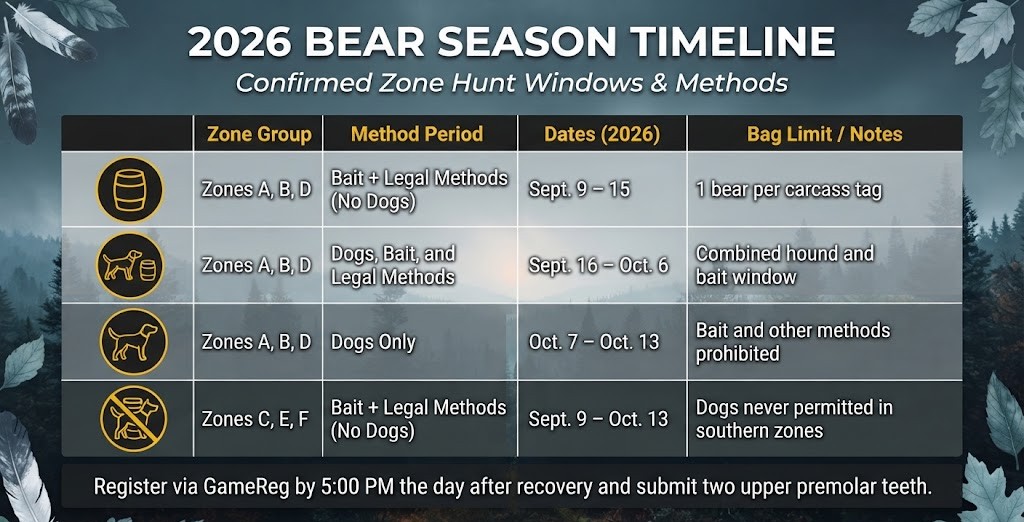
Season 1: Bait and Legal Methods, Sept. 9-15 (Zones A, B, D)
This opening window allows bait and other legal methods, with no dogs. It favors bait hunters who patterned bears ahead of the opener.
Wisconsin bear baiting regulations apply here. Per the DNR, bait placement may begin April 15, the limit is 10 gallons, and no animal parts are allowed. Check current DNR regulations before placing bait.
Season 2: Dogs, Bait, and Legal Methods, Sept. 16-Oct. 6 (Zones A, B, D)
Hounds, bait, and other legal methods all overlap in this period.
As of Oct. 5, this window closes Oct. 6.
Bait and hound groups share the woods, so respect landowners and other hunters. Check the DNR’s hound regulations for equipment rules before you run dogs.
Season 3: Dogs Only, Oct. 7-13 (Zones A, B, D)
Bait and other methods are not legal in this period. If you plan to hunt bear with hounds in Wisconsin, confirm bait-site cleanup requirements with the DNR before the changeover.
Zones C, E, and F: The season runs Sept. 9 to Oct. 13 with bait and legal methods only. Dogs are never permitted. Per the DNR, most of 2026’s record license increase went to the southern zones.
Wisconsin Bear Hunting Licenses and Permits
The draw is competitive. DNR figures show more than 34,000 applicants for 15,245 licenses, with about 106,000 more people buying preference points. Even in a record license year, drawing a tag is hard.
Wisconsin Hunting Licenses
| License | Resident | Nonresident | Notes |
|---|---|---|---|
| Bear application fee | $5 | $5 | Required to enter the drawing or earn a point |
| Class A bear license | $49.00 | $251.00 | Purchased after you’re drawn |
| Under 12 years old | $7.00 | $7.00 | Youth rate |
| Eligible military | N/A | $49 | Nonresident eligible military rate |
The Class A license comes with a paper carcass tag, and both are required to harvest. The bag limit is 1 bear per carcass tag per license year. For newer hunters, the DNR’s Learn to Hunt Bear program is a good starting point.

Wisconsin Hunting Permits
A harvest authorization is the permit you win in the drawing, and a preference point is a banked credit that improves your odds in later drawings.
Points work like this:
- Each year you don’t draw, you bank a point.
- The hunters with the most points draw first in each zone.
- You lose all points after 3 consecutive years without applying.
Draws can take several years, especially in northern zones. Hunting Locator’s seasons guide cites 7+ years in most zones.
To apply:
- Log in: Sign into Go Wild or visit a license agent.
- Choose your zone: Or choose to buy a preference point only.
- Pay the fee: Pay the $4.50 before the December deadline. The 2026 deadline was Dec. 10, 2025, so confirm the 2027 date with the DNR.
- Check results: Drawing results come in February.
- Buy your license: If drawn, buy your Class A license and receive your carcass tag.
Nonresident note: Nonresidents enter the same drawing and pay the same $4.50 application fee. The nonresident Class A license is $251.
Where to Hunt Bear in Wisconsin
Land choice matters nearly as much as the draw. Bears concentrate in the forested north and center of the state, and your hunting ground must sit inside the zone you’re licensed for.
Best Public Lands
Northern public ground is vast but can be crowded, especially for hound groups, and hunters often compete for bait sites. Start with these:
- Chequamegon-Nicolet National Forest: Large northern forest with extensive bear habitat.
- Northern county forests: Large blocks of public ground across the north.
- Northern state forests: Additional public options, so check property-specific rules.
Confirm which zone each property falls in before you commit to a spot.

Private Land Hunting with Hunting Locator
Tags are draw-limited and hard to earn. Public land in the north is crowded, hound hunters need dog-friendly permission, and bait hunters need undisturbed sites. Private access takes pressure off all of that.
Leasing vs. buying:
- Leasing: Lower upfront cost and seasonal or annual access. It suits nonresidents and groups.
- Buying: Hunting land for sale in Wisconsin gives you long-term control over bait sites and access, though it’s a bigger investment.
Either way, settle a few questions with the landowner: whether baiting or hounds are allowed, where the boundaries run, and which zone the property sits in.
Hunting Locator connects hunters directly with landowners who will lease or sell. You can search by state, game type, or acreage, and the Wisconsin bear hunting lease listings are updated by the landowners themselves. Browse the current Wisconsin listings and look for property details such as county, acreage, and game types. Join Hunting Locator to connect with Wisconsin landowners.
To line up ground before the 2027 draw results land, browse Wisconsin hunting leases now.
Guided Hunts
Bear guides and outfitters can fill the gap for hunters without local bait sites or hounds. That’s especially true for nonresidents spending $251 on a rare tag.
A guide makes sense if:
- You’re a nonresident with no local knowledge.
- You have no established bait sites.
- You want a hound hunt but don’t run dogs.
Ask any outfitter:
- How are bait sites managed, and when were they started?
- Which zone do you hunt? Does it match my license?
- Do you run dogs, and in which periods?
- What lodging is offered?
- How is meat care and processing handled?
- What are realistic success expectations?
To connect with outfitters and landowners, start with the Wisconsin listings page and the Hunting Locator homepage.
Bear Hunting Tips
Wisconsin bear season rewards hunters who prepare early, wait for good shots, and follow the rules.
- Know your zone rules cold: Methods change by date in Zones A, B, and D, so a legal setup on Oct. 6 is illegal on Oct. 7.
- Pattern bait sites early with trail cameras: Cameras tell you when bears visit and what size they are. Pair bear prep with deer season, since the same cameras and stands serve both.
- Control scent: Bears have exceptional noses, so scent-control gear is worth the investment.
- Play the wind: Set stands downwind of bait so your scent doesn’t reach approaching bears.
- Climb safely: Use a full-body harness every time you leave the ground. Tree stand and safety gear is a category worth getting right.
- Place shots ethically: Aim broadside or quartering away, behind the front shoulder, and wait for a clear shot. Good optics help you judge the animal.
- Judge cubs and sows carefully: Take time to watch for trailing cubs. Cubs and sows accompanied by cubs are illegal to shoot.
- Plan your recovery: Mark the hit, wait, and track carefully.
- Care for meat fast: Cool the carcass quickly. Bear meat care starts in the field.
- Register on time: Use GameReg by 5:00 PM the day after recovery, and submit two upper premolars.
- Hound hunters, know your area: Researchers have documented that wolves sometimes kill hunting dogs released near bear bait sites.
Explore bear gear in the Hunting Locator store to get ready for your next hunt.
More Resources from Hunting Locator
More Hunting Locator guides and tools for planning:
Plan
- Wisconsin hunting guide: licenses, education, and statewide rules
- Wisconsin hunting seasons overview: every season in one place
Species guides
- Bear season details: a companion look at Wisconsin’s bear season
- Whitetail deer season: dates and rules for Wisconsin’s most popular game
- Turkey season: spring and fall turkey details
- Small game season: easy-access hunting while you wait on a bear tag
- Waterfowl season: duck and goose seasons by zone
- Bobcat season: another predator opportunity
Access and gear
- Wisconsin hunting leases: browse private land available for lease
- Hunting Locator store: gear for the season ahead
- Hunting Locator homepage: search leases, outfitters, and guides nationwide
FAQ
When do I apply for a 2027 Wisconsin bear permit?
Applications are due in December through Go Wild or a license agent. The 2026 deadline was Dec. 10, 2025, and the drawing happens in February. Confirm the exact 2027 deadline with the Wisconsin DNR before you apply.
How do Wisconsin bear preference points work?
Each year you don’t draw, you bank a point, and applicants with the most points draw first in each zone. You lose all points after 3 consecutive years without applying. Draws can take several years, especially in northern zones.
How much does a nonresident bear license cost in Wisconsin?
The nonresident Class A bear license is $251, plus the $4.50 application fee. Hunters under 12 pay $7, and eligible military pay $49. The license is purchased after you’re drawn.
Can I hunt bear with dogs in Zone C?
No. Dogs are prohibited in Zones C, E, and F, which allow bait and legal methods only from Sept. 9 to Oct. 13. Hounds are allowed only in Zones A, B, and D.
Can I use bait Oct. 7-13 in Zones A, B, or D?
No. Oct. 7-13 is dogs only in those zones. The combined dogs, bait, and legal-methods period ends Oct. 6.
Can I shoot a cub or a sow with cubs?
No. Harvesting cubs or adult bears accompanied by cubs is strictly prohibited. The bag limit is 1 bear per carcass tag, so take your time confirming what you’re looking at.
How do I register a bear in Wisconsin?
Register electronically through GameReg by 5:00 PM the day after recovery. You must also submit two upper premolar teeth, which are used for population monitoring.
What can I hunt while waiting for a bear permit?
Spring turkey shares the December application timing, so check the turkey guide. Small game offers easy access, and the small game guide covers the details. Bobcat is another predator opportunity in the bobcat guide.
The Final Shot
Know your zone, respect the Oct. 6 to Oct. 7 changeover, protect cubs and sows, and register through GameReg on time. Those four habits keep your hunt legal. That’s the core of this Wisconsin Bear Season Guide for 2026.
Apply in December, and secure ground well before the February draw. Whether you’re banking points or filling a tag, Hunting Locator can help with dates, ground, and gear. Start planning next season’s ground now with the Wisconsin leases page.


