This Texas mule deer guide covers the 2026–2027 regulations for residents and non-residents. Texas is roughly 95% private land, so access matters as much as the calendar. Pick up gear for Texas hunting early, since open-country mule deer reward good optics and a well-prepared kit.
Dates verified for the 2026–2027 license year.
Inside:
- Archery and general season dates for the Panhandle and Trans-Pecos
- Bag limits, the 20-inch antler rule, and the licenses you need, including non-resident specifics
- Where to hunt: public land, private leases, and guided options, plus field tips
Start with the overview below, then go to the sections that apply to you.
Texas Mule Deer Season 2026 at a Glance
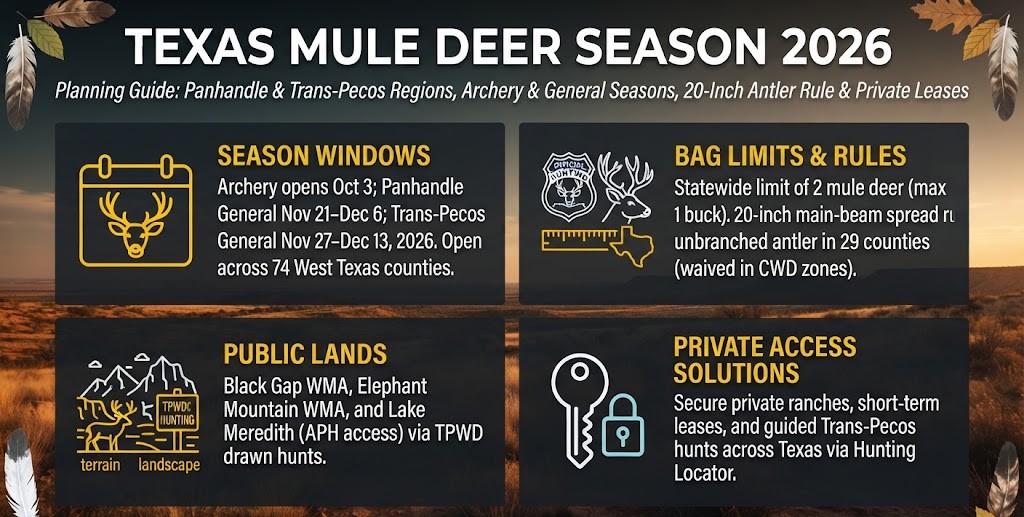
The Texas mule deer season runs October 3 through December 13, 2026, depending on region and method, with a statewide limit of 2 mule deer and no more than 1 buck.
Mule deer hunting happens only in the Panhandle and Trans-Pecos regions of far West Texas. According to TPWD, mule deer seasons are open in 74 counties.
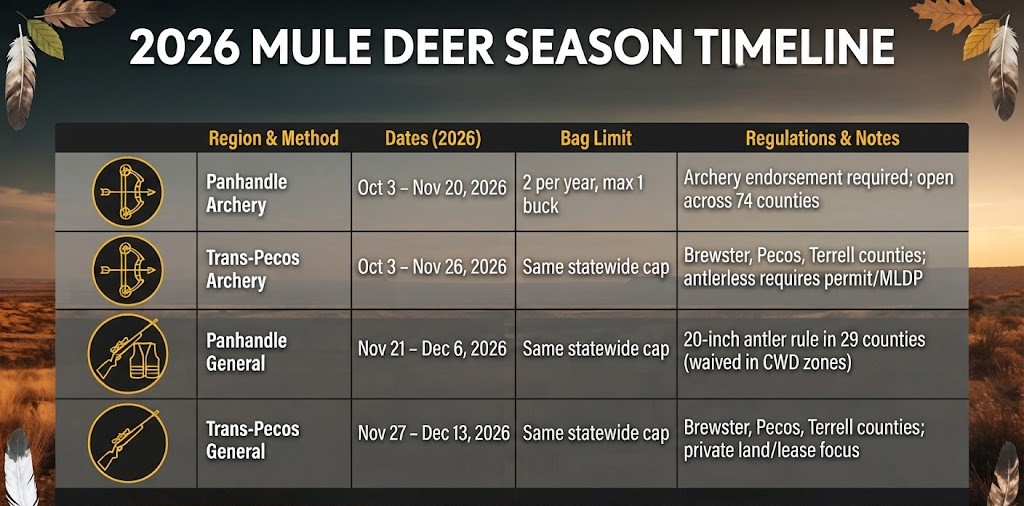
| Region/Method | Dates | Bag Limit | Regulations | Notes |
|---|---|---|---|---|
| Panhandle Archery | Oct 3 – Nov 20, 2026 | 2 per license year, max 1 buck (county limits apply) | Archery endorsement required; 20-inch/unbranched rule in designated counties | Open now |
| Trans-Pecos Archery (Brewster, Pecos, Terrell) | Oct 3 – Nov 26, 2026 | Same statewide cap | Archery endorsement; antlerless only with MLDP or antlerless permit | Open now |
| Panhandle General | Nov 21 – Dec 6, 2026 | Same statewide cap | 20-inch/unbranched rule in 29 counties (waived in CWD zones) | Secure private access early |
| Trans-Pecos General (Brewster, Pecos, Terrell) | Nov 27 – Dec 13, 2026 | Same statewide cap | Antlerless only with MLDP or antlerless permit | Mostly private land; see leases |
Most of the ground you’ll hunt is private, so start with current Texas hunting leases. Dates shifted from the 2025–26 season, so check any older calendar or printed schedule before you book a trip.
Here is what you’ll need to carry in the field:
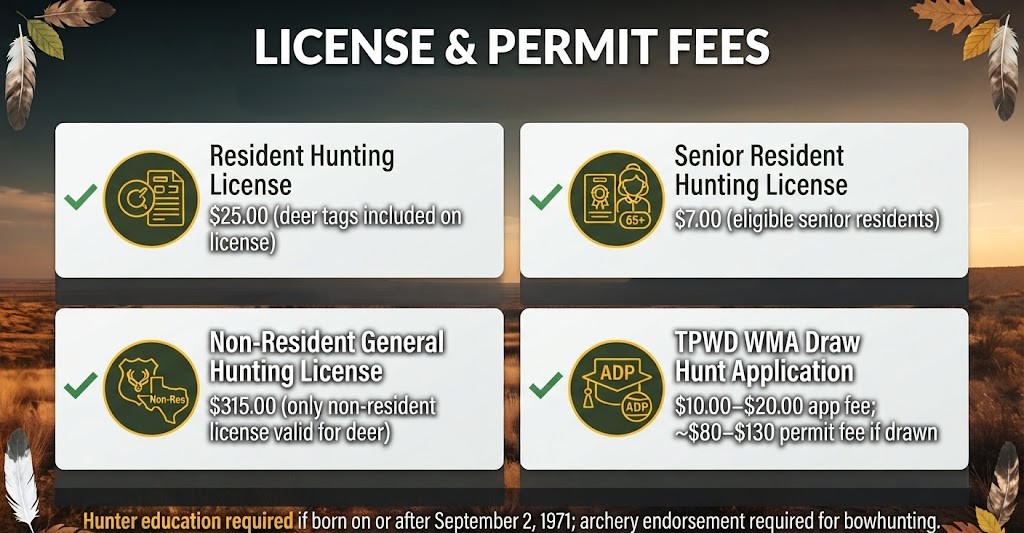
- Resident hunting license: $25 (senior resident: $7)
- Non-resident general hunting license: $315, the only non-resident license that covers deer
- Archery endorsement: required for the archery-only season
- Hunter education: required if you were born on or after September 2, 1971
- Antlerless permit or MLDP tag: required to take does where applicable
Bag limits are set county by county within the statewide cap. Confirm county limits, CWD zones, and carcass movement rules in the TPWD Outdoor Annual before every trip.
Texas Mule Deer Hunting Seasons for 2026
The general season runs November 21–December 6, 2026 in the Panhandle and November 27–December 13 in the Trans-Pecos, with archery opening in both regions on October 3. For the full regulatory calendar, see the official TPWD 2026-2027 season dates.
To plan a broader year of hunting, see every Texas season in one place. If you also hunt whitetails, note that Texas whitetail deer season bag limits are separate from your mule deer limit.
Archery Season (Panhandle and Trans-Pecos)
Archery runs October 3 through November 20 in the Panhandle and October 3 through November 26 in the Trans-Pecos. You need an archery endorsement, and the season is open now.
Early-season days can run warm, so bring extra water and plan for quick meat care. Archery also offers the longest window on the calendar, with more weeks to scout, glass, and wait for the right buck.
Panhandle General Season
The Panhandle general season runs November 21 through December 6, 2026. In 29 counties, a legal buck must have an outside main-beam spread of at least 20 inches or at least one unbranched antler. That restriction is waived in designated CWD zones.
Rules vary by county, so confirm yours in the TPWD Outdoor Annual before you go. Judging a buck at 300 yards is hard, so decide ahead of time what you’ll pass on.
Trans-Pecos General Season
The Trans-Pecos general season runs November 27 through December 13, 2026, in Brewster, Pecos, and Terrell counties. Antlerless mule deer may be taken only with an MLDP tag or an antlerless mule deer permit. Terrell County is also among the antler-restriction counties, so verify it in the Outdoor Annual.
The hunting differs from whitetail country. Instead of sitting a feeder stand, you’ll glass open desert and plan spot-and-stalk approaches across rugged terrain.
Texas Mule Deer Licenses and Permits
Texas residents hunt mule deer on a $25 resident hunting license. Non-residents must buy the $315 non-resident general hunting license.
Texas Hunting Licenses
| License | Who | Cost | Covers Mule Deer? | Notes |
|---|---|---|---|---|
| Resident Hunting License | Texas residents | $25 | Yes | Deer tags printed on license |
| Senior Resident Hunting License | Eligible senior residents | $7 | Yes | Confirm age eligibility with TPWD |
| Non-Resident General Hunting License | Non-residents | $315 | Yes | Only non-resident license valid for deer |
| Non-Resident 5-Day / Special License | Non-residents | Varies | No | Small game/exotics only; won’t cover deer |
If you’re coming from out of state:
- Buy the $315 general license.
- Complete hunter education if you were born on or after September 2, 1971.
- Add the archery endorsement if you’re bowhunting.
- Skip the 5-day license if you’re after deer, because it doesn’t cover them.
No draw is required for general-season licensing. Rimfire ammunition is not legal for mule deer, so leave the .22 at home. License prices can change, so confirm current costs with TPWD before you buy.
Texas Hunting Permits
Beyond your license, a few permits may apply depending on where and how you hunt:
- Managed Lands Deer Permit (MLDP): Issued to enrolled properties and used for antlerless harvest. Your landowner or outfitter can tell you whether their property participates.
- Antlerless mule deer permit: Required in Brewster, Pecos, and Terrell counties when no MLDP tag is available.
- Black Gap WMA public hunt: About $130 per adult. Youth hunt free.
- Annual Public Hunting (APH) permit: Opens APH-enrolled lands such as Lake Meredith near Amarillo. Check TPWD for the current APH permit price.
Public WMA hunts run through TPWD’s drawn hunts system. To apply:
- Create a TPWD account. You’ll use it for every application.
- Choose a hunt category and area. Pick the hunt that fits your dates and method.
- Pay the application fee. Fees are typically modest.
- Await results. TPWD notifies applicants after the draw.
- Pay the permit fee if drawn. This secures your spot.
On cost, Texas mule deer hunting basics puts application fees at around $10–$20, with access fees of roughly $80–$130 if you’re drawn. Licenses are sold through TPWD online and at licensed retailers.
Where to Hunt Mule Deer in Texas
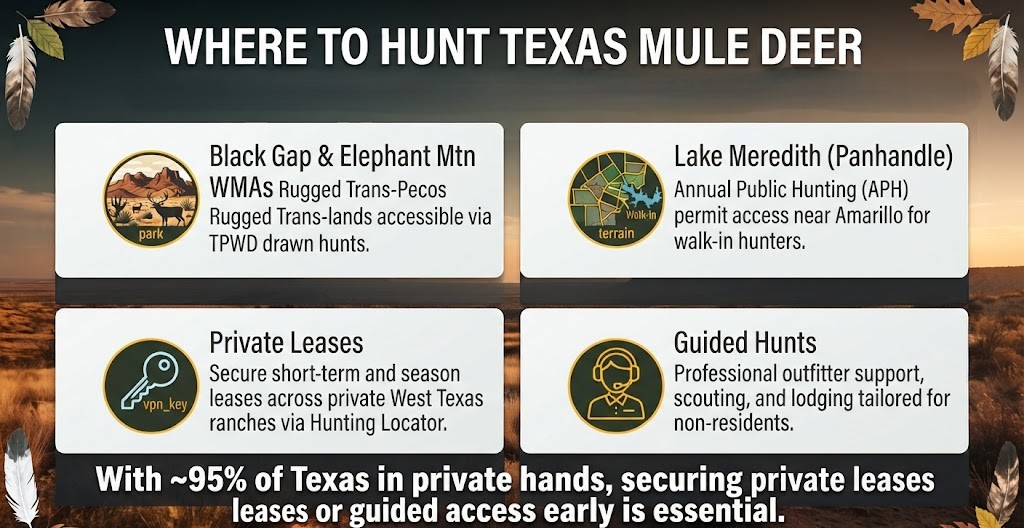
Most Texas mule deer hunting happens on private land in the Panhandle and Trans-Pecos, with limited public opportunities through TPWD drawn hunts and APH lands. If you want to stretch the trip, pair your trip with pronghorn in the same open country.
Best Public Lands
Public mule deer ground is limited, but these options are worth a look:
- Black Gap WMA: Remote, rugged Trans-Pecos desert. Drawn hunt at about $130 per adult, youth free.
- Elephant Mountain WMA: A known public mule deer option near Alpine, accessed through TPWD drawn hunts.
- Lake Meredith (Panhandle): APH access near Amarillo, a good fit if you want walk-in public access.
If you don’t draw, an affordable private lease can keep your season going.
Private Land Hunting with Hunting Locator
With about 95% of Texas in private hands, access largely determines your season. The two main paths are leasing and buying.
Leasing gives you flexibility. Depending on the property, you may find season leases, short-term leases, and day leases to match your budget and schedule. Buying West Texas land is a longer-term commitment, but it locks in access for years of seasons and family hunts.
Hunting Locator connects hunters with landowners who lease or sell land, searchable by state and game. You can compare properties, contact landowners directly, and find access without cold-calling ranches. Listings change often, so the best way to see what’s available now is to browse current Texas leases. Filter by game species and location to find West Texas properties that fit your plans.
If you own West Texas ground, you can list it and connect with hunters who will respect your land.
Guided Hunts
If you’re coming from out of state or hunting mule deer for the first time, a guided hunt takes much of the guesswork out of unfamiliar country. Guides handle scouting, access, and logistics so you can concentrate on the hunt itself.
Before you book, ask any outfitter:
- Are you properly licensed and insured?
- How many acres will I hunt, and how is hunting pressure managed?
- Do you follow county antler and bag limit rules?
- What meat and trophy care is included?
- What does the price cover, and what costs extra?
- Can you provide references from past hunters?
For a bigger trip, there are also combo hunts in the Trans-Pecos that add javelina to the itinerary. To see options, connect with outfitters through Texas listings.
Texas Mule Deer Hunting Tips
Open desert and big canyons call for a different approach than whitetail country, and the right gear for open-country mule deer helps. These tips cover the basics:
- Glass first, walk second: Mule deer bucks bed high and spot movement from hundreds of yards away. Good binoculars and spotting scopes let you find deer before they find you.
- Master spot-and-stalk: Unlike a whitetail stand hunt, you’ll locate deer from a distance and then plan a careful approach. Patience pays.
- Play the wind and thermals: Air moves differently in canyons and on slopes, so plan every approach around it.
- Know your shot distance and caliber: West Texas shots can be long, so practice at realistic ranges. Rimfire is illegal for mule deer, so choose appropriate rifles and ammunition and shoot them before the season.
- Know the antler rule before you squeeze: In restricted counties, a legal buck needs a 20-inch outside spread or at least one unbranched antler.
- ID mule deer vs. whitetail: Mule deer have large ears, forked antlers, and a black-tipped tail. This matters where ranges overlap.
- Dress for swings: Cold mornings and warm afternoons are common in late fall, so pack late-fall layers you can add or shed.
- Care for meat fast in warm weather: Field dress quickly, get the meat shaded, and cool it with ice.
- Follow CWD rules: Check station, sampling, and carcass movement requirements may apply. Confirm them in the TPWD Outdoor Annual.
More Resources from Hunting Locator
These pages can help you find land, compare species, and plan the rest of your season.
Start Here
- Hunting Locator: Search leases, outfitters, and hunting land across the country.
- Texas hunting leases: Browse current Texas listings from landowners.
- Texas hunting seasons: A hub for every Texas season.
Big Game
- Texas mule deer hunting season: The evergreen mule deer page.
- Texas whitetail deer season: Plan your whitetail hunt.
- Texas pronghorn season: Pair antelope with your mule deer trip.
- Texas javelina season: Add a javelina hunt to the itinerary.
Upland and Birds
- Texas turkey season: Spring and fall turkey options.
- Texas game bird season: Quail, pheasant, and more.
- Texas waterfowl season: Ducks, geese, and flyway planning.
Small Game and Specialty
- Texas small game season: Squirrel, rabbit, and other small game.
- Texas alligator season: A specialty hunt for adventurous hunters.
FAQ
Can non-residents hunt mule deer in Texas?
Yes, with the $315 non-resident general license. The 5-day license doesn’t cover deer. Most mule deer hunting happens on private land, so non-residents should arrange access early through a lease or guided hunt.
What is the Texas mule deer bag limit?
The limit is 2 mule deer per license year, with no more than 1 buck. County limits apply within that cap. Taking does requires an antlerless permit or MLDP tag where specified, so check your county’s rules.
What is the 20-inch rule?
In 29 counties, a legal buck needs an outside main-beam spread of 20 inches or more, or at least one unbranched antler. The rule is waived in designated CWD zones. Confirm your county in the TPWD Outdoor Annual.
Do I need an archery endorsement?
Yes, for the archery-only season. Add it to your license before you hunt. It’s separate from your base hunting license.
Is a draw required?
Not for the general license, which you can buy over the counter. Public WMA hunts, such as Black Gap, use TPWD drawn hunts with an application process.
Can I use a .22 rimfire?
No. Rimfire ammunition is illegal for mule deer in Texas. Use a centerfire rifle suited to long-range shots in open country.
Who needs hunter education?
Anyone born on or after September 2, 1971 must complete hunter education. You’ll need your certification before you buy a license or hunt, so plan ahead.
How do I find a mule deer lease?
Search by state and game on Texas hunting leases and contact landowners directly. Start early, since the best West Texas properties go quickly before the general seasons open.
How do I tell a mule deer from a whitetail?
Mule deer have large ears, forked antlers, and a black-tipped tail. Whitetails have a broad white tail and a single main beam with tines. For whitetail details, see the Texas whitetail deer season guide.
The Final Shot
Archery runs October 3 through November 20 in the Panhandle and through November 26 in the Trans-Pecos, with general seasons opening November 21 and November 27. Keep in mind the 2-deer, 1-buck cap, the 20-inch antler rule in restricted counties, and the license that matches your residency. Access is the main variable on this hunt.
Review the TPWD Outdoor Annual before every trip so county rules and CWD requirements don’t catch you off guard.
Archery is open now, and the rifle seasons start soon. Secure your access before November 21 in the Panhandle or November 27 in the Trans-Pecos, and browse Texas hunting leases to find ground that fits your plans.


