Season dates, bag limits, and permit requirements differ enough between Game Management Units that choosing the wrong one—or assuming your unit’s rules match a neighbor’s—can mean a wasted trip. This guide pulls the relevant regulatory facts into one place, whether you’re a resident double-checking your unit’s dates or a Lower-48 hunter budgeting a first trip north.
All dates and fees come from authoritative sources. Verify current dates and emergency closures directly with the Alaska Department of Fish & Game before your hunt.
Here’s what this guide covers:
- Season Dates & Units — when and where caribou seasons run across Alaska’s Game Management Units, from year-round Arctic hunts to fall-closing South-Central windows
- Licenses, Tags & Real Costs — the $160 non-resident license, $650 caribou tag, and the full DIY-vs-guided budget picture from drop camps to fully guided expeditions
- Where to Hunt — public land options, guided hunt considerations, and private-land access solutions for hunters seeking less pressure and more predictability
Quick Overview: Alaska Caribou Season at a Glance
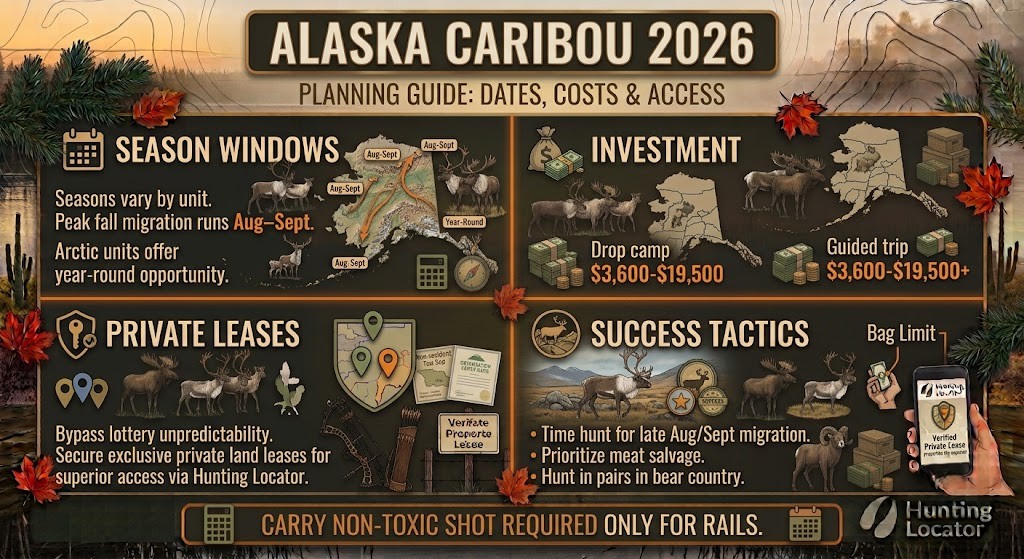
Alaska caribou season dates for 2026-2027 vary by Game Management Unit, with most general-season hunts opening between July and August and many units offering year-round opportunity.
Alaska is divided into 26 Game Management Units (GMUs), and seasons, bag limits, and special regulations vary significantly between them. GMUs are the organizing principle for everything that follows—the same species can have completely different season structures, bag limits, and registration requirements depending on which unit you’re hunting. Every hunter, resident or non-resident, must identify their specific GMU before making any planning decisions.
Quick Reference: 2026-2027 Alaska Caribou Season Dates by Unit
| Units | Season Dates (2026-2027) | Notes |
|---|---|---|
| Units 9B, 9C, 9E, 10, 11, 12, 13 | Aug 10, 2026 – Mar 31, 2027 | Extended fall-to-spring season; registration and harvest reporting required |
| Units 15A, 15B, 15C | Aug 10, 2026 – Dec 31, 2026 | Shorter fall window; verify closing dates carefully |
| Units 16A, 16B | Aug 10, 2026 – Mar 15, 2027 | Fall-to-spring; closes mid-March |
| Units 17A, 17B, 17C, 19A, 19B, 19C | Aug 1, 2026 – Mar 31, 2027 | Extended season; unit-specific registration requirements apply |
| Units 22, 23, 24, 25, 26A | Jul 1, 2026 – Jun 30, 2027 | Year-round season; Western Arctic herd bag limit rules apply in Unit 23 |
| Unit 26B | Jul 15, 2026 – Apr 30, 2027 | Extended season into spring |
| Unit 26C | Jul 15, 2026 – Mar 31, 2027 | Mid-July open through late March |
Bag limits vary significantly by unit and herd—see herd-specific details in the Seasons section below. Dates reflect the 2026-2027 regulatory cycle; always verify current dates and emergency closures with ADF&G before your hunt.
License, Permit & Education Requirements
Every caribou hunter in Alaska—resident or non-resident—must have specific documentation before heading into the field:
- Annual Hunting License — required for all hunters; non-residents pay $160
- Caribou Locking Tag — must be attached to the animal immediately after harvest; non-residents pay $650
- Harvest Ticket — free but mandatory; must be returned to ADF&G after the season whether or not you harvested
- Registration or Permit Hunt Authorization (unit-specific) — some units require registration hunts (such as the Fortymile RC860 in Units 20 and 25) or draw permits before you can legally hunt; verify your specific unit’s requirements with ADF&G
Full licensing details, costs, and the permit application process are covered in the Licenses and Permits section below.
Alaska Caribou Hunting Seasons
Alaska caribou hunting offers season structures ranging from a tight fall window to a full calendar year, depending on the unit. The seven unit-clusters below are grouped by date pattern to make planning easier. Treat this guide as a starting framework and confirm current-season specifics with ADF&G before you go—emergency orders can modify dates mid-season without notice. The broader Alaska hunting season guide covers the full regulatory picture if you’re planning a multi-species trip.
Season 1: Year-Round & Extended-Winter Units (Arctic & Western Alaska)
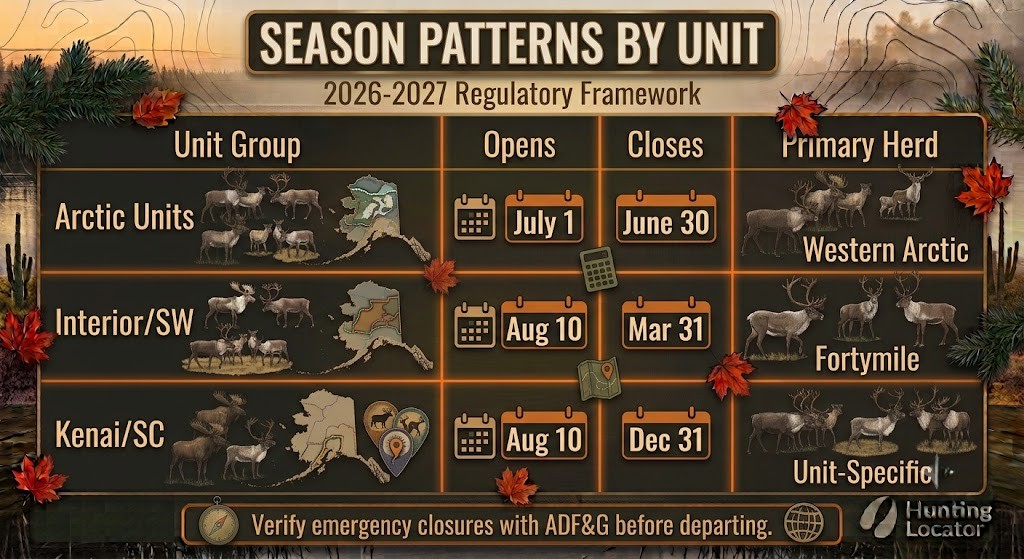
Units 22, 23, 24, 25, and 26A run from July 1, 2026 through June 30, 2027—a full calendar year. Units 26B and 26C open July 15, 2026, running into April 30 and March 31, 2027, respectively, offering extended spring hunting windows uncommon elsewhere in North American big-game seasons.
These northern Arctic units cover the territories of Alaska’s most prominent caribou herds. According to Hunting Locator’s research, the Western Arctic, Central Arctic, and Porcupine herds in northern Alaska are the most popular choices for self-guided non-resident hunters. ADF&G reports that Alaska’s caribou are distributed across 32 herds totaling approximately 950,000 animals, with an average annual harvest of about 22,000 statewide.
Western Arctic Herd Highlight: Unit 23 carries a bag limit of 15 caribou total, with only one allowed to be a cow. Non-residents should approach Unit 23 carefully. Alaska prioritizes subsistence hunting rights, and when caribou numbers decline, non-resident access is typically among the first to be reduced or eliminated. Huntin’ Fool’s 2026 research confirms that Unit 23 is largely closed to non-local hunters even with a draw permit, and that Western Arctic herd population pressures have driven significant closures of public lands to non-local hunters in recent years. This unit is most vulnerable to Alaska winter caribou quota closures and non-resident access restrictions—plan accordingly.
Season 2: Fall-to-Spring Units (Interior & Southwest Alaska)
Units 9B, 9C, 9E, 10, 11, 12, and 13 run August 10, 2026 through March 31, 2027. Units 17A, 17B, 17C, 19A, 19B, and 19C open one week earlier on August 1, 2026, and also close March 31, 2027. Together, these Interior and Southwest units represent some of the most actively hunted caribou country in the state, with late August through September identified as the prime window for most non-resident hunts due to fall migration patterns.
Fortymile Herd Highlight: The Fortymile Caribou Herd, managed across Units 20, 25, and portions of adjacent units, operates under a structured RC860 registration hunt framework. The Fortymile Harvest Plan allocates the entire annual harvest quota to a hunt area south of the Yukon River in portions of Units 20B, 20D, 20F, 25C, and all of Unit 20E. ADF&G’s official notification confirms that the closing date for all Fortymile hunt zones is March 31 unless closed earlier by emergency order, and that winter harvest quotas are subdivided between road-accessible zones. The fall RC860 registration hunt typically carries a 1-bull limit, with winter quotas strictly monitored throughout the season.
Critical planning step: ADF&G instructs Fortymile hunters to call the Fortymile Caribou Herd Hotline at (907) 267-2310 for current quota and zone closure information before departing for the field. Zone closures happen in-season without advance notice, and hunting a closed zone carries serious legal consequences.
Season 3: Fall-Closing Units (Kenai & South-Central Alaska)
Units 15A, 15B, and 15C offer the shortest window of any group, running August 10 through December 31, 2026—closing at year’s end while other units remain open well into spring. Units 16A and 16B run a longer fall-to-winter season, open August 10, 2026 through March 15, 2027.
Bag Limit Note: Across most Alaska units, bag limits run 1–2 caribou for most hunters. Non-residents are typically limited to 1–2 bulls, with some units—such as Unit 9D—restricted to one bull to manage resource pressure. Huntin’ Fool’s unit research notes that a handful of units allow non-residents to harvest two bulls per regulatory year, including Units 9D, 10, 24A, 25A, 25B, 25D, 26B, and 26C—but verify the current regulation for your specific subunit before assuming any expanded bag limit applies.
Many Alaska units have no closed season in the traditional sense, but every unit requires hunters to follow unit-specific registration procedures and harvest reporting requirements. Verify all reporting obligations with ADF&G before your hunt.
Alaska Caribou Licenses and Permits
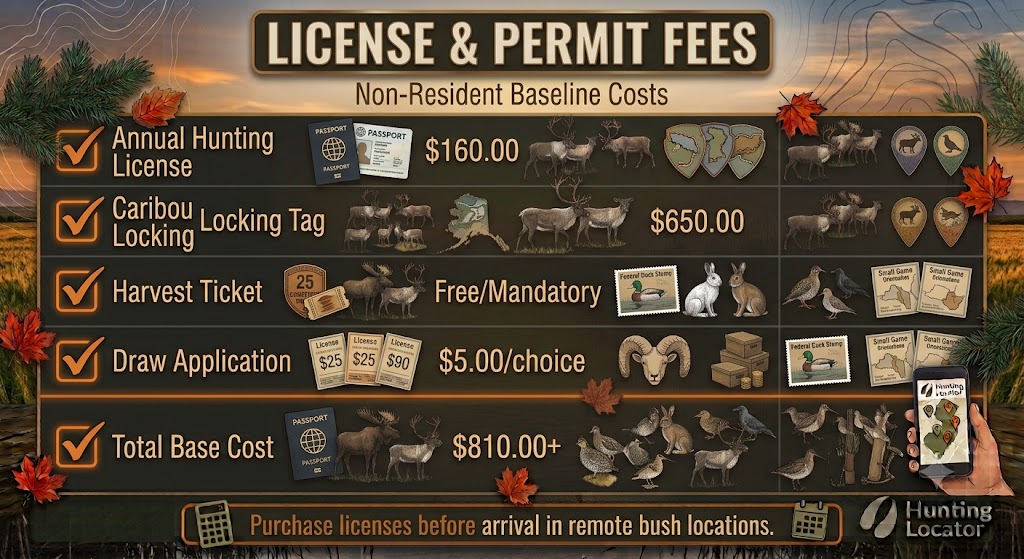
Hunters must purchase their license and caribou tag from ADF&G before arriving in Alaska. For 2026-2027, non-residents must pay $160 for an annual hunting license and $650 for a caribou locking tag.
Alaska Hunting Licenses
Alaska’s non-resident licensing structure is straightforward, but costs add up quickly when you factor in tags and application fees. Here’s the complete fee breakdown for 2026-2027:
| Item | Cost | Notes |
|---|---|---|
| Annual Hunting License | $160 | Required for all non-residents; purchase before arrival |
| Caribou Locking Tag | $650 | Must be attached to harvested animal immediately |
| Application Fee (draw hunts) | $5 per choice | Applies to draw/permit hunt applications |
| Harvest Ticket | Free | Mandatory for all caribou hunters; must be returned after season |
Non-residents planning a combo hunt pairing caribou with brown or black bear should budget significantly beyond the caribou-specific fees—combination guided hunts commonly exceed $20,000 before travel and gear.
Alaska residents operate under a separate, lower fee structure. The figures above apply specifically to non-residents. Resident hunters should consult the current ADF&G regulation booklet for applicable license costs and unit-specific requirements.
Alaska Caribou Hunting Permits
Most Alaska caribou hunting occurs under general season regulations—meaning over-the-counter harvest tickets and no drawing uncertainty. But some units and herds require additional authorization. Understanding which type of hunt your target unit falls under is essential before you purchase anything.
Hunt types available in Alaska:
- General Season / Over-the-Counter — Purchase your license and harvest ticket, follow season dates and bag limits, and hunt. Most productive units fall under this category. No application required.
- Registration Hunts — Required in specific units like the Fortymile (RC860). You register before hunting but don’t need to win a draw—registration is typically first-come, first-served within quota limits. Quotas can fill mid-season.
- Draw/Permit Hunts — Competitive draw with a December 15 application deadline. For the 2026 fall season, draw-only permit hunts are available to non-residents across Units 7, 14, 15, 20, and 23. Applications are submitted between November 1 and December 15 at $5 per choice. ADF&G releases draw results on the third Friday in February.
- Community Subsistence Harvest (CSH) — Tier I subsistence hunts available only to Alaska residents age 10 and older; not available to non-residents.
Where to purchase: Licenses, tags, and harvest tickets are available through ADF&G’s online licensing system, ADF&G offices, and authorized license vendors throughout Alaska. Purchase everything before you leave home—do not plan to handle licensing on arrival in remote areas where vendors may not exist.
Harvest ticket reporting: The free harvest ticket is mandatory and must be returned to ADF&G after your season ends—whether you harvested or not. ADF&G urges hunters to obtain a receipt when turning in hunt reports or to mail them by delivery confirmation. Failing to return your harvest ticket is a compliance violation that can affect future hunting privileges.
Alaska Caribou: Where to Hunt
Alaska’s scale is both its greatest appeal and its biggest planning challenge. ADF&G notes that state and federal governments own the bulk of Alaska’s land, making vast tracts of public land available to hunters—but that scale means access is rarely as simple as driving to a trailhead.
Best Public Lands for Alaska Caribou
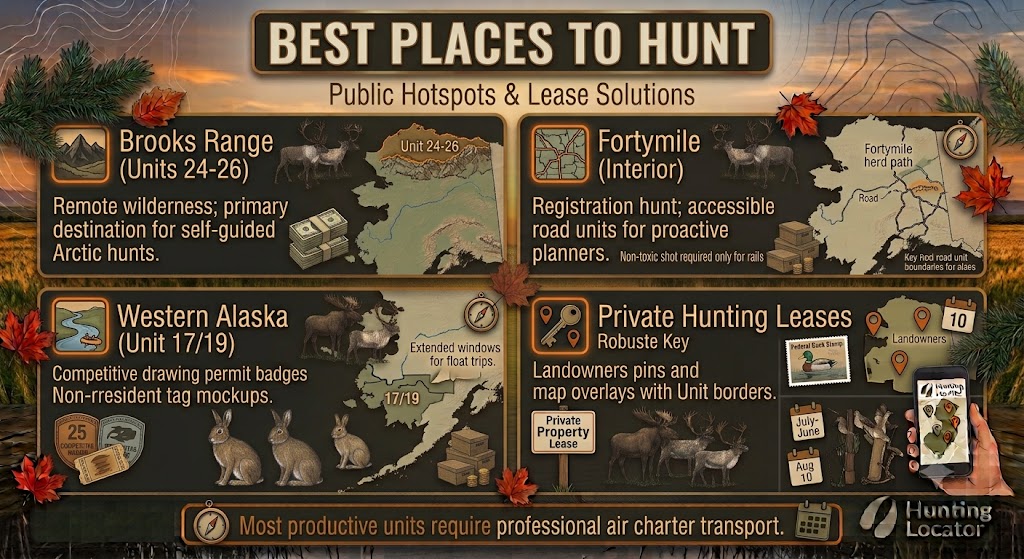
Public land is where most Alaska caribou hunting happens, and the opportunities are substantial for hunters willing to do the logistical work. Almost all productive Alaska caribou hunts require fly-in access—if a unit advertises easy road access, expect heavy competition. Several public land areas consistently produce for prepared hunters:
- Brooks Range / Gates of the Arctic (Units 24, 25, 26) — Year-round seasons and large herd territories make this the primary destination for Arctic caribou hunting, with Porcupine and Central Arctic herd ranges overlapping across remote, demanding terrain.
- Western Alaska / Kuskokwim Region (Units 17, 19) — Fall-to-spring seasons with strong caribou numbers in a less-trafficked region; float trip access is common here, combining river travel with hunting efficiency.
- Interior Alaska / Fortymile Country (Units 20, 25) — The Fortymile herd’s registration hunt structure makes this accessible and well-managed, with road-accessible zones offering a rare option for hunters who can’t afford fly-in logistics.
- Haul Road (Dalton Highway) Corridor — One of the few genuinely road-accessible caribou hunting options in Alaska; competitive during peak season but requires no fly-in costs.
- Southwest Alaska (Units 9, 10, 11, 12, 13) — Extended August-to-March seasons with diverse terrain; self-guided hunters frequently target the Western Arctic and Central Arctic herds in this broader northern region.
Private Land Hunting in Alaska
Private land hunting in Alaska is less common than in the Lower 48, given the large public land base, but it exists. For hunters dealing with public land competition or draw uncertainty, it’s worth serious consideration.
Leasing private land: Private landowners throughout Alaska lease hunting rights, with lease agreements typically covering hunting dates, hunter numbers, accessible areas, and any included services. Leases offer predictable access without the draw lottery or the risk of hitting a quota-closed zone mid-trip. Good leases move quickly, so start your search early.
Buying hunting land: For hunters planning recurring Alaska trips, land ownership eliminates annual access uncertainty. According to Hunting Locator’s land-for-sale research, Alaska land prices vary dramatically—listings start around $8,900 per acre, with premium parcels running into the millions. Ownership provides long-term access reliability and potential resale value, though it requires significantly more upfront capital than leasing.
Whether you’re looking to lease for a single season or explore purchase options, Hunting Locator’s platform connects you directly with landowners willing to lease or sell hunting properties. If public land pressure, draw uncertainty, or quota-closure risk is part of your planning problem, Hunting Locator’s Alaska lease listings are a practical starting point.
Caribou Hunting Tips for Alaska Success
Alaska caribou hunting is accessible, but preparation separates a productive hunt from an expensive one. Experienced hunters consistently point to the same factors:
- Time your hunt around the fall migration — Late August through late September is the prime window for most non-resident hunts, when fall migration concentrates caribou in predictable corridors. Early August brings severe insect pressure; October delivers rough weather and reduced opportunity in most units.
- Plan for meat salvage before antlers — Alaska law requires hunters to take all edible meat out of the field before antlers. This catches many first-timers off guard, especially when weather delays the flight out. Build extra time and a contingency plan into every trip itinerary.
- Hunt with a partner in bear country — During September caribou hunts, Arctic grizzly bears are in hyperphagia—extreme, insatiable hunger as they prepare for hibernation. Experienced Alaska hunters consistently recommend hunting in pairs unless you have extensive Alaska-specific bear experience.
- Book your air charter early and vet your transporter — Air charter availability defines your hunt. Research operators thoroughly, check references, and confirm logistics well before your hunt date. First-time hunters often underestimate how much the transporter relationship affects the entire hunt outcome.
- Call the quota hotline before heading into Fortymile country — If you’re hunting the RC860 registration area, ADF&G’s Fortymile Caribou Herd Hotline at (907) 267-2310 provides current zone closure and quota status. A closed zone discovered after a 200-mile drive is a preventable mistake.
- Verify your unit’s non-resident restrictions before you apply — Non-resident hunting opportunities are often the first reduced when caribou populations decline, and some units carry special restrictions even under general season. Confirm your specific unit’s non-resident rules with ADF&G before purchasing tags.
- Gear up properly for remote conditions — Alaska’s backcountry requires quality pack systems, weather-appropriate layering, reliable communication devices, and bear protection. Visit the Hunting Locator store for gear suited to Alaska’s conditions—the right equipment matters when you’re hours from the nearest road.
More Resources from Hunting Locator
Planning an Alaska hunt involves more than caribou season dates. Here are additional Hunting Locator resources for building a complete picture:
- Alaska Hunting Season Guide — The master reference for all Alaska hunting seasons by species and unit; start here if you’re planning a multi-species trip or need the full regulatory overview
- Alaska Caribou Hunting — A detailed look at caribou-specific tactics, herd territories, and access strategies to complement the season dates in this guide
- Alaska Hunting Leases — Browse verified private land lease listings in Alaska; your direct connection to landowners offering hunting access across the state
- Alaska Moose Hunting — Moose season planning guide for hunters looking to combine species or target Alaska’s most iconic big-game animal
- Alaska Brown Bear Hunting Season — Essential reading if you’re considering a combo bear-and-caribou hunt or hunting in bear-dense territory
- Alaska Black Bear Hunting Season — Season dates, units, and regulations for black bear hunting across the state
- Alaska Mountain Goat Hunting Season — For hunters targeting Alaska’s most technically demanding big-game species
- Alaska Deer Hunting Season — Sitka blacktail season guide for Southeast Alaska and the island chains
- Alaska Bison Hunting Season — One of the rarest draw hunts in the state; essential reading for serious permit hunters
- Alaska Muskox Hunting Season — Season guide for hunters pursuing Alaska’s most specialized Arctic big-game opportunity
- Alaska Wolf Hunting — Season information for predator hunters and those interested in wolf management units
- Alaska Small Game Hunting Season — Grouse, ptarmigan, and upland bird season guide; useful for filling days between big-game hunts
- Alaska Furbearer Trapping Season — Trapping season information for hunters who pursue Alaska’s fur-bearing species
Frequently Asked Questions
Do non-residents need a guide to hunt caribou in Alaska?
No. Non-resident U.S. citizens are not required to hire a licensed guide to hunt caribou in Alaska, making caribou one of the more accessible DIY big-game species in the state. However, some draw-permit units may have guide requirements specific to that hunt—always verify with ADF&G for your target unit. Non-resident aliens (non-U.S. citizens) are subject to different requirements.
What is the total cost for a non-resident Alaska caribou hunt?
At minimum, non-residents pay $160 for an annual hunting license and $650 for a caribou locking tag—$810 in required fees before any other expenses. Add $5 per choice if applying for draw hunts. Beyond licensing, DIY drop camp hunts typically cost $3,600–$7,000, while fully guided hunts range from $7,000 to over $19,500, with a self-guided hunt all-in often running around $5,000 for experienced hunters with their own gear.
What is the bag limit for caribou in Alaska?
Bag limits vary by unit. Most units allow 1–2 caribou, with up to 15 in some remote areas. Non-residents are typically limited to 1–2 bulls depending on the unit, with some units like Unit 9D restricted to one bull to manage resource pressure. The Western Arctic Caribou Herd in Unit 23 allows 15 caribou total, with only one permitted to be a cow. Always confirm bag limits for your specific unit with the ADF&G current regulation booklet.
When is the best time to hunt caribou in Alaska?
Late August through late September is the prime window for most non-resident caribou hunts, timed to coincide with fall migration when herds move across tundra and mountain passes in predictable patterns. Early August offers open seasons in some units but comes with severe insect pressure. October brings deteriorating weather and reduced access in most units, though winter seasons in Arctic units run into spring for hunters willing to manage extreme cold.
How does the Fortymile registration hunt work?
The Fortymile RC860 registration hunt covers portions of Units 20B, 20D, 20F, 25C, and all of Unit 20E. Unlike a draw hunt, registration hunts don’t require winning a lottery—you register and then hunt within the quota system. The fall RC860 typically carries a 1-bull limit, with winter quotas subdivided between road-accessible zones and strictly monitored throughout the season. The closing date for all Fortymile hunt zones is March 31 unless closed earlier by emergency order. Call the Fortymile Caribou Herd Hotline at (907) 267-2310 before heading out to check current zone status.
Can I find private land for caribou hunting in Alaska?
Yes, though private land hunting in Alaska is less common than in other states due to the large public land base. Private landowners throughout Alaska do lease hunting rights, offering reduced competition and more predictable access than public land draws or registration hunts. Hunting Locator’s Alaska lease listings connect hunters directly with verified landowners offering hunting access—browse current listings to find available properties for the 2026-2027 season.
Planning Summary
The season dates are in hand, costs are documented, and the units are mapped. What tends to separate a successful Alaska caribou hunt from an expensive close call is handling the details before you travel: licenses purchased before you land, harvest reporting obligations understood, air charter booked and vetted, and contingency plans in place for weather delays. Whether you’re targeting year-round Arctic opportunity in Units 22-26 or working the fall migration window in Fortymile country, lock in your Alaska hunting lease access if private land is part of your plan, gear up at the Hunting Locator store for the conditions you’ll actually face, and keep the ADF&G regulation page bookmarked for mid-season updates.


