Each of Alaska’s 26 Game Management Units has its own specific rules, and applications for fall 2026 and spring 2027 are open right now.
Here’s what we’ll cover in this comprehensive Alaska hunting season guide:
- Season dates and bag limits for all major game species across Alaska’s 26 Game Management Units
- License requirements and costs for residents and non-residents, including new 2026 requirements
- Where to hunt—public lands, guided options, and private land access
Alaska adopted major changes to hunting and trapping guidelines for 2025-2026, including bag limits, hunting unit boundary shifts and hunter education requirements that carry into 2026-2027.
Quick Overview: Season Dates, Alaska Hunting Licenses, and Regulations
Alaska requires hunting licenses for everyone 16 and older, with big game hunting needing additional locking tags and harvest tickets. Here’s what you need to know:
- Hunting License: Your basic legal hunting credential in Alaska
- Locking Tags: Numbered metal tags you must buy before hunting and lock onto harvested animals immediately
- Harvest Tickets: Free permits for general season hunts that you validate at the kill site
Emergency orders may override information in the Hunting and Trapping Regulation booklets, so always check current orders before heading out.
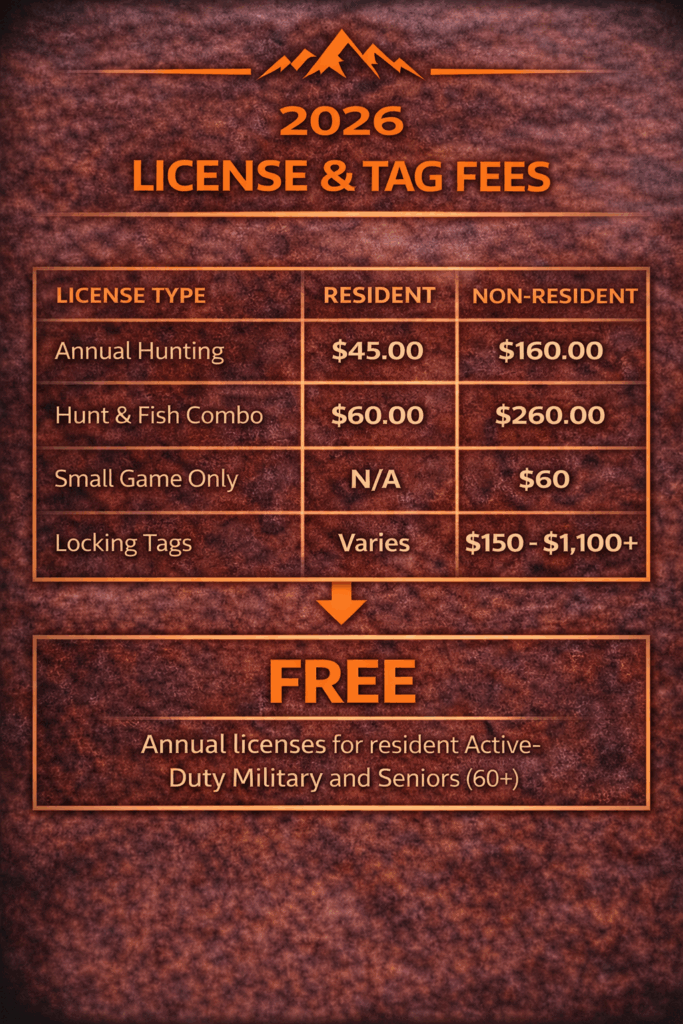
Alaska Hunting License Fees
| License Type | Resident Fee | Non-Resident Fee | Key Details |
|---|---|---|---|
| Annual Hunting | $45.00 | $160.00 | Standard license (Ages 16+ or 18+) |
| Hunting & Fishing Combo | $60.00 | $260.00 | Includes sport fishing |
| Small Game Only | N/A | $60.00 | Non-residents only; no big game |
| Permanent ID Card | Free | N/A | For residents aged 60+ |
Active-duty military members who are Alaska residents get a free annual hunting license.
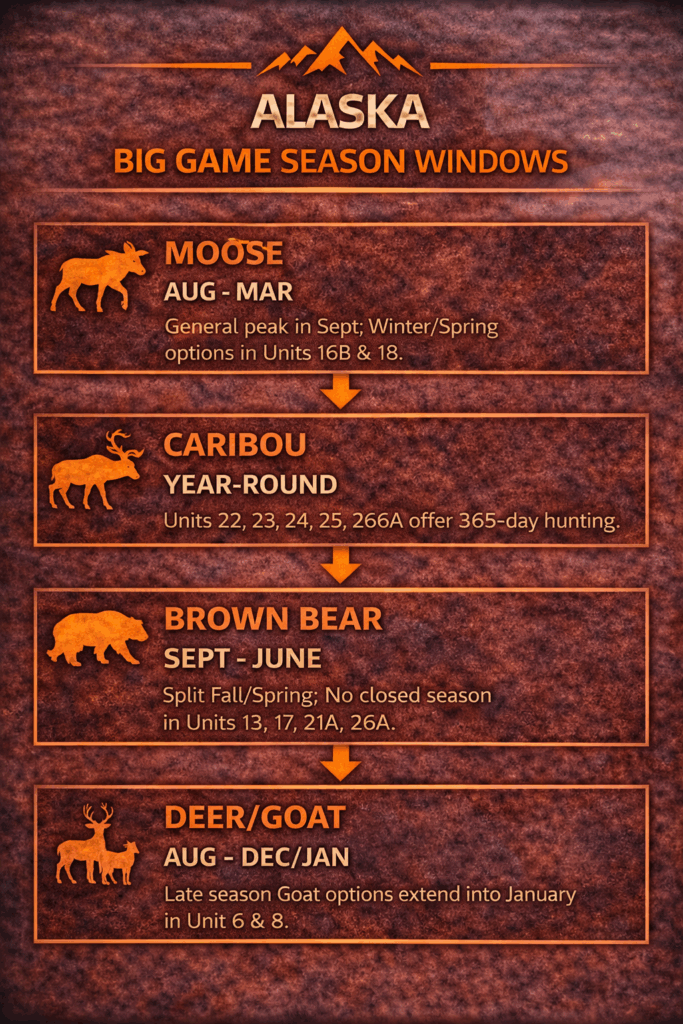
Most Alaska hunting happens between August and October, but seasons vary wildly by species and unit. Some species like caribou in certain units have year-round seasons.
Alaska Hunting Seasons Overview
| Species | Season Type/Units | Season Dates | Bag Limit |
|---|---|---|---|
| Moose | Units 1A–C, 3, 7, 13 (Res) | Sept 1 (or 15) – Sept 25 / Oct 20 | 1 Bull or Cow |
| Units 19, 22 | Aug 1 (or 10) – Mar 15 (or 31) | 1 Bull or Cow | |
| Unit 16B / 18 (Winter/Spring) | Dec – Mar / Apr | 1 Bull or Cow | |
| Caribou | Units 22, 23, 24, 25, 26A | Year Round (July 1 – June 30) | 1 to 2 |
| Units 9, 10, 11, 12, 13, 17, 19 | Aug 1 (or 10) – Mar 31 | 1 to 2 | |
| Units 15, 16, 26B/C | July/Aug – Dec/Mar/Apr | 1 to 2 | |
| Brown Bear | Units 13, 17, 21A, 26A | No Closed Season | 1 or 2 |
| Units 1, 3, 5, 6, 7, 11, 12, 15 | Generally Sept – June (Split Fall/Spring) | 1 or 2 | |
| Unit 8 (Option 2) | April 1 – May 15, 2027 | 1 or 2 | |
| Unit 9 (Option 1) | May 10 – May 31, 2026 | 1 or 2 | |
| Black Bear | Units 7, 9–15, 17–26 | No Closed Season | 1 to 3 |
| Units 1, 2, 3, 5, 6 | Sept 1 – June 30 | 1 to 3 | |
| Unit 16B (Wolverine Creek) | Sept 15 – May 31 | 1 to 3 | |
| Deer | Units 1 (most), 2, 4 (Non-Res), 8 | Aug 1 – Dec 31 | 1 to 4 |
| Unit 3 (General / Petersburg) | Aug 1 – Nov 30 / Dec 15 | 1 to 4 | |
| Unit 6 | Aug 1 – Sep 30 (Bucks) / Oct 1 – Dec 31 (Any) | 1 to 4 | |
| Unit 5A (Youth / General) | Oct 15 – Oct 31 / Nov 1 – Nov 30 | 1 to 4 | |
| Mountain Goat | Units 1 (most), 4, 5 | Aug 1 – Dec 31 | 1 Goat |
| Units 6A, 6B, 6D, 8 | Aug 20 (or Sep 15) – Jan 31 | 1 Goat | |
| Unit 15 / Unit 7 | Aug 10 – Nov 14 / Oct 15 | 1 Goat | |
| Wolf | Statewide (most units) | Aug 1 (or 10) – Apr 30 | 0 to 10+ |
| Wolverine | Statewide | Sept 1 – Mar 31 | 1 |
| Bison | Unit 6B | Sept 1 – Dec 31 | 1 Bull or Cow |
| Other units | Sept 1 – Mar 31 | 1 Bull or Cow | |
| Muskox | Nunivak & Nelson Island (Reg) | Sept 1 – Mar 31 | 1 Bull or Cow |
| Unit 22 & 26C (Draw Only) | Dates Vary | 1 Bull or Cow | |
| Small Game/Birds | Statewide | Aug 10 (or Sept 1) – Apr 30 (or May 15) | Varies |
Guide Requirements for Non-Resident Hunters
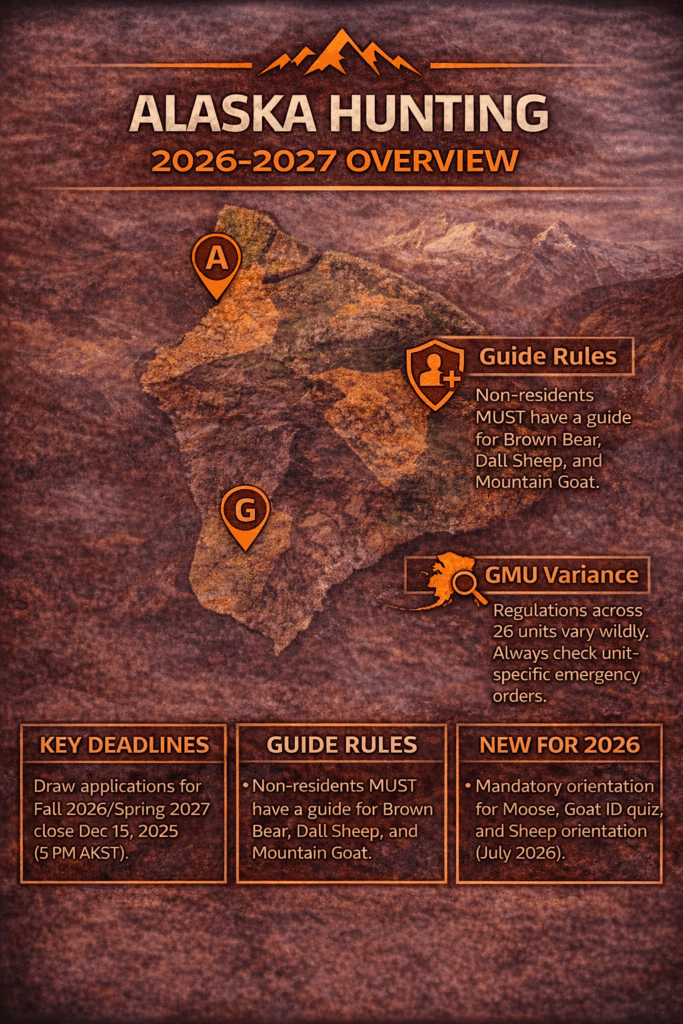
Nonresidents hunting brown/grizzly bear, Dall sheep, or mountain goat must be personally accompanied by an Alaska-licensed guide OR by an Alaska resident 19 years of age or older who is within the ‘second degree of kindred’. This family relationship includes parents, children, siblings, grandparents, grandchildren, aunts, uncles, nieces, and nephews.
For moose and caribou, non-resident U.S. citizens don’t need guides unless hunting in certain restricted units. Expect to pay $6,000-$15,000 for a brown/grizzly bear hunt, $4,000–$6,000 for a Dall sheep hunt, and $1,500–$4,000 for a goat hunt.
Alaska Moose Hunting
If you’re planning your first Alaska adventure, moose hunting should top your list. Moose, caribou, and black bear are the most sought-after animals by guided hunters, and moose lead the pack for good reason. Alaska’s moose are North America’s largest, with mature bulls hitting 1,500 pounds and sporting antlers spanning over 60 inches.
For comprehensive moose hunting strategies and unit-specific information, check out our detailed Alaska Moose Hunting guide.
Alaska Moose Hunting Seasons
Moose seasons change dramatically by Game Management Unit. Units 1A–C, 3, 7, and 13 offer resident-only seasons from September 1 (or 15) through September 25 or October 20, giving you prime rutting season opportunities when bulls are most vocal and responsive to calling.
Extended seasons in Units 19 and 22 run from August 1 (or 10) through March 15 (or 31), offering flexibility for hunters who prefer late-season hunting when bulls have shed their velvet. Winter and spring seasons in Units 16B and 18 (December through April) provide unique opportunities for hunters willing to tackle Alaska’s brutal winter conditions.
Alaska Moose Hunting Regulations
- Bag limit: 1 bull or cow (varies by unit; antler restrictions common)
- Nonresident orientation course required for all non-resident moose hunters (new for 2026)
- Locking tag must be purchased before hunting and attached immediately after harvest
- Antler restrictions vary by unit—verify “spike-fork-50” or “any bull” designations
- Harvest must be reported within required timeframe (check unit-specific requirements)
Alaska Caribou Hunting
Caribou hunting offers some of Alaska’s most accessible big game opportunities with liberal bag limits and year-round seasons in remote areas. Unlike moose hunting, caribou can be pursued by non-resident U.S. citizens without guides, making it attractive for DIY hunters seeking an authentic Alaska experience.
For detailed herd information and migration patterns, check our Alaska Caribou Hunting resource.
Alaska Caribou Hunting Seasons
The coolest thing about Alaska caribou hunting? Year-round seasons in Units 22, 23, 24, 25, and 26A, running from July 1 through June 30. This gives you incredible flexibility for planning around work schedules or weather conditions.
Units 9, 10, 11, 12, 13, 17, and 19 offer extended seasons from August 1 (or 10) through March 31, covering both early season when caribou are in velvet and late season when they’re in prime winter coats.
Alaska Caribou Hunting Regulations
- Bag limit: 1-2 caribou in most units; up to 15 in remote areas for residents
- No guide required for non-resident U.S. citizens
- Locking tag required; must be attached immediately after harvest
- Some herds (like Mulchatna) have specific restrictions—verify current status
- Transportation of meat before antlers/horns is prohibited in some units
Alaska Brown Bear Hunting
Brown bear hunting represents the ultimate Alaska big game experience, offering hunters the chance to pursue one of North America’s most formidable predators. These incredible animals can weigh over 1,000 pounds and stand 10 feet tall.
Our Alaska Brown Bear Hunting Season guide provides detailed unit analysis and hunting strategies.
Alaska Brown Bear Hunting Seasons
Several units offer no closed season for brown bear hunting, including Units 13, 17, 21A, and 26A, providing year-round opportunities. Most other units follow a split fall/spring season pattern from September through June.
Unit 8 offers a spring-only season (April 1 – May 15, 2027), while Unit 9 provides a brief spring opportunity (May 10 – May 31, 2026). Spring seasons often provide excellent hunting as bears emerge hungry from hibernation.
Alaska Brown Bear Hunting Regulations
Major 2026 Change: Unit 13: increased bag limit to two bears every regulatory year, representing a significant liberalization of harvest opportunities.
- Non-residents MUST be accompanied by Alaska-licensed guide or qualifying resident relative
- Bag limit: 1 or 2 bears (often restricted to 1 bear every 4 regulatory years)
- Unit 13 bag limit increased to 2 bears per regulatory year (2026 change)
- Skull and hide must be sealed by ADF&G within specified timeframe
- Bear baiting prohibited in certain areas due to significant public safety concerns
Alaska Black Bear Hunting
Black bear hunting offers a more accessible alternative to brown bear hunting, with no guide requirements for non-resident U.S. citizens and generous seasons including no closed season in many units. Alaska’s black bears are among North America’s largest, with mature boars often exceeding 400 pounds.
Visit our Alaska Black Bear Hunting Season page for detailed hunting strategies.
Alaska Black Bear Hunting Seasons
Black bear hunting offers exceptional opportunities with no closed season in Units 7, 9–15, 17–26, allowing year-round hunting in much of the state. The general season in Units 1, 2, 3, 5, and 6 runs from September 1 through June 30.
Unit 16B (Wolverine Creek) has a season from September 15 through May 31, still offering excellent spring and fall hunting opportunities.
Alaska Black Bear Hunting Regulations
- No guide required for non-resident U.S. citizens
- Bag limit: 1-3 per regulatory year depending on GMU
- No closed season in many units (7, 9-15, 17-26)
- Locking tag required and must be attached immediately after harvest
- Sealing requirements vary by unit—check local regulations
Alaska Dall Sheep Hunting
Dall sheep hunting represents the ultimate mountain hunting challenge in Alaska, combining physical demands with the pursuit of one of North America’s most beautiful and elusive big game animals. These pure white sheep inhabit Alaska’s most remote and rugged mountain ranges, requiring hunters to be in excellent physical condition.
Alaska Dall Sheep Hunting Seasons
Dall sheep seasons generally run from August through September, coinciding with the rut when rams are most active and visible. Most quality sheep hunting areas require draw permits, with application deadlines in December for the following year’s hunts.
Alaska Dall Sheep Hunting Regulations
New 2026 Requirement: Starting July 2026, all sheep hunters must complete a state-approved hunter orientation course, ensuring hunters can properly identify legal rams and understand field care requirements.
- Non-residents MUST be accompanied by Alaska-licensed guide or qualifying resident relative
- Bag limit: 1 ram; must be full-curl or larger
- New hunter orientation course required for all sheep hunters (effective July 2026)
- Permit required in most units
- Aircraft restrictions apply for sheep hunting in certain areas
Alaska Mountain Goat Hunting
Mountain goat hunting in Alaska offers the opportunity to pursue one of North America’s most challenging and rewarding big game species. These sure-footed climbers inhabit Alaska’s steepest and most remote terrain, making every hunt an adventure that tests both physical and mental limits.
For detailed information on goat hunting strategies and unit recommendations, visit our Alaska Mountain Goat Hunting Season guide.
Alaska Mountain Goat Hunting Seasons
Mountain goat seasons vary significantly by unit, with Units 1, 4, and 5 offering the longest seasons from August 1 through December 31. Units 6A, 6B, 6D, and 8 have later start dates (August 20 or September 15) but extend through January 31, providing winter hunting opportunities.
Shorter seasons in Units 15 and 7 (August 10 – November 14 and October 15 respectively) reflect more limited populations and the need for conservative management.
Alaska Mountain Goat Hunting Regulations
New 2026 Requirement: Anyone looking to hunt mountain goats must now pass a mountain goat identification quiz to ensure proper identification of billies versus nannies with kids.
- Non-residents MUST be accompanied by Alaska-licensed guide or qualifying resident relative
- Bag limit: 1 goat; taking nannies with kids prohibited
- Mountain goat identification quiz required for all hunters (2026 requirement)
- Permit required in most units
- Steep terrain and weather conditions make this among Alaska’s most challenging hunts
Alaska Minor Game Species Hunting
Alaska’s minor game species provide excellent opportunities for hunters seeking diverse experiences or those looking to extend their hunting seasons. These species often have liberal bag limits and extended seasons, making them perfect for hunters wanting to maximize their time afield.
Alaska Wolf Hunting Information
Wolf hunting in Alaska offers some of North America’s most liberal seasons and bag limits. Most units allow wolf hunting from August 1 (or 10) through April 30, with some extending to May 31 or June 30. Bag limits range from no limit in many units to caps of 2-10 wolves in others.
For comprehensive wolf hunting information, check our Alaska Wolf Hunting guide.
Alaska Wolverine Hunting Information
Wolverine hunting runs statewide from September 1 through March 31 with a standard bag limit of 1 wolverine in most open units. These elusive and powerful mustelids are among Alaska’s most challenging species to hunt, requiring patience and persistence.
Alaska Bison Hunting Information
Alaska bison hunting represents a unique opportunity to pursue North America’s largest land mammal. The general season runs from September 1 through March 31, though Unit 6B has a shorter season ending December 31. Bison hunting has been added to the list for proxy hunting for the elderly and the disabled.
For detailed bison hunting information, visit our Alaska Bison Hunting Season resource.
Alaska Muskox Hunting Information
Muskox hunting offers the chance to pursue one of the Arctic’s most unique and prehistoric-looking animals. Regular seasons run on Nunivak and Nelson Island from September 1 through March 31, while Units 22 and 26C offer draw-only hunts with varying dates.
Our Alaska Muskox Hunting Season guide provides detailed information on hunting these remarkable animals.
Alaska Small Game Hunting Information
Small game hunting in Alaska includes ptarmigan, grouse, snowshoe hares, and other species with seasons generally running from August 10 (or September 1) through April 30 (or May 15). Alaska has closed the season for Alaska hares in Units 9 and 17, and shortened the ptarmigan season in Unit 13B to August 20-February 15.
For comprehensive small game information, visit our Alaska Small Game Hunting Season guide.
Alaska Furbearer Trapping Information
Furbearer trapping seasons for beaver, coyote, and otter generally run from November 1 through April 30, providing winter opportunities when pelts are at their thickest and most valuable.
For detailed trapping regulations and techniques, check our Alaska Furbearer Trapping Season resource.
Where to Hunt in Alaska
Alaska’s hunting landscape covers 663 million acres of diverse terrain, from the temperate rainforests of Southeast Alaska to the Arctic tundra of the North Slope. This massive wilderness includes towering mountain ranges, endless tundra, dense forests, and countless rivers and lakes, providing habitat for an incredible diversity of game species.
Best Public Lands for Alaska Hunting
Alaska offers more public hunting land than any other state, with vast federal and state holdings providing access to world-class hunting opportunities:
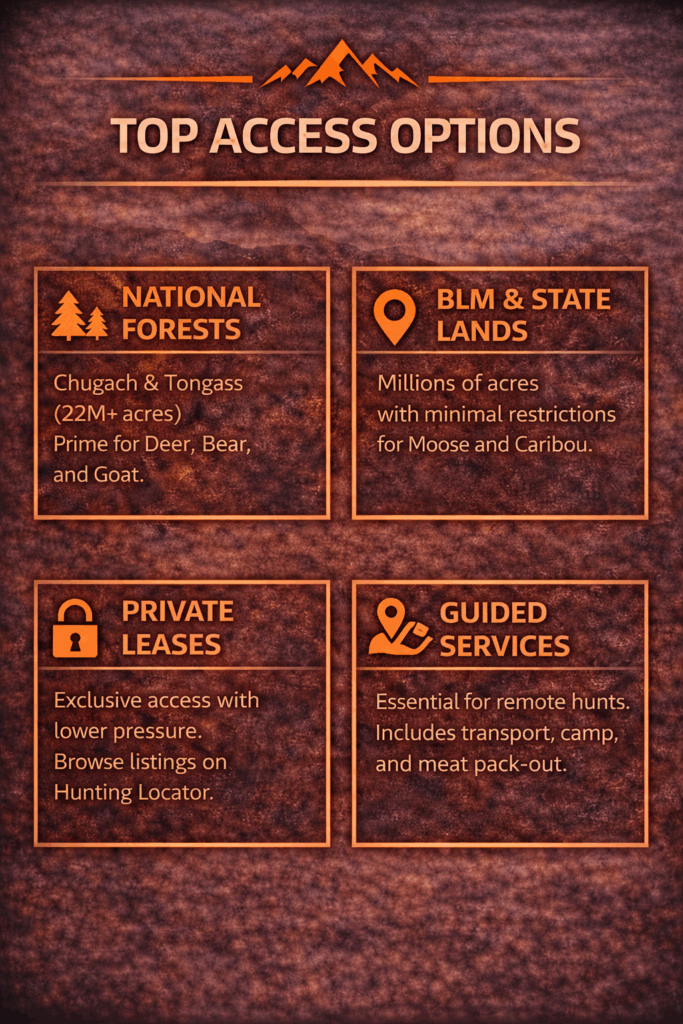
- Chugach National Forest: Southeast Alaska’s 5.4 million acres offer excellent deer, bear, and mountain goat hunting with relatively accessible terrain
- Tongass National Forest: The nation’s largest national forest at 16.7 million acres provides premier deer and bear hunting in Southeast Alaska
- Bureau of Land Management Lands: Scattered throughout Alaska, BLM lands offer hunting for moose, caribou, and other species with minimal restrictions
- Alaska State Lands: Millions of acres of state-owned land provide hunting opportunities throughout Alaska, often with good road access
- National Wildlife Refuges: While some have restrictions, many refuges allow hunting and provide excellent opportunities for waterfowl and big game
Guided Hunts in Alaska
Professional guide services provide expertise, equipment, and access to remote areas that would be difficult or impossible for DIY hunters to reach. Alaska’s licensed guides undergo rigorous training and testing, ensuring they can safely navigate the state’s challenging terrain and weather conditions.
Guided hunts typically include transportation to hunting areas, camp setup, field care of game, and assistance with trophy preparation. Guides can also help prepare and pack out your meat and trophies. Imagine carrying 750 lbs of dressed moose through a few miles of muskeg with a bear watching.
When selecting a guide service, consider their experience in your target area, success rates, included services, and client references. There are many ways to find a guide service. Some hunters attend outdoor shows where guides advertise. Others read magazine articles that feature guided hunts. Some rely on referrals or other forms of advertising. Of all of these methods, referrals are one of the best because they put you in direct contact with someone who knows the guide service.
Private Land Hunting in Alaska
While Alaska is known for its vast public lands, private land hunting opportunities do exist and can provide excellent hunting with less pressure than popular public areas. Private land hunting typically involves leasing arrangements with landowners or hunting through outfitters who have secured private access.
Private land leases can offer several advantages including exclusive or limited access, known game populations, and often better road access than remote public lands. However, private hunting opportunities in Alaska are limited compared to other states due to the abundance of public land.
Hunting Locator provides a comprehensive database of available hunting leases throughout Alaska. Our platform connects hunters directly with landowners, making it easier to secure quality hunting access. Whether you’re looking for a small parcel for deer hunting or a large tract for moose and caribou, our Alaska hunting lease listings can help you find the perfect hunting opportunity.
Hunting Locator’s innovative SaaS platform gives you direct access to landowners willing to lease or sell hunting properties, eliminating the middleman and providing transparent communication about available opportunities, pricing, and property details. With our user-friendly search tools, you can filter by species, acreage, price range, and location to find exactly what you’re looking for.
For all your hunting gear needs, from specialized Alaska hunting equipment to basic field supplies, visit the Hunting Locator store where you can find quality gear specifically selected for Alaska’s challenging hunting conditions.
FAQ
When is the deadline to apply for Alaska draw permits for 2026-2027?
Alaska Draw Hunt applications are typically November 1 – December 15. The fall 2026 and spring 2027 application period is currently open and will close December 15, 2025 at 5 p.m. (AKST). Don’t miss this critical deadline as Alaska’s draw system offers some of the best hunting opportunities in the state.
Do I need a guide to hunt moose and caribou in Alaska as a non-resident?
No, non-resident U.S. citizens don’t need guides for moose and caribou hunting in Alaska. However, nonresident aliens must be personally accompanied by an Alaska-licensed guide to hunt ANY big game animal, including moose and caribou. This makes moose and caribou excellent choices for DIY non-resident hunters looking to experience Alaska hunting without the expense of a guide.
What new requirements exist for Alaska hunters in 2026?
Several new requirements take effect for 2026: Nonresident hunters must view the Nonresident Moose Hunter Orientation materials and successfully complete the orientation prior to hunting. Additionally, anyone hunting mountain goats must now pass a mountain goat identification quiz, and starting July 2026, all sheep hunters must complete a state-approved hunter orientation course.
How much should I budget for an Alaska hunting trip?
Costs vary dramatically depending on species and whether you use guides. An annual nonresident hunting license costs $160, plus locking tags and other fees. For guided hunts, expect to pay $6,000-$15,000 for a brown/grizzly bear hunt, $4,000–$6,000 for a Dall sheep hunt and $1,500–$4,000 for a goat hunt. Your total investment can easily reach $20,000-$30,000 for a premium experience.
What are Alaska’s Game Management Units and why do they matter?
Alaska is divided into 26 Game Management Units (GMUs), and there’s wide variation in hunting seasons and bag limits for different species. The Alaska Hunting Regulation book is organized by Game Management Unit (GMU). Each unit section contains all the regulations for species in that area, and any special regulations in that unit. Understanding GMUs is crucial because seasons, bag limits, and special regulations vary significantly between units.
Can I hunt year-round in Alaska?
Some species offer year-round opportunities in certain units. Caribou hunting is available year-round (July 1 – June 30) in Units 22, 23, 24, 25, and 26A. Black bear hunting has no closed season in Units 7, 9–15, 17–26, and brown bear hunting has no closed season in Units 13, 17, 21A, and 26A. However, most hunting occurs between August and October when weather conditions are most favorable.
The Final Shot
Alaska hunting offers experiences unmatched anywhere else in North America, from pursuing massive moose during the September rut to tracking caribou across endless tundra. The 2026-2027 season brings important regulatory changes including new orientation requirements and updated bag limits that every hunter must understand before heading afield.
Whether you’re planning your first Alaska adventure or returning for another hunt, success depends on understanding the complex regulations, choosing the right units for your target species, and preparing for the unique challenges of hunting in the Last Frontier. The investment in time and money is significant, but the memories and experiences will last a lifetime.
Ready to start planning your Alaska hunting adventure? Visit Hunting Locator to access our comprehensive hunting resources, connect with experienced guides, and discover private land opportunities that can make your Alaska hunting dreams a reality. Your next great hunting story starts with proper planning, and we’re here to help you every step of the way.


