This Alaska Muskox guide covers what you need to plan a 2026 muskox hunt, whether you’re a longtime Alaska resident or flying in from out of state. It pulls the official ADF&G season dates, tag costs, and land-access options into one place instead of leaving you to piece it together from scattered sources.
What’s covered below:
- 2026 season dates and bag limits for every muskox hunt type, from Nunivak Island registration hunts to the Unit 22 & 26C draw
- License, tag, and permit costs for residents and nonresidents, so you can budget before you apply
- Where to hunt — public land, private leases, and guided outfitter options — so you can pick the path that fits your season and your budget
All dates and fees are current as of August 1, 2026 — confirm with ADF&G before applying.
Quick Overview
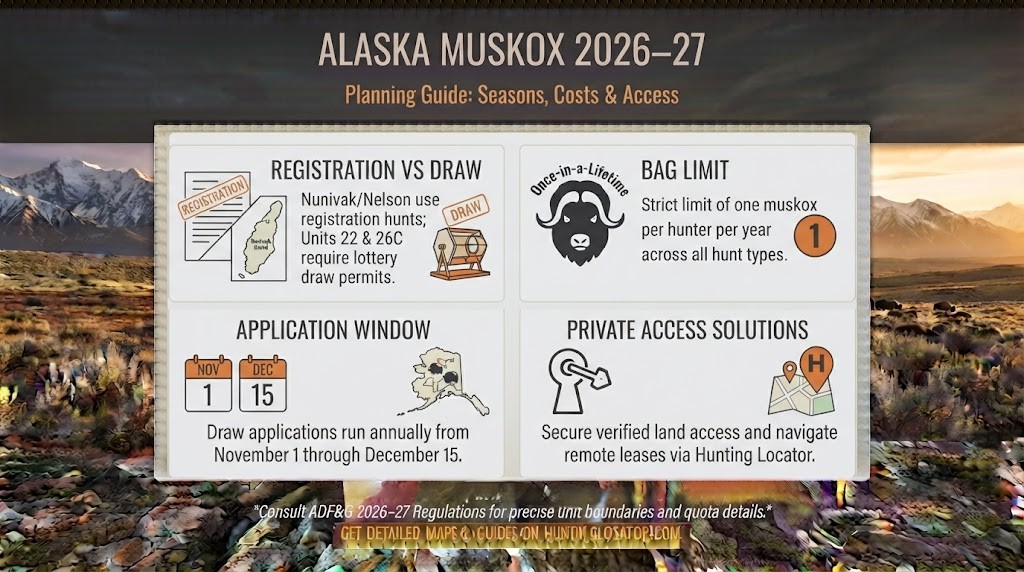
Muskox hunting in Alaska runs through two mechanisms: registration hunts, open to any qualified hunter until a harvest quota closes them, and draw-only hunts, which award a limited number of permits by lottery. Which one applies to your target hunt determines your timeline and your odds. Here’s the 2026 snapshot:
| Hunt Area / Type | Season Dates | Bag Limit | Notes |
|---|---|---|---|
| Nunivak & Nelson Island (Registration) | Sep 1, 2026 – Mar 31, 2027 | 1 | Registration hunt; permit required |
| Unit 22 & 26C (Draw Only) | Dates vary | $1 | Draw permit application required |
Before pursuing either hunt, you’ll need:
- A valid Alaska hunting license — required for every hunter age 16 and older, resident or nonresident
- A muskox tag (locking tag) — separate from your license, priced differently for residents and nonresidents
- Hunter education certification — required for eligible hunters through the 2026-2027 season
- One muskox permit per hunter per year — whether obtained through registration or the draw
For how these pieces fit together across species, the statewide Alaska hunting season guide covers licensing basics that apply no matter what you’re hunting.
Alaska Muskox Hunting Seasons
Muskox opportunities split into two paths: registration hunts on Nunivak and Nelson Islands, and draw-only hunts in Units 22 and 26C. Both carry a bag limit of one muskox, but how you get there — and how much lead time you need — differs substantially.
Nunivak & Nelson Island Registration Season
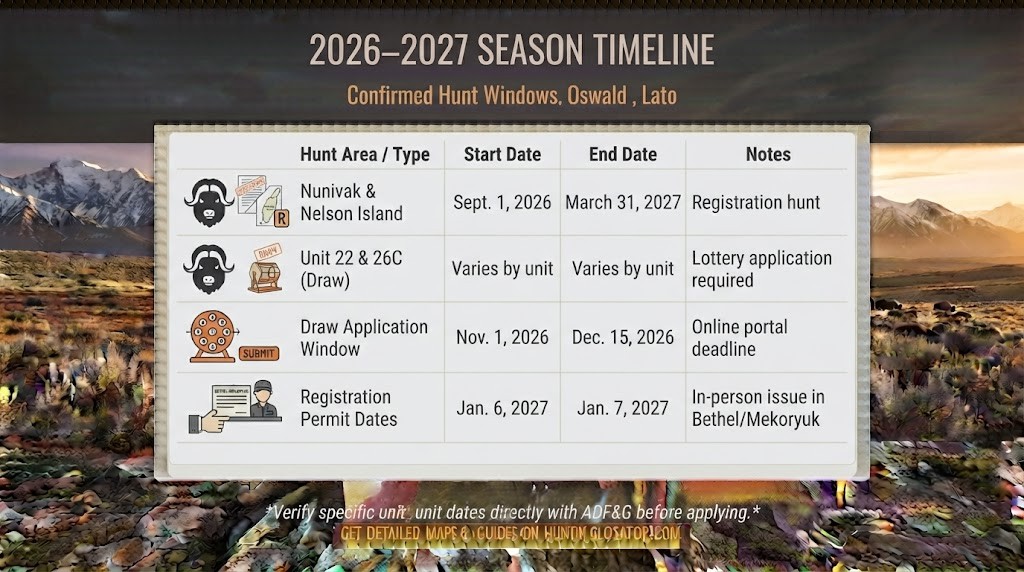
The registration season runs September 1, 2026, through March 31, 2027, with a bag limit of one muskox. This is the hunt most residents and DIY-minded nonresidents target first, since it doesn’t require winning a lottery.
According to muskox hunting opportunities explained by ADF&G, registration hunts generally don’t cap the total number of permits issued — the season closes by emergency order once the harvest goal is met. Timing matters here: hunters who register early have better odds of hunting before the quota fills.
Getting your permit involves a few concrete steps:
- Show up in person — permits are available in Bethel on January 6 at 8:00 am, and in Mekoryuk on January 7 at 6:30 am
- Carry your signed permit at all times — required while hunting or transporting muskox, and to show any authorized enforcement officer who asks
- Plan for rugged access — the fall hunt tends to run wet and windy, with transportation typically by boat or quadrunner
Most hunters reach Nunivak Island through the village of Mekoryuk via commercial air from Bethel, according to Nunivak Island muskox hunting details from ADF&G. It’s remote, but it’s one of the more accessible ways for a determined DIY hunter to fill a muskox tag.
Unit 22 & 26C Draw-Only Season
Units 22 and 26C run on the lottery system. Season dates vary year to year, and access comes exclusively through a draw permit — there’s no walk-up registration option. Bag limit still holds at one muskox, but getting a shot at that tag takes more planning.
The application window is fixed annually:
- Application period opens — November 1 at 8:00 am AKST
- Application period closes — December 15 at 5:00 pm AKST
- Apply online — through the ADF&G draw permit portal, open to both residents and nonresidents
These units draw serious interest from trophy hunters, so treat the November-to-December window as a hard deadline. Confirm the exact Unit 22 & 26C season dates with ADF&G before applying, since they vary year to year.
Alaska Muskox Licenses and Permits
Every muskox hunter in Alaska needs three things lined up in sequence: a hunting license, a muskox tag, and a hunt permit — either registration or draw. Skip a step and you’re not legally in the field.
Alaska Hunting Licenses
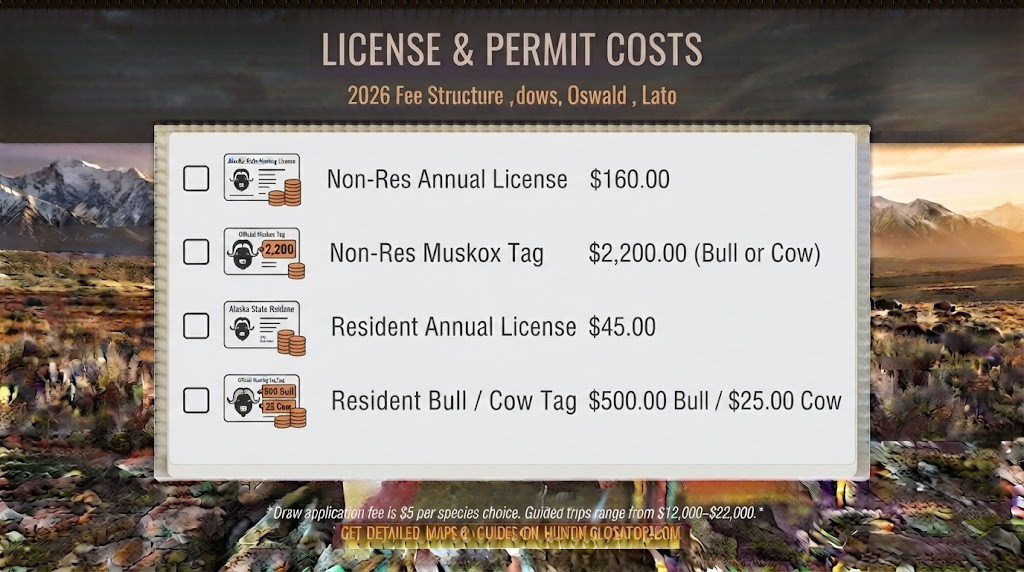
Here’s the fee breakdown for 2026, covering both residents and nonresidents:
| Item | Resident | Nonresident |
|---|---|---|
| Annual Hunting License | $45.00 | $160 |
| Muskox Tag – Bull | $500.00 | $2,200 |
| Muskox Tag – Cow / Registration hunts | $25 (reduced) | $2,200 |
| Draw Application Fee | $5 per species | $5 per species |
A few notes worth flagging before you buy: every hunter 16 and older needs a license regardless of residency, and nonresidents must purchase a locking tag specifically for muskox on top of their annual license. Alaska’s hunter education requirement also carries into the 2026-2027 season, so first-time applicants should confirm their certification is current. For the broader picture of how these rules apply across species, the Alaska hunting season guide covers statewide licensing basics in more detail.
Alaska Muskox Hunting Permits
Beyond your license and tag, you’ll need a hunt permit — which one depends on which season you’re pursuing. Registration permits cover Nunivak and Nelson Islands; draw permits cover Units 22 and 26C. Either way, you’re limited to one muskox permit per hunter per year.
Here’s how to get each one:
- Registration permit — apply in person in Bethel (January 6, 8:00 am) or Mekoryuk (January 7, 6:30 am)
- Draw permit — apply online through the ADF&G portal during the November 1 – December 15 application window
- Carry it with you — once issued, your signed permit must stay with you while hunting or transporting muskox, ready to show any enforcement officer who asks
ADF&G enforces the one-permit-per-hunter rule strictly, and showing up without your signed paperwork can end your hunt before it starts.
Where to Hunt Muskox in Alaska
Once your license and permit are sorted, the next question is where to go. Alaska muskox hunters generally choose from three routes — public land, private leased land, or a guided hunt — each fitting a different budget, timeline, and comfort level with logistics.
Best Public Lands
Public muskox hunting in Alaska centers on a handful of well-known areas, each with its own access challenges:
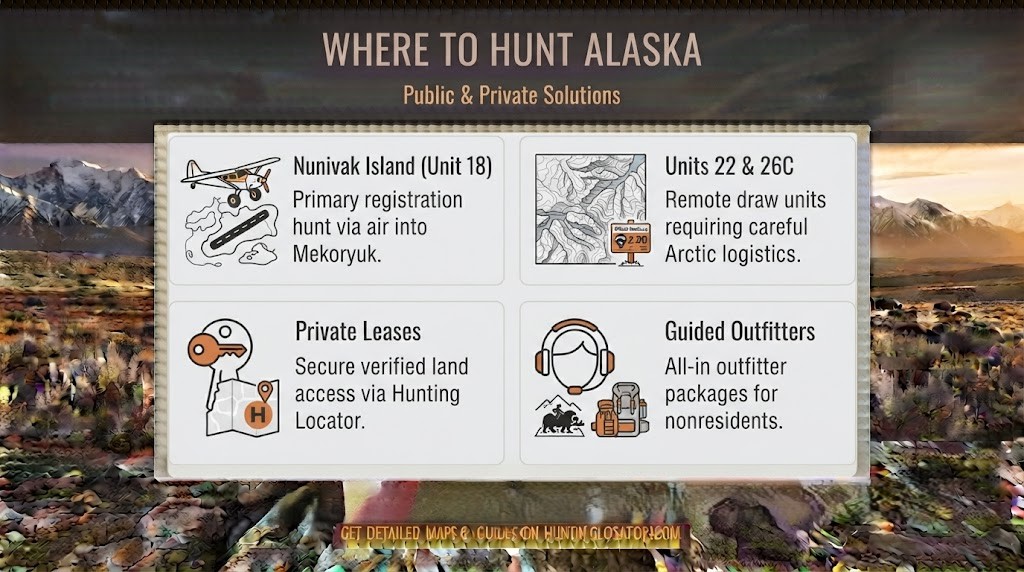
- Nunivak Island (Unit 18) — the primary registration hunt location, accessed via commercial air into Mekoryuk, the island’s only village
- Nelson Island — a second registration-hunt option in the same general region, with similarly remote access
- Unit 22 & 26C — the draw-only units, offering different terrain and a different hunting experience for those who land a permit
Access to these areas isn’t simple. Expect to rely on transporters, boats, or snowmobiles depending on the season, and budget extra time for weather delays. Some island access also crosses Alaska Native corporation land, so self-guided hunters should budget for native-land access permits as part of their overall trip cost, according to general industry guidance on self-guided muskox logistics.
Private Land Hunting with Hunting Locator
Public land muskox hunting comes with real trade-offs — remote logistics, unpredictable weather, and a quota that can close the season early if enough hunters fill their tags before you get your chance. Private land offers a different kind of certainty: controlled access on ground where you know exactly what you’re getting. Private land still requires landowner permission for any hunting access, so working through legitimate leases matters as much as finding the right piece of ground.
There are two main ways to secure that access: leasing private hunting land for a season or multiple seasons, or buying land outright if you’re looking for a long-term Alaska hunting base. Both give you something the public draw and registration systems can’t guarantee — certainty about where you’ll be hunting.
Hunting Locator connects hunters directly with landowners across the country who are ready to lease or sell their land, cutting out the guesswork of cold-calling property owners or hoping a public unit doesn’t fill before you arrive. Our Alaska listings include maps, acreage details, and tools to help you evaluate a property before you commit, whether you’re looking for a season-long lease or a piece of land to call your own. If you’re ready to lock down access before the 2026 season starts, browse Alaska hunting leases and see what’s currently available.
Alaska land pricing varies widely — some listings start around $8,900 an acre, with premium river-adjacent properties running considerably higher, based on Hunting Locator’s own land-for-sale data. That range is part of why working with a platform that vets and organizes listings is worth it, rather than piecing together ownership records and access rights on your own.
Guided Hunts
For nonresidents especially, a guided hunt takes the logistics off your plate — no figuring out transporters, boat access, or native-land permits on your own. Here’s what to expect:
- A licensed guide is typically required for nonresidents. General industry guidance indicates nonresidents usually need a licensed guide to hunt muskox in Alaska — verify this requirement with a licensed guide or ADF&G directly before booking.
- Budget $12,000–$22,000 all-in for a fully guided hunt. That range covers outfitter fees, transport, and lodging for a 2026 season nonresident muskox hunt, according to general industry guidance.
- Self-guided hunters should still expect $8,000–$12,000 each. That figure covers airplane fees, transporter services, tags, and native-land access permits — even without a guide, general industry guidance places these hunts firmly in five-figure territory.
- Book earlier than almost any other Alaska hunt. Muskox hunts require more lead time than most Alaska big-game seasons, so start your outfitter search and paperwork well before the season you’re targeting.
Muskox Hunting Tips
Preparation and gear separate a hard, cold, unsuccessful trip from one you’ll tell stories about for years. Focus on these before heading into muskox country:
- Dress for the Arctic, not just for cold. Layered cold-weather systems are non-negotiable — ground blizzards can develop with zero visibility in minutes, and at temperatures around -40°F, exposed skin can freeze in under two minutes, according to general industry guidance.
- Carry emergency backup, always. An emergency shelter, extra fuel, and a satellite communicator belong in every pack heading into remote muskox units, where help can be hours or days away.
- Bring enough rifle. Muskox are heavy, dense animals built for Arctic survival — pair a capable big-game caliber with quality optics.
- Plan your transport early. Whether it’s a boat, quadrunner, or snowmobile depends heavily on the season and area you’re hunting, so lock in your transporter well before opening day.
- Know the value of qiviut and meat. A winter bull’s qiviut coat holds real value when properly processed, and the meat is prized by hunters and subsistence users alike — handle both with care in the field.
Before you head out, check your gear list. The Hunting Locator store is a solid place to round out your kit for cold-weather, remote-access hunts like this one.
Combine Your Hunt
If you’re already making the trip to remote Alaska for muskox, check whether your unit and season overlap with other big-game opportunities. Some hunters stretch a single remote trip by pairing their muskox tag with a caribou hunt in the same region, or looking into bison opportunities if timing and units align. Given the logistics involved in reaching these remote areas, getting more than one hunt out of a trip is worth considering.
More Resources from Hunting Locator
Planning a 2026 muskox hunt often means understanding how it fits into Alaska’s broader hunting calendar. These guides cover the rest of the picture:
- Alaska hunting season guide — the broad statewide season overview covering all species and units
- Alaska muskox hunting season — our full species companion guide with additional muskox-specific detail
- Alaska moose hunting — season info for Alaska’s most iconic big-game species
- Alaska caribou hunting — a natural pairing hunt for many muskox trips
- Alaska bison hunting season — another limited-draw big-game option worth exploring
- Alaska brown bear hunting season — season details for Alaska’s premier predator hunt
- Alaska black bear hunting season — a more accessible bear-hunting option for residents and nonresidents alike
- Alaska mountain goat hunting season — for hunters chasing another Alaska mountain specialist
- Alaska deer hunting season — season info for Sitka blacktail and other Alaska deer hunts
- Alaska wolf hunting — details on predator seasons across the state
- Alaska furbearer trapping season — for hunters interested in trapping opportunities
- Alaska small game hunting season — season details for grouse, ptarmigan, and other small game
- Alaska hunting leases — browse current private-land listings across the state
- Hunting Locator store — gear up with the right equipment before your season starts
Frequently Asked Questions
What are the 2026 Alaska muskox season dates?
The Nunivak & Nelson Island registration season runs September 1, 2026 through March 31, 2027, with a bag limit of one muskox. Unit 22 & 26C draw hunt dates vary by year, so confirm the exact 2026 season dates directly with ADF&G before you apply.
How much does a nonresident Alaska muskox tag cost?
Nonresidents pay $2,200 for a muskox tag (bull or cow), plus a $160 annual hunting license and a $5 draw application fee if applying for Unit 22 or 26C. If you go the guided route instead of DIY, expect the full trip — outfitter fees included — to run $12,000–$22,000 all-in, according to general industry guidance.
How much does a resident muskox tag cost?
Alaska residents pay $45 for an annual hunting license, $500 for a bull tag, and just $25 for a reduced-fee cow or registration-hunt tag. That reduced pricing makes the Nunivak and Nelson Island registration hunts one of the more affordable big-game opportunities available to residents.
What’s the difference between a registration hunt and a draw hunt?
Registration hunts, like Nunivak and Nelson Islands, stay open to any qualified applicant until ADF&G closes the season by emergency order once the harvest goal is met. Draw hunts, like Units 22 and 26C, award a limited number of permits by lottery through an application window running November 1 to December 15.
Do I need a guide to hunt muskox in Alaska?
Muskox is a free-ranging species, but general industry guidance indicates that nonresidents typically need a licensed guide to hunt it legally in Alaska — verify this requirement directly with a licensed guide or ADF&G before booking your trip. Alaska residents can generally self-guide their hunts.
Where can I find private land to hunt muskox in Alaska?
Private land requires landowner permission for any hunting access, so working through vetted listings matters. Hunting Locator’s Alaska hunting leases page organizes current private-land opportunities across the state, giving you a starting point for securing access outside the public draw and registration systems.
The Final Shot
Planning a 2026 Alaska muskox hunt comes down to a few decisions: which season fits your timeline — the September 1 registration hunt or the Unit 22/26C draw — what you’re prepared to spend as a resident or nonresident, and where you’ll actually put boots on the ground. Whichever path you choose, the license-to-tag-to-permit sequence stays the same, and locking in each piece early gives you the best shot at a successful season.
This guide pulls together the official dates, costs, and access routes so you’re not hunting down scattered information the week before your trip. From here, the next steps are straightforward: confirm your season dates with ADF&G, budget your tag and license costs, and lock down where you’ll actually hunt.
If private land access is part of your 2026 strategy, Hunting Locator can help you explore Alaska leases and connect with landowners who can offer the kind of controlled, reliable access that public units can’t guarantee.
As a reminder, all information in this guide is current as of August 1, 2026 — always confirm final season dates and requirements with ADF&G before submitting any application.


