Whether you’ve hunted the same creek draw for years or you’re driving in from three states away chasing a bucket-list buck, this state rewards planning. Wait too long on permits or access, and you’ll spend the season scrambling instead of hunting.
This Kansas deer guide pulls season dates from the Kansas Department of Wildlife & Parks and covers what you need to hunt legally, where you can hunt, and what to expect once you’re in the field — whether you’re local or coming in from out of state.
Here’s what’s covered:
- 2026 season dates by method — youth, muzzleloader, archery, and firearm windows, plus bag limits in plain language.
- Licenses, permits, and costs — what residents and non-residents need to buy, and what it costs.
- Where to hunt — public land, private leases, and guided hunt options, so you’re not scrambling for access in October.
If you just need the numbers, start with the overview below.
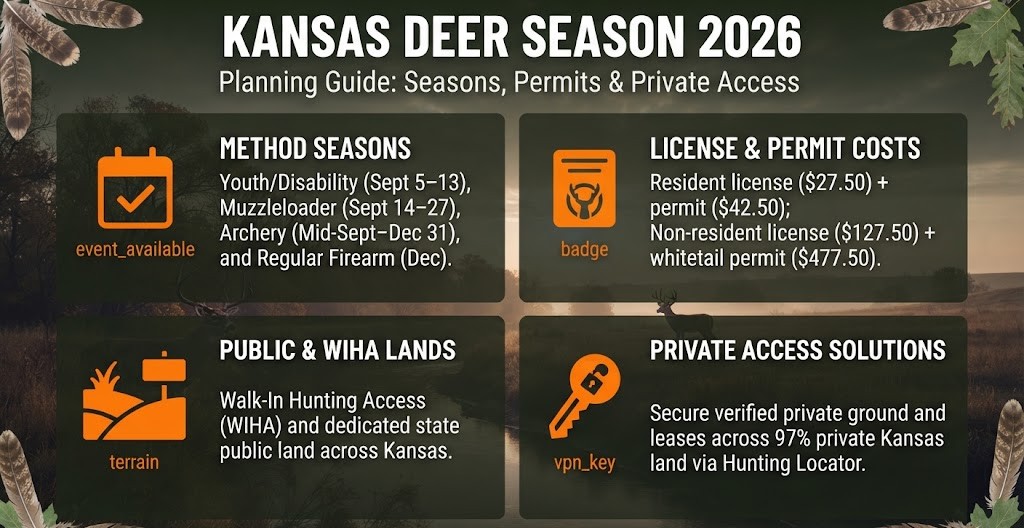
Quick Overview: Kansas Deer Season 2026 at a Glance
These are the key dates and limits for the 2026/2027 framework. Treat them as planning windows — KDWP sets the final season dates, legal methods, and unit-specific restrictions, so confirm before you buy a license or permit.
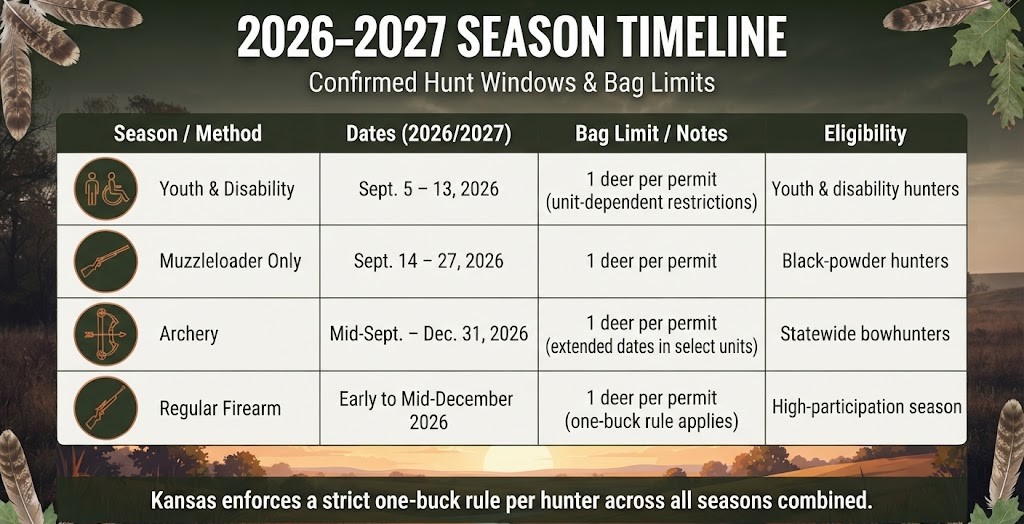
| Season (Method) | Dates (2026/2027 Framework) | Bag Limit Notes |
|---|---|---|
| Youth & Disability | September 5–13, 2026 | 1 deer per permit; sex/species restrictions vary by unit |
| Muzzleloader Only | September 14–27, 2026 | 1 deer per permit |
| Archery | Mid-September through December 31 (unit-dependent extended dates may apply) | 1 deer per permit |
| Regular Firearm | Early to mid-December | 1 deer per permit |
For a full breakdown of what each season means for your strategy, see the Kansas deer hunting season deep-dive.
The one-buck rule, in plain language: Kansas allows one antlered buck per hunter for the entire season, unless your specific permit says otherwise. This applies across archery, muzzleloader, and firearm seasons alike — once you tag a buck, you’re done for antlered deer until next year.
Before you hunt, you’ll need:
- Hunting License — your base credential. You cannot legally hunt in Kansas without one, regardless of species.
- Deer Permit — a separate purchase that authorizes you to take a deer, specific to species, sex, and unit.
- Hunter Education — required for all hunters born on or after July 1, 1957, before you can buy a license.
Confirm with KDWP: dates, fees, and unit restrictions change year to year. Verify current details at ksoutdoors.gov before you purchase anything.
Kansas Deer Hunting Seasons
Kansas splits its deer season into four windows, each tied to a specific method. Your choice of method shapes your dates, your stand placement, your gear, and how much pressure deer are under by the time you show up. These are planning windows — KDWP finalizes exact dates, methods, and unit-specific rules each year.
One detail that holds across all four seasons: big game shooting hours run one-half hour before sunrise to one-half hour after sunset.
Youth & Disability Season (Sept 5–13, 2026)
This window opens before the regular season, giving youth and disability hunters a shot at deer without a packed parking lot or a pressured herd. If you’re mentoring a first-timer, this is the season to circle.
Muzzleloader Season (Sept 14–27, 2026)
Muzzleloader season starts right as the youth window closes, giving black-powder hunters an early, method-specific window before archery opens statewide. Deer are still on late-summer patterns during this stretch, which can work in your favor if you’ve been scouting food sources.
Archery Season (Mid-September–December 31)
Archery is the longest of Kansas’s deer seasons, running from mid-September through December 31, with unit-dependent extended dates possibly applying in certain areas. That length gives you the most flexibility of any method — early-season patterns, the November rut, or a tag still open on New Year’s Eve. Confirm your unit’s exact end date with KDWP before planning a late-season sit.
Regular Firearm Season (Early–Mid December)
This is Kansas’s highest-participation season, running early to mid-December and drawing the biggest crowds to public ground and private leases alike. Blaze orange is required — worth reviewing that requirement, and other safety gear, before opening morning.
Kansas Deer Licenses and Permits
Two things stand between you and a legal Kansas whitetail: a hunting license and a deer permit. Residents can typically buy both over the counter; non-residents go through a competitive draw for deer permits. Confirm every fee and deadline below with KDWP before you commit any money.
Kansas Hunting Licenses
The hunting license gets you in the door — it doesn’t authorize you to take a deer on its own, but you can’t apply for or use a deer permit without one.
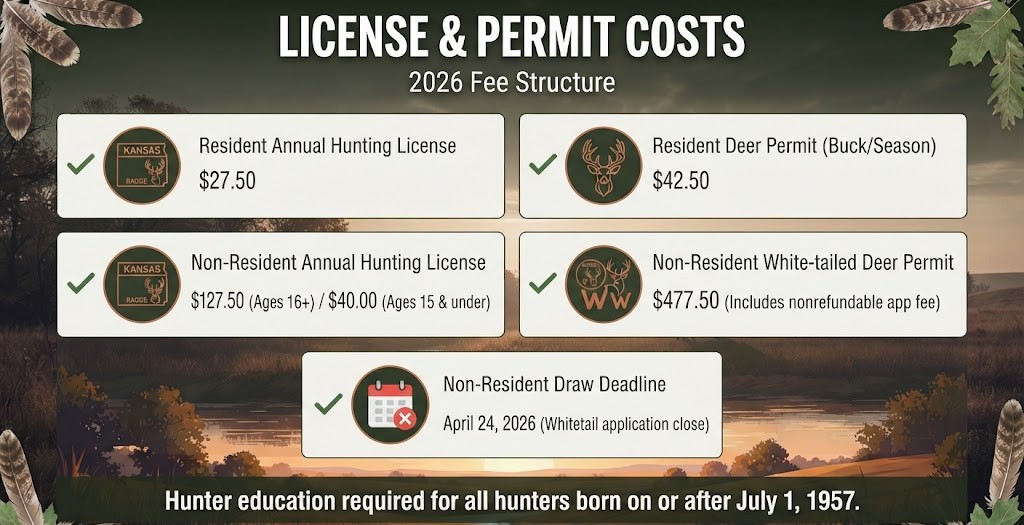
| Credential | Resident | Non-Resident |
|---|---|---|
| Hunting License (Annual) | $28 | $127.50 (16+) / $40.00 (15 & under) |
| Deer Permit (Buck/Season) | $43 | White-tailed Deer Permit: $477.50 (includes nonrefundable application fee for adults) |
| Youth Deer Permit | — | $115.00–$117.50 |
| Mule Deer Stamp (add-on) | — | $150 |
Hunter education requirement: all hunters born on or after July 1, 1957 must complete an approved hunter education course before purchasing a license. If you’re 16 or older and haven’t completed it, Kansas offers an apprentice license — a two-time deferral of the requirement, provided you’re supervised by a licensed adult 18 or older.
Non-resident permit fees include a nonrefundable application component, so you’ll pay that portion even if you’re not drawn. Confirm current fees and any changes directly with KDWP before you purchase.
Kansas Deer Permits
Every deer permit authorizes one deer, tied to species, sex, and unit. You’ll purchase your license and permit through KDWP’s official licensing portal, but the process depends on residency status.
For non-residents, the process runs through a structured draw:
- Apply by the deadline — non-resident limited-draw applications close on April 24, 2026, per the non-resident draw deadline announcement.
- Select your unit and adjacent unit — choose a primary hunting unit and pair it with an adjacent unit for each preference. If your primary unit fills up, you may still draw a permit in the adjacent unit.
- Purchase your license and permit — once drawn, you’ll need your non-resident hunting license alongside your deer permit. Add the Mule Deer Stamp at this stage if you’re after mule deer.
Non-resident deadline: April 24, 2026. Miss it, and you’re out for the season.
Resident deer permit application window: May 12–June 12. Residents generally have more flexibility and can typically purchase permits over the counter outside the draw process, but this window is still worth noting.
Kansas’s non-resident draw works like a lottery, using a preference-point system that weights applicants who’ve been unsuccessful in recent years toward better odds going forward. Recent framework changes have also brought more hunting units into the draw system for non-residents, so don’t assume a unit that was over-the-counter last year still is. It’s worth reviewing recent Kansas permit changes each season.
One more distinction: the non-resident draw and preference points apply specifically to whitetail deer permits. If mule deer is your target, add the Mule Deer Stamp during that same April application period rather than going through a separate draw.
Standard non-resident white-tailed deer permits often include an additional antlerless bag limit at no extra cost — effectively a bonus tag. Residents have their own path to additional antlerless tags as well. Either way, this is where access strategy starts to matter, which is what we cover next.
Where to Hunt Kansas Deer
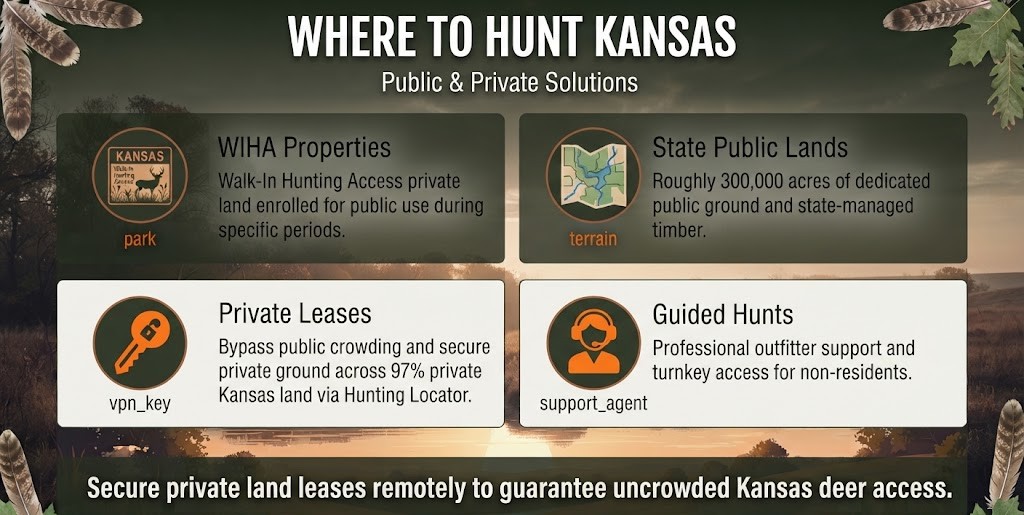
Kansas is roughly 97% private land, and that single fact shapes almost every hunting decision in the state. Access, more than skill, gear, or permit type, is often what separates a successful Kansas hunt from a frustrating one. Here are your three real options.
Best Public Lands
Public access in Kansas exists and rewards hunters willing to scout hard and plan ahead — good news if you’re hunting on a budget or close to home.
- WIHA (Walk-In Hunting Access) — private land enrolled voluntarily by landowners, opened to public hunting during designated periods. Not a shortcut to easy hunting, but productive for hunters willing to put in scouting time and cover ground.
- State Public Land — Kansas offers roughly 300,000 acres of dedicated public land, with landowners making an additional million acres available at various points throughout the year.
- Plan and time it — public access rewards timing over luck. Archery season’s long window gives you the most room to scout, wait out pressure, and find an opening other hunters miss.
Private Land Hunting with Hunting Locator
Since nearly all of Kansas is private ground, leasing or buying land solves the access problem directly — controlled hunting pressure, the ability to pattern deer over weeks instead of days, and consistency public land can’t match. Whether you want a season-long lease or ground to hunt for years, private access is where most serious Kansas deer hunters end up.
Finding quality access is one of the harder parts of planning a hunt, especially without family land or a longtime connection in the state. That’s the gap the Hunting Locator platform was built to close. It’s a marketplace that connects hunters directly with Kansas landowners ready to lease or sell huntable land, cutting out the guesswork and cold-calling that used to define the search for private access.
Current Kansas listings range from smaller acreage tracts suited to a single hunter working a food plot and timber edge, to larger multi-hundred-acre properties with river-bottom terrain built for trophy potential. Listings are updated regularly with acreage, location, and game type details, so you can compare real options instead of guessing.
To see what’s currently available, browse Kansas deer leases and start narrowing down properties that match your budget and hunting style. Good ground tends to move fast as the season approaches, so it’s worth starting the search now rather than in November.
Guided Hunts
For non-residents without local connections, a guided hunt is the turnkey option. Outfitters handle access, scouting, and on-the-ground logistics — you show up and hunt.
Choosing between leasing and guiding comes down to what matters most to you:
- Lease — more control over your hunt, lower cost per season over time, requires your own scouting effort, and builds repeat-year value as you learn the ground.
- Guided — higher upfront cost, minimal effort required from you, built-in local expertise, and often the better fit for a first-time Kansas trip or a trophy-focused hunt.
Guided hunt pricing varies by outfitter, property, and target species, so confirm specifics directly with any outfitter you’re considering. Hunting Locator connects hunters with landowners and outfitters who share a commitment to ethical hunts — the goal is finding the right fit for your season, not pushing one option over another.
Kansas Deer Hunting Tips
Preparation matters as much as luck. A few practical points for a productive season:
- Dress in layers — a layered system manages perspiration and blocks wind better than a single heavy jacket, and lets you adjust as temperatures swing across a long sit. Add blaze orange during firearm season — it’s both a safety necessity and a legal requirement.
- Carry the essentials — a reliable headlamp for pre-dawn setups and a sharp field-dressing knife for clean recovery are worth having every season.
- Scout before you sit — pattern deer movement and confirm your access boundaries before opening day. The long archery window rewards early legwork.
- Know your unit — confirm your unit’s species and sex restrictions, and keep the one-buck rule in mind before you climb into a stand.
- Plan for multi-day trips — if you’re traveling from out of state, build gear redundancy and solid logistics into your plan so a forgotten item or weather delay doesn’t derail the hunt.
Getting your gear dialed in before the season starts makes a real difference once you’re in the field. Gear up at the Hunting Locator store to be set from opening morning through the final sit.
More Resources from Hunting Locator
A hub for going deeper on Kansas hunting — deer specifics, other species, or straight to the platform and store.
Deer & Season Deep-Dives
- Kansas deer hunting season — the companion deep-dive covering deer-specific strategy and detail.
- Kansas hunting seasons overview — broader season context spanning multiple species.
Other Kansas Big Game
- Kansas elk hunting season — plan a second big-game pursuit alongside your deer hunt.
- Kansas antelope hunting season — worth a look given the mule deer and antelope overlap in western units.
Kansas Small Game & Birds
- Kansas small game hunting season — complementary options for the off-season stretches.
- Kansas upland game hunting season — pairs naturally with a fall deer trip.
- Kansas migratory bird hunting season — round out your bird-hunting calendar.
- Kansas waterfowl hunting season — built for the waterfowl crowd.
- Turkey hunting in Kansas — fall turkey is off the table for 2026, but it’s worth planning a spring turkey trip.
Platform + Store
- Browse Kansas leases — secure your deer-hunting access directly with landowners.
- Hunting Locator homepage — the platform hub connecting hunters and landowners nationwide.
- Hunting Locator store — get the right gear dialed in for your season.
Frequently Asked Questions
How much is a non-resident Kansas deer permit in 2026?
The non-resident white-tailed deer permit runs $477.50, which includes a nonrefundable application fee for adults, plus a $127.50 non-resident hunting license. Add $150 for a Mule Deer Stamp if you’re targeting mule deer. Applications close April 24, 2026 — confirm current fees with KDWP before applying.
What are the 2026 Kansas deer season dates?
The 2026/2027 framework includes Youth & Disability season September 5–13, Muzzleloader season September 14–27, Archery season mid-September through December 31, and Regular Firearm season early to mid-December. These are planning windows that KDWP finalizes each year, so confirm exact dates before purchasing any license or permit.
What does a resident Kansas deer permit cost?
Kansas residents pay $27.50 for the annual hunting license plus $42.50 for the resident deer permit (buck/season). Residents can generally purchase over the counter, though the formal application window runs May 12–June 12. Confirm current fees with KDWP before you buy.
Who needs hunter education to hunt deer in Kansas?
All hunters born on or after July 1, 1957 must complete an approved hunter education course before purchasing a hunting license. If you’re 16 or older and haven’t completed the course, Kansas’s apprentice license offers a two-time deferral of that requirement when you’re supervised by a licensed adult 18 or older.
What is the Kansas one-buck rule and bag limit?
Kansas allows one antlered buck per hunter per season unless your specific permit states otherwise. The general bag limit is one deer per permit, with sex and species restrictions varying by unit. Standard non-resident whitetail permits often include a bonus antlerless tag at no additional cost.
How do non-residents get access to private land in Kansas?
Since Kansas is roughly 97% private land, most non-residents secure access through a lease or a guided hunt rather than relying on public ground alone. Hunting Locator connects hunters directly with Kansas landowners who lease or sell huntable land — browse Kansas deer leases to see what’s currently available.
The Final Shot
A successful Kansas deer season comes down to knowing your dates, locking in your license and permit, securing access, and showing up prepared. With the non-resident draw closing April 24, 2026, and the resident application window running May 12–June 12, the clock is already moving.
The next steps are straightforward: confirm your season dates and unit details directly with KDWP, complete hunter education if you haven’t already, and lock down access before the best ground and guided slots fill up. Dates and fees in this guide come from KDWP, and it’s worth a final check at ksoutdoors.gov before you purchase anything.
Kansas’s private-land reality is a real constraint, but it’s a manageable one with the right access strategy. Time to scout and secure ground is limited, and the best spots tend to go early. When you’re ready, secure your Kansas deer access and lock in your season before the good ground is gone.


