Getting the most out of your Kansas small game hunting trip comes down to preparation — confirmed dates, secured land, and the right licenses before opening day. This guide consolidates season dates, bag limits, license costs, and land-access options for the 2026–27 season in one place, whether you’re a nonresident planning a pheasant trip, a resident hunting your home county, or a parent introducing a kid to small game for the first time.
Some 2026–27 details were still being finalized at publication. Verify final dates with the Kansas Department of Wildlife & Parks before you go out.
Here’s what this guide covers:
- Season dates and bag limits for pheasant, quail, prairie chicken, squirrel, and rabbit
- License and permit costs for residents, nonresidents, youth, seniors, and apprentice hunters
- Where to hunt — public land and WIHA areas, guided hunts, and private land leases
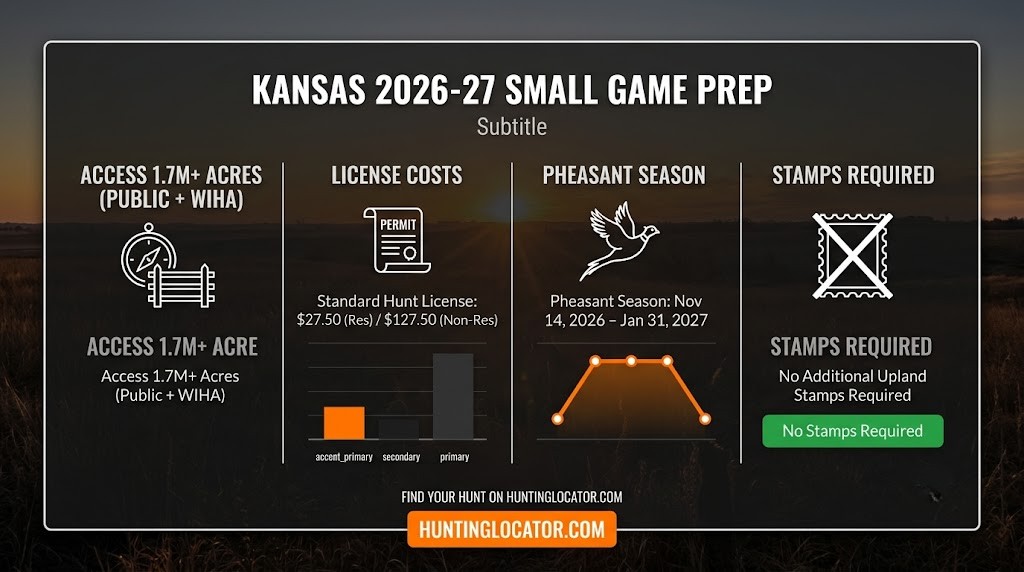
Quick Overview: Kansas 2026 Small Game Seasons at a Glance
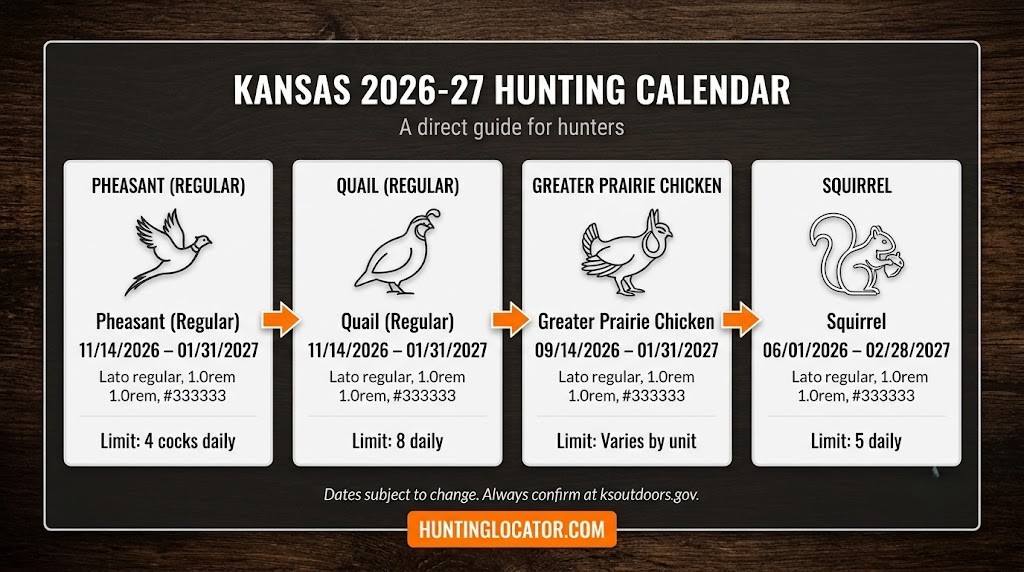
| Species | Season Type | Start Date | End Date | Daily Bag Limit |
|---|---|---|---|---|
| Pheasant | Youth Season | 10/31/2026 | 1/11/2027 | 2 cocks (youth) |
| Pheasant | Regular Season | 11/14/2026 | 01/31/2027 | 4 cocks daily |
| Quail | Youth Season | 10/31/2026 | 1/11/2027 | 8 daily |
| Quail | Regular Season | 11/14/2026 | 01/31/2027 | 8 daily |
| Greater Prairie Chicken | Regular Season | 09/14/2026 | 01/31/2027 | Varies by unit |
| Squirrel (Gray & Fox) | Extended Season | 6/1/2026 | 02/28/2027 | 5 daily |
| Cottontail Rabbit | Year-Round | Year-round | Year-round | 10 daily |
Always confirm final 2026–27 dates with the Kansas Department of Wildlife & Parks at ksoutdoors.gov before you hunt. Some upland and furbearer dates were still being finalized as of mid-2026.
Industry sources report confirmed 2026–27 upland openers of Youth/Disability November 7–8, 2026 and Regular November 14, 2026–January 31, 2027. Use these as planning benchmarks and defer to KDWP for final confirmation.
License and Education Requirements
Kansas licensing works in layers. Here’s what hunters need before heading into the field:
- Hunter education: Required for all hunters born on or after July 1, 1957 who are 16 or older — completion is mandatory before purchasing a standard hunting license
- Youth under 16: May hunt under the direct supervision of a licensed adult 18 or older without completing hunter education first
- Apprentice license: Available to hunters 16 and older who haven’t completed hunter education; valid for one season and usable twice in a lifetime before full certification is required — the supervising adult must be a licensed hunter 18 or older
- Base hunting license: Required for all hunters before taking any small game species — see the full fee breakdown in the license section below
- Where to buy: Licenses are available online through the GoOutdoorsKansas.com portal or at any authorized Kansas license vendor
Kansas Small Game Hunting Seasons
Each species offers genuine opportunity across a calendar that runs from early fall through late winter. The sections below cover official dates and limits, along with field context for each species.
Pheasant Season
The Kansas pheasant regular season runs November 14, 2026 through January 31, 2027, with a youth season opener on October 31, 2026. The daily bag limit is 4 roosters during the regular season and 2 cocks during the youth season. Verify final opener dates with KDWP before you hunt.
Western Kansas grasslands are the core of that reputation — vast CRP fields, milo stubble, wheat fields, and native grass corridors that hold wild roosters in numbers few other states can match. The best action typically comes in the first three weeks after opening day and again after snow arrives in mid-December, when birds concentrate in heavier cover.
Field rules to know:
- Roosters only: Hens are fully protected during the regular season
- Possession limit: Builds to 16 roosters after four days of hunting
- Proof of sex: A foot, plumage, or other identifying part must remain attached to harvested birds until they reach the hunter’s residence or storage location
- Transportation: If transferring game to another person, a signed slip with the hunter’s name, contact information, and license number is required
For nonresident hunters, outfitters and lodges in western Kansas towns like Colby, Hays, and Garden City cater specifically to traveling pheasant hunters, which helps with multi-day trip logistics.
Quail Season
Quail season runs concurrent with pheasant, with the same youth and regular season structure. The daily bag limit is 8 birds, and the possession limit is 32 birds after four days.
Bobwhite quail thrive in eastern and central Kansas, particularly in the Flint Hills transition zone — the edge between tallgrass prairie and cropland that creates ideal covey habitat. Walk-in hunting areas and CRP fields are prime locations for flushing coveys, and quail are often targeted alongside pheasant where their ranges overlap. For a combined pheasant-and-quail day, focus your scouting on native grass, hedge rows, and plum thickets in the central and eastern parts of the state.
Greater Prairie Chicken Season
The Greater Prairie Chicken regular season runs September 14, 2026 through January 31, 2027 — one of the earliest opening dates on the Kansas small game calendar. Bag limits vary by unit, so confirming your specific unit’s rules with KDWP before you go is essential.
Kansas holds one of the largest remaining populations of Greater Prairie Chickens in North America, with the Flint Hills tallgrass prairie as the species’ stronghold. It’s a walk-up hunt across open country with conservative limits designed to protect a population that doesn’t exist at huntable densities in most other states.
One important note: the Lesser Prairie Chicken, found in limited numbers in southwestern Kansas, may be restricted or closed depending on population status. Verify current lesser prairie chicken status with KDWP before planning any trip targeting that species.
Squirrel and Cottontail Rabbit — Year-Round Opportunities
These two species offer the most flexible hunting windows in the Kansas small game calendar. Gray and fox squirrel season runs from June 1, 2026 through February 28, 2027 with a daily bag limit of 5, while cottontail rabbit is open year-round with a daily bag limit of 10.
Small game hunting is well suited to beginners or those looking to explore Kansas woods and farmlands without high permit costs. The gear requirements are minimal, the terrain is accessible, and the extended seasons mean you’re not locked into a narrow window. Timbered creek bottoms hold gray squirrels reliably, while brushy field edges and CRP borders are consistent rabbit habitat across much of the state.
Kansas Small Game Licenses and Permits
Kansas licensing works in layers — first your hunting license, then your species permit, then any required stamp or registration. The sections below cover each layer so you know what to purchase before opening day.
Kansas Hunting Licenses
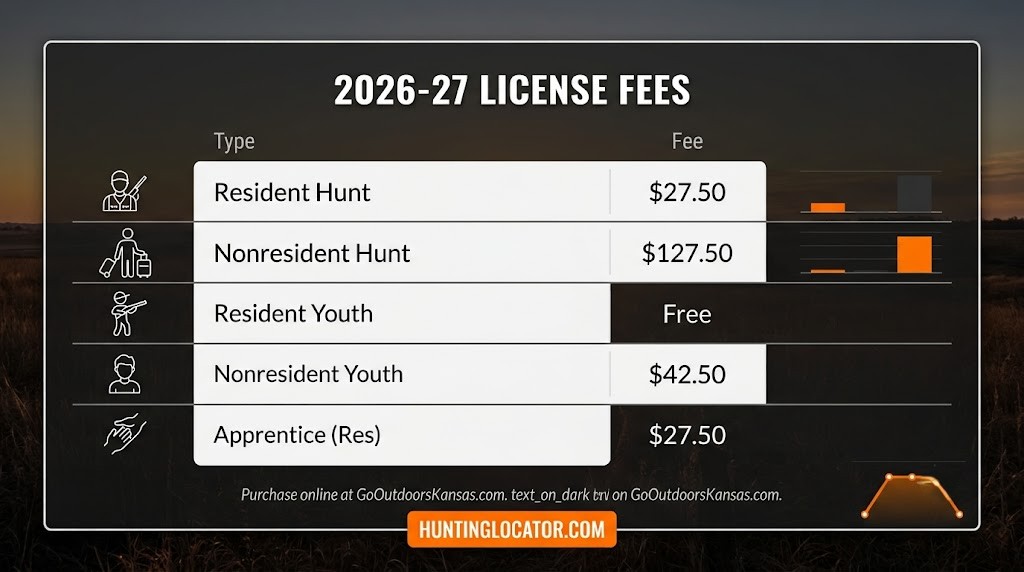
The base Kansas hunting license covers small game species including pheasant and quail statewide. Fee schedule for the 2026–27 season:
| License Type | Fee |
|---|---|
| Resident Hunt | $28 |
| Nonresident Hunt | $128 |
| Senior Resident Hunt (65+) | $15 |
| Resident Youth (under 16) | Free |
| Nonresident Youth (under 16) | $42.50 |
| Resident Combination (Hunt/Fish) | $47.50 |
| Nonresident Combination (Hunt/Fish) | $192.50 |
| Resident Apprentice License | $27.50 |
The $127.50 nonresident base license covers pheasant and quail statewide with no additional upland stamp required. If you’re also fishing during your Kansas stay, the $192.50 nonresident combination license adds fishing access for $65 more. As industry planning guides note, nonresidents should budget for the full trip — license, travel, lodging, and any guided hunt costs add up.
Resident youth under 16 hunt free. The apprentice license at $27.50 is available to any resident 16 or older who hasn’t completed hunter education, with a two-time lifetime purchase limit — after that, full hunter education certification is required.
Purchase licenses online through GoOutdoorsKansas.com or at any authorized Kansas license vendor.
Kansas Hunting Permits and Additional Requirements
For most Kansas small game species — pheasant, quail, squirrel, and rabbit — the base hunting license is all you need beyond hunter education certification. No additional stamps are required for upland birds for resident or nonresident hunters.
Additional requirements to be aware of:
- HIP Registration: Migratory bird hunters must hold HIP registration in addition to their base license — required if you’re combining small game with any dove or waterfowl hunting
- Greater Prairie Chicken: Unit-specific bag limits apply — confirm your unit’s rules directly with KDWP before the season
- Blaze Orange: 200 square inches of blaze orange (100 front, 100 back) plus a blaze orange hat is required during firearm deer seasons for all hunters in the field regardless of target species — plan accordingly if your small game season overlaps with any firearm deer season
- Hunter education: The course must be a minimum of 10 hours, with most averaging 12 hours over two or more days; online-only options are available for hunters 18 and older, while hunters aged 11–17 must complete an in-person skills session in addition to the online component
Kansas Small Game: Where to Hunt
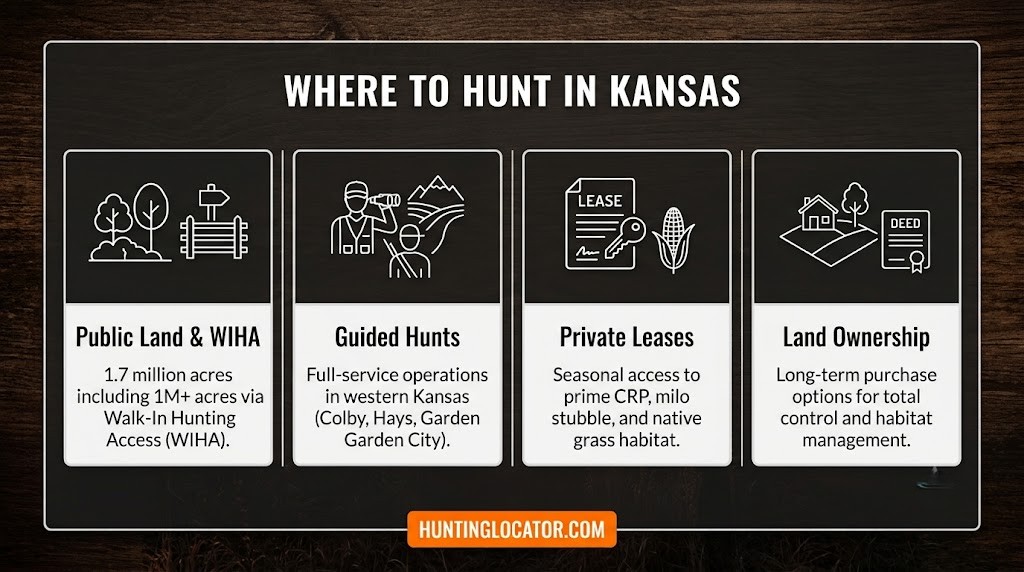
Kansas gives hunters three main access options: public land, guided hunts, and private land. Each fits different budgets, experience levels, and planning timelines.
Best Public Lands in Kansas
Kansas offers 300,000 acres of dedicated public land, plus landowners make another million acres available through the Walk-In Hunting Access program — totaling over 1.7 million acres of public hunting access statewide. Key options:
- Walk-In Hunting Access (WIHA): The WIHA program opens over one million acres of private land to public hunting — much of it prime upland habitat. WIHA atlases are available in August and are the essential planning tool for locating enrolled properties. Rules include no driving off designated paths, no permanent blinds, and strict respect for property boundaries
- State Wildlife Areas: Kansas operates a statewide network of wildlife areas managed by KDWP for habitat quality and hunter access
- Federal Lands: National grasslands and other federal holdings in western Kansas add substantial acres to the public land inventory, particularly in prime pheasant country
- CRP Fields: Walk-in areas and CRP fields make ideal habitat for flushing pheasants and coveys of bobwhite quail — prioritize these when planning locations using WIHA maps
- Flint Hills Region: The Flint Hills tallgrass prairie is the stronghold for both bobwhite quail and greater prairie chicken — public access here is worth prioritizing for hunters targeting either species
Guided Hunts
For nonresident hunters or anyone who wants a structured hunt without the scouting legwork, guided pheasant operations in Kansas are well established. Outfitters and lodges in western Kansas towns like Colby, Hays, and Garden City cater specifically to pheasant hunters, making it straightforward to combine a quality hunt with manageable logistics.
What to expect from a Kansas guided pheasant operation:
- Group structure: Operations like Spearpoint Ranch accommodate groups up to 20 hunters, tailoring hunts to each group’s preferences — popular with business groups, family outings, and women’s hunting groups
- Minimum group sizes: Minimum group size at many operations is 4 hunters, with per-person/per-day pricing based on group size
- Deposit requirements: A deposit of approximately $200 per person per day is standard at booking, typically due within 10 days of reservation
- Habitat: Guided operations in north-central and western Kansas offer access to rolling hills, CRP fields with food plots, cattail sloughs, and wooded creek bottoms that consistently produce roosters
- What to bring: Quality upland boots, hunter orange, and a well-broke bird dog improve any guided hunt — many operations provide dogs, so confirm details when booking
Top operations in prime pheasant counties fill quickly once the season calendar firms up, so book early.
Private Land Hunting with Hunting Locator
For hunters who want consistent, season-long access to quality ground, private land is the most reliable option. Kansas pheasant hunting is driven by the state’s vast CRP grasslands, milo stubble, and native grass habitat — and the best of that habitat is on private land. Leasing gives you the freedom to hunt on your schedule, scout pre-season, and build a long-term relationship with a piece of ground.
Private land access in Kansas comes through two paths: leasing and buying.
Leasing is the most common route for both resident and nonresident hunters. Annual leases provide exclusive or semi-exclusive access for the season, typically covering specific species or a combination. Pricing varies by acreage, habitat quality, and region — western Kansas pheasant ground commands premium rates during prime season, while rabbit and squirrel access on smaller parcels is more affordable. Finding landowners open to leasing has traditionally required either local connections or a lot of cold calls, which is where a land-access platform is useful.
Buying hunting land is the longer-term option for hunters who want permanent access and the ability to manage habitat themselves. Kansas farmland and grassland parcels range widely in price depending on county, soil quality, and water features — and ownership removes the annual access uncertainty that comes with leasing.
Hunting Locator connects hunters directly with landowners across Kansas who are ready to lease or sell hunting access. Browse verified Kansas hunting properties at huntinglocator.com/leases/state/kansas/, filter by species, acreage, and region, and contact landowners who’ve already indicated they’re open to hunters. Most members find a lease within two weeks.
Kansas Small Game Hunting Tips
These tips apply across species and experience levels.
- Scout before season: WIHA atlases drop in August — use that window to identify properties, mark access points, and understand the terrain before opening day. Hunters who do this consistently outperform those who show up without prior knowledge of the ground.
- Time your trip around weather: The best pheasant action typically comes in the first three weeks after opening and again after mid-December snow. Snow concentrates birds in heavier cover and makes them more predictable — a late-season trip is worth planning if your schedule allows.
- Read the habitat: Kansas pheasant hunting is driven by CRP grasslands, milo stubble, and native grass. For quail, focus on native grass, hedge rows, and plum thickets. Knowing what each species needs gets you to birds faster than walking fence lines at random.
- Hunt the edges: Transition zones between cover types — where CRP meets cropland or a creek bottom meets open grassland — consistently hold more birds. This applies to pheasant, quail, rabbit, and squirrel alike.
- Know your identification: Only rooster pheasants are legal. Proof of sex must remain attached during transport. For prairie chicken hunters, knowing the visual difference between greater and lesser — and knowing your unit’s specific rules — is non-negotiable.
- Wear the orange: 200 square inches of blaze orange front and back, plus a blaze orange hat, is required during firearm deer seasons for all hunters in the field. During small game seasons that overlap with deer firearms seasons, this is both a legal requirement and basic safety practice.
- Start new hunters on rabbits and squirrels: Small game hunting is well suited to beginners — extended seasons, accessible terrain, and relaxed bag limits make cottontail and squirrel hunting a natural introduction to the sport.
- Get your gear sorted: Quality upland boots, a bird vest, and shotgun shells suited to your conditions — early season heat versus late-season cold and wind — make a real difference across a full day in western Kansas. Visit the Hunting Locator store for gear recommendations suited to Kansas small game conditions.
More Resources from Hunting Locator
- Hunting Locator Kansas Leases — Browse verified private land listings across Kansas, filterable by species, acreage, and region. Connect directly with landowners ready to lease or sell hunting access.
- Hunting Locator Home — Hunting leases, outfitter connections, and land-access tools across the U.S.
- Arkansas Hunting Season Guide — Full-season overview for hunters eyeing Arkansas as a destination state, covering all major species and seasons.
- Arkansas Small Game Hunting Season — Arkansas small game seasons in detail — useful for hunters who split time between Kansas and the South.
- Arkansas Deer Hunting Season — Season dates, regulations, and land-access guidance for Arkansas whitetail hunters.
- Arkansas Turkey Hunting Season — Spring turkey planning resource for one of the South’s top turkey states.
- Arkansas Waterfowl Hunting Season — Duck and goose season guide for the Mississippi Flyway.
- Arkansas Migratory Bird Hunting Season — Dove, woodcock, and other migratory bird seasons in Arkansas.
- Arkansas Feral Hog Hunting Season — Year-round hog hunting regulations and access options in Arkansas.
- Arkansas Black Bear Hunting Season — Season structure and permit information for Arkansas black bear hunters.
- Arkansas Elk Hunting Season — Application process, season dates, and hunting unit details for Arkansas elk.
- Arkansas Alligator Hunting Season — Permit process and season details for Arkansas alligator hunting.
- Hunting Locator Arkansas Leases — Private land listings across Arkansas for hunters looking to secure access south of Kansas.
- Hunting Locator Store — Upland boots, vests, shotgun ammunition, and other gear for Kansas small game hunting.
FAQ
Do I need a special license or stamp to hunt pheasant and quail in Kansas?
No additional upland stamp is required beyond your base Kansas hunting license. The resident license ($27.50) and nonresident license ($127.50) both cover pheasant and quail statewide. If you’re also hunting migratory birds like doves, you’ll need HIP registration — but for upland birds only, the base license is sufficient.
What is the Kansas apprentice hunting license and how many times can I use it?
The Kansas apprentice hunting license costs $27.50 and is available to any resident 16 or older who hasn’t completed hunter education. It defers the education requirement for one season and can be purchased a maximum of two times in a lifetime. After the second use, full hunter education certification is required to purchase a standard license. While hunting on an apprentice license, the apprentice must be accompanied by a licensed adult 18 or older.
Can a nonresident hunter use Kansas WIHA areas?
Yes — the WIHA program is open to both resident and nonresident hunters with a valid Kansas hunting license. The WIHA atlas is published in August and lists all enrolled properties with access rules. Restrictions apply to all hunters regardless of residency: no driving off designated paths, no permanent blinds, and all property boundaries must be respected.
What are the possession limits for pheasant and quail in Kansas?
The pheasant possession limit is 16 roosters after four days of hunting — four times the 4-bird daily bag limit. The quail possession limit is 32 birds — four times the 8-bird daily limit. Proof of sex must remain attached to pheasants during transport.
Is the Greater Prairie Chicken season the same statewide?
No — bag limits for Greater Prairie Chicken vary by unit, with the Flint Hills serving as the primary hunting area. The season runs September 14, 2026 through January 31, 2027, but unit-specific rules apply. Verify your unit’s bag limits with KDWP before hunting. Also note that lesser prairie chicken hunting may be restricted or closed depending on population status — confirm current status before planning any trip targeting that species.
How do I find private land to hunt in Kansas without cold-calling landowners?
Hunting Locator’s Kansas lease listings connect you directly with landowners who are actively open to hunters. Browse by species, acreage, and region. The platform handles both seasonal leases and land purchase inquiries, and most members report finding access within two weeks of signing up.
Planning Summary
Kansas has long seasons, diverse species, and more public access than most states its size. The planning work — confirming dates with KDWP, securing your license, and locking in land access before season — is what determines whether a Kansas trip delivers.
If land access is your remaining gap, Hunting Locator has verified Kansas hunting properties at huntinglocator.com/leases/state/kansas/. Browse by species, acreage, and region, and connect with landowners who are ready for hunters.


