The thing is, Montana black bear regulations can trip you up if you’re not prepared. Different Bear Management Units have different season dates. Some areas close when quotas fill up. And don’t even think about buying a license without passing that bear identification test first.
This guide cuts through the confusion and gives you everything you need for a successful 2026 hunt. We’ve pulled the latest info straight from Montana Fish, Wildlife & Parks and organized it so you can actually use it.
Here’s what we’ll cover:
- Exact season dates for spring and fall (plus those tricky BMU variations)
- Real license costs and what you actually need to buy
- Where to find bears on public land, private ranches, and everything in between
Let’s jump into the essentials first.
Quick Overview
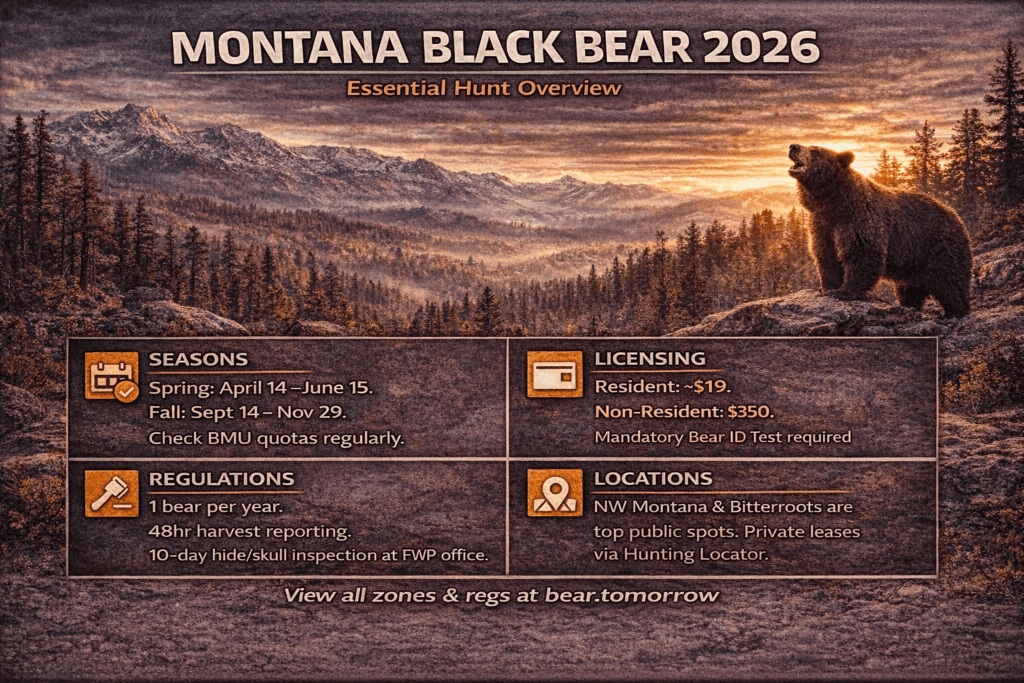
Montana splits its bear country into Bear Management Units, and each one has its own rules. The 2026-2027 regulations got approved by the Fish and Wildlife Commission on December 4, 2025, and they’re good from March 1, 2026, through February 28, 2027.
| Element | Details |
|---|---|
| Spring Season | April 14 – May 30 or June 14, 2026 (depends on your BMU) |
| Fall Season | September 14 – November 29, 2026 |
| Bag Limit | 1 black bear per license year |
| Resident License Cost | ~$19 (plus fees) |
| Non-Resident License Cost | $350 |
| Required Test | Bear Identification Test (free, online) |
| Harvest Reporting | Mandatory within 48 hours |
| Hide/Skull Inspection | Required within 10 days at FWP office |
Here’s something that catches people off guard: you must pass the bear identification test before you can even buy a bear license. No exceptions. The good news? It’s free and you only take it once.
What you’ll need for licenses:
- Base hunting license (Conservation License for residents; appropriate non-resident license)
- Black Bear License ($19 resident / $350 non-resident)
- Bear Identification Test certificate (pass it first, then buy your license)
- Hunter Education certificate (if you were born on or after January 1, 1985)
- Hound License (if using dogs—tack on another $250 for non-residents)
Now let’s break down when you can actually hunt.
Black Bear Hunting Seasons
Montana gives you two shots at bears each year: spring and fall. Each season hunts completely different, and you need to know which Bear Management Units have quotas that can shut things down early.
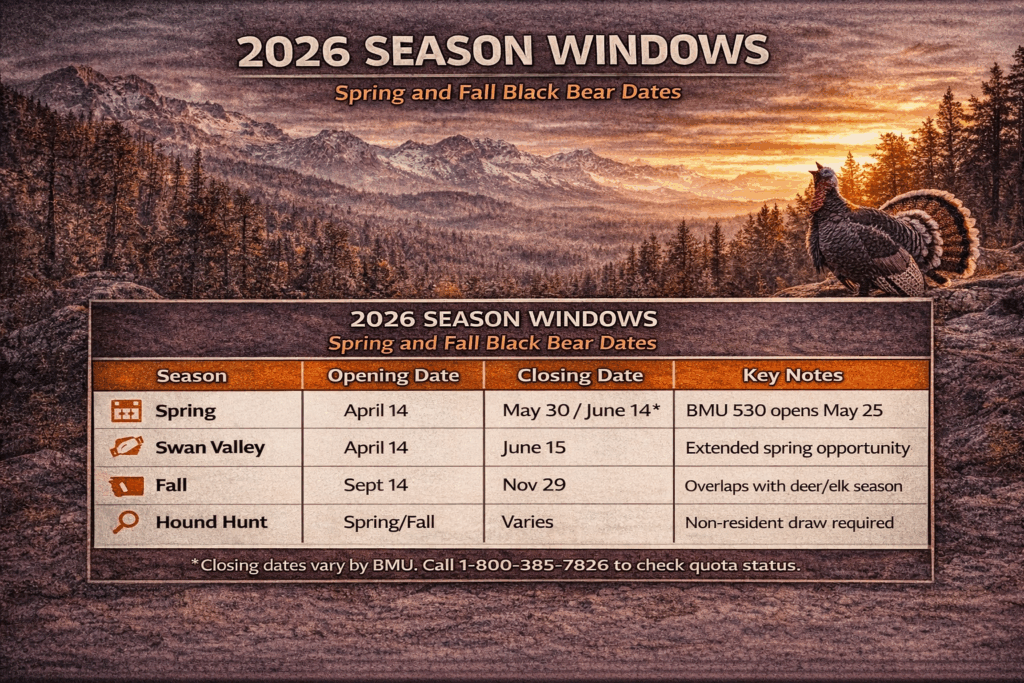
Here’s the deal with quotas: BMUs 411, 420, 440, 450, 510, 520, 530, 600, and 700 all have harvest limits. When they hit their numbers, the season closes. Period. Call 1-800-385-7826 or 406-444-1989 to check quota status before you head out.
Spring Black Bear Season
Spring season runs April 14 through May 30 or June 14, 2026, depending on where you hunt. But here’s a curveball: BMU 530 doesn’t open until May 25. They created this unit in 2024 by splitting BMU 520, so don’t get caught off guard.
The Swan Valley is special. It stays open until June 15th, making it one of the few places in Montana where you can hunt bears into mid-June. They extended the hound season to match, so if you’re running dogs, that’s extra time on the mountain.
Spring hunting is all about food. Bears come out of their dens hungry and head straight for the first green-up. Think south-facing slopes, open meadows, and old logging cuts where the snow melts first and grass starts growing.
One more thing that trips people up: if you buy your spring license after April 14, you can’t hunt for 24 hours. Plan accordingly.
Fall Black Bear Season
Fall season runs September 14 through November 29, 2026. This is when bears go into hyperdrive, packing on fat for winter. They’re hitting berry patches, oak brush, and anything else that’ll add calories.
Fall hunting overlaps with deer and elk seasons, which is perfect if you want to chase multiple species on one trip. Montana’s got all the color phases you could want – cinnamon, blonde, brown, and classic black bears.
The bears are more predictable in fall because they’re locked onto food sources. Find the food, find the bears.
Montana Black Bear Licenses and Permits
Getting licensed for bear hunting isn’t complicated, but there’s a specific order you need to follow. Take the Bear Identification Test first, then buy your licenses.
Montana Hunting Licenses
Here’s what everything costs:
| License Type | Resident Cost | Non-Resident Cost | Notes |
|---|---|---|---|
| Conservation License | Required (base) | Required (base) | Get this first |
| Black Bear License | ~$19 + fees | $350 | Need Bear ID Test certificate |
| Hound License (if using dogs) | Included | $250 additional | Spring requires drawing |
The Bear Identification test is online only, though FWP staff can help you take it in person if you don’t have internet access. You only take it once, but you need to show proof every time you buy a license. Keep taking it until you pass – there’s no limit on attempts.
Why the test matters: kill a grizzly by mistake and you’re looking at $500-$2,000 in fines plus potential jail time. Don’t rely on color or size to tell them apart. Look at the claws, ears, face shape, and shoulders. Grizzlies have that dished face and distinct forehead, while black bears have a straight line from forehead to nose.
Montana Hunting Permits
Most bear licenses are over-the-counter, but hound hunting is different. Non-residents who want to use dogs in spring need to enter a drawing for the Nonresident Hound License.
If you don’t draw, they’ll refund your $250 hound license fee. But here’s the catch: you have to return your Spring Black Bear license by April 14 if you don’t draw. No exceptions.
If you do get a Nonresident Hound License, you can’t help anyone else hunt bears. And remember, hound hunting is off-limits in occupied grizzly habitat in certain BMUs. New for 2026: hunters can build bonus points for black bears.
Montana Black Bear: Where to Hunt
Montana’s got bears, but they’re not everywhere. Western Montana holds most of the state’s black bear population, and you’ve got options for how to hunt them.
Best Public Lands
Montana’s public land system gives you millions of acres to explore. Here’s where the bears are:
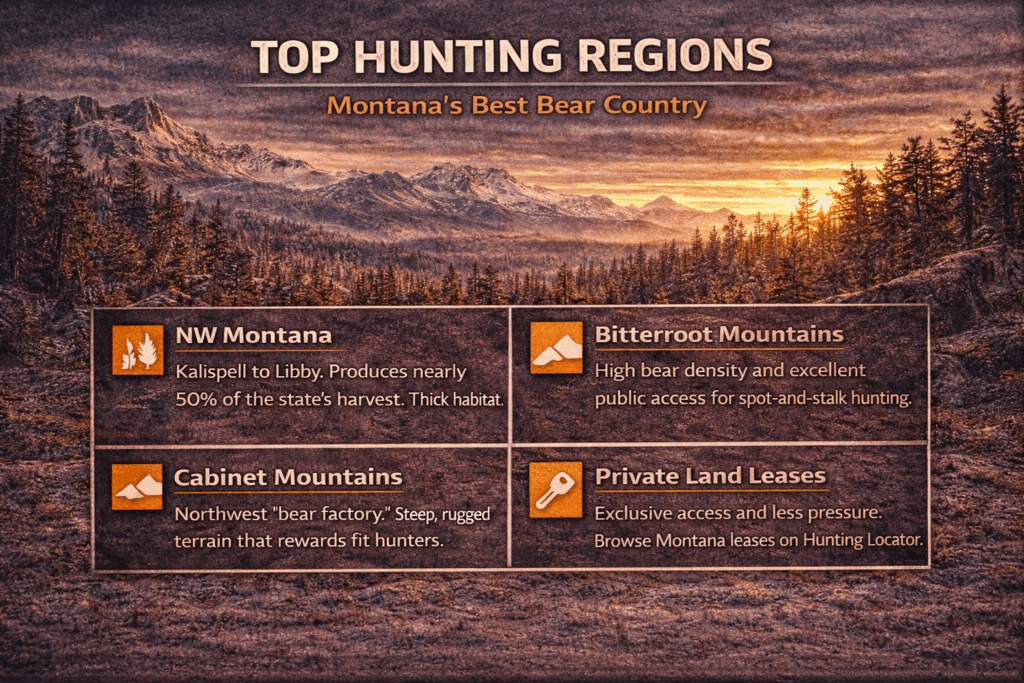
- Bitterroot Mountains – Known for high bear density and good public access. Varied terrain with excellent spring green-up areas.
- Cabinet Mountains – Northwest Montana’s bear factory. Tough country that rewards hunters who can handle steep terrain.
- Sapphire Mountains – Good public access with steady bear activity. Less intimidating than the Cabinets.
- Northwest Montana (Kalispell to Libby) – Nearly 50% of Montana’s bears get killed in this corner of the state, mostly on public land.
- Swan Valley – That extended season until June 15th, plus thick conifer habitat that holds bears.
Don’t overlook Block Management. This program opens up 6.8 million acres of private land for free public hunting. It’s a partnership between landowners and FWP that gives you access to places you’d never hunt otherwise.
Guided Hunts
Outfitters make sense if you’re new to Montana or want someone else handling the logistics. They know where the bears are, how to hunt them, and can get you onto private ground you’d never access on your own.
Outfitters like Crazy Creek and Absaroka-Beartooth work both private ranches and public land in Western and Central Montana. They keep hunting pressure light to maintain high success rates.
What you get with an outfitter: access to private and remote public land, local knowledge of bear patterns and feeding areas, guidance on spot-and-stalk techniques (baiting is illegal in Montana), and help with harvest reporting and inspection requirements.
Private Land Hunting
Private land means less pressure, more predictable bears, and usually better success rates. Private ranches often have high bear numbers with good color variation. Low hunting pressure keeps success rates high.
You can get private land access through direct contact with landowners, outfitter packages that include private ground, or online platforms that connect hunters with property owners.
Hunting Locator cuts out the middleman and connects you directly with Montana landowners ready to lease hunting rights. Whether you want dedicated bear hunting or multi-species opportunities, our Montana platform shows you what’s available with clear pricing and terms. No more cold calling or wondering if the landowner actually wants hunters.
Black Bear Hunting Tips
Montana bear hunting success comes down to understanding bear behavior, having the right gear, and using effective strategies. You can’t bait in Montana, but spot-and-stalk, still-hunting, and calling all work.
- Hunt the Food – Spring means fresh vegetation on south slopes and meadows. Fall means berry patches and oak brush.
- Time It Right – Dawn and dusk are prime time when bears feel safe moving in the open.
- Glass Everything – Quality binoculars and a spotting scope are essential for picking apart distant slopes.
- Bring Enough Gun – Flat-shooting calibers like .270, .308, or .30-06 work well for Montana’s varied terrain.
- Know Your Bears – Study black bear vs. grizzly differences. Focus on facial profiles, ear shape, and shoulder humps.
- Handle Meat Properly – FWP says cook all bear meat thoroughly because of trichinosis risk.
- Make Good Shots – Bears are tough. Practice your shooting and understand vital organ placement.
More Resources from Hunting Locator
Get the most out of your Montana hunting with these guides:
- Montana Hunting Hub – Everything you need to know about Montana hunting
- Montana Elk Hunting Season – Combine elk and bear hunting in fall
- Montana Deer Hunting Season – Multi-species hunting opportunities
- Montana Turkey Hunting Season – Spring turkey and bear combo hunts
- Montana Wolf Hunting Season – Predator hunting in bear country
- Montana Mountain Lion Hunting Season – Another predator that shares bear habitat
FAQ
Do I need to take the Bear Identification Test every year?
You only take the test once, but you need proof every time you buy a license. Keep that certificate safe.
What happens if I harvest a bear in a quota unit?
You have 48 hours to report your harvest. Within 10 days, you must bring the complete hide and skull to an FWP office for inspection, tagging, and possible tooth removal for aging.
Can non-residents hunt with hounds in Montana?
Yes, but non-residents need a Nonresident Hound License that costs an extra $250. Spring hound hunting requires a drawing.
When do Bear Management Units close due to quotas?
Call 1-800-385-7826 or 406-444-1989 for current quota status. Units close when they hit or approach their limits.
What’s the difference between spring and fall bear hunting?
Spring targets bears coming out of dens and feeding on new vegetation. Fall focuses on bears preparing for hibernation by feeding on berries and nuts. Different seasons, different strategies, different bear behavior.
How much does a non-resident bear license cost?
$350 for the bear license, plus your base hunting license and conservation license fees.
The Final Shot
Montana’s 2026 black bear seasons offer some of the best hunting opportunities in the West. From the extended Swan Valley season running until June 15th to the productive northwest regions where half of Montana’s bears get harvested, you’ve got options that fit any hunting style. Success comes down to knowing the regulations, getting quality access, and adapting your strategy to each season.
Whether you’re a Montana resident taking advantage of that $19 license or a non-resident making the investment for a premium experience, preparation makes the difference. Get your Bear Identification Test done early, buy your licenses before that 24-hour waiting period kicks in, and consider both public and private land options based on the hunting pressure you want to deal with.
Montana’s bears are waiting. Make 2026 the year you experience what hunting these incredible animals in Big Sky Country is really about.


