This guide covers confirmed 2026 Montana Fish, Wildlife & Parks (FWP) season dates, license costs, permit structure, and land access options — whether you’re a resident hunting on a general tag, a non-resident working through the combo license system, or a hunter looking for private ground. Here’s what’s inside:
- Confirmed 2026 elk season dates by method — archery, general rifle, backcountry, and shoulder seasons
- Resident and non-resident license and permit costs, plus a breakdown of the application process
- Where to hunt — public land, private leases through Hunting Locator, and guided hunts
Quick Overview: 2026 Montana Elk Season at a Glance
Montana Fish, Wildlife & Parks governs all elk hunting regulations in the state, and the 2026 dates and fees are confirmed. For a closer look at seasonal details, see our full Montana elk hunting season breakdown.
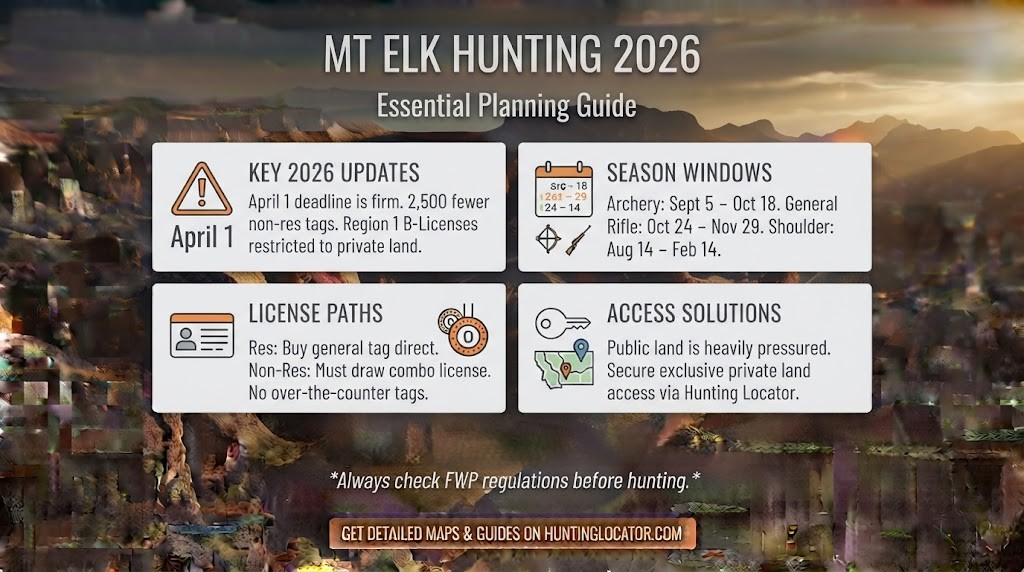
Three things worth noting before the table: the April 1, 2026 application deadline is firm for non-resident combo licenses; approximately 2,500 fewer nonresident licenses are available for 2026–2027 compared to prior years; and Region 1 Elk B-Licenses are now restricted to private land only, which significantly limits public land antlerless opportunity in northwestern Montana. On the other side of the ledger, Montana’s 2025–2026 winter was mild with light snowpack and no widespread winterkill — a reasonable indicator of healthy herd conditions going into fall.
2026 Montana Elk Season Dates
| Season Type | Dates | Bag Limit |
|---|---|---|
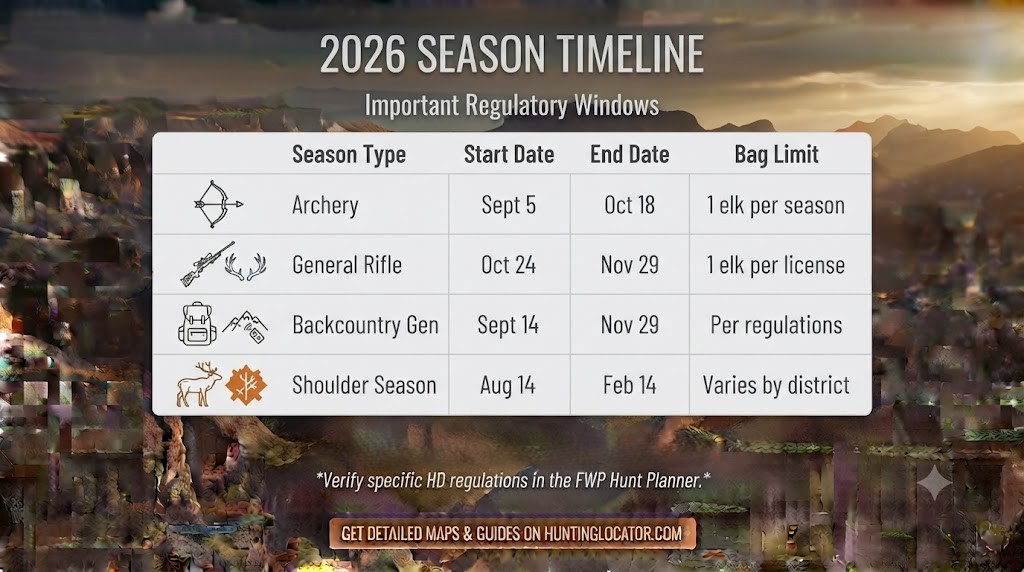
| Archery | Sept 5 – Oct 18, 2026 | 1 elk per season |
| General Rifle | Oct 24 – Nov 29, 2026 | 1 elk per license |
| Backcountry Archery (HDs 150, 280) | Sept 5 – Sept 13, 2026 | Per regulations |
| Backcountry General (HDs 150, 280) | Sept 14 – Nov 29, 2026 | Per regulations |
| Shoulder Seasons (Select HDs) | Aug 14, 2026 – Feb 14, 2027 | Varies by district |
License, Permit & Education Requirements
A quick orientation on the key components:
- General Elk License — Your core tag, valid for one elk. Montana residents may hold only one general elk license per season; it’s the starting point for any elk hunt in the state.
- Elk Permit — Expands your opportunity to hunt a specific hunting district but is not a second tag and does not allow you to harvest an additional animal. It unlocks access to a specific unit, nothing more.
- Elk B-License (Antlerless) — A district-specific add-on for antlerless harvest. In 2026, Region 1 B-Licenses are valid on private land only — a meaningful change for hunters in northwestern Montana.
- Bow and Arrow License — Required for archery season participation, for both residents and non-residents.
- Hunting Districts (HDs) — Montana’s geographic units that determine which seasons, bag limits, and permits apply in a given area. HDs are the organizing framework for the entire elk hunting system and are referenced throughout this guide.
Montana Elk Hunting Seasons (2026)
The combined archery, rifle, and muzzleloader seasons give hunters over 12 weeks to pursue elk — a window that’s hard to match in the West. Backcountry and shoulder season options extend that calendar further. Here’s what each season covers.
Archery Season
The 2026 Montana archery elk season runs September 5 through October 18 — 44 days spanning the heart of the rut. Early-season bachelor groups give way to hard-horned bulls as September progresses, making this a productive window for calling bulls into range. You’ll need to add a Bow and Arrow License to your general elk license before heading into the field. The one-elk-per-season bag limit applies, and a filled archery tag punches your general elk license for the year.
General Rifle Season
General rifle season opens October 24 and runs through November 29, 2026 — 37 days covering post-rut movement and late-season elk behavior. This is the highest-participation elk season in Montana, and opening weekend draws significant crowds on public land near road-accessible trailheads. The one-elk-per-license bag limit holds. Hunters who wait for snow to push elk to lower elevations often find better action in November.
Backcountry Seasons (HDs 150, 280)
Montana designates special backcountry seasons for Hunting Districts 150 and 280 with their own date structure. The Backcountry Archery season runs September 5 through September 13 — the first nine days of the broader archery opener, targeting early-season elk in remote terrain. The Backcountry General season picks up September 14 and runs through November 29, overlapping with and extending beyond the standard archery and general rifle windows. Bag limits in these districts are per regulations — verify current district-specific rules with Montana FWP before your hunt.
Shoulder Seasons (Select HDs)
Running from August 14, 2026 through February 14, 2027, shoulder seasons fall before and/or after standard seasons in select hunting districts, with bag limits and specific dates varying by district. These seasons function primarily as a herd management tool, creating additional antlerless harvest opportunity where FWP needs to reduce population growth. One important detail: shoulder seasons do not grant any private-land permission — you still need explicit landowner consent or a lease arrangement to hunt private ground, regardless of season type.
Montana Elk Licenses and Permits
Residency status determines your cost, your process, and your timeline. For both residents and non-residents, Montana FWP is the governing authority, and all fees listed here are confirmed 2026 figures. The foundational rule bears repeating: an elk permit expands your opportunity to hunt a specific district but is not a second tag and does not allow you to harvest an additional animal.
Montana Resident Elk Licenses
Residents have a straightforward, affordable path to an elk tag. Here’s the full 2026 cost breakdown:
| License / Application | Cost |
|---|---|
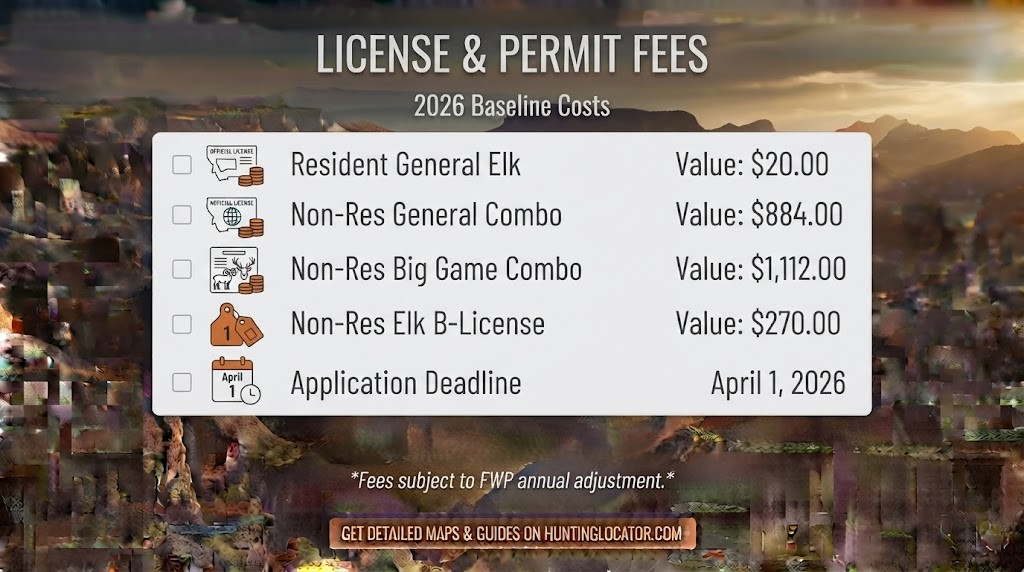
| General Elk License (Adult) | $20 |
| General Elk License (Youth / Senior 62+) | $10 |
| Elk Permit / B-License Application | $9 |
| Bow and Arrow License (archery season) | $10 |
Montana residents may hold only one general elk license per season, valid for one elk. Youth hunters and residents 62 and older qualify for the $10 discounted tier. If you plan to apply for a permit or B-License, add the $9 application fee on top of your base tag cost.
Non-Resident Elk Licenses
Non-residents generally cannot purchase a standalone elk tag over the counter. You must apply for or purchase a Combo License through Montana’s application system, with April 1, 2026 as the hard deadline.
| License | Cost | What It Covers |
|---|---|---|
| General Elk Combination | $884 | General elk hunting |
| Big Game Combination | $1,112 | Both deer and elk |
| Elk B-License (Antlerless) | $270 | Antlerless harvest; requires general elk license |
| Elk Permit Application | $9 | Expands opportunity by district (not a second tag) |
If elk is your only target species, the General Elk Combination at $884 is your option. If you want to hunt both deer and elk on the same trip, the Big Game Combination at $1,112 bundles both. The Elk B-License at $270 is an add-on for antlerless harvest and requires a general elk license as a prerequisite.
Montana Elk Permits and the Application Process
Montana’s two-stage draw system works as follows:
- Create a Montana FWP MyFWP account — All applications are submitted online; you’ll need a verified account before applications open.
- Applications open March 1, 2026 at 5:00 a.m. MST — Applications for non-resident combination licenses become available at this time.
- Submit your application by April 1, 2026 at 11:45 p.m. MST — This is the hard deadline. Late applications are not accepted.
- The combination license draw runs first — Montana draws the combination license before the limited-entry permit draw, meaning only hunters who draw a combo license are eligible to enter the permit draw.
- The limited-entry permit draw follows — If you drew a combo license but didn’t draw a special permit, you can still hunt general open units or return your license for a partial refund (80% before August 1; 50% before the general season opens).
Montana’s preference point system awards 75% of total tags to applicants with the highest points, while the remaining 25% are distributed randomly to zero-point applicants — so first-time applicants always have a realistic shot at a tag. Non-residents hunting with an outfitter may be eligible to purchase both a regular and an outfitter preference point at application, which can accelerate draw odds meaningfully.
Montana Elk Hunting: Where to Hunt
Montana offers a wide range of access options — from national forest and BLM land open to any licensed hunter, to private leases that reduce competition and improve success rates. Here’s how to think about each.
Best Public Land for Elk Hunting in Montana
Montana offers nearly 16 million acres of national forest and over 8 million acres of BLM land — more public elk habitat than most hunters will fully cover in a lifetime. The tradeoff is pressure: general units near road-accessible areas draw heavy traffic, particularly opening weekend of rifle season. Going deeper into the backcountry reduces competition substantially. Key public land areas to research for your 2026 hunt include:
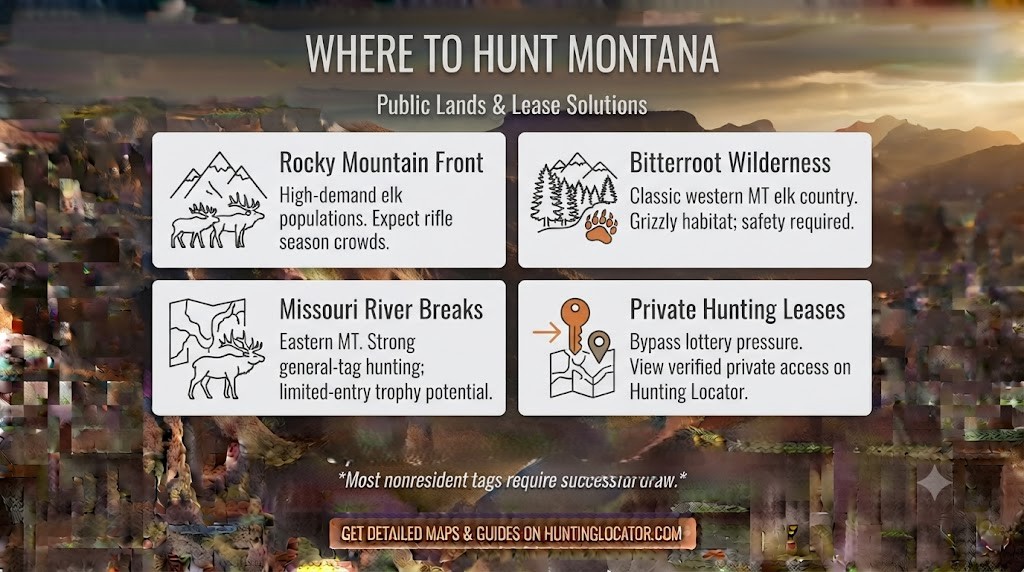
- Rocky Mountain Front — A high-demand region with consistent elk populations and varied terrain. Expect competition during rifle season, but archery hunters willing to hike can find real solitude.
- Bitterroot Wilderness — Classic elk country in western Montana. Note that much of western Montana is grizzly bear habitat, making bear awareness and proper food storage necessary, not optional.
- Missouri River Breaks — Eastern Montana’s breaks country offers strong general-tag elk hunting, with limited-entry units producing large bulls for hunters who’ve built preference points.
- Gallatin National Forest — Good elk numbers and multiple access points; a solid option for resident DIY hunters near south-central Montana.
- Helena and Lewis & Clark National Forests — Multiple HDs with consistent archery and general season opportunity; less pressure than higher-profile areas while still holding reliable elk numbers.
Montana’s Block Management Program also opens roughly 6.8 million acres of private and otherwise inaccessible land to public hunting — a useful bridge between pure public land access and paid private leases.
Private Land Hunting with Hunting Locator
Private land tends to produce better results for trophy bulls in Montana, and the harvest data supports that. In 2024, approximately 46% of Montana’s elk harvest came from public land, even though public land represents only about 30% of the state’s total acreage — an indication that private land produces disproportionately high success rates when access is secured. The challenge is finding and locking in that access, especially in districts where private land dominates and cold-contact landowner outreach has become increasingly difficult.
Hunting Locator is a platform that connects hunters directly with Montana landowners who are ready to lease or sell their hunting ground. It gives you searchable access to verified private land listings across the state, so you can identify properties that match your budget, target species, and season timing without the cold calls.
Browse available Montana elk hunting leases on Hunting Locator to see current private land opportunities. Whether you’re looking for a seasonal archery lease in the river bottoms, a rifle-season ranch setup in eastern Montana, or a long-term land purchase, Hunting Locator’s Montana listings cover the full range.
Guided Elk Hunts in Montana
For hunters who want local expertise combined with private land access, a guided hunt is worth considering. Guided operations in Montana typically run on private land leases, removing the public-land pressure equation and providing horses, camp support, and outfitter-assisted licensing in many cases.
One established Montana outfitter reports a 95% elk hunting success rate on private land, with trophy bulls in the 250–350 inch range taken regularly — numbers that reflect what dedicated private-land management can produce. Fully guided hunts generally include lodging, meals, daily guiding, and meat care, with the Montana elk combination license often included in the package price through outfitter preference points. A few things to understand before booking:
- If your outfitter includes a license through their outfitter preference point allocation, that license can only be used with the services of a Montana-licensed outfitter — it is not transferable to a DIY hunt.
- Non-residents hunting with a licensed outfitter may be eligible to purchase both a regular and an outfitter preference point at application, improving draw odds.
- Fully guided package pricing varies by season type, duration, and outfitter; quality operations fill early.
For guided private-land experiences, Hunting Locator’s outfitter and guide directory is a solid starting point for finding reputable Montana operations.
Elk Hunting Tips for Montana Success
A Montana elk tag is earned as much in preparation as in the field. When it comes to gear, the Hunting Locator store has you covered for every phase of the hunt.
- Scout before the season opens — Montana’s elk country is vast, and showing up opening morning without pre-season reconnaissance is a reliable way to burn days. Use satellite maps, trail cameras, and early-season glassing trips to identify travel corridors, wallow locations, and feeding areas before archery season begins.
- Master your calling during archery season — The archery window (Sept 5 – Oct 18) spans all phases of the rut. Early September bulls respond to cow calls; as the rut intensifies toward late September, aggressive bugling and raking can pull in a dominant bull. A quality diaphragm call and external bugle from the Hunting Locator store gives you flexibility across the rut timeline.
- Layer for elevation and temperature swings — Montana’s elk country runs from river bottoms at 3,000 feet to alpine basins above 9,000. Temperatures can swing 40°F in a single day during September archery season. A quality layering system — moisture-wicking base, insulating mid, and waterproof outer — keeps you functional regardless of conditions.
- Go deeper during rifle season — Opening weekend of general rifle season draws significant pressure to accessible public land. Your best odds often sit a mile or two beyond where most hunters are willing to walk. Pack in, set up camp, and let that pressure work in your favor as elk move to less-disturbed terrain.
- Carry hunter orange — it’s required — Montana law requires at least 400 square inches of fluorescent orange during rifle seasons. A quality orange vest or hat from the Hunting Locator store handles compliance easily; add a safety whistle and first aid kit to your pack as well.
- Hunt the November snow — Hunters who wait for the first major snowfall of late October or November often capitalize on elk moving to lower elevations along predictable routes. Late general season can produce excellent action for this reason, particularly in higher-elevation units where snow drives elk movement.
- Prepare for grizzlies in western units — If you’re hunting any unit in western Montana, carry bear spray in an accessible holster and know how to use it. Grizzly bears are an active presence throughout western Montana’s elk habitat, and situational awareness is a genuine safety requirement.
- Know your hunting district regulations — Montana’s system of Hunting Districts means the rules in HD 150 may differ substantially from those in HD 410. Download the current FWP Deer, Elk, and Antelope Regulations PDF before your hunt and confirm exactly which rules apply to your specific district.
More Resources from Hunting Locator
- Montana Hunting Overview — The complete starting point for hunting in Montana, covering all major species, seasons, and land access in one place.
- Montana Elk Hunting Season Guide — An extended look at elk hunting strategy, district breakdowns, and seasonal planning.
- Montana Deer Hunting Season — Season dates and licensing for whitetail and mule deer, for residents and non-residents.
- Montana Antelope Hunting Season — Season dates, permit info, and access guidance for pronghorn.
- Montana Bighorn Sheep Hunting Season — Application strategy and logistics for one of the West’s most competitive draws.
- Montana Bison Hunting Season — A guide to Montana’s bison hunt structure, one of the more distinctive opportunities in North America.
- Montana Black Bear Hunting Season — Spring and fall bear seasons, including bait and hound hunting regulations.
- Montana Bobcat Hunting Season — Season structure and licensing for one of Montana’s premier furbearers.
- Montana Moose Hunting Season — Limited-entry moose permits are highly competitive; this guide explains how to build your application strategy.
- Montana Mountain Goat Hunting Season — One of the toughest draws in the West; application process and hunt logistics covered in full.
- Montana Mountain Lion Hunting Season — Season dates, quota system, and licensing for mountain lion.
- Montana Turkey Hunting Season — Spring and fall turkey season details for residents and non-residents.
- Montana Game Bird Hunting Season — Upland bird opportunities including pheasant, Hungarian partridge, and sharp-tailed grouse.
- Montana Waterfowl Hunting Season — Duck and goose season structure, federal regulations, and public water access.
- Montana Wolf Hunting Season — Current season structure, quota updates, and licensing.
- Montana Hunting Leases — Browse current private land lease listings across Montana, filterable by species, acreage, and region.
Frequently Asked Questions
When does the 2026 Montana elk season open?
The first opportunity for most hunters is the archery season opener on September 5, 2026. Shoulder season hunters in select districts can start as early as August 14, 2026. General rifle season opens October 24, 2026, and the Backcountry Archery season in HDs 150 and 280 also opens September 5 with a distinct closing date of September 13.
Can a non-resident buy a Montana elk tag over the counter?
No. Non-residents generally cannot purchase a standalone elk tag — they must apply for and draw a Combo License (either the General Elk Combination or the Big Game Combination for deer and elk). Applications open March 1, 2026, and the hard deadline is April 1, 2026 at 11:45 p.m. MST.
What is the difference between a Montana elk permit and an elk B-License?
An elk permit expands your opportunity to hunt elk in a specific hunting district — it does not allow you to harvest an additional animal and is not a second tag. An Elk B-License is an antlerless-specific add-on that, in qualifying districts, allows you to take a cow or calf elk in addition to your general tag. In 2026, Region 1 B-Licenses are restricted to private land only, limiting antlerless opportunity on public ground in northwestern Montana.
What is the bag limit for elk in Montana?
The standard bag limit is one elk per general elk license per season. Montana hunters may hold only one general elk license. An elk permit or B-License may provide an additional antlerless opportunity in specific districts under specific conditions, but a permit alone does not allow a second elk harvest in general open units.
How much does it cost for a non-resident to hunt elk in Montana in 2026?
The base cost for a non-resident elk-only license is $884 for the General Elk Combination. Adding deer requires the Big Game Combination at $1,112. An Elk B-License adds $270 on top of your combination license, and a Bow and Arrow License is required for archery season. A $9 application fee applies to permit applications.
Do I need landowner permission to hunt during a shoulder season on private land?
Yes. A shoulder season designation does not grant any permission to hunt on private land. Private land access requires explicit landowner consent or a lease agreement regardless of season type. Montana elk hunting leases on Hunting Locator are one way to secure that access before the season opens.
Plan Ahead
Montana’s 2026 elk calendar covers nearly every hunting style — backcountry archery in early September through shoulder season hunting in February. The licenses, land access, and preparation decisions all need to happen well before opening day. If you’re looking for private ground, browse Montana private land hunting leases on Hunting Locator to find properties that match your season, budget, and goals.


