This Montana turkey guide cuts through the regulatory maze so you can focus on what matters—planning a successful hunt. We’ve pulled together everything from Montana Fish, Wildlife & Parks plus insider knowledge to help both residents and nonresidents make the most of the 2026 season.
Here’s what you’ll find:
- Season dates and how the new nonresident rules actually affect your hunt planning
- License costs broken down so you know exactly what you’ll spend
- Where to hunt when public land isn’t an option (spoiler: private land just became way more important)
Let’s dive into what you need to know.
Quick Reference Facts
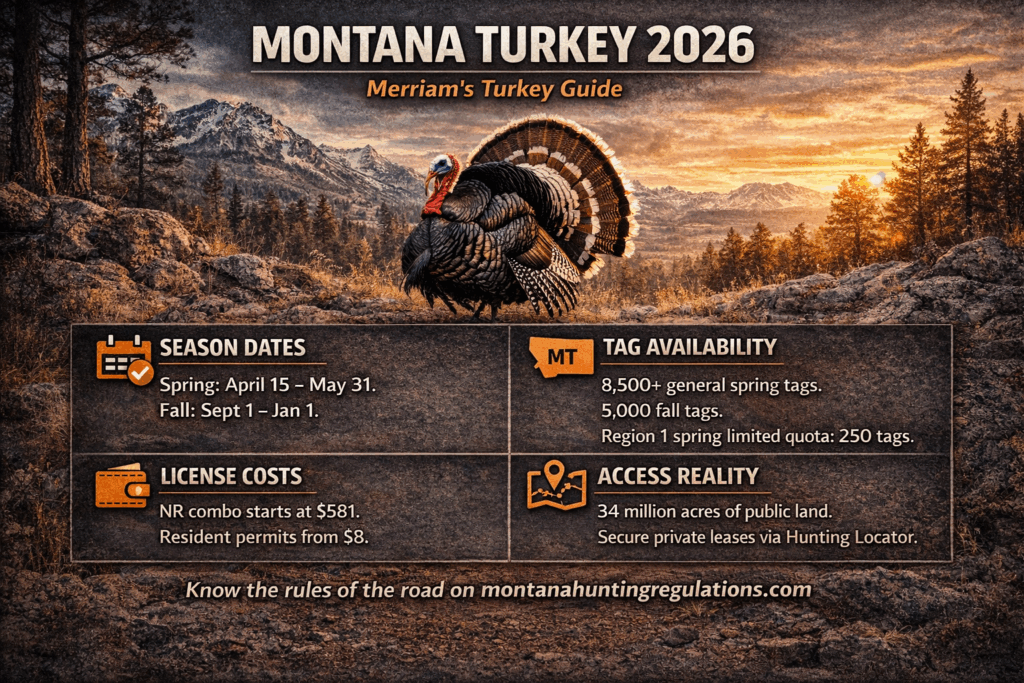
Here’s everything at a glance for Montana’s 2026 turkey seasons:
| Element | Details |
|---|---|
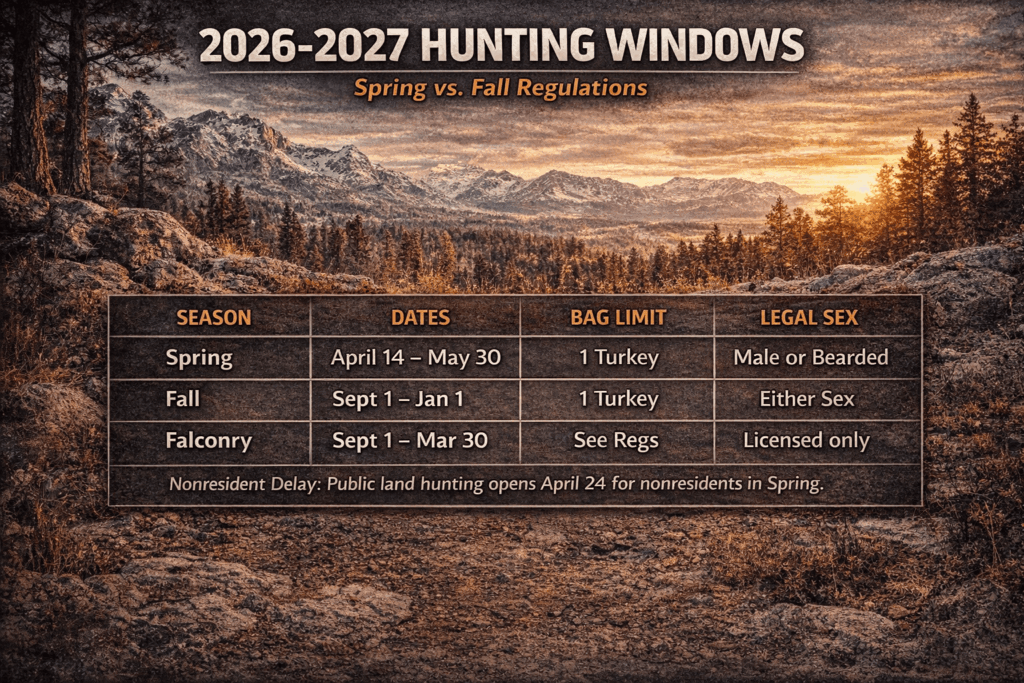
| Spring Season | April 14 – May 30, 2027 |
| Fall Season | September 1, 2026 – January 1, 2027 |
| Falconry Season | September 1, 2026 – March 30, 2027 |
| Nonresident Delay | 10 days on public land and Block Management areas (spring opens April 24 for nonresidents) |
| Spring Bag Limit | 1 male or bearded turkey (general license, statewide) |
| Fall Bag Limit | 1 turkey, either sex (Regions 1-3 and 5-7) |
| Legal Methods | Shotgun and archery only (spring); electronic calls prohibited |
| Resident License Cost | $6.50 |
| Nonresident License Cost | $58 (with Upland/Combination License) or $115 (without) |
| Required Base Fee (Nonresident) | $15 |
Before you can hunt, you need these basics covered:
- Hunting License: Base requirement before buying any turkey tag
- Turkey License: Available over-the-counter, no lottery system
- Hunter Education: Mandatory if you were born after January 1, 1985
- Conservation License: Bundled with your base hunting license
- AIS Prevention Pass: Check current FWP requirements for your hunting area
Planning to chase other birds too? Check out Montana’s game bird regulations for combination license deals.
Season Dates and Regulations
Montana runs spring, fall, and falconry turkey seasons. Spring gets the most action because gobblers are fired up and vocal during breeding season.
Spring Turkey Season
Dates: April 14 – May 30, 2026
Here’s the big change: nonresidents can’t hunt public land or access-program properties until 10 days after opening. So while residents start April 14th, nonresidents wait until April 24th for public ground.
Bag Limit: One male or bearded turkey, good statewide
Legal Gear: Shotguns and bows only. You can use mouth calls, box calls, slate calls, and decoys, but electronic calls are off-limits.
Spring hunting is prime time because toms are actively seeking hens and responding to calls. Weather makes or breaks your hunt—clear, cool mornings with minimal wind are perfect.
Transport Rule: Keep one leg and foot attached when moving your bird to prove it’s a legal male.
Fall Turkey Season
Dates: September 1, 2026 – January 1, 2027
Fall season lets you harvest either sex in Regions 1-3 and 5-7, unlike spring’s male-only rule. The 10-day nonresident delay hits fall season too.
Bag Limit: One turkey, any sex
Fall hunting is completely different. Turkeys flock up instead of pairing off, so forget hen calls—you need to sound like a lost flock member. Great option if you want to harvest a hen or extend your season.
Falconry Season
Dates: September 1, 2026 – March 30, 2027
This one’s for licensed falconers only. If that’s you, check with Montana Fish, Wildlife & Parks for specific permit requirements.
License Costs and Requirements
Montana keeps it simple—turkey licenses are available over-the-counter, no drawing required. But the price difference between resident and nonresident is pretty steep.
License Breakdown
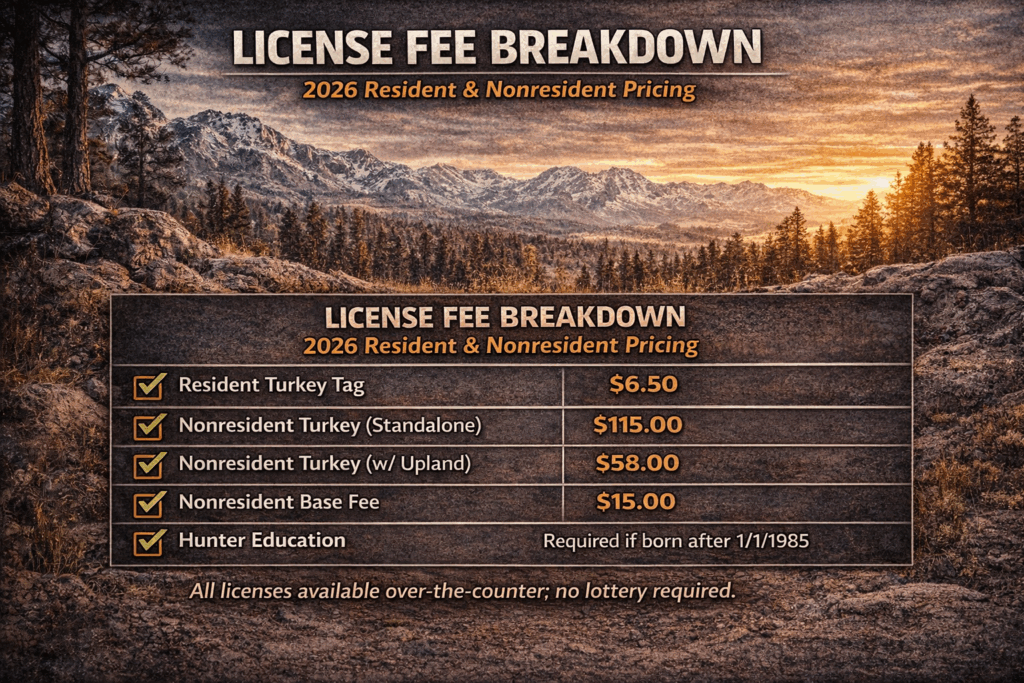
You need a base hunting license plus the turkey-specific tag. Nonresidents have two routes: bundle it with an upland license (cheaper) or buy it standalone (ouch).
| License Type | Cost |
|---|---|
| Resident Turkey License | $7 |
| Nonresident Turkey License (with Upland/Combination License) | $58 |
| Nonresident Turkey License (without Upland License) | $115.00 |
| Required Base Fee (Nonresident) | $15.00 |
If you’re a nonresident hunting only turkeys, you’re looking at about $130 total. But if you’re also planning to hunt Montana’s upland birds, the combination route saves you money at $73 total.
Buy online through FWP’s system or at any licensed vendor. Just remember—if you were born after January 1, 1985, you need hunter education first.
Getting Your License
Montana turkey hunting doesn’t require special permits or drawings—just buy your license and go.
Where to Buy:
- Online through Montana FWP’s license system
- Any licensed vendor across Montana
- Available immediately when purchased
No Deadlines: Buy anytime before or during season, no lottery system to worry about.
Education Requirement: Anyone born after January 1, 1985 must complete hunter education from Montana or any other state/province before purchasing licenses.
Where to Hunt
Access is the biggest challenge, especially with the new nonresident restrictions. You’ve got public land (with delays), guided hunts, and private access—each with different trade-offs.
Public Land Options
Montana has solid public turkey habitat, but nonresidents face that 10-day wait. For residents, these are great spots. For nonresidents, they become viable starting April 24th.
Top public hunting areas include:
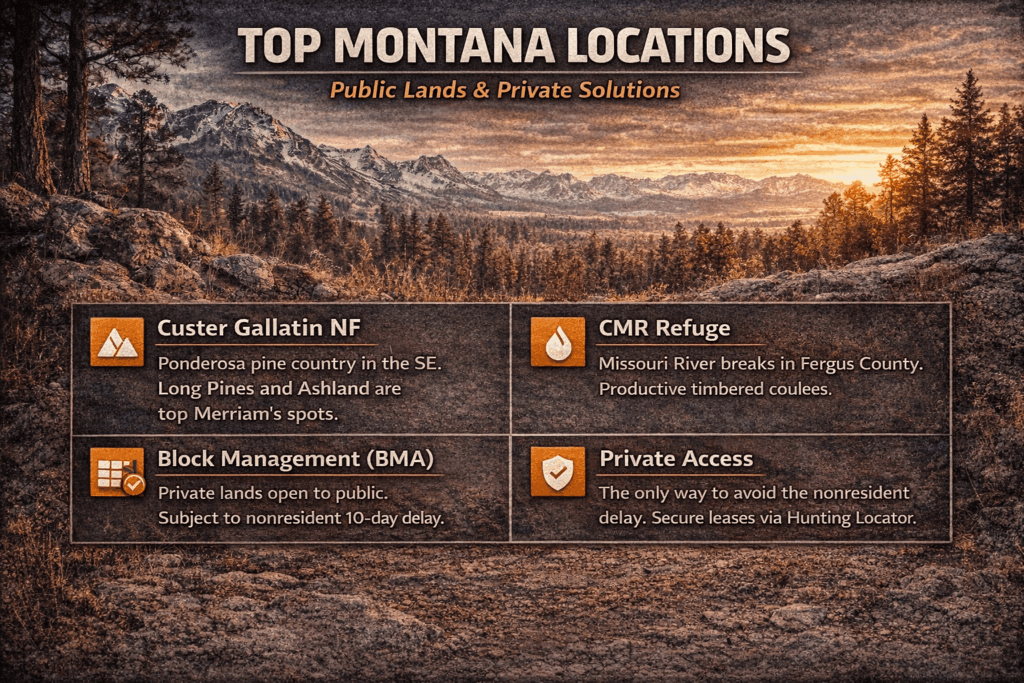
- Custer Gallatin National Forest – Ponderosa pine country in the southeast holds good Merriam’s populations. Long Pines and Ashland areas are FWP favorites.
- Charles M. Russell National Wildlife Refuge – Missouri River breaks with scattered turkey populations in timbered coulees. Fergus County sections are productive.
- Bitterroot National Forest – Western Montana’s dense forests and river bottoms, though turkey numbers may be lighter.
- Lolo National Forest – Mixed terrain with river corridors in western Montana.
- Block Management Areas – Most BMA properties are also closed to nonresidents during the delay, though some may open for spring turkey. Check individual BMA rules.
Eastern Montana (Long Pines, Ashland, Fergus County, CMR) offers your best bet for a first Montana turkey hunt based on FWP recommendations.
Guided Hunting
Guided hunts give you the full package—local knowledge, lodging, and private land access. Guides handle scouting, calling, and logistics, perfect if you’re new to Montana.
Guided Merriam’s hunts typically run in the low thousands, covering guide services, camp, meals, and usually private land access.
It’s expensive compared to DIY, but guided hunts on private land sidestep the nonresident delay completely—making them attractive for opening week.
Private Land Access
Here’s the key: the 10-day delay only applies to public land and access-program ground, not regular private land with permission. That makes private access the only realistic opening-week option for many nonresident hunters.
Private land means less pressure, ability to scout specific birds, and tactical advantages. The birds are way less pressured on private ground. You can pattern the same tom over several mornings.
Access Options:
- Direct Permission: Traditional door-knocking approach; requires local connections and time
- Day-Rate Bookings: Much cheaper middle ground where you pay for access and control, not full guide service
- Seasonal Leases: Longer-term deals for consistent access
Finding private land access usually means weeks of cold calls and driving back roads hoping to connect with the right landowner. Hunting Locator’s Montana listings cut through that frustration by connecting you directly with landowners offering verified hunting opportunities.
You absolutely must have permission for private property hunting. No exceptions.
Hunting Tips That Actually Work
Montana turkey success comes down to prep work, patience, and understanding how Merriam’s behave in western terrain.
- Scout Like Your Hunt Depends On It – Preseason scouting for turkey sign is your best bet for finding productive areas. Look for roost trees, droppings, feathers, scratching areas, and dust bowls. Preferred roost trees are tall, over-mature ponderosa pines protected from wind.
- Keep Calling Simple – Most calls imitate hens—yelps, purrs, cackles, cuts. Start with basic yelps and forget the rest. Don’t over-call, especially on pressured public birds.
- Hunt Dawn – Turkeys can be hunted anytime, but early morning is money. They roost overnight and gobble while still in trees. Early mornings are prime because gobblers are actively seeking hens.
- Get Your Gun Right – Most hunters prefer 12-gauge with full choke. Full choke 12-gauge with size 2 shot or BBs. Pattern your gun before season to know your effective range.
- Master Concealment – Turkeys have incredible vision and spot movement instantly. If you can’t sit perfectly still, you won’t call in birds. Use good camo and set up against large trees or natural cover.
- Follow the Snowline – Spring turkeys often follow receding snow uphill while feeding. This helps predict movement patterns as weather warms.
Need gear for your Montana hunt? Check the Hunting Locator store for equipment tested in western conditions.
More Montana Hunting Resources
Expand your Montana hunting knowledge with these guides:
- Montana Hunting Hub – Central resource for all Montana hunting seasons and regulations
- Montana Deer Hunting – Complete guide to mule deer and whitetail opportunities
- Montana Elk Hunting – Everything about Montana’s premier big game hunting
- Montana Game Bird Hunting – Upland bird seasons including pheasant, grouse, and partridge
- Montana Waterfowl Hunting – Duck and goose hunting in Big Sky Country
- Montana Black Bear Hunting – Black bear hunting opportunities and regulations
Frequently Asked Questions
When can nonresidents start hunting turkeys in Montana for 2026?
Nonresidents hunting public lands and access-program properties can’t start until April 25, which is 10 days after the April 15 opener for residents. But nonresidents can hunt private land with permission starting April 15.
What does a nonresident turkey license cost in Montana?
Nonresident turkey licenses cost $115 standalone, or $58 with an Upland/Combination license. Add the required $15 base fee, so you’re looking at either $130 or $73 total depending on which package you choose.
What’s the bag limit for Montana turkeys?
Spring season allows 1 male turkey on a general license, valid statewide. Fall season allows 1 turkey of either sex in Regions 1-3 and 5-7.
Do I need hunter education for Montana turkey hunting?
Anyone born after January 1, 1985 must complete hunter education from Montana or any other state/province before buying a hunting license.
What weapons are legal for turkey hunting in Montana?
Shotgun and archery only for spring season. Electronic calls are banned, but mouth calls, box calls, slate calls, and decoys are legal.


